Architecture and Revolution explores the consequences of the 1989 revolutions in Central and Eastern Europe from an architectural perspective. It presents new writings from a team of renowned architects, philosophers and cultural theorists from both the East and the West. They explore the questions over the built environment that now face architects, planners and politicians in the region. They examine the problems of buildings inherited from the communist era: some are environmentally inadequate, many were designed to serve a now redundant social programme and others carry the stigma of association with previous regimes. Contributors include: Daniel Libeskind, Bernard Tschumi, Laura Mulvey, Helene Cixous, Andrew Benjamin and Frederic Jameson.
eBook - ePub
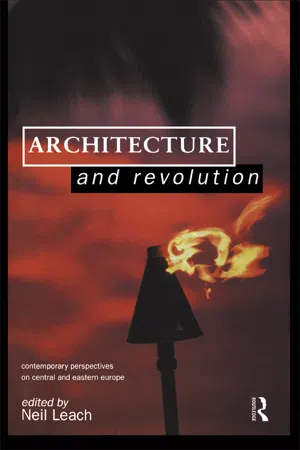
Architecture and Revolution
Contemporary Perspectives on Central and Eastern Europe
- 256 pages
- English
- ePUB (mobile friendly)
- Available on iOS & Android
eBook - ePub
About this book
Information
I
Historical perspectives
1 Sources of a radical mission in the early Soviet profession
Alexei Gan and the Moscow Anarchists
Catherine Cooke
Ten years after the 1917 revolution, there were several clearly identifiable theories of a consciously ‘revolutionary’ and ‘socialist’ architecture being practised, taught and debated in the Soviet Union. Some were purely modernist; others sought some synthesis of modernity with classicism. As soon as these various approaches start to be formulated with any rigour and launched into the public domain, we can evaluate them as more or less subtle professional responses to certain dimensions of Bolshevik ideology.1 However, preceding that stage and underpinning it was a process of personal adjustment and collective refocussing whereby a relatively conservative capitalist profession faced up to a new context and started mentally defining its tasks or writing a new narrative for its practice.
This earlier part of the process, during the Civil War, is infinitely less accessible than what happened once building activity revived in 1923–4. The earliest stages of the process were also being conducted in a political environment which was very different from that of the mid-1920s, an environment that was more fluid and more plural than mainstream accounts from either East or West have suggested. In the phrase of Paul Avrich, who is one of the few (besides survivors) to insist on documenting the minority radical groups of the revolution, both Eastern and Western orthodoxies have to differing degrees been written ‘from the viewpoint of the victors’, that is privileging the Bolsheviks.2 In reality, important voices were also coming from other directions. Such was the Bolshevik terrorisation of dissent that for decades the safety of individuals and their historical reputations demanded that these censoring filters be applied. In the new situation, however, it becomes possible to start opening up the early biographies of some key individuals to show a much richer picture.
In the context of architecture, the first person whom we find rethinking the city as an active political agent in Marxist terms is Alexei Gan in his typographically dramatic little book Constructivism, published in 1922.3 Gan is well known for playing various roles as theorist, publicist and typographical designer at the heart of Moscow avant-garde art and architecture from 1920 onwards. His Constructivism opens with a lengthy quotation from the Communist Manifesto of 1848 and his reference point throughout is ‘the proletariat with its sound Marxist materialism’. However, he is merciless in hi s critiq ue of the Bolshevik Pa cultural leadership.

Figure 1.1 Alexei Gan at work on a magazine cover, 1924, photographed by Alexander Rodchenko
Commentary on Gan’s book has conventionally focussed on his venom against ‘old art’. This is traditionally and reasonably attributed to the productivist artists’ natural vehemence in 1922 in face of a revival of easel painting after the Party’s economic retreat into a quasi-capitalist New Economic Policy (NEP) in the previous year. By encouraging private enterprise and free markets, this was reviving the concept that creative work in its conventional media legitimately existed to provide accoutrements or entertainments as objects of consumption. Certainly the aesthetic consequence of this economic retreat is one of Gan’s most direct targets, but he extends that critique into merciless attacks on the Party’s new cultural hierarchy in the Commissariat of Popular Education, Narkompros:
The Communists of Narkompros who are in charge of art affairs are hardly distinguishable from non-Communists outside Narkompros. They are as much captivated by the idea of beauty as the latter are by notions of the divine…. Their words promise the future whilst they reverently transmit and popularise the past. Whether in painting, sculpture or architecture, this is impelling them in the direction of the most reactionary déclassé maniacs…. As if guided by a prayer book they venerate the art of those very cultures about which they are so scathing when they discuss the theory of historical materialism.4
The origins of the voice we hear here have always been obscure. Its political explicitness, and even more its political edge, are very different in their confidence and sharpness from anything we hear in the statements of other creative people in Russia at that time. What we can now see is that this voice which mocks ‘our responsible and so very authoritiative leaders [his emphasis]…who paint themselves up to look like Marx’,5 and which challenges them to face the implications of their own ideology, has its origins not in Bolshevism but in anarchism.
In the materialist view which Gan brought to Soviet architecture, he conceptualised the built environment as one dimension of ‘the intellectual-material culture of Communism.’ He explicitly propounded this view of its sociallyformative role in an effort to overcome ‘the lack of even minimal Marxist understanding’ amongst all practitioners ‘whether in painting, sculpture or architecture’.6 The aggressiveness of his voice, in both discussions and writing, made it effective propaganda. If his Marxism seems at times suspiciously plus royalist que le roi, however, this is perhaps because his own political allegiance had once been very publicly displayed as lying with a rival ideological group: a group by which the Bolsheviks had felt sufficiently threatened since the Revolution to make it an early target of their increasingly dreaded new secret police, the Cheka.
The vacuum of ideology in the post-revolutionary profession
Those who emerged as leaders of the radical archiectural avant-garde of the 1920s had not been conspicuous as social or aesthetic dissidents before the revolution in the way that the bohemian, iconoclastic artists had been. There was very little in Russian architecture before the war that was socially innovative by the standards that would be applied thereafter. As progressive structural and servicing technologies arrived from Europe at the turn of the century, a form of art nouveau developed that was declared by sympathetic commentators to be inherently ‘democratic’, but such a term was very relative.7 A building boom among the new middle classes gave a dramatically new shape and scale to city centres, but it was the architectural expression of a reformist political option that was increasingly doomed after 1905.8 It left a material matrix that can be physically and ideologically reinhabited with Russia’s return to a capitalist culture today.
But in 1917, it bequeathed the new regime a building stock whose very robustness made it ill-adopted to change.
When building ceased in 1913–14 the modernising, westernising decade of the 1900s had created a Russian architectural profession which, though relatively small, was not significantly different in its profile from those of the West. Above all, it was similar in the extent of its political engagement, which was generally minimal. Very few architects fled when their world collapsed in October 1917. One senses that they stayed with their buildings as doctors stay with their patients, more engaged by the professional act of ministration than by high politics. Where, then, and amongst whom do we first see signs of personal engagement with the new ideology?
Conspicuously, it was not in the old capital. Between signing and ratifying a peace treaty with Germany at Brest-Litovsk but with German advances still underway, Lenin transfered his new government to Russia’s historic centre of Moscow on 10–11 March 1918. From that date, the city resounded with political voices as the new leaders moved conspicuously around it and the new ‘people’s commissariats’ embarked on their social and economic reorganisation of the country, mainly from requisitioned hotels. Petrograd, formerly St Petersburg, was now a relative backwater.
A conceptual context for rethinking the built environment had been created by some of the new government’s earliest legislation, which nationalised all real estate and redistributed housing space.9 For the middle and upper classes, the ensuing process of ‘quartering, eviction and concentration’ were the most exquisite torture and violation. For the former have-nots, this effected a vast improvement but also gave them shelter of a manifestly ill-adapted kind. Architects suffered with the rest, but for them the new legislation was also the first draft of a new scenario.
The first task through which professionals in both cities engaged with the new Soviet government was that of effecting emergency repairs and protection to architectural monuments damaged by fighting or vandalism. This was taken very seriously by Commissar of Popular Education, Anatoly Lunacharsky, as part of his Marxist ideological obligation to preserve the cultural heritage and artefacts made by the working populace.10 This obsession with preventing pillage and vandalism created caretaking jobs for a large number of young architects in the immediate aftermath of the Revolution, and the new legal reality became daily more tangible as they moved freely around buildings that were hitherto ‘private’. Having passed from multiple to single ownership, this space was manifestly accessible to reshaping as one whole.
Once the Bolshevik party had asserted its authority with such brutality during the Civil War, useful debate in any field had to accept the Party’s values as their premise. Even interpretation of their constantly evolving policy was a complex task that imposed rapid learning curves on all concerned. In a profession such as architecture, those who led the way were inevitably those who combined a suitable predisposition with useful prior experience; the vast majority of its members were essentially ignorant of the minority ideology which now ruled them. At all
three levels of the built-environmental task, at the levels of urbanism, architecture and theory, the early work of professionals reveals a complete ideological vacuum.
An Architectural Studio for the Replanning of Moscow was set up by the city council, Mossoviet, in August 1918, just five months after the Party leaders moved into the Kremlin. The announcement in Izvestiia made clear that it was motivated by the historic urge of all post-revolutionary regimes to make their new citadel ‘beautiful’.11 As if the logic was obvious, it declared that ‘the overall political perspectives of the urban economy cannot be developed without such a plan.’12 The notion that the plan should depend upon the politics (not vice versa) would be precisely Gan’s message in 1922.
The Studio was headed by the fifty-year old academician Ivan Zholtovsky, famed for his adulation of Palladio, who had wide pre-revolutionary experience in and around Moscow. Zholtovsky was known to the cultured Lunacharsky and made himself personable to the new government.13 Zholtovsky later recalled his personal briefing meeting with Lenin. The leader was plainly still living out the parallel with the French Revolution that had sustained him, as colleagues remarked, through the first days of their own takeover. This was the element of heritage to which their own plans must refer. In Zholtovsky’s words, ‘Vladimir Ilich talked about how Moscow must be rebuilt in such a way that it became something with an overall aesthetic conception to it, whilst also being convenient for the individual citizen.’14 Lenin stressed to him three times, ‘Remember, just don’t make it in bourgeois taste!’, which in Russia at that time meant either the overdecorated eclecticism of late nineteenth-century commercial architecture or the art nouveau which followed it. Zholtovsky loathed them both as much as his new client did, but their shared preference for classicism derived from personal tastes rather than Marxist theory.
The plan which resulted at the end of 1918 proposed a traditionally imposing administrative centre of classical building around the Kremlin, a ring of fully-serviced suburbs of the kind obligatory in model city plans worldwide during the 1910s.15 The most apposite criticism of it came from less glamorous planning people in the new economic administration, VSNKh. These men from highway engineering and the pre-war Garden Cities movement could see that this was ‘an architectural plan without any basis in traffic flows et cetera’, a failed to ‘take into account the new socio-economic structure of our life’.16 But Zholtov...
Table of contents
- Cover Page
- Title Page
- Copyright Page
- Illustrations
- Contributors
- Acknowledgements
- Introduction
- I Historical perspectives
- II Architecture and change
- III Strategies for a new Europe
- IV The Romanian question
- V Tombs and monuments
Trusted by 375,005 students
Access to over 1.5 million titles for a fair monthly price.
Study more efficiently using our study tools.
Frequently asked questions
Yes, you can cancel anytime from the Subscription tab in your account settings on the Perlego website. Your subscription will stay active until the end of your current billing period. Learn how to cancel your subscription
No, books cannot be downloaded as external files, such as PDFs, for use outside of Perlego. However, you can download books within the Perlego app for offline reading on mobile or tablet. Learn how to download books offline
Perlego offers two plans: Essential and Complete
- Essential is ideal for learners and professionals who enjoy exploring a wide range of subjects. Access the Essential Library with 800,000+ trusted titles and best-sellers across business, personal growth, and the humanities. Includes unlimited reading time and Standard Read Aloud voice.
- Complete: Perfect for advanced learners and researchers needing full, unrestricted access. Unlock 1.5M+ books across hundreds of subjects, including academic and specialized titles. The Complete Plan also includes advanced features like Premium Read Aloud and Research Assistant.
We are an online textbook subscription service, where you can get access to an entire online library for less than the price of a single book per month. With over 1.5 million books across 990+ topics, we’ve got you covered! Learn about our mission
Look out for the read-aloud symbol on your next book to see if you can listen to it. The read-aloud tool reads text aloud for you, highlighting the text as it is being read. You can pause it, speed it up and slow it down. Learn more about Read Aloud
Yes! You can use the Perlego app on both iOS and Android devices to read anytime, anywhere — even offline. Perfect for commutes or when you’re on the go.
Please note we cannot support devices running on iOS 13 and Android 7 or earlier. Learn more about using the app
Please note we cannot support devices running on iOS 13 and Android 7 or earlier. Learn more about using the app
Yes, you can access Architecture and Revolution by Neil Leach in PDF and/or ePUB format, as well as other popular books in Architecture & Architecture General. We have over 1.5 million books available in our catalogue for you to explore.