eBook - ePub
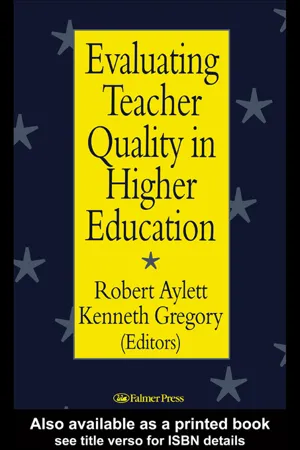
Evaluating Teacher Quality in Higher Education
- 138 pages
- English
- ePUB (mobile friendly)
- Available on iOS & Android
eBook - ePub
Evaluating Teacher Quality in Higher Education
About this book
Drawing on material presented at a one day conference, this collection addresses the need to recognize academics' contributions to higher education, as well as the ways in which academics' efforts in the teaching and learning process can be acknowledged and suitably rewarded.
Information
1 Introduction: The Evaluation of the Teaching of Individual Academics in Higher Education: Progress Towards a Construct
Abstract
There is general agreement that a method for evaluating teaching in higher education is sorely needed and that it is desirable to avoid a situation in which each institution has laboriously to develop its own approach. Although a number of proposals have been forthcoming, these tend to be based either on extensive catalogues or on comparatively short lists, both of which leave much of the necessary work to the individual academic or to the institution. A general construct is needed. In what follows, this need is explored, an account of what is available is provided, and a suggestion made concerning the requirements such a construct should meet. An outline scheme is proposed, based upon four major components: the approach to teaching; the delivery of teaching; outcomes of teaching; and recognition of the academic. These four components or groups of criteria must be set within the institutional context. With reference to the previous literature, a comprehensive list of criteria is suggested under each of the headings of the major components. The major components are developed further in chapters 11 and 12.
Introduction
It has been increasingly recognized that in higher education teaching has been given less quantitative attention than research, and that there is an urgent need for individuals and institutions alike to be in a position to specify the quality of teaching and its effectiveness. A paradox has arisen in that, although individual academics may spend more of their time in teaching, at both undergraduate and postgraduate levels, it is easier to document their research activity and output than it is to document their teaching activity. Although in recent years far greater emphasis has been placed upon the character and probity of teaching, there is still no available overall framework which can be used to describe the teaching profile of an individual academic. This introduction suggests why we need to develop evaluation of teaching at the individual level (section 1); summarizes what is already available (section 2); suggests what is required (section 3); and then proceeds to suggest what information is needed (section 4). A way of integrating this information to form a coherent structure is offered in chapter 11. The structure of the volume as a whole is outlined in the final section of this chapter.
The Need for Teaching Evaluation
It is generally accepted that the prime responsibility for maintaining and enhancing the quality of teaching and learning rests with each individual institution (1991 White Paper). At the Times Higher Education Supplement Conference in 1993 it was suggested that institutions should devise their own appropriate quality procedures and mechanisms, without branding them as managerialist, and accept that outside agencies can judge outputs. Responsibility for devising these procedures and mechanisms rests, then, with individual institutions; but in such a situation there is a danger that every institution is forced to reinvent the same wheel. In this context, considerable benefit could be derived from identifying model procedures which may emanate from one institution but which can be transferred and used as a basis for developing procedures in other institutions. In the UK, Elton (1987) suggested that, analogous to the Funding Council Research Assessment Exercises (1985, 1989), methods to characterize teaching quality could be devised. Such methods could apply to departments or programmes, but equally could be designed to express the teaching character or profile of individual academics.
This chapter reviews how the teaching profile of an individual academic may be constructed; chapters 2–7 offer a variety of perspectives on the problem, especially relating to the UK; chapter 8 offers one international perspective; whilst chapters 11 and 12 offer a particular way forward.
There are at least three reasons for wishing to be in a position to express the teaching profile of an individual academic. The first reason relates to the case of promotion, which often rests upon abundant information relating to research output with much smaller amounts of attention given to the character, effectiveness and output of an individual’s teaching effort. This discrepancy may possibly have arisen because of the lack of a tradition of, and a method for, describing teaching character. Teaching evaluation, in this sense, can be described as summative and may be applied not only to the process involved in teaching for a particular programme or course, but also to the contribution which is made by an individual member of staff. Such a summative approach could be achieved entirely internally, according to the contributions made within a single institution, or it could be effected by involving some element of external peer review. Secondly, it is necessary to describe the teaching profile of an individual academic more precisely in order to improve the process and effectiveness of the individual contribution; this is the formative evaluation of teaching. The two reasons identified thus far relate to an individual member of staff: the summative to promotion and the formative to the improvement of teaching and to the development of the individual. There exists, however, a third reason or cluster of reasons: to provide accountability within the institution, to demonstrate the character of teaching being provided, and to facilitate scrutiny by external bodies. In some disciplines, scrutiny by external bodies has long been employed (for example in connection with accreditation for particular qualifications), but although in the UK, as in other countries, there have always existed a number of ways in which accountability has been required, the recent development of the Students’ Charter gives further reason for considering this need to demonstrate accountability.
What is Already Available?
No general scheme for the characterization of an individual higher education teaching profile seems to exist, although in their 1991 work, and subsequently in a revised second edition (1993), Elton and Partington suggested that the criteria for establishing standards of research could be adapted for use in the evaluation of teaching. This led them to formulate new ‘bespoke’ criteria for teaching, grouped in thirteen categories (fifteen in 1993), of which eight (ten in 1993) related to teaching within the institution and five related to external regulators (called ‘other teaching criteria’ in 1993). Table 1.1 reproduces the criteria they suggested. In 1993 they concluded that it would be necessary to adopt agreed standards and criteria for teaching excellence, and to establish means of gathering evidence for establishing such teaching excellence, and reported that a number of institutions had embarked upon developing procedures which began to respond to these suggestions. Two annexes in the 1993 edition detailed the promotion procedures at the University of Nottingham, and the information for applicants for personal appointment to Professor or Associate Professor at Queensland University of Technology, Australia. Jones (1993) (annex 3 in Elton and Partington, 1993) attempted a practical procedural framework based on different judges for eight criteria.
Table 1.1: Formulation of new ‘bespoke’ criteria for teaching as suggested by Elton and Partington in October 1991 (column A) and in 1993 (column B)
Column A | Column B |
| (a) Teaching within the institution 1. Preparation for teaching — clarity of aims and objectives for each course component — preparation of content/quality of notes, handouts etc. — preparation of materials and equipment, and of acetates, slides, videos etc. | |
2. Quality of delivery of teaching — evidence of lecturing effectiveness and excellence — evidence of small group teaching effectiveness and excellence — evidence of practical teaching effectiveness and excellence — evidence of fieldwork effectiveness and excellence — evidence of postgraduate supervision effectiveness and excellence | |
3. Volume and range of teaching — amount of time spent on teaching — experience of a wide range of teaching e.g. to a variety of — students sizes of groups content of intrinsic difficulty | |
4. Innovation in teaching — innovations in curriculum/course design — innovations in methodologies e.g. distance learning materials — collaboration in teaching-team teaching, etc. — innovations of national/international repute in the teaching of the specific subject area — short course developments — modular programme developments | |
5. General communications with students — availability outside class times — guidance and counselling — motivating students | |
6. Assessment/examination procedures — evidence of range of methods of assessment used — innovation in assessment techniques | |
7. Evaluation of own teaching — systematic and regular reflection on all the above practices — regular use of peer/student evaluation — continuing reflection on teaching in relationship to
| |
8. Management of teaching — course leadership — chair of programme committees, for example, for curriculum development modularization assessment etc. — responsibilities for learning support — staff/student consultative committee duties — ‘Enterprise’ tutorship | |
| 9. Teaching scholarship and esearch — evience of scholarship — effect of scholarship on teaching — influence of research on teaching e.g. in project work. 10. Teaching and the world of work — benefits from employer contact — involvement of employers in teaching — placement f students. | |
| b. Other teaching criteria 11. Invitations to teach elsewhere — national/international conferences, lectures, seminars — regular teaching visits to other university departments 12. Membership of profifessional groups — subject-bsed — interest-specific, for example assessment groups curriculum groups 13. Professional service to other universities and organizations — as external examiner — as adviser/consultant 14. Publications on teaching — critical reflection on teaching approaches — textbooks — compilations of teaching materials — major pedagogic publications — editorial work — referee for journals etc. 15. Teaching grants and contracts secured — grants for teaching development work — contracts to provide teaching programmes for other organizations |
Developments of this kind in Britain were catalyzed by the work of the HEQC Quality Audit, which considers procedures and processes, and provides reports at institution level. Some sixty institutions had been audited up to 1995, the intention being that the first round of audit visits to UK universities would be complete by the end of 1995. Quality assessment has also been undertaken by the Funding Councils. The approaches adopted by the HEFCE (Higher Education Funding Council for England), the SHEFC (Scottish), and the HEFCW (Welsh) are developmental and differ in detail, but their overall objective is to provide an assessment of the quality of teaching by discipline, department, or cost centre, in specific institutions, and then possibly to relate this to funding. The HEFCE Assessors’ Handbook (1993) includes consideration of strategies of learning, teaching and assessment. Advice has also been produced from the CVCP Staff Development and Training Unit via a series of documents, particularly related to staff development, and these include the paper by Elton and Partington (1991) referred to above.
The four developments noted above, namely, general approaches especially associated with staff development, actions undertaken in specific institutions, national academic audit, and national schemes for teaching assessment, provide the framework within which the profile of teaching of an individual academic needs to be considered. In other educational situations, most significantly in school teaching, the definition of professional competences has been advocated (DfE, 1992), and this is an approach which could perhaps be applied to university teaching. Since the development of a scheme at the University of California, Berkeley, in 1957, of Distinguished Teaching Awards, similar approaches to the recognition of teaching excellence in individual institutions have been utilized elsewhere and, for example, McNaught and Anwyl (1992) showed that, by September 1991, eighteen out of thirty-seven higher education institutions in Australia had some form of teaching award scheme and others had proposals in hand.
What is Needed?
Loder (1993), after undertaking a University of London, Institute of Education study to define and assess the quality of undergraduate education, concluded that the only effective way to assess the quality of teaching was to ask the people being taught, possibly implying that there would be no need for other information to be presented as part of the teaching profile for an individual member of staff. Given, however, that students are able to comment in an informed way only upon certain aspects of the teaching and learning process, there does remain a need for further information to be provided in order to build up a profile. The goal of establishing a means of expressing teacher effectiveness in relation to quality and standards remains elusive. The development of a general construct capable of...
Table of contents
- Cover
- Half Title
- Title Page
- Copyright
- Contents
- Preface
- 1. Introduction: The Evaluation of the Teaching of Individual Academics in Higher Education: Progress Towards a Construct
- 2. Assurance of Teaching Quality: Top-Down and/or Bottom-Up Strategy
- 3. Quality Assessment in Higher Education in England: Present Performance, Future Perspectives
- 4. Teaching Profiles: The Quality Context
- 5. Criteria for Teaching Competence and Teaching Excellence in Higher Education
- 6. Promoting Excellent Teachers at Oxford Brookes University: From Profiles to Peer Review in Ten Years
- 7. Contributions on Specific Aspects from Particular Institutions:
- 8. Quality Assurance at MacQuarie University
- 9. Successfully Creating a Customer Focused Culture Throughout Your Organization and Effectively Managing the Change
- 10. The Individual and the Institution: Quality Management in Higher Education
- 11. A Construct for Teaching Profiles (containing reports from convenors of discussion groups)
- 12. The Prospect
- List of Conference Participants
- Index
Trusted by 375,005 students
Access to over 1.5 million titles for a fair monthly price.
Study more efficiently using our study tools.
Frequently asked questions
Yes, you can cancel anytime from the Subscription tab in your account settings on the Perlego website. Your subscription will stay active until the end of your current billing period. Learn how to cancel your subscription
No, books cannot be downloaded as external files, such as PDFs, for use outside of Perlego. However, you can download books within the Perlego app for offline reading on mobile or tablet. Learn how to download books offline
We are an online textbook subscription service, where you can get access to an entire online library for less than the price of a single book per month. With over 1.5 million books across 990+ topics, we’ve got you covered! Learn about our mission
Look out for the read-aloud symbol on your next book to see if you can listen to it. The read-aloud tool reads text aloud for you, highlighting the text as it is being read. You can pause it, speed it up and slow it down. Learn more about Read Aloud
Yes! You can use the Perlego app on both iOS and Android devices to read anytime, anywhere — even offline. Perfect for commutes or when you’re on the go.
Please note we cannot support devices running on iOS 13 and Android 7 or earlier. Learn more about using the app
Please note we cannot support devices running on iOS 13 and Android 7 or earlier. Learn more about using the app
Yes, you can access Evaluating Teacher Quality in Higher Education by Robert Aylett, Kenneth Gregory, Robert Aylett,Kenneth Gregory in PDF and/or ePUB format, as well as other popular books in Education & Education General. We have over 1.5 million books available in our catalogue for you to explore.