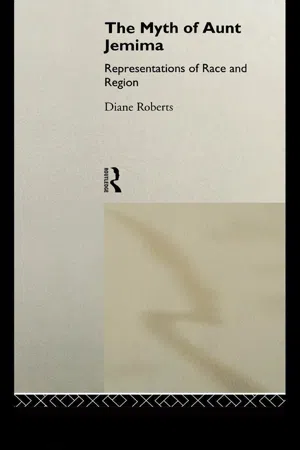
The Myth of Aunt Jemima is a bold and exciting look at the way three centuries of white women writers have tackled the subject of race in both Britain and America. Diane Roberts challenges the widely-held belief that white women writers have simply acquiesed in majority cultural inscriptions of race. The Myth of Aunt Jemima shows how 'the mythic spheres of race, of the separation of black and white into low and high, other and originary, tainted and pure, remain to trouble a society struggling still to free itself from debilitating racial representations.'
Beautifully written with a powerful series of textual readings, The Myth of Aunt Jemima pushes at the boundaries of thought around the issues of race and gender. An important and innovative book.
- 240 pages
- English
- ePUB (mobile friendly)
- Available on iOS & Android
eBook - ePub
About this book
Information
1
UNCLE TOM’S CABIN
An authentic ghost story
After all, let a man take what pains he may to hush it dawn, a human soul is an awful ghostly, unquiet possession for a bad man to have.
Harriet Beecher Stowe, Uncle Tom’s Cabin
Uncle Tom’s Cabin (1851) is a novel of sexual crises. It is also a novel of religious, social, economic and ethical crises galvanized by the overwhelming issue of race, a warning that slavery not only oppressed blacks but degraded whites, endangering the cherished ideal of participatory democracy that both inspired and eluded nineteenth-century Americans. Harriet Beecher Stowe said that the worst of slavery was “its outrage upon the family”(Key 257). For the white family, the outrage lay in slaveholding men committing adultery with their female slaves, available and officially submissive. Slavery made sin easy. For the black family, the outrage was manifested in the torture, humiliation and violation of the slaves’ minds and bodies. Children were separated from their mothers, black men and women were denied sanctified marriage, husbands were sold away from wives, women were kept as concubines or used as breeders.
The sub rosa truth, the skeleton in the South’s closet, was that the black family and the white family were often the same family; slavery created criminal situations where the powerful members of the family betrayed the weak. Two definitions of family competed for dominance: the sentimental, bourgeois ideal of the father, mother and children in a discrete domestic package, and the broader, patriarchal, almost Biblical sense of a household.1 Engels reminds us that family refers etymologically to ownership, not kinship; Southern planters spoke of wives, children, land and slaves as their “family”or “household.”Abolitionists rejected this proprietorial, hierarchical notion of family for the more compact and, as they saw it, more egalitarian domestic version. As Angelina Grimké indignantly demands, “But do the fathers of the South ever sell their daughters?”(6, her emphasis). Stowe answers yes, and their sons, too. The slave’s body is not her or his own: the slave’s sexuality, like the slave’s ability to work, is just another commodity.
To Stowe, slavery produces sexual anarchy. White men evade moral responsibility to women: in Uncle Tom’s Cabin, none of the mulatta Cassy’s owners, fathers of her children, would even consider marrying her: it would be illegal, anyway. In Stowe’s second abolitionist novel, Dred (1856), the mulatta Cora Gordon’s white brother Tom threatens her with rape. Not only does slavery attack women, it attacks the maternal. Where white men sexually enslave women, the unexamined elevation of motherhood, to which nineteenth-century middle-class culture was committed, is impossible: “Under these arrangements, the customary lexis of sexuality, including ‘reproduction,’ ‘motherhood,’ ‘pleasure,’ and ‘desire’ are thrown into unrelieved crisis”(Spillers, “Mama’s Baby”76).2 Uncle Tom who, as Stowe says of Jesus, has “more of the purely feminine element in him than any other man,”falls victim to this antimaternalism (Stowe, Religious Studies 36). Leslie Fiedler sees him as the central sufferer of the novel, the “heroine”in the violent clutches of the ravisher: “We do not remember the turncoat Puritan Legree squeezing the virginal breast of Emmeline, eyeing her lustfully; he is frozen forever…at his purest moment of passion, himself the slave of his need to destroy the Christian slave Tom”(Fiedler, Love and Death 265–66).
Legree acts “the archetypal seducer, ready for the final violation”of Tom in a scene that represents the power relations of the slave South in gendered terms: masculine aggression and power over feminine victimization and self-sacrifice. I would argue that Tom’s subjugation should be read as part of a general pattern that includes Cassy and Emmeline: they suffer the slave South’s all-out assault on the feminine and the maternal. The “violation”of Tom, the “outrage”threatening Emmeline, Cassy’s history of abuse, as well as the menace directed at Eliza, and George Harris’ pain over his sister’s sale as “fancy goods”in the New Orleans slave market, constitute a sexual context which, in Stowe’s eyes, reduces women’s humanity. The slave South denies the sacredness of the maternal hearthside altar (while paying elaborate and, to Stowe, unconvincing, lip service to a useless idol, the white woman on the pedestal): the slave South is therefore an assault on the central moral institution of the nation—the female-centred family.
George Eliot proclaimed “Mrs Stowe has invented the negro novel,”that is, she exploited the rich thematic possibilities of the “conflict of races”(571–73). Fiedler echoes this, saying Stowe “invented American blacks for the imagination of the whole world”(Fiedler, Inadvertent Epic 26). It is troubling that a white novelist should be credited with creating blacks for fiction; where is the “negro”in the negro novel? Displaced. Stowe constructed a white-generated, white-directed vision of black slavery meant to ignite white political change. She was not the first white writer to become notorious using the “conflict of races”in fiction; Aphra Behn did it a hundred and sixty-odd years earlier, and Frances Trollope did it sixteen years earlier. Others such as Richard Hildreth, John Pendleton Kennedy, Harriet Martineau, Caroline Gilman, Lydia Maria Child and J.H.Ingraham, produced fiction representing various sides of the race issue before Uncle Tom’s Cabin.3 And black writers like Frederick Douglass and Mary Prince recounted stories of black struggle. But Stowe was fortunate in her moment: the Fugitive Slave Law had been passed in 1850, the Free Soil movement was loudly questioning the future of the United States as a slaveholding nation and the Nullification furor—the attempt by slave states to void federal legislation—was kicking up again. Though black and white abolitionists were publishing in Britain and America, Uncle Tom’s Cabin, a work its author saw as conciliatory, grabbed the lion’s share of publicity. Here is a salient irony in the battle over racial representation: that a novel by a white woman of colonizationist leanings could be said to “invent”the African American as a fictional subject.
This can be looked at another way. Toni Morrison makes the point that an “invented Africa”and “invented Africans”lie at the root of American nation-building; we have been shaped “by the four-hundred-year-old presence of, first, Africans and then African-Americans”(Morrison, Playing in the Dark 4–5). So it would have to be a white writer creating the “negro novel”just as white colonisers created “blackness”for the imagination of power. Therefore, arguing back again, George Eliot was quite right—Stowe distilled a set of racial constructions for the world and exploited them.
Stowe also “invented”the slave South, the ambivalent South which has fuelled American popular culture and driven America’s sense of its regions ever since. Stowe’s South combines an Edenic landscape with infernal immorality; her South is at once seductive, idyllic, tormented and vicious. Of course, Uncle Tom’s Cabin was not the first novel ever to depict the South in such contradictory language: Frances Trollope’s Jonathan Jefferson Whitlaw, published in 1836, raises images of both heaven and hell, as does Frances Kemble’s Georgia journal of 1838–39 (see Chapters 3 and 4). Indeed, early European accounts of southern colonies from Virginia to Guiana toy with theological imagery crossed with anxiety over what passions such warm climates might enkindle in their inhabitants. In Oroonoko, Behn compares Surinam to Eden when she likens the Carib Indians to “our first parents before the fall”(then describes the violent episodes of Oroonoko’s slavery and lynching in the flower-filled “paradise”). In Uncle Tom, Stowe manipulates older literary and popular discourses and characters at a moment when the novel-reading world was fascinated with Southern slavery to create the South as American Other. We still see the vestiges of, responses to, revisions of and homages to that South in the fiction of William Faulkner, Eudora Welty, Ralph Ellison, Erskine Caldwell, Charles Chesnutt, Flannery O’Connor, Carson McCullers, Alice Walker, Cormac McCarthy and Toni Morrison, a realm of anarchic eroticism, grotesquely shot through with violence: in other words, the “Southern gothic.”4
In Stowe’s fiction, the South is populated by insistent, clamorous bodies who, like poltergeists, are more felt than seen. The masses of slaves are as “invisible”as ghosts compared to the dominant, visible whites who own them. It is as if Stowe is determined to utter the spell that will force these shades into visibility, to assert their physical being. Slave bodies are not single and sacrosanct, like white bodies; they are multiple and expendable. But Stowe defies their official subterranean status and focuses on the harms done to their bodies as well as to their minds.
Southerners bought slaves, worked them, housed them, fed them, slept with them, chained them, beat them and sometimes killed them. The slave is “historically, North America’s most coveted body, that is, the captivated man/ woman-child who fulfills a variety of functions at the master’s behest”(Spillers, “Changing the Letter”27). The slave’s body is the goods and that which produces the goods. It is also a forbidden body: polluted and polluting. The discourses of the slave body are paradoxical. White culture feels great anxiety over black and white touching, yet the plantation produces mulattoes. Laws are written more stringently defining the opposition between the black body and the white body, yet some bodies move dangerously between the insisted-upon poles. George and Eliza, Cassy and Mme de Thoux, mask their “blackness”with “whiteness,”while legally the children of slave masters are forced to mask their “whiteness”with “blackness.”The white South is obsessed with the body; in order for its “peculiar institution”to work at all, it must be ever-vigilant of the alien, threatening, subtly-hued bodies that inhabit it. In the gothic South, the suppressed, the sub rosa, the subterranean, that which is locked up in cellars and attics, or forced to live in the Quarters or kept discreetly in little houses in New Orleans, will necessarily return to destroy what Faulkner called “the eggshell shibboleth of caste and color”(Faulkner, Absalom, Absalom! 139). The writer participates in this play of secrets and disguises. Toni Morrison’s minstrel show metaphor applies to the world Stowe makes in Uncle Tom’s Cabin: “In minstrelsy, a layer of blackness applied to a white face released it from law…so American writers were able to employ an imagined Africanist persona to articulate and imaginatively act out the forbidden in American culture”(Morrison, Playing in the Dark 66). Stowe’s strategy is to force a communion of black and white, allowing white readers, however partially and safely, to figure themselves as slaves through the characters in her novel.
Stowe uses images of lawless, excessive sexuality to construct her sinning South. For her, North America can be represented as an uneasy composite of Bakhtin’s classical and grotesque bodies with the rational, righteous, liberal intelligence at the top—that is, New England, Ohio and Canada, the homes of order and liberty—while the “dirty,”unspeakable, irrational parts—that is, the slave South—seethe at the bottom. The bottom, the “low-Other,”in Bakhtin’s term, is ruled by the appetites, not enlightenment. The South is “down there”the way the stomach, the bowels and the genitals are “down there.”The South has always been eroticized in white American minds. Even before it became a slave society, the South was represented in early narratives as a female body to be penetrated, ravished, exploited and impregnated, a landscape of breasts and genitals displayed for the “use”and “enjoyment”of the European coloniser, much as the female slave’s body was to be used and enjoyed at will by the European American master.5 In Robert Johnson’s “Nova Britannia”(1609), Virginia’s streams and springs are “like veynes in a naturall bodie”; Virginia has “hills and mountains making sensible proffer of hidden treasure, neuer yet searched”(Kolodny 11). John Hammond’s treatise, “Leah and Rachel; or The Two Fruitfull Sisters Virginia and Mary-land”(1656), presents the colonies as two ripe, amorous women (ibid. 13). The very naming of the first Southern colonies after women demonstrates the colonisers’ commitment to seeing the “New World”as a feminine space to be “taken”: Virginia implies not only a compliment to Elizabeth I but an ideology: virgin land to be possessed, to be made fruitful.
The institution of slavery reinforced the representation of the South as erotic since, to Europeans, Africans had always been associated with sexuality. Uncle Tom’s Cabin juxtaposes the erotic with the infernal in Stowe’s moralized geography; the further South slaves go, the worse conditions get. From the comparatively tolerable Kentucky plantation of the Shelbys, Aunt Chloe laments: “‘Nobody ever comes up that goes down thar!’”(163). “Down there”is the lower South of Louisiana, and “down there”is the kingdom of the damned, mysterious and horrible—like the gothic dungeon or the forbidden regions of the body. Spillers reminds us of the 1853 children’s abridgment of Stowe’s novel called A Peep into Uncle Tom’s Cabin: “The prurient, voyeuristic suggestion of ‘peep’ is quite appropriate to a national mentality that wants to ‘steal’ a look at the genitals in vague consciousness that they are covered by an interdiction”(Spillers, “Changing the Letter”30). Looking at slavery is looking at a taboo, covered, “shameful”part of the national body; the slave South represents at once the sinful regions of the body, the oubliette with the nasty secret, and hell.
Stowe’s South weaves the Calvinist surety of sin with the Romantic strands of the gothic and the orientalist; she insists on revealing slavery’s sexual crises.6 Stowe’s Calvinism has been much discussed: I shall concentrate on her use of orientalist and gothic representations in Uncle Tom’s Cabin.7 The gothic’s emphasis on family degeneracy, guilt and the supernatural combines with the orientalist obsession with captive sexuality, rich surroundings and pleasure, providing Stowe with a familiar popular and literary vocabulary for discussing what she saw as the sins of slavery: rape, incest, miscegenation, adultery, dead children, stolen children, absent spouses, split families, broken marriages. Stowe’s South is not just culturally Other but morally alien. Of course, in declaring this so, Stowe steers perilously close to romanticizing the very passions she abhors. The moral of her story demands the exhibition of uncontrolled desire that is the heart of Southern darkness; but the uttering of that desire threatens to drown out the Christian revelation that is supposed to redeem the South’s soul.8
VOLUPTUOUS GARDENS: THE ORIENTAL SOUTH
Edward Said remarks that the white westerner sees “the Orient as a sort of surrogate and even underground self”(Said, Orientalism 103). The slave South is America’s domestic Orient, its secret self, its Other, as the African and the female—so involved in representations of the South—are Other. The feminized, receptive, seductive metaphorical landscape of the South owes much to the seductive, secretive metaphorical landscape of the Orient. The geography of the Other is a cultural production: the west makes the east in the image of its “dark”self as the American North constructs the slave South as its “dark”self. Said reminds us that
geographical sectors such as “Orient”and “Occident”are man-made.
Therefore as much as the West itself, the Orient is an idea that has a history, a tradition of thought, imagery and vocabulary that have given it reality and presence in and for the West. The two geographical entities thus support and to an extent reflect each other.
Therefore as much as the West itself, the Orient is an idea that has a history, a tradition of thought, imagery and vocabulary that have given it reality and presence in and for the West. The two geographical entities thus support and to an extent reflect each other.
(Said, Orientalism 5)
Orient and Occident depend on each other for definition; the values of the North (defined for Stowe and many other abolitionists as New England) depend on the sins of the South, just as the conventions of being white take shape against the conventions of being black.
Representations of the South in a number of nineteenth-century texts intersect with representations of the Orient. In this symbolic geography, North=West and South=East. By inventing an “eastern,”erotically-charged, pagan, authoritarian, chaotic Other within the occidental, quotidian, Christian, chaste, orderly democracy of the United States, abolitionist writers could insist that slavery threatens the country’s domestic decorum. In Uncle Tom’s Cabin Stowe draws upon literary orientalism to imagine a New Orleans where the putative “jungles”of “darkest Africa”meet Islamic Spain. In English writing from the seventeenth century on, the various “Orients”of Arabia, Turkey, Greece, India, Africa, even Spain and China merged as landscapes for fiction. The actual histories, customs, religions and governments of these nations mattered less than a titillating exoticism: they were tyrannical, cruel, luxurious (in both senses), and they had harems. Sexual licence combined with male control of women’s bodies made the “Orient”fatally fascinating (if officially repellent) to European and American readers.9 Inventing an Oriental South became a powerful abolitionist tactic, demanding that the American public recognize a despotic kingdom where men have sexual access to women slaves within the borders of their democratic republic, decadent poison weakening the national body.
In The Key to Uncle T...
Table of contents
- COVER PAGE
- TITLE PAGE
- COPYRIGHT PAGE
- ACKNOWLEDGEMENTS
- INTRODUCTION
- 1: UNCLE TOM’S CABIN: AN AUTHENTIC GHOST STORY
- 2: “INSTIGATED BY THE DEVIL”: THE SOUTH AND HARRIET BEECHER STOWE
- 3: MISS WRIGHT, MRS TROLLOPE AND MISS MARTINEAU: OR, THREE BRITISH WOMEN LOOK AT AMERICAN SLAVERY
- 4: THE STRANGE CAREER OF FANNY KEMBLE
- 5: OLLA PODRIDA AMERICA: LYDIA MARIA CHILD AND RADICAL MISCEGENATION
- 6: JEMIMA AND JEZEBEL IN THE NEW SOUTH: TWENTIETH-CENTURY WOMEN ON RACE
- EPILOGUE: MAKING THE WORD THE THING
- NOTES
- BIBLIOGRAPHY
Trusted by 375,005 students
Access to over 1.5 million titles for a fair monthly price.
Study more efficiently using our study tools.
Frequently asked questions
Yes, you can cancel anytime from the Subscription tab in your account settings on the Perlego website. Your subscription will stay active until the end of your current billing period. Learn how to cancel your subscription
No, books cannot be downloaded as external files, such as PDFs, for use outside of Perlego. However, you can download books within the Perlego app for offline reading on mobile or tablet. Learn how to download books offline
Perlego offers two plans: Essential and Complete
- Essential is ideal for learners and professionals who enjoy exploring a wide range of subjects. Access the Essential Library with 800,000+ trusted titles and best-sellers across business, personal growth, and the humanities. Includes unlimited reading time and Standard Read Aloud voice.
- Complete: Perfect for advanced learners and researchers needing full, unrestricted access. Unlock 1.5M+ books across hundreds of subjects, including academic and specialized titles. The Complete Plan also includes advanced features like Premium Read Aloud and Research Assistant.
We are an online textbook subscription service, where you can get access to an entire online library for less than the price of a single book per month. With over 1.5 million books across 990+ topics, we’ve got you covered! Learn about our mission
Look out for the read-aloud symbol on your next book to see if you can listen to it. The read-aloud tool reads text aloud for you, highlighting the text as it is being read. You can pause it, speed it up and slow it down. Learn more about Read Aloud
Yes! You can use the Perlego app on both iOS and Android devices to read anytime, anywhere — even offline. Perfect for commutes or when you’re on the go.
Please note we cannot support devices running on iOS 13 and Android 7 or earlier. Learn more about using the app
Please note we cannot support devices running on iOS 13 and Android 7 or earlier. Learn more about using the app
Yes, you can access The Myth of Aunt Jemima by Diane Roberts in PDF and/or ePUB format, as well as other popular books in Social Sciences & Feminist Literary Criticism. We have over 1.5 million books available in our catalogue for you to explore.