Feared and admired in equal measure, Mary Midgley has carefully yet profoundly challenged many of the scientific and moral orthodoxies of the twentieth century. The Essential Mary Midgley collects for the first time the very best of this famous philosopher's work, described by the Financial Times as 'common sense philosophy of the highest order'.
This unrivalled introduction to a great philosopher and brilliant writer incorporates carefully selected excerpts from Mary Midgley's bestselling books, including Wickedness, Beast and Man, Science and Poetry, and The Myths We Live By. With a specially written foreword by James Lovelock, this classic text presents a superb and eminently readable insight into questions she has returned to time and again in her renowned sharp prose. This anthology discusses major topics, such as the roots of human nature, reason and imagination, the myths of science and the importance of holism in thinking about science and the environment.
- 424 pages
- English
- ePUB (mobile friendly)
- Available on iOS & Android
eBook - ePub
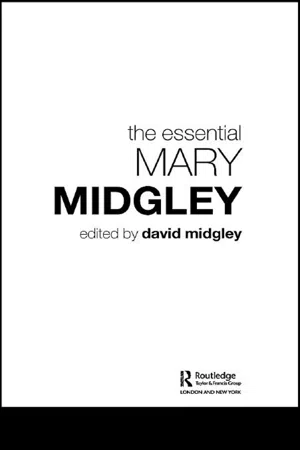
The Essential Mary Midgley
About this book
Information
Part One – The Roots of
Human Nature
CONCEPTUAL PROBLEMS OF AN
UNUSUAL SPECIES
The overall theme of Mary Midgley’s Beast and Man is an attempt to deepen and correct our understanding of human nature by connecting and comparing it with our understanding of the nature of other species.
In the first chapter, ‘Have We a Nature?’, she examines various traditional approaches to explaining human behaviour, in particular to the understanding of motive. These mostly fall into two types: those that, like Marxism and Freudian psychoanalysis, seek to explain all human behaviour in terms of one or two universal motivations (power, property, sex, etc.), and those that, like existentialism and behaviourist psychology, deny that we have any inborn or natural motives at all – our actions are entirely the product of radical free choice or of conditioning.
She contrasts these accounts with that of ethology, which approaches the study of human motivation on the premise that, being a mammalian species, we are likely to share the general structure of motivation found in such species. This structure comprises a number of broad ranges of motives (often misleadingly labelled ‘instincts’), such as territoriality, aggression, sex, parenting, dominance and so on, which can be made sense of in terms of the biological needs of the species.
The idea that we share a large part of our psychological nature with other species does not of course imply that there is nothing unique about human beings. But it does conflict with many traditional philosophical views which try to explain human psychology exclusively in terms of supposedly unique features – generally rationality, consciousness and the capacity for language – thereby implying an absolute, categorical distinction between
Man and Animal. The next chapter, ‘Animals and the Problem of Evil’, considers the implications of this view, showing how it distorts our idea both of ourselves and of other species. Man (for this is a characteristically masculine view) is seen as essentially rational, other animals (Beasts) as essentially ruled by irrational emotions. Animals become invested with all of the negative, destructive attributes which Man wishes to disavow – we form our image of the Beast on the basis of our own shadow.
‘Speech and Other Excellences’, taken from the third section of the book, entitled ‘The Marks of Man’, further explores the question of human uniqueness, in particular the claims that language and rationality respectively have no counterpart in other species. Without minimizing the significance of the fact that these qualities are developed in human beings to a degree quite unprecedented elsewhere, Midgley shows their continuity with the mental capacities of other species. They are grounded in a general need on the part of social creatures to communicate with and understand the motives and intentions of other members of their community. She considers in some detail the empirical evidence that chimpanzees can in fact use a human language at a level far beyond what was previously supposed possible, reinforcing the Wittgensteinian point that the phenomenon of language can only be understood as part of a way of life involving a whole range of complex types of social interaction within a community. Much of this social structure we share, as ethological studies have shown, with other primates; this is the foundation on which the special human achievements of language and culture are built.
In this perspective, rationality is seen not as Descartes saw it, as the capacity for logical deduction, but as the art of striking a balance between the wide range of motives and considerations which bear on our choices. We have, like other social creatures, to arbitrate between our own and others’ interests, to weigh the consequences of our actions, to decide on priorities and so forth. Though it might be thought that animals entirely lack the capacity to do these things, closer examination of their actual way of life shows that they not only can do so, but often could not survive if they could not. Again, this does not negate the fact that human capacities in this area vastly exceed those of other species; it does, however, provide a possible explanation of how such capacities could possibly have come into being in the first place.
Sources: ‘Have We a Nature?’ and ‘Animals and the Problem of Evil’ – slightly abridged from chs 1–2 of Beast and Man, Cornell University Press, 1978; ‘Speech and Other Excellences’ – condensed from ibid., chs 10–11.
1 HAVE WE A NATURE?
UNDERSTANDING OUR MOTIVES
Every age has its pet contradictions. Thirty years ago, we used to accept Marx and Freud together, and then wonder, like the chameleon on the tartan, why life was so confusing. Today there is similar trouble over the question whether there is, or is not, something called Human Nature. On the one hand, there has been an explosion of animal behaviour studies, and comparisons between animals and men have become immensely popular. People use evidence from animals to decide whether man is naturally aggressive, or naturally territorial; even whether he has an aggressive or territorial instinct. Moreover, we are still much influenced by Freudian psychology, which depends on the notion of instinct.1 On the other hand, many sociologists and psychologists still hold what may be called the Blank Paper view, that man is a creature entirely without instincts. So do Existentialist philosophers. If man has no instincts, all comparison with animals must be irrelevant. (Both these simple party lines have been somewhat eroded over time, but both are still extremely influential.)
According to the Blank Paper view, man is entirely the product of his culture. He starts off infinitely plastic, and is formed completely by the society in which he grows up. There is then no end to the possible variations among cultures; what we take to be human instincts are just the deep-dug prejudices of our own society. Forming families, fearing the dark, and jumping at the sight of a spider are just results of our conditioning. Existentialism at first appears a very different standpoint, because the Existentialist asserts man’s freedom and will not let him call himself a product of anything. But Existentialism too denies that man has a nature; if he had, his freedom would not be complete. Thus Sartre insisted that
there is no human nature . . . Man first of all exists, encounters himself, surges up in the world, and defines himself afterwards. If man as the Existentialist sees him is not definable, it is because to begin with he is nothing. He will not be anything until later, and then he will be what he makes himself.2
For Existentialism there is only the human condition, which is what happens to man and not what he is born like. If we are afraid of the dark, it is because we choose to be cowards; if we care more for our own children than for other people’s, it is because we choose to be partial. We must never talk about human nature or human instincts. This implicit moral notion is still very influential, not at all confined to those who use the metaphysic of essence and existence. So I shall sometimes speak of it, not as Existentialist, but as Libertarian – meaning that those holding it do not just (like all of us) think liberty important, but think it supremely important and believe that our having a nature would infringe it.
Philosophers have not yet made much use of informed comparison with other species as a help in the understanding of man. One reason they have not is undoubtedly the fear of fatalism. Another is the appalling way terms such as instinct and human nature have been misused in the past. A third is the absurdity of some ethological propaganda.
About the fear of fatalism I shall not say much, because it seems to me quite misplaced here. The genetic causes of human behaviour need not be seen as overwhelming any more than the social causes. Either set would be alarming if treated as predestined to prevail. But no one is committed to doing that by admitting that both sets exist. Knowing that I have a naturally bad temper does not make me lose it. On the contrary, it should help me to keep it, by forcing me to distinguish my normal peevishness from moral indignation. My freedom, therefore, does not seem to be particularly threatened by the admission, nor by any light cast on the meaning of my bad temper by comparison with animals.
As for words such as instinct, drive and the nature of a species, ethologists have done a great deal of work here toward cleaning up what was certainly a messy corner of language. Much more is needed, and I shall try to do a little of it. Such words must somehow be reorganized, not just thrown away. They are necessary if we are to talk either about other species or about our own.
People may still wonder, however, why we should need, for understanding human life, concepts developed to describe animal behaviour. Perhaps I can best bring out the reason by glancing at a problem we often have when we try to understand human motivation – the shortage of suitable conceptual schemes.
Consider the case of someone (call him Paul) who buys a house with an acre of land, though he can scarcely afford it, instead of one without. How should we describe this ‘scientifically’? What should we say he is doing? Plenty of economic descriptions are available. He might be meaning to grow turnips to sell or to supply his household; he might be speculating for resale, or buying as an investment or as a hedge against inflation. It is interesting that even at this stage, where all the alternatives are economic, we already need to know his motive in order to decide among them. The ‘facts’ of the particular transaction are not enough to classify it, or explain it, even economically, unless they include motives.3 (Motives, of course, are not just his private states of mind, but patterns in his life, many of which are directly observable to other people.) We cannot say what he is doing until we know why he does it.
Now, what happens if the motives are not economic? Paul, it turns out, is not trying to make money out of the land at all. When asked, he says that he bought it to secure his privacy. He hates being overlooked by strangers. As his whole conduct is consistent with this, we believe him. Besides believing, however, we still need to understand this motive. That is, we want to see how it fits into the background of his life, and of human life generally.
Shall we accept a simple Marxist interpretation, that he is showing off his riches to establish his class status? This will not get us far. Of course people do show off for that reason. But merely saying so does not account for the particular forms showing off takes. The ostentatious rich buy big cars, because those are what most people would like to have if they could. They do not usually display their status by burning themselves to death on piles of paper money in the streets. And it is the basic taste that we are trying to understand. Explaining motives by ostentation is always producing a box with another box inside it. We must ask next; why display that? This was the weakness of Thorstein Veblen’s view of art as conspicuous expenditure to impress the populace. As later and more subtle Marxists have pointed out, if art is to be worth displaying, it has to have a real point in the first place.4 Of course a particular ostentatious person can display things he sees no point in. Whole groups within a society may do it; many Romans thus collected Greek art. But this is still parasitical. It depends on acknowledging the authority of people who do see the point, and treating them as the norm. It needs too, I think, an explicit doctrine that the thing itself actually is valuable, with reasons given. Thus, the more people explicitly praise pictures, or horses, or yachts, or abbeys to pray for one’s soul, the more likely other people with no genuine taste for these things are to want them. But this wanting is a by-product of the praise. It is not what the praise itself is about. Ostentation, in fact, is just one of the cure-all political explanations which people produce for motives and which turn out circular.
The most central case is power. The desire for power is necessarily secondary to other desires, because power is power to do certain things, and valuing those things has to come first. Those who really pursue power just for its own sake are neurotics, entangled in confusion by habit and destroying their own lives. Hobbes realized this:
So that in the first place, I put for a general inclination of all mankind, a perpetual and restless desire of power after power, that ceaseth only in Death. And the cause of this is not always that a man hopes for a more intensive delight than he has already attained to; or that he cannot be content with a moderate power: but because he cannot assure the power and means to live well, which he hath present, without the acquisition of more.5
This puts power in its place as an insurance. But Hobbes still made it central and probably never realized how much this circular psychology limited the value of his political theory. I suspect that Marx’s position was similar. Nietzsche, when he made the Will to Power a primary motive, did try to give it a more direct meaning. He thought of power as straightforward dominance over other people – indeed, more specifically still, delight in tormenting them6 – which is certainly clearer, but happens to be false, except of psychopaths.
Now Paul certainly might be just being ostentatious, buying land he did not want, solely because he saw other rich men doing so. But if so, his case would be a parasitical one, and we should need to shift our attention, if we wanted to understand the motive, to some rich man who actually did want the stuff. This same consideration works even more strongly against another equally fashionable, and more respected, shortcut, the notion of conformity. He bought it, some say, because his society had conditioned him to value it. Now (again) some people certainly are so distractedly conventional that they will do almost anything to be like the neighbours. But their existence depends on having neighbours who are not like them, who make positive suggestions. If the neighbours too did not care what they did apart from conforming, there would be nobody to generate the standards that everybody conforms to. Society is not a subsistent Being, a creative divinity. Not everybody can always be at the receiving end of culture.
Paul, we will say, knows what he is doing, to the extent that what moves him actually is the motive he mentions, not his class or society. Indeed, both may disapprove of what he does, and he himself may even be rather puzzled by his motive, in the sense that its strength surprises him, and that it is not explicitly linked to his value system.7 In this sense, he does not quite know what he is doing. He needs further understanding of what his motive means or amounts to. We all have motives sometimes that put us in this quandary, which is why we badly need to understand our motives better.
His motive then really is the wish for privacy. He ‘hates being overlooked by strangers’.
I have picked this motive because it is one on which all the main traditional theories of motive are particularly unhelpful – a fact that may well leave Paul, if he is an educated fellow, puzzled, defensive, and even somewhat ashamed of its force. Freud does supply us with the notions of voyeurism and exhibitionism. But these are positive tastes. How will they explain anybody’s dislike of being looked at? Certainly there could be an inversion here, a horror of sex. If someone has a morbid and excessive fear of being looked at, we might suspect that it linked up with a disturbance of his sexual life, and there would be ways to check this suspicion. But perfectly normal people want privacy; indeed, everybody sometimes does so unless he is a gravely deranged exhibitionist. And since we do not need (as Freud did) to balance a contemporary concealment of sex by dragging it forcibly into every explanation, we can ask dispassionately whether there is evidence for a sexual motive of any explanatory va...
Table of contents
- COVER PAGE
- TITLE PAGE
- COPYRIGHT PAGE
- FOREWORD
- ACKNOWLEDGEMENTS
- INTRODUCTION
- PART ONE – THE ROOTS OF HUMAN NATURE
- PART TWO – PHILOSOPHIZING OUT IN THE WORLD
- PART THREE – THE MYTHS OF SCIENCE
- PART FOUR – REASON AND IMAGINATION
- PART FIVE – GAIAN THINKING: PUTTING IT ALL TOGETHER
- NOTES
- BIBLIOGRAPHY OF WORKS BY MARY MIDGLEY
Trusted by 375,005 students
Access to over 1.5 million titles for a fair monthly price.
Study more efficiently using our study tools.
Frequently asked questions
Yes, you can cancel anytime from the Subscription tab in your account settings on the Perlego website. Your subscription will stay active until the end of your current billing period. Learn how to cancel your subscription
No, books cannot be downloaded as external files, such as PDFs, for use outside of Perlego. However, you can download books within the Perlego app for offline reading on mobile or tablet. Learn how to download books offline
Perlego offers two plans: Essential and Complete
- Essential is ideal for learners and professionals who enjoy exploring a wide range of subjects. Access the Essential Library with 800,000+ trusted titles and best-sellers across business, personal growth, and the humanities. Includes unlimited reading time and Standard Read Aloud voice.
- Complete: Perfect for advanced learners and researchers needing full, unrestricted access. Unlock 1.5M+ books across hundreds of subjects, including academic and specialized titles. The Complete Plan also includes advanced features like Premium Read Aloud and Research Assistant.
We are an online textbook subscription service, where you can get access to an entire online library for less than the price of a single book per month. With over 1.5 million books across 990+ topics, we’ve got you covered! Learn about our mission
Look out for the read-aloud symbol on your next book to see if you can listen to it. The read-aloud tool reads text aloud for you, highlighting the text as it is being read. You can pause it, speed it up and slow it down. Learn more about Read Aloud
Yes! You can use the Perlego app on both iOS and Android devices to read anytime, anywhere — even offline. Perfect for commutes or when you’re on the go.
Please note we cannot support devices running on iOS 13 and Android 7 or earlier. Learn more about using the app
Please note we cannot support devices running on iOS 13 and Android 7 or earlier. Learn more about using the app
Yes, you can access The Essential Mary Midgley by David Midgley in PDF and/or ePUB format, as well as other popular books in Philosophy & Epistemology in Philosophy. We have over 1.5 million books available in our catalogue for you to explore.