- 200 pages
- English
- ePUB (mobile friendly)
- Available on iOS & Android
eBook - ePub
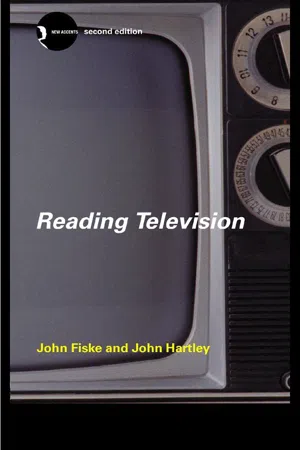
Reading Television
About this book
Reading Television was the first book to push the boundaries of television studies beyond the insights offered by cultural studies and textual analysis, creating a vibrant new field of study. Using the tools and techniques in this book, it is possible for everyone with a television set to analyze both the programmes, and the culture which produces them. In this edition, Hartley reflects on recent developments in television studies, and includes suggestions for further reading. His new foreword underlines the continuing relevance of this foundational text in the study of contemporary culture.
Information
1
‘READING’ TELEVISION
In August 1976, the British Broadcasting Corporation produced a programme to celebrate forty years of television entitled What do you think of it so far . . . ? The answer to that catchphrase question (known to every fan of TV comedians Morecambe and Wise) is ‘Rubbish!’ Evidently the BBC is as dubious as some of its critics about the quality of its output over the years. In the face of such modesty from the oldest broadcasting institution in the world, it would perhaps be rash to assert the contrary judgement – that television’s customary output may be just as good in its own terms as Elizabethan drama and the nineteenth-century novel were in theirs.
However, if we are to go by some of the criticisms made about Elizabethan theatres and dramatists by their own contemporaries, we can see that those closest to the scene do not always make the best judgements. After all, Shakespeare himself was called ‘an upstart crow’ who ‘supposes he is as well able to bombast out a blank verse as the best of you’ by a fellow playwright, Robert Grene. And some of the most respectable citizens in the country considered that the Shakespearean theatres left something to be desired:
They are the ordinary places for vagrant persons, Maisterles men, thieves, horse stealers, whoremongers, Coozeners, Coneycatchers, contrivers of treason and other idele and daungerous persons to meet together . . . They maintaine idlenes in such persons as haue no vocation & draw apprentices and other seruants from their ordinary workes and all sortes of people from the resort vnto sermons and other Christian exercises to the great hinderance of traides & pphantion of religion.
(Cited in Harbage 1941, pp. 84–5)
Television has been accused of many (though by no means all) of these crimes by its own contemporary critics. And yet, like the Elizabethan theatres, it is a familiar and popular experience for a large proportion of people from all sections of society.
Since the seventeenth century, Elizabethan drama has been subjected to a great deal of scrutiny, and early judgements such as the ones we have mentioned are now considered perhaps a little hasty. What is lacking in respect of television is this same kind of scrutiny. Television productions may be as good as those of the Elizabethan theatre, but we have no fully formed language of appreciation to ‘read’ them by. The tools of literary and dramatic appreciation are by now very sophisticated. But these tools will not necessarily do for television. Just as literature is not the same ‘thing’ as drama (and so you cannot ‘read’ a Shakespeare play in the same way as you would read a nineteenth-century novel), so television as a medium differs from both. Furthermore, television is a characteristic product of modern industrial society, while literature and the theatre come down to us from societies whose structures and organization were different. True, both have had to adapt to the modern world – but one of the features of that world is television.
Hence the tools of traditional literary criticism do not quite fit the television discourse. At best they can be used in the way a metaphor works – the unknown tenor of television might be apprehended by means of the known vehicle of literary criticism. But even here there are problems, one of the most fundamental of which is the difficulty in recognizing that literature and television are two different types of media. Every medium has its own unique set of characteristics, but the codes which structure the ‘language’ of television are much more like those of speech than of writing. Any attempt to decode a television ‘text’ as if it were a literary text is thus not only doomed to failure but is also likely to result in a negative evaluation of the medium based on its inability to do a job for which it is in fact fundamentally unsuited.
But we live in a society where literacy and its associated skills and modes of thought are valued very highly. This means that the tendency to judge all media, including television, by the prescriptions of literacy is not the result of mere intellectual confusion. Rather it is a reflection of dominant cultural values, instilled during five hundred years of print-literacy. Furthermore, it is a tendency that is not confined to television’s critics. The consequent habits of thought have encouraged those people who control and encode the television message (people who are drawn largely from the most literate sections of society) to attempt to preserve literate values within the medium.
This is an example of what McLuhan calls ‘rearviewmirrorism’ – where a new medium explores its potential in terms of the medium it is in the process of supplanting. Television is to some extent subversive of the very values most prized by literacy, which perhaps explains the uneasiness felt by the BBC about its achievements over forty years of broadcasting. The written word (and particularly the printed word) works through and so promotes consistency, narrative development from cause to effect, universality and abstraction, clarity, and a single tone of voice. Television, on the other hand, is ephemeral, episodic, specific, concrete and dramatic in mode. Its meanings are arrived at by contrasts and by the juxtaposition of seemingly contradictory signs and its ‘logic’ is oral and visual. We shall attempt to show how the contradiction between literate and non-literate modes of thought derives from social and historical conditions and how it has helped to shape the form of television discourse. In other words, before we can arrive at a language of appreciation appropriate to television, we must formulate an idiom which takes account of the singularity of the medium, and of its place in history.
In the chapters that follow, we aim to show how much of this work is already under way. It may look at first as though we are taking a sledge-hammer to a rather insignificant nut – after all, everybody knows what it is like to watch television. Certainly; and it is television’s familiarity, its centrality to our culture, that makes it so important, so fascinating, and so difficult to analyse. It is rather like the language we speak: taken for granted, but both complex and vital to an understanding of the way human beings have created their world. Indeed, the resemblance of television discourse to spoken language explains our interest in the communicative role played by television in society.
We shall try to show how the television message, as an extension of our spoken language, is itself subject to many of the rules that have been shown to apply to language. We shall introduce some of the terms, originally developed in linguistics and semiotics, that can help us to identify and successfully decode the sequence of encoded signs that constitutes any television programme. The medium itself is both familiar and entertaining, but this should not blind us to its singularity. As Diamond (1975) has rightly pointed out:
Television’s detractors argue that it is the ‘boob tube’, that it requires a minimum of intelligence to use (‘You don’t even have to know how to read’). Actually, television is a very demanding mode of communication. Television’s information is ephemeral; there is no way for the viewer to go back over material, in the way a newspaper reader or book reader can glance back over the page.
(p.)
In other words, we should not mistake an oral medium for an illiterate one. We have the example of Shakespeare to remind us that non-literate entertainment can be as demanding, and satisfying, as the most profound works of literature.
In later chapters we shall consider the place of television in society. The way it communicates with its audience can be likened to what happens if, when flicking through the pages of this book, you were to come across letters in print resembling your own name. All the other words escape your attention as your eye scans the fast-moving information, but your name is deeply imprinted on you: you are primed to recognize its familiar form even when you are unaware that you have been ‘reading’ the information. In the same way the television medium presents us with a continuous stream of images almost all of which are deeply familiar in structure and form. It uses codes which are closely related to those by which we perceive reality itself. It appears to be the natural way of seeing the world. It shows us not our names but our collective selves.
It does this so ‘naturally’ that discussion of the process might seem to be superfluous. But it is at that point that discussion in fact becomes most crucial. Television is a human construct, and the job that it does is the result of human choice, cultural decisions and social pressures. The medium responds to the conditions within which it exists. It is by no means natural for television to represent reality in the way that it does, just as it is by no means natural for language to do so. Both language and television mediate reality: there is no pristine experience which social people can apprehend without the culturally determined structures, rituals and concepts supplied to them via their language. Language is the means by which people enter into society to produce reality (one part of which is the fact of their living together in linguistic society). Television extends this ability, and an understanding of the way in which television structures and presents its picture of reality can go a long way towards helping us to understand the way in which our society works.
Hence the television discourse presents us daily with a constantly up-dated version of social relations and cultural perceptions. Its own messages respond to changes in these relations and perceptions, so that its audience is made aware of the multiple and contradictory choices available from day to day which have the potential to be selected for future ways of seeing. Of course, the picture does not appear to be so fluid as we watch: there are ‘preferred’ meanings inherent in every message. But even preferred meanings, which usually coincide with the perceptions of the dominant sections of society, must compete with and be seen in the context of other possible ways of seeing. These ‘active contradictions’ in the television message serve to remind us of our culture’s daily state of play. (Good examples of this process can be found in a News at Ten bulletin, analysed in detail in chapters 6 and 8.)
This social function can no longer be performed by other art forms such as the novel, especially on the mass scale available to television. It is often claimed that certain great artists, for instance Joyce, Kafka, Brecht, or Sterne in Tristram Shandy, are able to ‘defamiliarize’ the established conventions of thought and perception. Defamiliarization is a term borrowed from Russian Formalist criticism (see Lemon and Reis 1965). It describes the way these writers hesitate or hold back from producing sense in their messages, thereby demonstrating the arbitrary nature of the codes with which we are familiar. They thus demystify our perception of reality, which emerges as ‘real-seeming’, rather than as reality itself. The effect of this effort, it is claimed, is to confront the reader with their true place in the ideological framework of society. Defamiliarization rescues the individual from a ‘consumerist’ role. The inclusion of such ‘messages’ as Ulysses or The Trial or The Resistible Rise of Arturo Ui into the stream of products of the novel or theatre genres serves to isolate the conventions of the mainstream and thus expose them to view.
Television is widely held to be unsuited to this kind of role. It is taken to be wholly commercial, conventional and conservative. But this is only another way of saying that as a medium it is normative, a casual part of everyday experience. In fact, it is the very familiarity of television which enables it, according to our analysis, to act as an agency for defamiliarization. It is, indeed, more suited to this role than many of the great critical works of literature because contradictory perceptions are structured into all its messages, and we are not encouraged by any shaping artistic vision to learn to live with them. Furthermore artists like Brecht and Joyce are to some extent frustrated in their intentions by the fate of their products, which have been, as it were, re-mystified by the constant admiration which is their unhappy lot. It is difficult for a reader to use a great work of art for purposes of shattering, reforming and reproducing the established norms when the work in question has been incorporated into these norms.
Television is certainly aware of the arbitrariness of many of its own codes, and while not criticizing them, certainly celebrates them. What we, the audience then do with the message is another matter. We are certainly not suggesting that we are constantly and consciously defamiliarizing the message in order to criticize or isolate the ideological framework within which we live. What we do suggest is that taking television as we find it, we, the audience, are spontaneously and continuously confronted with this framework and must negotiate a stance towards it in order to decode and thus enjoy the entertainment in which it is embodied.
Hence the kind of analysis which has read Joyce and Kafka without ‘reading’ television eventually denies to the ordinary viewers the power – even the possibility – of recognizing for themselves their own situation in all its complexities and contradictions. The television message, on the other hand, is forced by its own constraints and internal contradictions to accord just this freedom of perception to all its viewers. In other words, we do not need to impose changes on the television message in order to produce defamiliarization; rather we should, as critics, learn to understand what it is that the language of television is saying to us.
2
CONTENT ANALYSIS
WHAT’S THERE
The starting-point of any study of television must be with what is actually there on the screen. This is what content analysis is concerned to establish. It is based upon the non-selective monitoring, usually by a team of researchers, of the total television output for a specified period. It is not concerned with questions of quality, of response or of interpretation, but confines itself to the large scale, objective survey of manifest content. However, the reading of television must progress from the manifest content to the latent content, and very few analysts have begun to tread this path.
None the less, it is clearly important to establish what is, in fact, there, even though the individual viewer will watch only a fraction of it. It is also worth pointing out that a global view can correct the inevitable imbalance of the individual’s experience of the medium. One of the earliest major studies of television content was made by Smythe in 1953. Smythe analysed all the drama programmes broadcast in New York City in the first week of January of that year. He found, among other things, that drama concentrated on people in their courting or child-bearing ages and portrayed disproportionately few of the young or old. The characters worked in professional, middle-class jobs rather than in routine white-collar or blue-collar ones, and males outnumbered females by 2:1. This sexual discrimination was repeated in the heroes of stories, where males again out-numbered females by 2:1, but among villains the male dominance was 4:1. Villains tended to be older than heroes, and were less likely to be white Americans. Only ten blacks were portrayed during the week, eight of whom were in minor roles, while the other two were heroes.
De Fleur (1964) studied six months’ output of drama on television in a midwestern town in the early 1960s. He was interested in how the world of work was represented on television, how it compared with the real world of work in America, and the sort of attitudes it might form in children about their future careers. His findings supported many of Smythe’s: for instance that ordinary jobs of modest prestige were held by half of the actual labour force, but by only 10 per cent of the TV labour force, and that there was a corresponding overrepresentation of high-prestige jobs. This was especially true for males, well over half of whom on television held jobs of high prestige.
This sort of descriptive study can provide useful data about the content of television output as a complete ‘message system’. The researchers are cautious about inferring much of socio-cultural significance from them, but Smythe wonders if the fact that villains are older than heroes might represent, to a society that values youth with its physical activity and sexuality, the menace of an older generation that holds on to its social power despite physical decline. A currently popular series, Starsky and Hutch, suggests a similar contemporary pattern.
But despite their caution, most researchers do make some references from the message system of television to the society that produces it and to which the message responds. Where they differ is in the way they see the relationship between the two. De Fleur argues that:
Television presents least often and as least desirable (from a child’s standpoint) those occupations in which its younger viewers are most likely to find themselves later . . . Television may be instructing children in ways that are not readily apparent even to close observers – ways that may lead to later disappointments as the individual enters the labour force.
(1964, pp. 69–70)
This implies that the world of work on television should represent the real world of work precisely, and that because it does not, it distorts reality. It also implies that children in particular and viewers in general react to the message system in the same way as they react to the reality that it portrays.
Gerbner disagrees with both these implications when he argues that ‘to be “true to life” in fiction would falsify the deeper truth of cultural and social values served by symbolic functions’ (1973b, p. 268); or again, ‘The symbolic world is often very different from the “real” world . . . The power and sig...
Table of contents
- COVER PAGE
- TITLE PAGE
- COPYRIGHT PAGE
- GENERAL EDITOR’S PREFACE
- READING TELEVISION AFTER 25 YEARS: A NEW FOREWORD BY JOHN HARTLEY
- 1. ‘READING’ TELEVISION
- 2. CONTENT ANALYSIS
- 3. THE SIGNS OF TELEVISION
- 4. THE CODES OF TELEVISION
- 5. THE FUNCTIONS OF TELEVISION
- 6. BARDIC TELEVISION
- 7. AUDIENCES
- 8. THE MODES OF TELEVISION
- 9. DANCE
- 10. COMPETITION
- 11. TELEVISION REALISM
- 12. A POLICEMAN’S LOT
- CONCLUSION: SOMETHING COMPLETELY DIFFERENT?
- REFERENCES
- FURTHER READING
Trusted by 375,005 students
Access to over 1.5 million titles for a fair monthly price.
Study more efficiently using our study tools.
Frequently asked questions
Yes, you can cancel anytime from the Subscription tab in your account settings on the Perlego website. Your subscription will stay active until the end of your current billing period. Learn how to cancel your subscription
No, books cannot be downloaded as external files, such as PDFs, for use outside of Perlego. However, you can download books within the Perlego app for offline reading on mobile or tablet. Learn how to download books offline
We are an online textbook subscription service, where you can get access to an entire online library for less than the price of a single book per month. With over 1.5 million books across 990+ topics, we’ve got you covered! Learn about our mission
Look out for the read-aloud symbol on your next book to see if you can listen to it. The read-aloud tool reads text aloud for you, highlighting the text as it is being read. You can pause it, speed it up and slow it down. Learn more about Read Aloud
Yes! You can use the Perlego app on both iOS and Android devices to read anytime, anywhere — even offline. Perfect for commutes or when you’re on the go.
Please note we cannot support devices running on iOS 13 and Android 7 or earlier. Learn more about using the app
Please note we cannot support devices running on iOS 13 and Android 7 or earlier. Learn more about using the app
Yes, you can access Reading Television by John Fiske,John Hartley in PDF and/or ePUB format, as well as other popular books in Social Sciences & Media Studies. We have over 1.5 million books available in our catalogue for you to explore.