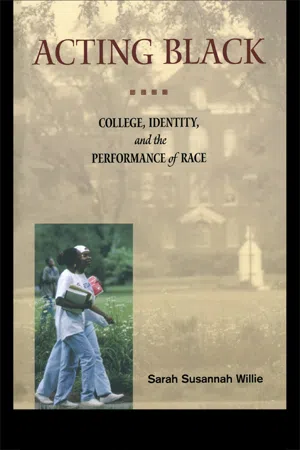
Sarah Willie asks: What's it like to be black on campus. For most Black students, attending predominantly white universities, it is a struggle. Do you try to blend in? Do you take a stand? Do you end up acting as the token representative for your whole race? And what about those students who attend predominantly black universities? How do their experiences differ?
In Acting Black, Sarah Willie interviews 55 African American alumnae of two universities, comparable except that one is predominantly white, Northwestern, and one is predominantly black, Howard. What she discovers through their stories, mirrored in her own college experience , is that the college campus is in some cases the stage for an even more intense version of the racial issues played out beyond its walls. The interviewees talk about "acting white" in some situations and "acting black" in others. They treat race as many different things, including a set of behaviours that they can choose to act out.
In Acting Black, Willie situates the personal stories of her own experience and those of her interviewees within a timeline of black education in America and a review of university policy, with suggestions for improvement for both black and white universities seeking to make their campuses truly multicultural. In the tradition of The Agony of Education (Routledge, 1996) , Willie captures the painful dilemmas and ugly realities African Americans must face on campus.
- 224 pages
- English
- ePUB (mobile friendly)
- Available on iOS & Android
eBook - ePub
About this book
Information
1
INTRODUCTION
[T]he project of history is…to understand [the] production [of identity] as an ongoing process of differentiation, relentless in its repetition, but also…subject to redefinition, resistance and change.
—Joan Scott, “Multiculturalism and the Politics of Identity”
This book is one take on college and race. It is based on interviews with fifty-five college-educated African Americans in the Chicago area during 1990 and 1991. The people I interviewed were undergraduate students between 1967 and 1989 at either historically black Howard University in Washington, D.C., or predominantly white Northwestern University in Evanston,Illinois.1 Desiring to understand my own experience at a predominantly white college with one semester spent at a historically black one, I decided to speak with African-American alumni and alumnae of two institutions of higher education, comparable (as I show in chapter 4) but for the racial composition of their student bodies. I wondered why some African Americans chose mostly white colleges and others chose historically black ones. I wondered if the racial sense African Americans had of themselves was influenced by the college they attended. I was especially interested in the ways that formal equality coexisted with informal inequality—that is to say, the contradiction that everyone is equal on paper because discrimination has been made illegal and the reality that most people of color still experience racial discrimination.
With each question I asked, respondents answered twice—first addressing my question and then addressing the salient question of their lives. With the first answer came portraits of college life—from socializing with friends and sense of community to enduring the rigors of academics and, for many, a sense of alienation and isolation. Alumni focused on the trade-offs made to pursue a degree with unequivocal prestige to those made with the hope of enjoying four years undistracted by explicit racism. With the latter answer came extensive commentary on what it means to be black in the late twentieth- century United States. The men and women with whom I spoke taught me about college in particular and how it feels to be a college-educated African American more generally. They taught me about the flexibility of race as a social identity, and the ways that all Americans, not just African Americans or other racial minorities, play or inhabit race roles at this moment in history.
In college and graduate school—and now as a college professor—I have seen most people of color in these settings forced to participate in a metaphorical racial trial. We are presumed to be guilty; in this case, guilt is synonymous with not being a “good fit” with the college, unless we prove ourselves otherwise. This phenomenon is not limited to the college campus. At times the trial is explicit, but these days, it is usually implicit. Sometimes the players in this metaphorical race trial refuse to play their roles, other times they have no choice. But the limited roles of prosecutor and defendant, judge and juror remain Durkheimian social facts, coercing even the most stubbornly anti-racist individuals into them as we interpret, ignore, or take a stand on anything having to do with race.
Why, well after the gains of the Civil Rights movement, were black college students still experiencing these racial trials? The answer, I believe, can be found in the powerful history of white supremacy in the United States. The ways in which the ideology of white supremacy persists are often difficult to see. Nonetheless, racism persists, woven into the fabric of the culture with even more subtlety, and, to many, less visibility after the dramatic changes wrought by the Black Freedom Movement.
When I began this project, I felt as if I were the defendant in one of these “Does she or doesn’t she fit?” trials, and I saw conducting interviews with other African Americans as a way to begin gathering evidence. But evidence to prove what? That white colleges are racist? That African Americans are exhausted by racism? That black colleges are the answer? The more evidence I gathered, the more the paradigm of defense and prosecution seemed inadequate to the task of examining race and college. Scholarship, though often adversarial, offered another way of approaching the situation of black students in college. My professors encouraged me to listen carefully, to investigate, to describe, and to examine previous scholarship. The scientific method paid off, and my interviews with black college alumni brought me beyond the quadrangle of the college campus and revealed ways to understand race better.
Institutions of higher education are diverse, as are the students who attend them. My observations apply to many students of color, but students of color, too, are a varied group. They come from groups with different practical and experiential histories and with different relationships to the ideology of white supremacy. So while this book is about college and race, it is not about all racial groups and it is not a large quantitative comparison. It does not include interviews with European Americans, Asian Americans, Native Americans, multiracial Americans, and Latinos and Latinas, and it does not look at colleges and universities where other racial minority groups are in the majority.
Indeed, “a more complex racial climate is emerging within the historically White colleges and universities in the United States” (Bowman and Smith 2002:103). This racial climate change is not limited to white campuses, for on historically black campuses, especially at the graduate school level, more white, Asian, and Latino students are also present.
This new racial climate is tempered by three contemporary trends: (1) the growing opposition to civil rights-era policies to provide access and support services for African American college students who still remain underrepresented; (2) the increasing demands for more multiethnic institutional changes from both Latina/o and Asian American students who make up an expanding portion of the college student population; and (3) the changing racial ideologies that college students [bring] from distinct ethnic backgrounds. (Bowman and Smith 2002:103)
Qualitative scholarship on the specificity of these experiences, in addition to that on African Americans, must be supported and encouraged so that we have more comparative data and can further appreciate the differences and similarities among groups.
In the rest of this chapter I describe the study, the sample, and the methodology I used, and I briefly outline the book.
FROM STUDENT TO RESEARCHER: SAMPLE AND METHOD
My dissertation project proposed an investigation of the experiences of blacks in college between the late 1960s, when Martin Luther King, Jr., was assassinated, through the late1980s, when the toll of mounting resistance to civil rights initiatives was becoming obvious. As late as 1954, over 90 percent of black students were educated at historically black colleges. In contrast, by 1995 these same schools were educating only 20 percent of the African Americans in college as a result of the dramatic changes wrought by the gains of the Civil Rights Movement. I assumed that speaking to alumni from both a predominantly white and a predominantly black college would yield insights I had not even considered about the relationship between race and higher education.
Using the snowball method of sampling,2 I sought African-American alumni who had been undergraduates at either Howard University in Washington, D.C., or Northwestern University in Evanston, Illinois, both of which had large bodies of alumni in the Chicago area where the study was conducted. Asmidsized urban uni-versities, Howard and Northwestern are similar in many ways, though the racial composition of each is almost the photographic negative of the other. About 80 percent of the Northwestern student body was European American when I did the study, and about 80 percent of Howard’s student body was African American. Their similarities and differences are described at greater length in chapter 4.
I set out in search of Howard and Northwestern alumni with a list of questions about college expectations, student-faculty relations, student social life, economic background, and career aspirations. The conclusions of this study are based on fifty-five interviews with black college alumni—fifteen men and fifteen women who attended Northwestern and fourteen men and eleven women who attended Howard—that I conducted in 1990 and 1991. Two-thirds of the interviews took place in person and the rest over the phone. Respondents had begun college as early as 1967, and everyone had graduated or left school by 1988. Each respondent spent at least two years as an undergraduate at either Howard or Northwestern.3 The interviews were a combination of closed and open-ended questions and they lasted from twenty-five minutes to three hours.4
FROM RESEARCHER TO TEACHER: THE DIALOGUE OF INTERPRETATION
As I expected, college alumni told me about friends and roommates, social and academic obstacles, personal triumphs and tragedies, classes, advisors, professors, and parties. They remembered painful experiences of individual and institutional racism,5 all narrated against the backdrop of and sometimes intimately connected to the tumultuous events unfolding in the United States.
I soon learned that social research rarely brings us the insights we expect to find. When the formal interview stopped, many of my respondents continued to talk. They described what it meant for them to be black, how they participated in the expansion and contraction of that meaning, how their understanding of what it meant to be black had changed over time, and how they negotiated racially polarized settings. Some alumni gave long answers to the question of why they chose the school they attended, and I began to interpret their soliloquies as racial justifications. Indeed they often told me what they thought their decision conveyed about their commitment to other black people. Others spoke at length, with nuance and poignancy, about their continued struggle to understand race and the implications this aspect of their identity had for their personal and professional lives. Their ideas encouraged me to focus on racism and racial identity as much as on the college experience.
By the time I began to analyze the transcripts of the interviews, I was well beyond my own college experience. I had finished three years of graduate study, one year as a teaching assistant, and two more years teaching my own courses, first at Northwestern University and then at Colby College. At both places, I taught on race and eth-nicity in the United States. As I prepared for my third year of teaching, the voices from the interview transcripts took on the role of a Greek chorus. They urged me to investigate whether the definitions of race I was encountering in textbooks and scholarship were explaining their experiences.
As my role had changed from student to teacher, I was seeing others struggle with issues I had confronted. If I had ever believed that race and racial identity were salient issues only for me or even only for the respondents in my study, these beliefs were refuted during class times and office hours. Not only were the classes I taught on race fully enrolled, the discussions were weighty and charged. The students who came to my office hours documented race as a central issue by their numbers and the substance of their concerns. In addition, the journal entries of those who did not drop by my office revealed little knowledge about the country’s racial history and few spaces in which to wrestle with its implications.
As I moved between the interview transcripts, the classroom, and the library, I discovered that many sociologists’ definitions of race were accurate, but that most were incomplete. Influenced by the scholarship of postmodernists who were questioning whether individuals exist as unified subjects and whether representation—racial and otherwise—was enough of a political goal (Butler 1991, Young 1990), I began to appreciate arguments about the complexity of identity. In particular, the idea that individual identity is a uniquely modern phenomenon and always in flux was an “Aha!” moment for me.
At the same time, I found it difficult to reconcile this with the seeming coherence and realness of identity for myself, my respondents, and my students. In the transcripts of the interviews, respondents talked with greater clarity and distance than I have heard most people talk about their identities, and for them racial identity held both constraint and liberation. They were unlike those postmodernist scholars who question the relevance of racial representation, since they understood representation in politics, on television, and in textbooks to be a crucial aspect of achieving a positive sense of self as well as a more accurate understanding of the world. They were like the postmodernists, however, in the multiple ways they talked about race. In their memories of college and their present lives, black alumni described the ways they consciously acted white in certain settings and acted black in others. Although they saw themselves as black, that did not mean they understood blackness as something simple or simplistic. The people with whom I spoke treated race as sets of behaviors that they could choose to act out, as expectations they had of themselves and others, as physical difference, and as ethnicity and subculture. Consciously negotiating their identities, even when there was sometimes very little room to do so, the men and women in this study described performing.
The observations that I heard during people’s interviews were distinct from what I had seen in the sociological literature on race. As Michael Omi and Howard Winant argue in Racial Formation in the United States (1994), theories about race and race re-lations in twentieth-century America are characterized by three approaches. These approaches focus on ethnicity, class, and nation. The racial theory dominant in each historical period “is shaped by actually existing race relations,” and whatever theory is dominant provides the members of society “with ‘common sense’ about race, and with categories for the identification of individuals and groups in racial terms” (Omi and Winant 1994:11). Omi and Winant criticize these approaches, arguing that race scholars have done every one a disservice by not pushing the intellectual envelope when it comes to race. Race theories are often as
political and ideological as…theoretical. They neglect both the institutional and ideological nature of race in America, and the systemic presence of racial dynamics in [a wide range of] social spheres…. Instead they focus attention on racial dynamics as the irrational products of individual pathologies. (Omi and Winant 1994:10)
While scholars have had limitations, they have both reflected and contributed to the difficulty that regular people have had wrapping their minds around race. Throughout this study, I heard individuals conceive of and describe race in the ethnic, economic, and nationalistic terms that Omi and Winant note have characterized twentieth-century American thinking. But I also observed black alumni speaking about race in terms going well beyond these three approaches.
Omi and Winant are correct that much is missing in the sociological literature on race. My respondents’ discussions revealed an acknowledgment that race is relational, situational, and interpersonally dynamic. When understood with these added dimensions, race cannot be defined only as a characteristic of identity that limits and circumscribes life chances, or only as a stigma for nonwhites, or, in the case of whites, only as an “invisible knapsack” that opens doors and provides privilege.6 Understood with greater dimensionality, race and racial identity become another site of human agency, a characteris...
Table of contents
- COVER PAGE
- TITLE PAGE
- COPYRIGHT PAGE
- ACKNOWLEDGMENTS
- NOTE FOR THE READER
- 1: INTRODUCTION
- 2: BLACKS IN COLLEGE: PAST AND PRESENT
- 3: ONE BLACK IN COLLEGE: QUAKER FRIENDS AND BAPTIST SISTERS
- 4: METHODIST NORTHWESTERN AND CONGREGATIONALIST HOWARD: BRIEFLY INTRODUCED
- 5: THE IVORY TOWER: LIFE AT NORTHWESTERN
- 6: THE EBONY TOWER: LIFE AT HOWARD
- 7: CODA: “EVERYBODY USED TO BE RADICAL”
- 8: RACE
- 9: BLACKNESS
- 10: IMPLICATIONS
- APPENDIX: METHOD AND SAMPLE
- BIBLIOGRAPHY
- NOTES
Trusted by 375,005 students
Access to over 1.5 million titles for a fair monthly price.
Study more efficiently using our study tools.
Frequently asked questions
Yes, you can cancel anytime from the Subscription tab in your account settings on the Perlego website. Your subscription will stay active until the end of your current billing period. Learn how to cancel your subscription
No, books cannot be downloaded as external files, such as PDFs, for use outside of Perlego. However, you can download books within the Perlego app for offline reading on mobile or tablet. Learn how to download books offline
Perlego offers two plans: Essential and Complete
- Essential is ideal for learners and professionals who enjoy exploring a wide range of subjects. Access the Essential Library with 800,000+ trusted titles and best-sellers across business, personal growth, and the humanities. Includes unlimited reading time and Standard Read Aloud voice.
- Complete: Perfect for advanced learners and researchers needing full, unrestricted access. Unlock 1.5M+ books across hundreds of subjects, including academic and specialized titles. The Complete Plan also includes advanced features like Premium Read Aloud and Research Assistant.
We are an online textbook subscription service, where you can get access to an entire online library for less than the price of a single book per month. With over 1.5 million books across 990+ topics, we’ve got you covered! Learn about our mission
Look out for the read-aloud symbol on your next book to see if you can listen to it. The read-aloud tool reads text aloud for you, highlighting the text as it is being read. You can pause it, speed it up and slow it down. Learn more about Read Aloud
Yes! You can use the Perlego app on both iOS and Android devices to read anytime, anywhere — even offline. Perfect for commutes or when you’re on the go.
Please note we cannot support devices running on iOS 13 and Android 7 or earlier. Learn more about using the app
Please note we cannot support devices running on iOS 13 and Android 7 or earlier. Learn more about using the app
Yes, you can access Acting Black by Sarah Susannah Willie in PDF and/or ePUB format, as well as other popular books in Social Sciences & Educational Policy. We have over 1.5 million books available in our catalogue for you to explore.