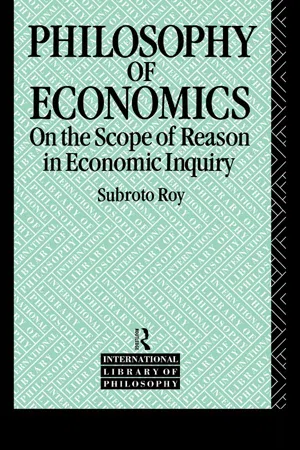
The first work to seriously and successfully bridge twentieth century economics and philosophy. Subroto Roy draws these two disciplines together and examines the intellectual roots of economics.
In this book, some of the central philosophical questions facing the modern economist will be raised. Most attention will be given to the question of the appropriate relationship between the positive and the normative, as well as to its parent question of the appropriate scope of objective reasoning in the making of evaluative judgements. Closely related is the question of the appropriate role of the economic expert in society, while slightly more distant questions have to do with the significance of interpersonal comparisons of utility, with the philosophical status of the concepts and theorems of mathematical economics, and with how judgements of probability should be understood. It is this family of questions which will be the concern of the present work.
Economics is a science with potentially important practical bearing upon the lives of men and nations. The state of the modern world may have been affected more profoundly and subtly by the use or misuse of economic knowledge than by many another science1. Yet anyone familiar with the intellectual history of the field will know it to have seen more conflicts, and often conflicts of a more destructive kind, than may be reasonably expected or tolerated in the development of a scholarly discipline. The reader will be familiar with the many explicit and implicit divisions of opinion that have occurred upon theories and methods and evidence and policies, which have sometimes torn apart individual university departments and even threatened the integrity of the science itself. Indeed the modern economist in a despondent mood might be inclined to say of the state of his discipline as David Hume once said of philosophy: There is nothing which is not the subject of debate, and in which men of learning are not of contrary opinions. The most trivial question escapes not our controversy, and in the most momentous we are not able to give any certain decision. Disputes are multiplied, as if everything was uncertain, and they are settled with the utmost warmth, as if everything was certain.’2
At the same time as there have been deep and persistent divisions on substantive questions of economic theory and method and evidence and policy, there has been a deliberate or inadvertent consensus about the answer to an important question in the theory of knowledge. Modern economists happen to have been practically unanimous in their opinion on the possible scope of objective reasoning in the making of judgements, and thus in their opinion on the appropriate relationship between the positive and the normative. A broad consensus has developed to the effect that while common reasoning can have some scope in evaluative discussion, it is quite possible in practice and in principle for this scope to become exhausted. At such a point of the exhaustion of reason, only sheer and unadulterated subjective differences will be found to remain between people. Put another way, it has been believed possible for judgements ultimately to become immune to rational question and criticism.
Many of the pioneers of twentieth century economic thought, Kenneth J.Arrow, Milton Friedman, F.A.Hayek, Sir John Hicks, Oskar Lange, Gunnar Myrdal, Lionel Robbins, Joan Robinson, Paul Samuelson, Joseph Schumpeter, Jan Tinbergen, to name but a few, who between themselves would represent all of the main schools of contemporary economics, may be found to have shared such a thesis in the theory of knowledge, differing amongst themselves only upon the relatively minor question of the precise amount of room reasoning should be considered to have: some saying a great amount, others saying almost none, but all agreeing that whatever the exact amount it is a finite amount, both actually and potentially. The theory of demand, the theory of macroeconomic policy, the theory of welfare economics, the theory of social choice—each has in whole or in part rested upon an epistemological premise of this kind. If such a consensus can be shown to have existed, the reader may agree it to be something of a remarkable fact, since it would be difficult indeed to find a single substantive proposition of theory or method or evidence or policy to which a similar measure of consensus among modern economists might obtain.
One of the objects of the present work will be to argue that the fact that there have been tremendous disharmonies on substantive economic questions, may not be independent of the fact there has been this kind of harmony in the theory of knowledge among many of the pioneers of twentieth century economics as well as the many more who have followed them. If the epistemological point hitherto accepted as true happens in fact to be false, it becomes possible that the scope of objective reasoning on substantive questions has been artificially prevented from being extended as far as it could have and should have been. Evaluative judgements are clearly of indefinite variety: attitudes towards goods or people, expectations of the future, recommendations to buy or sell, advice to a friend or a student or a government, etc.—roughly, all judgements taken by an individual or social agent about a right or optimal course of action in given circumstances. We shall find the consensus has been that it is possible for reasoning to come to a necessary halt in the process of coming to such judgements, whether the maker of the judgement is a public body or a private individual acting in the capacity of consumer or voter. A large amount (and possibly the whole amount) of what may deserve to be within the domain of common and objective reasoning comes to be placed instead under the rule of subjective will and caprice. Not only must we live with the fact that discussions between citizens or economists or politicians or spouses or siblings or nation-states do frequently come to end without resolution, because there happens to be a lack of patience or tolerance or perseverance or good humour or whatever, but also that such outcomes may be written into the script from the start. In any normative discussion, we are to be permitted to call a unilateral halt merely by declaring ‘Well that is a value judgement of mine’ or That is a personal opinion of mine’, with the implication that any further questioning is out of bounds and unacceptable. Given a theory which allows us in this way to declare as we please what to call objective science and what to call subjective opinion, and given that it may be but human nature to be sceptical of the other fellow’s dogma while being oblivious to one’s own, we may have some explanation of how the consensus among economists in the theory of knowledge may have caused and preserved a state of affairs in which rival substantive dogmas can thrive—because the processes of common reasoning and even communication itself may have been allowed too often to come to a virtual standstill (or move at a snail’s pace). ‘Disputes are multiplied, as if everything was uncertain, and they are settled with the utmost warmth, as if everything was certain.’
The gist of the present work will be that the present consensus in the theory of economic knowledge is logically inconsistent. It is therefore untenable and deserves to be abandoned. Men can aspire to, and in fact do attain and possess, certain and objective knowledge in an indefinite number of contexts. At the same time, there is no proposition of any kind held by anyone which must be thought of as necessarily closed to further question on grounds of reason or evidence. This simple maxim is something that may be found to hold in any field of human inquiry or endeavour one cares to mention—mathematics or medicine, ethics or physics, history or probability, logic or theology—and it will be our purpose in this work to examine its consequences in the context of economics in particular.
2. Our study is one in what may be called theory of economic knowledge, and it may be worth a moment to consider what may be meant by this.
Bertrand Russell said of pure mathematics that it was a subject ‘in which we do not know what we are talking about’3—meaning that the pure mathematician does not normally intend to refer in theorems to substantive factual truths about the world. The epistemology or theory of knowledge of a discipline may be thought of similarly as being not concerned with either affirming or denying, corroborating or refuting the substantive propositions that happen to be made within the discipline. The study of the theory of economic knowledge may be thought of as not making any commitment one way or another to the substantive propositions which are to be found within the department of economics itself. Instead it is a more abstract undertaking, which seeks to examine certain kinds of questions from outside the department in the practical hope of dissolving or at least clarifying the character of substantive questions and controversies that may be occurring within. For example, to ask whether a criterion of truth and falsity can be applied to economic propositions, or whether objective knowledge is possible in the field, or how the kinds of propositions made in economics are to be justified, or how they compare and contrast with propositions made in other departments of inquiry—these would be the kinds of question we might see asked in the theory of economic knowledge; from which too the importance can be seen of generally abstaining from making substantive commitments in the process.
Much of the present work, especially Parts I and II, may be understood to be an attempt to provide a theory of economic knowledge of this kind. Thus the reader will not find in it commitments made to any substantive economic propositions. There is no theorem reported of the existence or efficiency of some new kind of economic equilibrium, no new model or evidence offered of the influence of the supply of money on prices, no new theory of how the expectations of economic agents may be formed or fulfilled or disappointed, no new evidence or explanation of why some country may be experiencing rapid growth or high inflation or increasing unemployment. No new result within economic science; one might almost say, nothing substantive! The present work will offer no more than ‘a machine to think with’ on certain philosophical aspects of economics; it intends to leave economics as it is—and yet in so doing to have shown the way out of some of the philosophical difficulties that are encountered in its study. ‘For the clarity that we are aiming at is indeed complete clarity. But this simply means that the philosophical problems should completely disappear.’4
Yet the practical purpose of making an investigation of this kind may be stated quite readily. For suppose, for the sake of argument, we granted the truth of our simple maxim and assumed that the epistemological concepts ‘knowledge’ and ‘doubt’, and their allied concepts ‘objectivity’ and ‘freedom’, should not be seen as incompatible in the project of inquiry. What consequences would follow from accepting such a viewpoint? Clearly first of all, we would be placed in a happy position of being able to say that no matter how deep or persistent the actual disagreements between economists or between citizens on economic questions happened to be, there is knowledge to be had in the study of economics. Not just high sophistry or rhetoric or political posturing or the opinions and prejudices of different people—but certain and objective knowledge about those actions, events, and phenomena that are part of the economic context. We would be able to say, in other words, there are at least some propositions in economics which are true, and which moreover can be known to be true.
An important ambiguity is possible here in asking whether there is knowledge about a given matter, insofar as such a question can be taken either as asking whether it is possible for there to be any knowledge about the matter, or as asking whether it is known that someone actually possesses such knowledge and how that has been determined. Defining as an expert someone who has the most reasonable and justifiable answer to give to a question, we need to distinguish, in other words, the relatively cool logical question of whether there can be any such thing as expert knowledge from the more heated political question of who is supposed to be such an expert and how we are supposed to know that. For instance, a question like ‘Is there a proof to Fermat’s last theorem?’ can be understood either in the manner of the pure mathematician, as asking whether there can be a proof to the proposition it is impossible
for positive integers x, y, z, n, and
; or in the manner of the historian of mathematics, as asking whether any human being has come up with such a proof, as Fermat said he had done but of which no record exists. Among the great thinkers, Plato is the most influential to have crossed these wires in suggesting it possible not only for there to be objective knowledge about mathematics and ethics and statesmanship, but also for a special and closed set of experts to come to be identified to whom such knowledge should be thought of as being exclusively given. Plato’s theory can be and has been interpreted as giving license to elitism and dictatorship, yet the natural protest which the ideas of these would evoke in most of us may lead to an equal and opposite error of denying the very possibility of knowledge because we feared or wished to reject the idea of being ruled by a closed set of self-described experts. Once these wires are uncrossed, we may see it to be quite possible to maintain that there can be objective knowledge and expertise in economics, without making any commitments toward specifying who should be considered an expert on some economic issue, or how we are supposed to determine that, or for that matter claiming any such knowledge or expertise for ourselves.
A second consequence of our simple maxim may seem more troubling. For by its second part, we should also have to say that even while there is objective knowledge in economics, there is nevertheless no proposition in the field which must be thought of as being necessarily closed to further question. Not the proposition that every human act is a rational act, nor the proposition that economic agents continually maximize utility, or are well modelled as doing so, nor the proposition that the market economy cannot be expected to reach full employment and needs to be and can be actively supplemented by macroeconomic policy, nor the proposition that the growth of money is necessary and sufficient for inflation, nor the proposition that free trade will maximize world output given factor immobility, nor the proposition that externalities imply a possible scope for taxes and subsidies, nor the proposition that the histories of nations is a history of class struggle. By the second part of the maxim, there is no axiom or theorem of economic theory, no finding of economic history, no estimate of the value of an economic coefficient, no prediction of the course of an economic variable, no proposal of economic policy, which must be thought of as being closed to further question. None whatsoever. ‘No statement is immune to revision’ (Quine).5
Taken together, then, the net consequence of supposing objectivity and freedom, knowledge and doubt, to be compatible concepts deserving of equal respect, is that we shall be able to chart a course which steers us clear of two perennial and opposing hazards besetting all projects of human inquiry, viz., Scepticism and Dogmatism—the modern origins of which were traced by the American philosopher Charles Sanders Peirce to the cartesian proposal that philosophy ‘must begin with universal doubt, whereas scholasticism had never questioned fundamentals.’6 In the pages to follow, we will be denying universal doubt and we shall be free to question fundamentals. In an indefinite number of contexts, there is certain and objective knowledge to be had. Scepticism, understood technically as a logical thesis denying that we can possibly have or know that we have certain knowledge, is therefore a false thesis. At the same time, there is no proposition which is necessarily closed to question. Dogmatism, understood technically as a logical thesis implying there can be or must be some propositions which are absolutely and incorrigibly true, is therefore an equally false thesis. In place of a theory of knowledge restricting the scope of common reasoning to the finite or even the potentially finite, it is possible to have a theory of knowledge extending this scope to the potentially infinite. In particular, while normative proposals in economics or elsewhere may be supposed to be objectively better or worse depending on the soundness of the positive grounds given in their support, there are no unquestionable normative proposals—because there are no unquestionable positive grounds. The simple practical result of making the present investigation is that it will permit a sure and safe course to be found between Scepticism and Dogmatism for any project of economic inquiry.
3. Would such a simple and straightforward thesis be new to economics in any way? To what extent has the argument which has been summarized above and which will be developed in the chapters to follow not been expressed before? The reader may wish an answer to such a question, and the author presently takes this to be as follows.
With respect to the general debate which has occurred about knowledge and scepticism especially in moral philosophy, there will be little if anything in the present work which is a direct or novel contribution to it. While the philosophers have not been concerned with political economy at all, we shall be passive participants to their discussions, listening in to see what can be learned for our purposes and not intending to add to them directly. It may be remembered of course that it has not been long since economics formally broke away from philosophy to become a specialized discipline in its own right, in the belief that the concerns of economics are of a more concrete and practical kind than those of philosophy.7 Since then we have made many highly abstract and theoretical claims, while also becoming scornful of philosophical thinking and believing ourselves to be exempt from its influences. Yet serious philosophical thought constitutes a mature...
Table of contents
Cover Page
Title Page
Copyright Page
Preface
1. Introduction
Part I
Part II
Part III
Notes and References
Select Bibliography
Trusted by 375,005 students
Access to over 1.5 million titles for a fair monthly price.
Study more efficiently using our study tools.
Frequently asked questions
Yes, you can cancel anytime from the Subscription tab in your account settings on the Perlego website. Your subscription will stay active until the end of your current billing period. Learn how to cancel your subscription
No, books cannot be downloaded as external files, such as PDFs, for use outside of Perlego. However, you can download books within the Perlego app for offline reading on mobile or tablet. Learn how to download books offline
Perlego offers two plans: Essential and Complete
Essential is ideal for learners and professionals who enjoy exploring a wide range of subjects. Access the Essential Library with 800,000+ trusted titles and best-sellers across business, personal growth, and the humanities. Includes unlimited reading time and Standard Read Aloud voice.
Complete: Perfect for advanced learners and researchers needing full, unrestricted access. Unlock 1.5M+ books across hundreds of subjects, including academic and specialized titles. The Complete Plan also includes advanced features like Premium Read Aloud and Research Assistant.
Both plans are available with monthly, semester, or annual billing cycles.
We are an online textbook subscription service, where you can get access to an entire online library for less than the price of a single book per month. With over 1.5 million books across 990+ topics, we’ve got you covered! Learn about our mission
Look out for the read-aloud symbol on your next book to see if you can listen to it. The read-aloud tool reads text aloud for you, highlighting the text as it is being read. You can pause it, speed it up and slow it down. Learn more about Read Aloud
Yes! You can use the Perlego app on both iOS and Android devices to read anytime, anywhere — even offline. Perfect for commutes or when you’re on the go. Please note we cannot support devices running on iOS 13 and Android 7 or earlier. Learn more about using the app
Yes, you can access The Philosophy of Economics by Subroto Roy in PDF and/or ePUB format, as well as other popular books in Philosophy & Economic Theory. We have over 1.5 million books available in our catalogue for you to explore.