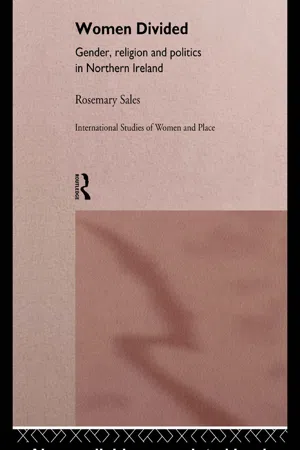
The ongoing Irish peace process has renewed interest in the current social and political problems of Northern Ireland. In bringing together the issues of gender and inequality, Women Divided, a title in the International Studies of Women and Place series, offers new perspectives on women's rights and contemporary political issues.
Women Divided argues that religious and political sectarianism in Northern Ireland has subordinated women. A historical review is followed by an analysis of the contemporary scene-- state, market (particularly employment patterns), family and church--and the role of women's movements. The book concludes with an in-depth critique of the current peace process and its implications for women's rights in Northern Ireland, arguing that women's rights must be a central element in any agenda for peace and reconciliation.
- 256 pages
- English
- ePUB (mobile friendly)
- Available on iOS & Android
eBook - ePub
About this book
Information
Topic
Sciences physiquesSubtopic
Géographie1
INTRODUCTION
To many outsiders, politics in Northern Ireland appears to be about an archaic struggle between two groups defined in religious terms—Protestants and Catholics1—whose leaders all seem to be men. Women, and women’s concerns, have been largely invisible in the reports and in much of the literature generated by the ‘Troubles’—the euphemism for the violent conflict which has dominated Northern Ireland for much of the past twenty-five years.2 Where women have been prominent in representations of the conflict, they have generally been portrayed as the ‘peace makers’, uninvolved in the conflict itself.
In 1994, Republican and loyalist paramilitaries announced ceasefires, halting their military campaigns, and initiating a ‘peace process’. Sadly, the opportunities opened up for a transformation in Northern Irish society were not seized. The response of the British Government in particular was grudging and suspicious, and the delays in bringing about all-party talks led to the resumption of violence by the IRA seventeen months later. At the time of writing, October 1996, the loyalist ceasefire is still holding, but in September 1996, loyalist prisoners associated with the Ulster Defence Association announced that they no longer supported the ceasefire. This, together with the IRA’s return to violence, may have delivered fatal blows to the already faltering peace process.
One of the ironies of the ‘peace process’ has been the absence of women—the ‘peace makers’—from the negotiations. Discussions between party leaders have been conducted mainly in secret, and the agenda has been narrowly constricted. Women have largely been excluded from the formal political process in Northern Ireland, and therefore from a role within the peace process itself.
Women, however, play an active role in the politics and society of Northern Ireland. They have been at the forefront of community organisations which have attempted to unite both communities around issues of common concern. Activity around ‘women’s issues’ has gained momentum in the 1990s and has involved large and varied groups of women in both communities. Many women have also been active in the political movements in Northern Ireland. They have been prominent in peace movements, but some women have also become involved in paramilitary activity in both loyalist and Republican organisations, and in the political parties associated with them.
Women are increasingly asserting their own demands, which challenge the mainstream agendas of what is traditionally defined as politics within Northern Ireland. In order to preserve unity between women—to allow work on areas where they can agree—women’s groups have tended to avoid debating and taking positions on the issues which divide the communities. Some have even suggested that women have no real interest in the issues surrounding the conflict. Others argue that women have a vital interest in the outcome of the conflict, and in the political institutions that are developed. For women (predominantly Protestants) who identify with unionism, maintaining the link with Britain is crucial not only to their own identity, but as a means to secure women’s interests, particularly through the economic resources provided through government expenditure. For nationalist (predominantly Catholic) women, the struggle for women’s rights within Northern Ireland cannot be separated from the broader struggle against the injustices inherent in the Northern Ireland state. While most women would agree that women’s rights must be placed at the heart of any new agenda for Ireland’s future, the separation of ‘women’s issues’ from the mainstream political agenda risks marginalising women’s concerns.
This book is about the experience of women in a divided society. It discusses women’s role in the economy and politics of Northern Ireland, and the changes brought about by twenty-five years of conflict. Women from the two communities have responded differently to the conflict, and to the problems and opportunities it opened up. The book also discusses attempts by groups of women to overcome the sectarian divide, and the possibilities of developing a common agenda for women.
The conflict has often been portrayed as a religious dispute. The two communities are defined in terms of religious affiliation, and the terms ‘Protestant’ and ‘Catholic’ have been used as ‘boundary markers’ for the two groups. But these different political and national identities stem from the different historical experiences of colonialism, and from their relations to the state in Northern Ireland. The origin of the present conflict lies in the mass protests of the civil rights movement in the 1960s against the systematic exclusion of Catholics within Northern Ireland from political and economic power.
The divisions which now appear as religious differences originate from the different patterns of colonial relationships established in Ireland. In the South, settlement was limited, and colonists were mainly absentee landlords. The North was more densely settled by people from England and Scotland, who came from a variety of class backgrounds, including artisans and peasants. They were marked out from the native Irish by their Protestant religion, and by the privileges they obtained first in relation to land tenure, and later in the industrial sphere. Protestants have tended to identify themselves as British, and as separate from the Catholic Irish, although this has been by no means constant. In the eighteenth century Protestants were in the vanguard of Irish nationalism and only in the twentieth century did the divisions become firmly entrenched with the formation of Northern Ireland.
Northern Ireland was established in 1920, following the war of independence waged by Irish Republicans against British rule in Ireland. The Protestant population in the North opposed independence, and fought to retain their links with Britain, the Union. Ireland was partitioned into two states, one of which became the independent Irish Republic. The six North Eastern counties became Northern Ireland, and remained in the United Kingdom, with a semi-autonomous parliament at Stormont outside Belfast.
Unionists were in a majority in Northern Ireland, but their control over the state was fragile. Northern Ireland contained a minority of Catholics, most of whom identified with Irish nationalism, while Unionists were in a minority in Ireland as a whole. To secure their rule, the Unionist majority in Northern Ireland institutionalised discrimination against Catholics, while the police became a (virtually) Protestant force, with a wide range of emergency powers at its disposal. Northern Ireland was, in the words of its first Prime Minister, a Protestant state,3 with the state apparatus used ruthlessly to maintain Unionist control.
Northern Ireland became a divided society, in which the separation and alienation of Protestants and Catholics became part of everyday experience. Politics has centred around community loyalties, giving little space for alternative agendas. The mainstream parties draw their support almost exclusively from one community or the other. Class and gender loyalties became subordinated to community loyalties, making alternative politics difficult to sustain.
Partition created conservative regimes in both the North and the South, in which the churches have had a powerful influence on state policy making. Women were divided from each other both geographically and politically. Northern women were separated by the border from Southern women, but within Northern Ireland itself, Catholic and Protestant women were divided on community lines.
NORTHERN IRELAND’S CONTESTED PLACE
The conflict in Northern Ireland is not merely about relations between the two communities within the state, it is about wider identification with territory and culture. For Unionists, Northern Ireland is part of the United Kingdom, and they identify as British. Nationalists claim an identity with the rest of Ireland.
Northern Ireland’s contested national identity is at the heart of the conflict. It is formally part of the United Kingdom of Britain and Northern Ireland, but even the name of the state suggests an ambivalence. For Protestants their Britishness is at the root of their political identity, but Northern Ireland is not part of Britain, which consists of England, Scotland and Wales. Britain is referred to as ‘GB’ or the ‘mainland’, which is ‘over the water’. Other unionists describe themselves as Ulstermen or -women, but this too is problematic. Northern Ireland was carved out of the ancient nine-county province of Ulster, but three of the original counties are now in the Irish Republic. Nationalists have a less ambiguous sense of national identity. They claim affiliation with Ireland as a whole, and aspire to a united Ireland. Many challenge the legitimacy of Northern Ireland, and refer to it as ‘the Six Counties’ to underline its artificiality.
For the people of Britain, the loyalty of Protestants to their Britishness is generally a matter of indifference. Many British people were hardly aware of Northern Ireland as part of their own state until the mass protests of the civil rights movement brought British soldiers onto the streets of Belfast and Derry and onto their television screens. Events in Northern Ireland are generally portrayed as a succession of crises and violent incidents, which most British people prefer to ignore.
The ambivalent status of Northern Ireland is demonstrated in the Prevention of Terrorism Act (PTA), passed in the wake of the bombing of a public house in Birmingham in 1974. The PTA allows terrorist suspects to be deported from Britain to Northern Ireland—a form of ‘internal exile’. Critics also point out the double standards involved: suspected terrorists deemed too dangerous to be allowed in Britain, are able to remain at liberty in Northern Ireland.
For over twenty-five years, Northern Ireland has been governed directly by the British Government in London, by parties which do not exist in Northern Ireland.4 The most distinct of the regions of the United Kingdom, Northern Ireland has the least autonomy and local accountability. While in many areas British laws and policies are transferred to Northern Ireland, the priorities of policy makers have been quite different from those in relation to Britain. Women’s concerns have remained a low priority for politicians and policy makers.
WOM EN’S PLACE IN NORTHERN IRELAND
Northern Ireland was founded on the exclusion of women as well as Catholics from full citizenship. The Unionist state was conservative on social and economic questions, and women were discouraged from taking on public roles in politics and within the wider social and economic life. The past three decades have seen major economic and social changes, with women increasingly involved in the public sphere. They remain largely excluded from formal politics. There has been no woman MP for Northern Ireland since the 1960s, and the proportion of women among local councillors is low.
Sectarianism, and the construction of political and social life around community loyalties, has been a powerful force in maintaining women’s subordination. A national identity based on religious affiliation has strengthened the Churches within both communities as a focus for their common interests. Church leaders are often called upon as spokesmen (sic) for their community. In the Protestant community, many elected politicians are ministers of the Church, most notably Dr Ian Paisley, leader of the Democratic Unionist Party who combines defence of the Union with fiery fundamentalist and anti-Catholic rhetoric. The exclusion of Catholics from state power under Stormont gave the Catholic Church a wider role in the social life of the Catholic community. Both Churches have played a prominent role in welfare services, cultural life and schooling and the wider politics of the community.
The Churches, both Protestant and Catholic, have promoted conservative views on social issues, particularly in relation to the family and sexuality. The Churches promote and reinforce notions of deference and obedience, and conformity to a rigid code of sexual behaviour. The sexual division of labour in the Church—with male clergy and a predominandy female membership, whose role is largely confined to domestic tasks—is a metaphor for gender relations in the wider sphere of social and political life.
One of the few areas of agreement between politicians and clergy from both sides has been their opposition to abortion and gay rights. Both Catholic and Protestant have campaigned against the Brooke Clinic which provides contraceptive advice to young people, and against abortion. Ian Paisley famously set up ‘Ulster Against Sodomy’ to try to prevent a ruling from the European Court to extend the 1967 Act legalising homosexual acts between consenting adults to Northern Ireland. The role of religion in cementing political allegiances, moreover, means that politicians have been reluctant to challenge the Churches’ teaching on these issues.
The civil rights movement of the 1960s challenged the second-class status of Catholics within Northern Ireland. It led to dramatic changes in the relations of the two communities to the state, ultimately bringing the overthrow of the local Northern Ireland parliament at Stormont. The movement did not, however, challenge the gender inequality which has been a central feature of both communities. When the movement escalated from civil protest to armed conflict, residential and workplace segregation increased, bringing greater polarisation along religious lines. As the conflict developed, the ties of community became more strongly entrenched, as armed conflict placed a premium on loyalty.
Feminists in Northern Ireland have had to confront the ideological dominance of Church teaching, and the idea that to challenge the prevailing politics of their community is disloyal. To identify as a Catholic ‘was, and still is, perceived by many Catholics as an anti-colonial act’ (McLaughlin 1986:369). Colonial relations have ensured the survival in Northern Ireland of a particularly conservative form of Catholicism. Within the nationalist movements, the rights of women have been seen as, at best, secondary to the national struggle (Ward 1983). The nationalist history of conflict with state authority has nevertheless meant that Catholic women have a tradition of struggle with which they can identify. Women in nationalist areas played an active role in the community protests from the early days of the civil rights movement, and are still generally more active in political and community groups than most Protestant women.
Protestant women have remained much less visible. The public face of the Protestant community is overwhelmingly male, represented by male political and Church leaders, many of them with strongly anti-feminist views. The ties of the Protestant community to the Union make it even more difficult for Protestant women to challenge the authority of ‘their’ state and political leaders. Those who fight for their own interests are seen as ‘rocking the boat’ (Gordon 1990). Feminism is seen as alien, and even associated with Republicanism.5
The past twenty years have seen major shifts within the Protestant community. Social and economic restructuring, and the policy shifts brought about by twenty years of ‘the Troubles’ have undermined the economic basis of Protestant privilege, loosening the ties which have bound the Protestant community together. While the response has often been fear and defensiveness, it has also opened up new possibilities for women to become more active in economic and political life. Women from both communities have become active in informal politics, and are increasingly acknowledged as ‘the backbone of the community’.6
Those working on ‘women’s issues’ have tended to avoid divisive issues in order to build dialogue and activity across the sectarian divide. In the elections to the Forum in June 1996, a Women’s Coalition was formed to unite women across the divide around issues of common interest, and to try to gain a voice for women in the peace process. The hastily formed group gained nearly 2 per cent of the vote, and two places on the Forum. The intervention was not however welcomed by all feminists, since many felt it was necessary to take a position on the constitutional issues being debated within the Forum.
THE RELIGIOUS DIVIDE IN CONTEMPORARY NORTHERN IRELAND
Divisions between Protestant and Catholic reach into every area of life in Northern Ireland, affecting where people live, go to school, work, drink and play sport; who their friends and neighbours are, and whom they marry. For most, it determines national identity and political allegiance. The identification of Protestants with unionism (support for the maintenance of Northern Ireland as part of the United Kingdom); and Catholics with nationalism (who favour a united Ireland as an immediate or long-term goal) though by no means complete, is nevertheless powerful.
Religion is not an immediately visible identity. Protestants and Catholics look more or less the same; speak the same language;7 share much popular culture, watch the same television programmes. But segregation is more allembracing than between apparently more dissimilar groups in Britain and Europe. The extent of separation varies across Northern Ireland. The major cities have rigidly demarcated Protestant and Catholic areas. In thirty-five of Belfast’s fiftyone wards, the population was at least 90 per cent Catholic or Protestant in 1991 (Murray 1995:218). Many rural areas are overwhelmingly populated by one community The wealthy constituency of North Down has such a solidly Protestant population that no nationalist party put up a candidate in the byelection in June 1995. Segregation also varies with social class. It is most intense within working-class ghettos, where residential segregation is highest, and mass unemployment further restricts the range of social contact (see e.g. Dunn 1995:5).
Residential segregation provides the basis for the promotion of a specific cultural heritage and a common set of values and beliefs. This is compounded by an almost entirely segregated school system (Murray 1985; 1995). Many people grow up with no social contact with people from the other community. Women, who are less likely to work outside their own communities, are even less likely than men to come into contact with people from the other community. The rate of ‘mixed marriages’ is estimated to be as low as 9 per...
Table of contents
- COVER PAGE
- TITLE PAGE
- COPYRIGHT PAGE
- TABLES
- GLOSSARY
- ACKNOWLEDGEMENTS
- 1: INTRODUCTION
- 2: THE RISE AND FALL OF STORMONT
- 3: EXPLAINING THE CONFLICT
- 4: BRITISH POLICY UNDER DIRECT RULE
- 5: SOCIAL POLICY AND SOCIAL DIVISIONS
- 6: EMPLOYMENT INEQUALITY IN THE 1990S
- 7: ENGENDERING CHANGE
- 8: WOMEN AND THE ‘PEACE PROCESS’
- NOTES
- BIBLIOGRAPHY
Trusted by 375,005 students
Access to over 1.5 million titles for a fair monthly price.
Study more efficiently using our study tools.
Frequently asked questions
Yes, you can cancel anytime from the Subscription tab in your account settings on the Perlego website. Your subscription will stay active until the end of your current billing period. Learn how to cancel your subscription
No, books cannot be downloaded as external files, such as PDFs, for use outside of Perlego. However, you can download books within the Perlego app for offline reading on mobile or tablet. Learn how to download books offline
Perlego offers two plans: Essential and Complete
- Essential is ideal for learners and professionals who enjoy exploring a wide range of subjects. Access the Essential Library with 800,000+ trusted titles and best-sellers across business, personal growth, and the humanities. Includes unlimited reading time and Standard Read Aloud voice.
- Complete: Perfect for advanced learners and researchers needing full, unrestricted access. Unlock 1.5M+ books across hundreds of subjects, including academic and specialized titles. The Complete Plan also includes advanced features like Premium Read Aloud and Research Assistant.
We are an online textbook subscription service, where you can get access to an entire online library for less than the price of a single book per month. With over 1.5 million books across 990+ topics, we’ve got you covered! Learn about our mission
Look out for the read-aloud symbol on your next book to see if you can listen to it. The read-aloud tool reads text aloud for you, highlighting the text as it is being read. You can pause it, speed it up and slow it down. Learn more about Read Aloud
Yes! You can use the Perlego app on both iOS and Android devices to read anytime, anywhere — even offline. Perfect for commutes or when you’re on the go.
Please note we cannot support devices running on iOS 13 and Android 7 or earlier. Learn more about using the app
Please note we cannot support devices running on iOS 13 and Android 7 or earlier. Learn more about using the app
Yes, you can access Women Divided by Rosemary Sales in PDF and/or ePUB format, as well as other popular books in Sciences physiques & Géographie. We have over 1.5 million books available in our catalogue for you to explore.