- 296 pages
- English
- ePUB (mobile friendly)
- Available on iOS & Android
eBook - ePub
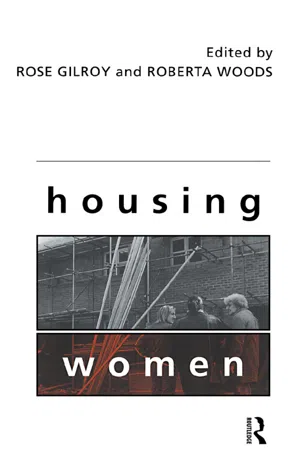
Housing Women
About this book
First Published in 2004. This edited collection presents a comprehensive examination of women's relationship to housing as consumers of housing services and managers of those services. While much of the literature has portrayed women as passive recipients of housing services, Housing Women shows the very active role women have played in housing protest movements and in managerial roles. Diverse strands of women's housing experiences are drawn together in discussion of key issues such as the meaning of 'home', access and participation, and educational, training and employment issues. The housing concerns of specific groups are looked at in detail. Throughout, the book is forward looking, considering the possibility of new housing forms which could challenge gender assumptions and be more attractive and useful for women. The contributors make policy recommendations necessary to the creation of affordable housing and employing and training agencies to ensure better equal opportunity policies. Presenting the work of leading researchers and practitioners in the field, this important volume will be of interest to students of women's studies and housing as well as to practitioners working in housing associations and networks.
Chapter 1
Introduction
Roberta Woods
The idea for this book arose out of a conference held at the University of Newcastle upon Tyne in 1991 to explore current issues for women in the delivery and management of housing services. It was the view of the conference organisers that the conference would explore an agenda that was relevant to the 1990s. It was also the intention that the papers delivered at the conference would present, as far as possible, a holistic view of women’s housing concerns. The conference was divided into three parts to consider women as consumers, providers and protesters of housing services. This gave participants an opportunity to consider how women access a range of housing tenures; innovative housing designs; the ways in which various groups of women have different experiences of housing; how appropriate housing education is for women; career prospects within housing management, and the role that women play in campaigning for better housing.
This book draws on the themes that were identified at the conference and thus includes chapters which address the wide-ranging nature of women’s housing issues. There is, however, another reason for this broad-based approach. Both the editors are actively involved in housing education and are thus acutely aware of the need to produce a textbook which will seek to introduce students to several key issues in housing for women.
Since 1980 a number of publications have sought to address the issue of gender inequality in the housing market. This seems to have become a particularly crucial issue during the 1980s, given the thrust of government policy towards support for owner occupation with a residual ‘social’ or ‘independent’ sector to accommodate those not able to purchase on the open market.
Literature on this subject to date has considered issues which disadvantage women in gaining access to owner occupation (Shelter Briefing, 1987; Brion, 1987). But it has gone further to outline aspects of policy which undermine women’s needs or, at a more theoretical level, has sought to examine the role of housing form in reproducing stereotyped gender roles and the dominance of the nuclear family (see Watson, 1986, 1988; for a different perspective see Saunders and Williams, 1988; and Saunders, 1989).
Within the literature much attention has been given to the structural disadvantages that women face and which place them in a weak position with regard to the provision of housing. Empirical evidence on women’s actual experience of housing and how this relates to housing management practice is rare. The literature focuses on the barriers to owner occupation and difficulties faced in gaining access to council housing.
Income differentials between the sexes are seen as particularly important in limiting access to owner occupation (Morris and Winn, 1990; Brion, 1987). Morris and Winn also suggest that it is the lack of a male breadwinner which appears to be the crucial factor in restricting access. Policies of lending agencies which might discriminate directly against women have also been highlighted (Watson, 1988; Equal Opportunities Commission, 1978). However, direct discrimination by, for example, treating women’s earnings differently to those of men, or not treating women seriously when they apply for a mortgage, has been challenged by Glithero (1986). Improvements in the situation with regard to mortgage lending have been noted by the Nationwide Anglia Building Society (1989).
In respect of council housing, attention has focused on housing allocations policies which might discriminate against women (Kelly, 1986; Brailey, 1985); for example, a lack of sensitivity about offering dwellings in close proximity to previous violent partners, or ignoring the needs of single women without dependent children. The particular problems faced by women following relationship breakdown have been documented by Logan (1986) and the Institute of Housing and the Scottish Homeless Group. Problems can vary from local authorities requiring proof of separation before rehousing to the type and unsuitability of the housing offered. This may on a temporary basis include being placed in bed and breakfast accommodation which Conway (1988) has shown to be particularly unsuitable for families and a cause of ill health. Given the difficulties which women may face with regard to housing on the breakdown of a relationship, a number of women become homeless or apply to local authorities to be rehoused under the homeless persons legislation (Brailey, 1985; Watson and Austerberry, 1986; Logan, 1986; Morris and Winn, 1990).
Much of the women and housing literature broadens into the debate within urban geography to consider the relationship between gender roles and the form of the built environment. Of importance here are planning policies, architecture and design (Bowlby et al., 1982; Little et al., 1988). These studies reflect upon safety and design and architectural impediments to supportive living such as nuclear family housing or deck access high rise. Danger for women is linked to underground walkways and car parks, poor lighting and excessive shrubbery. These point to more theoretical questions relating to gender divisions of space (McDowell, 1983) or the ways in which the home, location and environment curtail or enhance women’s choice (MacKenzie and Rose, 1983).
It is also the case that literature has addressed the differing housing needs or different experiences of housing services of young women (National Council for One Parent Families, 1989), elderly women (Darke, 1987) and Black women (Rao, 1990).
Sexty (1990) examines the economic and social constraints which place women in a disadvantaged position in the labour market and examines the effects of privatisation in housing. Data from the General Household Survey are presented showing that single, widowed and divorced or separated women are more likely to be council tenants and less likely to be home owners than their male counterparts. Similar under-representation in owner occupation among single females was noted by Munro and Smith (1989) using data from the National Child Development Study. Such information suggests that council housing is particularly important for women. How this housing is allocated to them is, then, a significant issue. More recently Muir and Ross (1993) have examined the particular problems that women face in accessing housing in London.
The literature, while addressing a wide range of issues with regard to women and housing, has focused on economic constraints, weaknesses in the law relating to family breakdown, inadequacies in homeless persons legislation, general problems of allocation systems and latterly to the concentration of women in the public sector.
This book seeks to build upon the current literature briefly outlined here and to draw together the diverse strands of women’s housing experiences. The first four chapters consider the general themes of access, participation and the meaning of home. Chapters 5–8 address the housing concerns of specific groups of women. Chapters 9 and 10 look at education, training and employment issues. Chapters 11 and 12 present innovative housing designs. General conclusions are contained in Chapter 13.
Jane Darke, in Chapter 2, considers the meaning of home. Criticising Saunders’ assertion (1990) that the meaning of home as a nurturing and safe haven is the same for men and women, she argues that women value their homes in a particular, contradictory, way. Women contribute much greater time and energy to housework than men. Although most women experience this domestic role as burdensome, it is difficult to relinquish because of women’s strong identification with the home: ‘the sense of exploitation can coexist with pride at performing at least some aspects of the role well’ (this volume, p. 23). This mixture of love and resentment, Darke suggests, is common to most women. There is no false consciousness in women feeling pride and pleasure in housework, and indeed many women are denied this by financial pressure to go out to work. In the same way, male violence and bad housing mean that many women are denied the experience of home that others enjoy.
Rose Gilroy (Chapter 3) considers women’s access to housing, establishing that women find it difficult to become owner occupiers without a male partner. Most women are unable to win this ‘mark of success’ on their own even if they are economically active: they must find their prince before they can get their palace. Using data from a study by McCarthy and Simpson (1991), Gilroy observes that upon divorce among owner occupiers, custodial fathers have greater staying power in the tenure compared with custodial mothers, who are more likely to end up renting. This finding is linked to women’s poorer wages and limited access to full-time waged work given caring and domestic responsibilities. She also suggests that women caring for dependants in owner occupation are less likely to inherit property in the future because of pressure to release equity to pay for formal care. Problems of debt too— both mortgage and rent arrears—may be affecting women disproportionately. This problem is made worse by many women having to buy or rent housing with greater maintenance and running costs, further compounded by women’s lack of DIY skills. Gilroy concludes that, if women are to be helped into owner occupation, more funding is needed for equity share and mortgage rescue schemes. However, women will always need the option of responsibly managed, quality and affordable rented property.
Women and tenant participation is the subject of the chapter by Hood and Woods (Chapter 4). Although women are not well represented among housing decision-makers, they are often very active in tenants’ associations. The council tenant’s right to be consulted was made law by the 1980 Housing Act. By the late 1980s over two-fifths of local authorities had formal methods for involving tenants in decisions, while four-fifths had informal methods. In giving tenants a right to opt for an alternative landlord (a right, incidentally, that few tenants wanted), the 1988 Housing Act was a strong stimulus for local authorities to develop tenant participation within a ‘customer care’ framework, encouraged further by the Citizen’s Charter. However, in reality tenants’ influence over decisions remains weak. Tenants, for example, have no rights to be consulted about rents or other financial matters. Hood and Woods suggest that this will remain the case until tenants can make a collective input to decisions, with their representatives having negotiation rights. This degree of involvement has to be supported by landlords, with tenants’ confidence being built up within a culture of participation. It is often women who get together first, but they face particular problems. Among these are childcare and dealing with intimidating and bureaucratic procedures. As a result, men often end up leading the groups.
Roger Sykes (Chapter 5) considers the position of older women, a large and growing part of the population, many of whom are living alone. It is estimated that over 1.3 million older people are living in poor housing conditions in urgent need of assistance. Most of these people are women. Despite recent promotion of the ‘Woopie’ (well-off older person) concept, only about 20 per cent of the older population could be considered to be comfortably off; 40 per cent are poor and extremely disadvantaged. Older women are much less likely to have occupational pensions; those who have receive markedly less, and older women are likely to have lower savings. Older women are more likely to suffer disabilities than older men, as well as loneliness and social isolation. Roger Sykes reminds us that around 90 per cent of older people live in general housing, with only 10 per cent in sheltered housing, residential or nursing homes. However, old age, disability and poverty often make desirable a move out of general housing into manageable, affordable accommodation, possibly with care. Reviewing older people’s housing options, he describes in detail the range of provision developed by the housing association Anchor, England’s largest provider of housing with care. Affordable sheltered housing, locally available, together with an option to access ‘Staying Put’ or ‘Care and Repair’ services, if these are what is needed to stay in general housing, are particularly important components of a housing policy for older people.
Perminder Dhillon-Kashyap considers the housing needs of Black women in Chapter 6. Black women are as diverse a group as any other but have in common experiences of racism and sexism. Discrimination in owner occupation, private renting and council renting is a long-established and widespread experience. This discrimination is associated with racist propaganda and racist attacks, as evidenced in the September 1993 local election victory for the British National Party on the Isle of Dogs. Women are particularly affected by concerns about their personal safety on the streets as well as in their homes. Escaping domestic violence can mean deportation if this entails breaking the ‘12-month rule’. Checks on the immigration status of Black people by housing authorities mean that many are being required to prove their entitlement to services. These issues add to the housing problems caused by higher unemployment among Black people. Homelessness or domestic violence is often more difficult for Black women, who face discrimination, a lack of awareness about their rights and a lack of support. Most metropolitan housing authorities fail to maintain monitoring systems, despite continuing evidence of discrimination in accessing council housing.
Douglas and Gilroy (Chapter 7) show how the emphasis of housing and social security policy on the nuclear family has disadvantaged young people, making them vulnerable to homelessness caused by poverty and relationship problems which, in the case of young women especially, is largely hidden. Few young people who are not parents receive priority status under Britain’s homeless legislation; it is also difficult for many young people to find work, social security rules discriminate against them, and a combination of low wages and benefit tapers traps many in poverty. In theory, the 1989 Children Act should improve this situation, but the authors found no evidence of this from their work in the north east of England. Homelessness among young women is less public than among men, typically arises from relationship problems and is ‘solved’ through private channels. Pregnant young women under 18 are particularly vulnerable because they are denied Income Support until within 11 weeks of having the baby. Douglas and Gilroy discuss some housing initiatives in Newcastle upon Tyne designed to respond to these problems, including the ‘First Move’ scheme which provides supported furnished accommodation for young people.
Smailes (Chapter 8) returns to a critique of the dominance of ‘families’ in housing policy, this time showing how lesbians’ needs are either ignored or suppressed. Lesbians face discrimination and harassment, leading to particular problems of rejection by relations, and problems in sheltered housing, residential homes and hostels. Lesbian relationships are not recognised in law, denying succession rights, for example, and fears about lack of confidentiality mean that their needs remain invisible. A recent National Federation of Housing Associations survey revealed that, while two-fifths of housing associations targeted lesbians and gay men in their policies, few actually monitor lettings and job applications. Smailes found from discussion with lesbian women that their choice is for women-only housing and to live in areas with other lesbians.
Equal opportunities in education and training for housing is discussed in Brion’s chapter (9). Many women are employed in housing services but few are to be found among the senior posts. Although there is evidence that this is changing, it may actually reflect achievements during the 1980s that have not continued in the 1990s. Brion argues that men’s dominance in senior housing posts reflects male power in education and training, particularly in building-related areas, reinforcing the idea that leadership, management and technical subjects belong to men. Equal opportunities policies often fail to address the aspects of behaviour and curriculum content which perpetuate the subordination of women. Monitoring is often weak and performance indicators are often not used. Brion sets out a checklist which can be used by employers seeking training and which promotes equal opportunities. This includes such checks as whether the training institution provides guidance and training to staff about non-discriminatory practice, and whether men and women are encouraged to contribute equally to class discussion, including sensitive discussion of issues of unequal participation. Within the Institute of Housing (IOH), the equal opportunities working group has brought about significant changes with, for example, the Institute committed to 50 per cent of its members of council being women by the year 2000. The part-time route to IOH qualifications has been retained on equal opportunity grounds.
In 1992 there were only 16 women chief housing officers in England and Wales. This, however, was six more than Coatham and Hale found in 1989 when they interviewed women in these positions. In their chapter (10), they point out that the critical career years for achieving management responsibilities are when women experience their most demanding family commitments. The literature suggests that among the factors associated with women getting to the top are having a mentor, being childless or divorced, minimising career breaks, an urban base and hard work. Coatham and Hale found that women chief housing officers had also made definite decisions to achieve their positions, and had made remarkable progress on the way. The support of both parents appeared to be influential, as appeared to be being the eldest child ‘exercising power in the home’. Organised domestic arrangements seem to be critical, although ‘there are few women prepared to trail blaze to the top with children’. Long working day...
Table of contents
- Cover Page
- Title Page
- Copyright Page
- Illustrations
- Contributors
- Chapter 1: Introduction
- Chapter 2: Women and the meaning of home
- Chapter 3: Women and owner occupation in Britain
- Chapter 4: Women and participation
- Chapter 5: Older women and housing— prospects for the 1990s
- Chapter 6: Black women and housing
- Chapter 7: Young women and homelessness
- Chapter 8: ‘The struggle has never been simply about bricks and mortar’
- Chapter 9: Snakes or ladders?
- Chapter 10: Women achievers in housing
- Chapter 11: Questioning the American dream
- Chapter 12: Innovative housing in the UK and Europe
- Chapter 13: An agenda for action
Trusted by 375,005 students
Access to over 1.5 million titles for a fair monthly price.
Study more efficiently using our study tools.
Frequently asked questions
Yes, you can cancel anytime from the Subscription tab in your account settings on the Perlego website. Your subscription will stay active until the end of your current billing period. Learn how to cancel your subscription
No, books cannot be downloaded as external files, such as PDFs, for use outside of Perlego. However, you can download books within the Perlego app for offline reading on mobile or tablet. Learn how to download books offline
Perlego offers two plans: Essential and Complete
- Essential is ideal for learners and professionals who enjoy exploring a wide range of subjects. Access the Essential Library with 800,000+ trusted titles and best-sellers across business, personal growth, and the humanities. Includes unlimited reading time and Standard Read Aloud voice.
- Complete: Perfect for advanced learners and researchers needing full, unrestricted access. Unlock 1.5M+ books across hundreds of subjects, including academic and specialized titles. The Complete Plan also includes advanced features like Premium Read Aloud and Research Assistant.
We are an online textbook subscription service, where you can get access to an entire online library for less than the price of a single book per month. With over 1.5 million books across 990+ topics, we’ve got you covered! Learn about our mission
Look out for the read-aloud symbol on your next book to see if you can listen to it. The read-aloud tool reads text aloud for you, highlighting the text as it is being read. You can pause it, speed it up and slow it down. Learn more about Read Aloud
Yes! You can use the Perlego app on both iOS and Android devices to read anytime, anywhere — even offline. Perfect for commutes or when you’re on the go.
Please note we cannot support devices running on iOS 13 and Android 7 or earlier. Learn more about using the app
Please note we cannot support devices running on iOS 13 and Android 7 or earlier. Learn more about using the app
Yes, you can access Housing Women by Rose Gilroy,Roberta Woods in PDF and/or ePUB format, as well as other popular books in Social Sciences & Geography. We have over 1.5 million books available in our catalogue for you to explore.