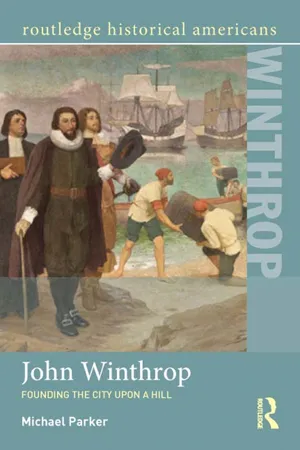
Puritan politician, lawyer, and lay theologian John Winthrop fled England in 1630 when it looked like Charles I had successfully blocked all hopes of passing Puritan-inspired reforms in Parliament. Leading a migration, he came to New England in the hopes of creating an ideal Puritan community and eventually became the governor of Massachusetts. Winthrop is remembered for his role in the Puritan migration to the colonies and for delivering what is probably the most famous lay sermon in American history, "A Model of Christian Charity." In it he proclaimed that New England would be "a city upon a hill"--an example for future colonies.
In John Winthrop: Founding the City upon a Hill, Michael Parker examines the political and religious history of this iconic figure. In this short biography, bolstered by letters, sermons, and maps, John Winthrop introduces students to the colonial world, the Pequot Wars, and the history of American Exceptionalism.
- 212 pages
- English
- ePUB (mobile friendly)
- Available on iOS & Android
eBook - ePub
About this book
Information
PART I
JOHN WINTHROP
CHAPTER 1
THE WINTHROPS OF GROTON MANOR
In the spring of 1630 four small wooden ships carrying about 700 passengers made their way through bitter cold and often-tempestuous North Atlantic seas to the New World. Fleeing the oppressive religious and political policies of England’s King Charles I and Bishop William Laud, as well as economic depression, these determined refugees sought freedom and prosperity in a land styled not long before as “New England.” They were an important part of what became known as the Great Migration, an exodus of puritans from England that took place principally between Charles I’s dismissal of Parliament in 1629 and the beginnings of the Puritan Revolution in 1640. The flagship of this little fleet was dubbed the Arbella after Lady Arbella, who was a passenger on board.
Also on board the Arbella was John Winthrop, the governor of the new colony. Sometime shortly before this voyage or possibly during it, he gave the most famous lay sermon in American history, “A Model of Christian Charity,” which has never ceased to intrigue and often inspire those who have come after. A forty-two-year-old lawyer and member of the English country gentry, Winthrop was an imposing but likable figure. He had a handsome if somber face, with the distinctive long nose of the Winthrop family, stylish long hair, and a carefully cropped beard. In his portrait, possibly completed in 1629, he held a satin glove in his left hand and wore the dark coat and broad neck ruff and cuffs of a gentleman, and his arched eyebrows and level gaze projected the confidence of his class (see portrait, Document 1). Born in 1588, the year of the Spanish Armada, Winthrop spent his youth in the last glittering years of the Elizabethan Age when the exploits of Drake, Raleigh, and Hawkins were the common talk of tavern rooms and palace halls; and the literature of Spenser, Marlowe, and Shakespeare was first heard abroad in the land. But Winthrop was not essentially an Elizabethan. The age of Queen Elizabeth Regina Gloriana, for all its apparent triumphs, was largely one of unconsummated exploration and state-sanctioned piracy while that of the early Stuart kings in seventeenth-century England, for all its staggering failures, was one of successful colonization. Winthrop, sometimes styled the puritan Moses, would help to organize and lead what was one of the most positive and far-reaching achievements of the era: the founding of the Massachusetts Bay Colony.
Winthrop lived during the height of the puritan age in England. The colony he led was essentially a puritan enterprise, which cannot be rightly understood aside from its religious wellsprings. In severing the Church of England from the Roman Catholic Church in the 1530s, Henry VIII set England on a course toward the Protestant religion. Though Henry dissolved the monasteries and made himself the Supreme Head of the Church of England, the church under him retained much of its Catholic heritage. It was only with the accession of his son Edward VI that the Reformation came to England in earnest. Edward, however, ruled only for a short period, 1547 to 1553, and was followed by his Catholic half-sister Mary, who reintroduced Catholicism to the island. The burning of a large number of Protestants as heretics during her reign earned her the epitaph “Bloody Mary” and gained for the Protestant cause in England the aura of martyrdom. When Mary died in 1558, an exultant nation elevated her Protestant half-sister Elizabeth to the throne. The Parliament of 1559 and the Convocation of 1563 established the Church of England as an independent and Protestant church with the queen as its Supreme Governor. The Elizabethan Settlement of religion, while preserving much of the liturgy, ornamentation, and polity of the Catholic past, embraced the theology of the continental Reformation. This unlikely mix of the old and the new succeeded in satisfying those in the broad middle range of religious opinion in England but left the fringes profoundly disgruntled.
Puritanism in England began in the 1560s as a reaction to the religious via media (middle way) established in the early years of the Elizabethan era. The attempt to find a middle position between the medieval traditionalism of Rome and the Calvinist radicalism of Geneva would never be satisfying to those who yearned to make England a holy community. They saw the Elizabethan Settlement as an incomplete reformation. At first derided as precisionists and later as puritans, these passionate and uncompromising Christians sought to purify the Church of England of its Romanish encrustations. They especially loathed ecclesiastical government by a hierarchy of priests and bishops headed by the queen, and the continuance of liturgical traditions that implied continuity with England’s Catholic past. Rejecting tradition, they favored, instead, a new church based solely on the Scriptures where the word would be purely preached and the saints allowed to organize themselves after the pattern of the apostolic church as they understood it. Though it began as a reform movement within the Church of England, puritanism quickly became much more than that. Repressed by Elizabeth I, harried by James I, and thwarted by Charles I, the puritan movement exploded into revolution in the early 1640s, advanced to regicide in 1649, matriculated to a tyranny of the saints in the 1650s, and then collapsed in dismal failure with the restoration of the status quo ante in 1660. In the era of the Restoration, John Milton wrote of a “paradise lost,” and John Bunyan depicted in The Pilgrim’s Progress the life of Christians as one of constant struggle and inevitable persecution. But in New England, under the leadership of John Winthrop, the puritan dream took root and flourished, leaving an enduring impression on the nascent American soul.
* * *
Winthrop lived most of his first forty-two years in Groton, Suffolk County, in the southeast of England. The people of Suffolk together with those of six other counties—Norfolk, Essex, Hertfordshire, Cambridgeshire, Hunting-donshire, and Lincolnshire—made up the bulk of the English puritans who settled in Massachusetts. The transplanted place names in New England can usually be traced to these counties of Southeastern England: county names like Suffolk, Essex, and Norfolk; and town and city names like Boston, Dedham, and Ipswich to name a few. The educated elite of New England largely hailed from East Anglia (the counties of Suffolk and Norfolk) and the surrounding eastern counties, and the majority had attended one of three Cambridge colleges: Emmanuel, Magdalen, or Trinity.
There were many little fishing villages along the coast where the dampness was known to cause “agues” (fevers), a problem that extended as far inland as Groton. The green rolling countryside of the interior was used for either farming or, where the land was not as rich, for grazing sheep and cattle. The English spoke proverbially of three Suffolk features: “Suffolk stiles,” referring to Suffolk’s early enclosure of common land; “Suffolk milk,” for Suffolk sent more butter and milk to London than any other county; and “Suffolk fair maids,” which needs no explanation. The county had its share of the great estates of the squires and noblemen but was mostly made up of small family farms of a score or more acres of land. Yeoman farmers (freemen who owned their own farms) primarily engaged in dairy farming, and to a lesser extent they might also have bred horses and kept pigs, poultry, and sheep. The major crops were barley, rye, and wheat. But farmers would also grow small amounts of oats, peas, vetches, hops, and hemp. East Anglia was also a center of the textile industry. During slack times, such as the cold winter months when there was little to be done on a farm, the yeoman and their families would engage in the making of yarn for the cloth-making industry, a major part-time source of income for those in the southern half of Suffolk. This simple agrarian society, with its traditions of deference and its natural rhythms and beauty, was the milieu of Winthrop’s youth and much of his early manhood.
Due to interruptions in the wool trade during England’s wars against Spain and France in the 1620s, the region experienced an economic depression during much of the decade. But aside from its economic woes, East Anglia would still have been the fitting and certainly predictable center point of the puritan emigration movement to New England. It had a long history of rebellions in the Middle Ages, and as recently as 1549 in the reign of Edward VI it had been the scene of Ket’s Rebellion. Amidst the uncertainties of the English Reformation, the East Anglians had been avid supporters of Protestantism, and during the reign of Catholic Queen Mary, 225 of the 273 Protestants burned at the stake (known as Marian martyrs) were from this region. Finally, under Elizabeth and the first two Stuarts, East Anglia waxed ever more restive as the stronghold of the puritan movement.
* * *
The Winthrops of Suffolk County first rose to prominence in the sixteenth century. During this time there were three generations of Adam Winthrops. Little is known of the first of them except his name, that he was married to Joane (or Jane) Burton, and that he produced a son of the same name who became the founder of the Winthrop dynasty. This second Adam Winthrop was born 9 October 1498 in the town of Lavenham (pronounced Lannam), Suffolk County. After moving to London and completing an apprenticeship as a clothier, he applied himself to his trade with apparent success. The court books of the Clothworker’s Company of London reveal his steady upward mobility. In 1537 he was a steward, in 1544 a quarter-warden, in 1545 an upper-warden, and in 1551 a master of the company. More than merely a craftsman, Adam was involved in the continental wool trade as an exporter. Adam’s business success made possible a rise in social status that he realized in 1544 upon purchasing Groton Manor in Suffolk County. A modest estate, it no doubt derives its name from the Old English Groten-ea or “sandy stream,” referring to the nearby River Box. By acquiring the Groton estate, he became “Lord of the Manor.” It allowed him, four years later, to obtain the rank of gentleman and be granted a coat of arms.
In addition to the manor’s surrounding land, the estate also included tenement land in Boxford and Edwardstone and the rectory of St. Barthomew’s Church, which lies about a half mile from Groton Place. As “Patron of the Church,” Adam had the right to name the rector of the church, a privilege he first used in 1546 when he appointed his stepbrother, Roger Ponder, to the position. The church still exists, a sturdy Gothic structure of gray flint, imposing but amiable against the surrounding fields of green. Hard by the church stands Groton Hall, an unassuming Elizabethan house that served the church’s landed endowment and was used to hold the manorial courts.
* * *
The third Adam Winthrop, the father of John Winthrop, married Alice Still in 1574, but she died two years later. Adam married again in 1579. His new wife was Anne Browne, the daughter of Henry Browne, a minister in nearby Edwardstone. Around 1580, the couple moved to Edwardstone to live in Browne’s house, which he had recently vacated. They produced their first child, Anne, in 1581, but she lived only fifteen days. Happily they had four more children. The first of these was born in 1586 and was also named Anne. Two years later, on 12 January 1588, Adam and Anne produced their third child, John Winthrop. The couple had two more children: Jane in 1592 and Lucy in 1601.
Because Adam had two older brothers, William and John, he must have realized that it was unlikely that he would ever come into possession of Groton Manor. When the second Adam died in 1562, John became lord of Groton Manor, and William inherited his father’s London house. The young Adam had to find employment to sustain himself and maintain his social status. Consequently, he decided to study law, was admitted to the Inner Temple in 1574, and in 1584 became a barrister. He practiced law in London but continued to live in Edwardstone. In 1594, Adam’s brother John obtained a license of alienation, which gave him the right to sell the Groton estate and thereby disinherit his brother and entangle the estate for his nephew. But John did not exercise this right. Instead, Adam and his family moved from Edwardstone to Groton, with Adam acting as the steward of the estate. Later he succeeded in purchasing the Groton estate for his son, John. From the time of his move to Groton until his death nearly three decades later, Adam lived at Groton Hall, enjoying the life of a country squire.
* * *
John Winthrop could only have had fleeting memories of the home in Edwardstone where he was born and spent his earliest childhood. When he was seven or eight the family moved to Groton Hall. The new house, the center of his expanding world, was alive with the activities of four siblings, busy servants, and the comings and goings of extended family and local gentry. And as John grew older, he ventured beyond the manor lands into the nearby fields, green rolling hills, fertile valleys, and thick woods of Suffolk County.
In 1595, John’s father sent him to John Chaplin, a local vicar, for schooling. John was seven years old then, the usual age in which a child would begin grammar school. It was common for the sons of the aristocracy and gentry to receive private tutoring, but John may not have studied alone, for Chaplin may have taken on more than one student at a time to supplement his income. It is probable that, at some later point, John attended the Free Grammar School at Boxford a few miles away.
Prior to commencing grammar school, students were to have already mastered elementary reading, writing, arithmetic, and the Short Catechism in English. In this way students learned to read English at the same time that they learned the Ten Commandments, the Lord’s Prayer, the Creed, and the broad outlines of the Anglican faith.
Grammar school education consisted of learning the Latin language and classical literature as well as grammar, rhetoric, and logic. Religion also played an important part. There were daily prayers at the school, and at the weekly worship services, John would have had a steady dose of the Bible, the Book of Common Prayer, didactic sermons, and the singing of the Psalms. It is clear from Winthrop’s later writings that all of this made at least some impression. In 1637 when Winthrop was forty-nine years old and living in New England, he wrote a brief spiritual account of his life, Christian Experience, chronicling his Christian journey from early youth to his contemporary experience and providing the only account we have of his childhood. He said of his early youth, “I was very lewdly disposed, inclining unto and attempting (so far as my years enabled me) all kind of wickedness, except swearing and scorning religion, which I had no temptation unto in regard of my education.”1 This, of course, should not be taken at face value. It is unlikely that John was more lewd, wicked, or undisciplined than most small boys, and his assessment must be judged in the light of his later puritan sensibilities.
* * *
In March 1603, the fifteen-year-old John left home to begin his career as a student at Trinity College, Cambridge. He arrived at Trinity College while it was in the midst of the great building campaign of Thomas Neville, master of Trinity from 1593 to 1615, who was responsible for the construction of the Cloisters, the Great Court, library, kitchen, fountain, and Hall. At this time Trinity was attracting the sons of the country gentry and urban lawyers, and thereby helping to educate the ruling class of the new era. John’s initial reaction to Trinity was not good. He said of himself, “I fell into a lingering fever, which took away the comfort of my life. For being there neglected and despised, I went up and down mourning with myself; and being deprived of my youthful joys, I betook myself to God …”2 The fever and a serious bout of homesickness succeeded at least in driving John to God, but when he had recovered, he soon settled into his former ways, allowing God to recede into the background.
John stayed at Trinity College for less than two years, ending his college career before the end of 1604. Winthrop wrote very little about his Cambridge period, and therefore what impression it may have made on him is unclear. He says of this time that his sinful tendency was checked by his natural conscience and that he observed ordinary duties yet “cared for nothing but how to satisfy my voluptuous heart.”3 Clearly John was not yet a puritan, and he does not even say that he had discovered puritanism during his college days, which could have been likely, for Cambridge at this time was a hotbed of puritanism.
* * *
Early in 1605, at the age of seventeen, John’s youth came to an abrupt end when he consented to be wed to Mary Forth of Great Stambridge, Essex County. It was usual for families to arrange marriages at this time, there being many property and status issues to consider. But potential mates could not be forced to ma...
Table of contents
- Cover
- Half Title
- Title Page
- Copyright Page
- Dedication
- Table of Contents
- Preface
- PART I: John Winthrop
- PART II: Documents
- Selected Bibliography
- Index
Trusted by 375,005 students
Access to over 1.5 million titles for a fair monthly price.
Study more efficiently using our study tools.
Frequently asked questions
Yes, you can cancel anytime from the Subscription tab in your account settings on the Perlego website. Your subscription will stay active until the end of your current billing period. Learn how to cancel your subscription
No, books cannot be downloaded as external files, such as PDFs, for use outside of Perlego. However, you can download books within the Perlego app for offline reading on mobile or tablet. Learn how to download books offline
Perlego offers two plans: Essential and Complete
- Essential is ideal for learners and professionals who enjoy exploring a wide range of subjects. Access the Essential Library with 800,000+ trusted titles and best-sellers across business, personal growth, and the humanities. Includes unlimited reading time and Standard Read Aloud voice.
- Complete: Perfect for advanced learners and researchers needing full, unrestricted access. Unlock 1.5M+ books across hundreds of subjects, including academic and specialized titles. The Complete Plan also includes advanced features like Premium Read Aloud and Research Assistant.
We are an online textbook subscription service, where you can get access to an entire online library for less than the price of a single book per month. With over 1.5 million books across 990+ topics, we’ve got you covered! Learn about our mission
Look out for the read-aloud symbol on your next book to see if you can listen to it. The read-aloud tool reads text aloud for you, highlighting the text as it is being read. You can pause it, speed it up and slow it down. Learn more about Read Aloud
Yes! You can use the Perlego app on both iOS and Android devices to read anytime, anywhere — even offline. Perfect for commutes or when you’re on the go.
Please note we cannot support devices running on iOS 13 and Android 7 or earlier. Learn more about using the app
Please note we cannot support devices running on iOS 13 and Android 7 or earlier. Learn more about using the app
Yes, you can access John Winthrop by Michael Parker in PDF and/or ePUB format, as well as other popular books in Storia & Primordi della storia americana. We have over 1.5 million books available in our catalogue for you to explore.