Economy and Society is a major landmark in the recent emergence of economic sociology. Robert J. Holton provides a major new synthesis of social scientific thinking on the inter-relationship between economy and society arguing for the importance of politics and culture to the functioning of the economy and drawing on the strengths but avoiding the weaknesses of economic liberalism and political economy.
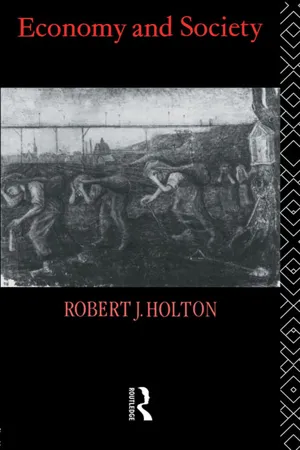
- 304 pages
- English
- ePUB (mobile friendly)
- Available on iOS & Android
eBook - ePub
Economy and Society
About this book
Information
Introduction
Economic issues are a major concern for contemporary individuals, households, communities and governments. Economic growth and decline, wealth and poverty, employment and unemployment, productivity and inefficiency, freedom of choice and inequalities of economic power - these represent some of the most pressing reference points by which the welfare of individuals, households, communities and governments are judged. While there are major differences concerning the priority that should be accorded economic matters, no-one can ignore their importance in modern life without being branded a hopeless utopian.
For large portions of the world's population in the Third World, economic issues are a matter of immediate material survival, of life and death. Even in the Western world, where material survival is, for most, more secure, economic issues dominate the agenda for everyday life and political debate. Rich and poor are inextricably implicated in economic life, even though their life-chances differ considerably through inequalities in control over economic resources.
Beyond the material struggles and exigencies of everyday life, economic questions are intimately bound up in the ways we understand the structure and dynamics of social life, and in debates about what kind of economic arrangements best advance human welfare. During the twentieth century these concerns have been expressed in the analysis of capitalism and socialism (or communism) as rival economic systems, and in public policy debates about the relative merits of free markets and public planning. Such debates raise questions about the actual operation of economic institutions such as markets, private property rights in economic resources, public planning agencies, and about the ways such institutions relate and interact with political and cultural institutions. Many questions arise as a result. These include the relative merits of capitalism and socialism, or markets as against welfare states, in generating economic efficiency and a just distribution of economic resources. Key values such as 'freedom', 'justice' and 'equality' are critical yardsticks against which the performance of economic institutions are judged.
Underlying these debates is the spectre of economic development as a dynamic yet destabilising process, that outstrips the capacities of human agencies to control it. The fear of social life being dominated by apparently uncontrollable economic processes has become intensified by the increasing reality of a world economic system. The anxiety is that global economic institutions and processes have become more powerful than either nation-states or social movements seeking to regulate economic life in accordance with individual, or community or national political objectives.
The analysis and debate of economic issues is shared - albeit in different ways - both by those inclined to measure human welfare primarily in material terms such as income and productivity, and by those who believe that economic considerations should be subordinate to 'higher' social values, such as equality, justice and environmental protection. This reminds us that economic analysis is far more than a technical matter, for it raises many of the most important values about which individuals and governments feel most passionately. Economic arrangements will always be matters for evaluation and moral scrutiny.
The present study is. however, not intended to resolve such matters of moral evaluation and political choice. The aim is rather to provide a survey of the principal ways in which economic life may be analysed and understood. Within this survey particular attention is given to the relationship between the economy and other aspects of society, such as the political system and cultural values. This book is centrally concerned with theories of economy and society. Such theories seek to explain how the economy and the wider society interact, how far economic forces determine the shape and fate of society, and how far social forces outside the economy proper in turn influence the course of economic affairs. These general themes are pursued through an analysis of key theories of economic institutions such as markets, property rights in economic resources and systems of production and consumption, together with the cultural meanings and values that have become associated with economic activity.
The importance of economic matters in contemporary society is of course reflected in the emergence of specialised bodies of social scientific thought, associated above all with the rise of economics as a distinct profession. Economists have sought both to understand the functioning of the economy, and to advise individuals and governments on how best to secure their economic welfare. At the same time economists have not succeeded in achieving an effective monopoly of discussion over economic issues. There are two reasons for this.
First, much economics has been highly abstract and mathematical in character focussing on arcane technical issues rather than economic problems as they are perceived in policy-debate and everyday life. Leontief (1985, pp. 29-30) in an analysis of articles in the American Economic Review during the 1970s, reports that 50 per cent were purely mathematical containing no empirical data at all, while 22 per cent contained 'cooked up' data not assembled in a systematic manner. Of the few articles that were based on direct empirical analysis, several concerned laboratory experiments on pigeons and mice, rather than observations of human beings. This state of affairs has left something of a void which other social scientists, including sociologists and political scientists, have sought to fill alongside a minority of economists.
A second reason for the lack of effective monopoly control by economists over economic discussion is the willingness of non-economists to tackle head on the relationship between the economy and the wider society. This includes the interactive relationships between the economy, the political system and broader cultural values and norms. As we shall see in Chapters 4 and 5, these matters have only recently and belatedly been picked up in a systematic manner by mainstream economists, and only through the application of narrowly economic (rational choice) assumptions to social and political life. The present study, written by a sociologist, takes as its premise the failure of mainstream economics to offer more than a partial account of how the economy works. This failure is largely related to a parallel failure to explain the interactive relationship between economy and society, except in excessively narrow ahistorical terms. Another way of putting this is to say that an analysis of the economy and its place in society is too important to be assigned to economists alone.
1 Defining the Economy
A historical, multi-dimensional approach
What is the Economy? Towards a Preliminary Definition
It is easier to produce a check-list of the major components of economic life, as conventionally described, than to get social scientists to agree on a settled definition of what the economy actually is. One such check-list recently suggested by Richard Swedberg (1987, p. 5) is outlined in an expanded and amended form in Table 1.1.
This represents a valuable 'common sense' inventory of institutions and issues commonly regarded as constituting the economy. What it does not indicate is the common quality that

distinguishes this list from the non-economic aspects of society. Put another way, if the economy is to be regarded as a part of a wider whole, what is it that differentiates the economy from that which lies beyond? Is it some common element in the listed set of economic phenomena themselves? Or is it some overarching human need or challenge that all these phenomena seek to satisfy?
Historically, the terms 'economy and 'economic' derive from the ancient Greek terms Oikos and Oikonomia, which refer to a self-provisioning extended household. The oikos sought to satisfy its members' needs by supplying food, clothing, shelter and sociability from within itself with little or no exchange with others. The analysis of household provisioning in this sense is rather foreign to the contemporary check-list of economic phenomena listed in Table 1.1, although it does live on in an attenuated way in notions like home economics concerned with cooking and other forms of domestic management. The tracing of linguistic derivations in this way does not, however, get us anywhere close to modern conceptions of the economy as a distinct part of society with its own purposes or functions, distinct from those of the other parts.
The ancient Greek oikos can be regarded as a base unit of the social system, in which the household was simultaneously an economic, cultural and political institution, and the male householder the foundation of political and patriarchal authority. This type of institution differs from modern conceptions of the economy in two ways. First, it combines a wide range of social functions, including political and cultural affairs alongside economic provisioning. This contrasts with the modern tendency to generate specialised economic institutions. Second, its economic outreach does not include exchange with other households through mechanisms such as barter, markets and so forth. Again this contrasts with modern economic systems of exchange as distinct from self-sufficiency. We must therefore look elsewhere for an answer to the question 'What is the economy?'
The most widely used approach to defining the economy is to identify it with the performance of a specific social function distinct from other non-economic functions. The foremost strategy for defining a specific economic function makes use of the distinction between the 'ends' or 'objectives' of human action on the one hand, and 'the means' used to achieve such 'ends' on the other.
Within this framework, the specifically economic function centres on the means used to satisfy human 'ends' or 'wants', rather than the creation of those wants or ends in themselves. This definition is often elaborated to associate the economy with the satisfaction of material wants, rather than other kinds of wants. This emphasis on the material, however, is hard to sustain since it is difficult to distinguish material wants from other kinds of wants, without making rather arbitrary assumptions. Put more concretely, it seems arbitrary to limit the economic function to the production of basic material necessities such as food, clothing and shelter, to the exclusion of goods and services which reflect social status and which convey symbolic messages about those who possess them. Purchase of a Rolls Royce or a Ferrari is not only a matter of satisfying a material want for transport, but is also implicated in other kinds of wants, including possession of status symbols of success, power and wealth. To sever one kind of want from another seems highly misleading, especially as the definition of what constitutes a basic want or a luxury varies between cultures and across history. For many in the Third World simply owning a car is regarded as a luxury.
If it is not possible to limit the definition of the economy to the means necessary to satisfy purely material wants, it is possible to be more precise about the specific types of material means involved. This is appropriate because the economy cannot be indiscriminately associated with the deployment of any kind of means to reach a given end. If the 'end' in question is religious salvation and the 'means' chosen is 'prayer', the deployment of prayer would not typically be regarded as an "economic activity', unless some subsidiary assumption is made, such as the belief that the level of financial contributions accompanying religious devotion had a bearing on the spiritual outcome. Even then, this hypothetical transaction would not be regarded as a mainstream economic activity unless religious bodies turned the sale of devotional means of salvation into a regular and continuous activity, or unless the majority of supplicants attended church just to participate in the transaction.
The initial definition of economic activity focussing on the deployment of 'means' to realise 'ends', can be made more precise by focussing on land, labour and capital as essentially material means by which the economy operates. Whereas the economy functions by deploying material means to satisfy wants, the remainder of society can be thought of as functioning both to generate and articulate wants, and to deploy means other than land, labour and capital, e.g. prayer, love, friendship, in satisfying them.
Before we proceed any further with this type of functional definition, it must be stressed that reference to 'function' does not imply the invariable success of economic institutions in satisfying wants. To say that the economy functions to satisfy wants using certain types of means should not be taken to imply invariable successful performance of this function. This point requires emphasis in order to avoid the functionalist trap of assuming that wherever economies exist, this must reflect successful performance of economic functions. After all, world history is littered with examples of famine and economic depression, while the much-vaunted economic dynamism of previous world leaders such as seventeenth-century Holland or nineteenth-century Britain no longer perform at the same level as today's vanguard economies in Japan, the USA or Germany.
A leading example of a function-based approach to defining the economy is provided by mainstream or liberal economics. This typically adds a further essential component to the means-end approach to the economy, by positing a chronic scarcity of means by which to realise our ends. In this view it appears we never have enough means to satisfy all our wants simultaneously. Thus economics, the study of the economy focusses, in the words of leading economist Paul Samuelson (1976, p. 3), on 'how people and society end up choosing, with or without the use of money, to employ scarce productive resources that could have alternative uses, to produce various commodities [sic!] and distribute them for consumption now or in the future among various persons and groups' (Samueison's emphasis).
This emphasis on scarcity and choice of means presupposes that we want to get the most from our limited means. As such the definition of the economy approximates to the popular notion of 'economising' or being economical with our resources.
This emphasis on the problem of scarcity and the need for prudent choice has recently received a major boost from the emergence of widespread concern over environmental problems facing the planet Earth. In particular, much stress has been placed on the finite nature of the earth's physical resources, and the consequent need to treat physical resource utilization in the light of the depletion of scarce and often non-renewable resources. This problem of finite environmental resources provides a new dimension to the conventional economistic emphasis on scarcity, by encouraging a cautious and prudent choice of economic techniques with a view to resource conservation. This environmentalist support for 'scarcity'-based definitions of economic activity is a somewhat unexpected one insofar as environmentalists and economists often draw rather different practical conclusions about the scale and dangers of resource depletion. These differences do not, however, undermine the importance of the common focus on problems of choice under conditions of scarcity.
A number of criticisms have been levelled at scarcity-based definitions on the grounds of narrowness of conception, and of limited historical applicability to economic life. Polanyi (1977) and Sahlins (1972) for example argue that many tribal or ancient societies do not possess insatiable appetites or wants, and hence do not suffer from the perception that the resources necessary to satisfy this multiplicity of wants are in scarce supply. Sahlins' discussion of stone-age economics in hunter-gatherer societies is particularly interesting in this respect. On the basis of anthropological evidence drawn from hunter-gatherer groups such as the Kalahari bushmen or Australian Aborigines, he claims that wants in such societies are very simple and the means are generally at hand to satisfy them. This interpretation appears to fly in the face of the perception by members of modern societies that hunter-gatherers live in conditions of extreme destitution, on the precarious margins of subsistence. Sahlins, however, insists on the paradoxical point, that hunter-gatherers, while they have a very low standard of living, may nonetheless feel comfortable with their lives in the sense of not feeling deprived of goods and services that they lack. What looks like abject scarcity to an outsider is experienced in terms of satisfaction by hunter-gatherers able to migrate in search of food and sociability.
This discussion warns us that the formulation 'unlimited wants-scarce means' is very much a product of cultural circumstances rather than a universal feature of human society. For the hunter-gatherer wants are scarce and means often plentiful. The drive to satisfy a multiplicity of wants through scarce means is not, according to Sahlins, a bask component of human nature. 'It is not that hunters and gatherers have curbed their mater...
Table of contents
- Cover Page
- Half Title page
- Title Page
- Copyright Page
- Dedication
- Contents
- List of figures and tables
- Acknowledgements
- Part I
- Part II
- Bibliography
- Name Index
- Subject Index
Trusted by 375,005 students
Access to over 1.5 million titles for a fair monthly price.
Study more efficiently using our study tools.
Frequently asked questions
Yes, you can cancel anytime from the Subscription tab in your account settings on the Perlego website. Your subscription will stay active until the end of your current billing period. Learn how to cancel your subscription
No, books cannot be downloaded as external files, such as PDFs, for use outside of Perlego. However, you can download books within the Perlego app for offline reading on mobile or tablet. Learn how to download books offline
Perlego offers two plans: Essential and Complete
- Essential is ideal for learners and professionals who enjoy exploring a wide range of subjects. Access the Essential Library with 800,000+ trusted titles and best-sellers across business, personal growth, and the humanities. Includes unlimited reading time and Standard Read Aloud voice.
- Complete: Perfect for advanced learners and researchers needing full, unrestricted access. Unlock 1.5M+ books across hundreds of subjects, including academic and specialized titles. The Complete Plan also includes advanced features like Premium Read Aloud and Research Assistant.
We are an online textbook subscription service, where you can get access to an entire online library for less than the price of a single book per month. With over 1.5 million books across 990+ topics, we’ve got you covered! Learn about our mission
Look out for the read-aloud symbol on your next book to see if you can listen to it. The read-aloud tool reads text aloud for you, highlighting the text as it is being read. You can pause it, speed it up and slow it down. Learn more about Read Aloud
Yes! You can use the Perlego app on both iOS and Android devices to read anytime, anywhere — even offline. Perfect for commutes or when you’re on the go.
Please note we cannot support devices running on iOS 13 and Android 7 or earlier. Learn more about using the app
Please note we cannot support devices running on iOS 13 and Android 7 or earlier. Learn more about using the app
Yes, you can access Economy and Society by Robert J. Holton in PDF and/or ePUB format, as well as other popular books in Social Sciences & Political Economy. We have over 1.5 million books available in our catalogue for you to explore.