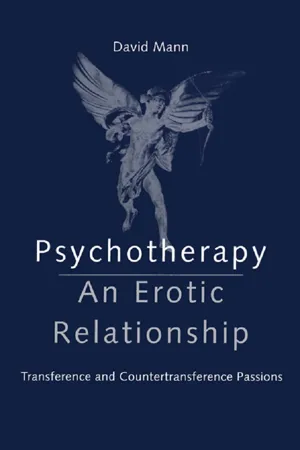
Psychotherapy: An Erotic Relationship challenges the traditional belief that transference and countertransference are merely forms of resistance which jeopardize the therapeutic process. David Mann shows how the erotic feelings and fantasies experienced by clients and therapists can be used to bring about a positive transformation.
Combining extensive clinical material with theoretical insights and new research on infants, the author traces erotic development back to the parent-child relationship, drawing parallels between this relationship and the therapist/client dyad. Individual chapters explore the function of the erotic within the unconscious, pre-Oedipal and Oedipal material, homoeroticism in therapy, sexual intercourse as a metaphor for psychological change, the primal scene and the difficulties of working with perversions.
eBook - ePub
Psychotherapy: An Erotic Relationship
Transference and Countertransference Passions
- 224 pages
- English
- ePUB (mobile friendly)
- Available on iOS & Android
eBook - ePub
About this book
Information
1
The Erotic Transference
She’s all States, and all Princes I,
Nothing else is.
Nothing else is.
(John Donne The Sun Rising)
The erotic is at the heart of unconscious fantasy life. The infant, born from the erotic encounter of the parents, will find his or her1 earliest experiences are enveloped in the pre-Oedipal eroticism of mother and child. As the field of erotic experiences widens, the individual will encounter both wonder and tragedy. Satisfaction of the erotic becomes the most treasured and the most painful of human experiences. By its very nature it is psychically binding.
The erotic is usually understood as sexual desire. However, in early Greek Orphic mythology, Eros is associated with more than sexual arousal: he is described as being the first of the gods; without him none of the rest could have been born. He is hatched from an egg and sets the universe in motion. In some traditions, he is equated with the sun. Eros created life on earth, piercing the barren world with his life-giving arrows and where the earth was pierced luxuriant greenery appeared. He breathed into the nostrils of clay forms of men and women giving them the spirit of life. Eros, the erotic, is thus about creativity. In later versions of the myth, Eros is depicted as the son of Aphrodite. It is not until another son is born, Anteros the god of passion, that Eros can grow up. He flies about on golden wings shooting his arrows at random, setting hearts on fire. In even later versions of the myth, he falls in love with Psyche, who became the personification of the soul. Eros was never considered sufficiently responsible to rank among the ruling Olympian family of gods.
The erotic is the very creative stuff of life and is inextricably linked to passion. It is a maverick, capable of the unexpected, and is the therapeutic momentum in analysis. The issue is one of passion, an intensity of feeling with no easy resolution; but out of the heat of passion old links are weakened and new links can be forged. Passion of all kinds dominate the analytic setting: hate, anger, aggression, envy—and hardly less so, love and the erotic. However, the erotic transference, like Eros himself, has been left to the mar gins of analysis, never quite making it to the acceptable family of ideas in psychoanalytic theory and practice.
The Erotic and Metaphor
Before proceeding further, some clarification of terms needs to be attempted. The subject matter under discussion, the erotic, is such an emotive and passionate area of human life, I doubt that a clear, watertight and agreeable definition of the term is possible, nor will one be attempted here. This is true in ordinary life. How much more difficult the task becomes in the analytic setting and in psychoanalytic writing which attempts to be objective. Having immersed myself in the analytic literature, I have discovered that one obvious theme emerges: there are no reliable, objective reports on this important subject. What we have are subjective experiences out of which various investigators try to make sense—this book being no exception. It is, I consider, an extremely positive process so long as we do not lose sight of the subjective nature of our thinking.
Therefore, I do not propose a tight definition of ‘erotic’. Quite the contrary, I will keep my terms loose, even unclear, to allow a wide range of material to be considered in the clinical transference and countertransference. I do not believe that a term like ‘erotic’ or ‘love’ can be precisely defined; nor do I think any single definition will produce a unified agreement.
There is no detached stance to the erotic, since it permeates psychological activity and is a basic human quality. Thus the individual cannot stand beyond it to gain an objective perspective on what it really is. The only perspective is one that works its way through the erotic. This very procedure is in itself an expression of the erotic bond towards others. Since there is no cool detachment, there is only passion, sometimes hot or cold or all the degrees in between. This should not pose a problem so long as we keep in our minds the contribution made by passion when we begin discourse. Even the most ardent rationalist is making a passionate statement about conviction.
I would propose that the erotic is primarily psychological and not physical, although it is usually considered in terms of sexual excitement. Animals have sex but, to the best of our knowledge, they do not bring a psychological component, an underlying erotic fantasy, to it. Humans, on the other hand, do, whether consciously or unconsciously. That is to say, the erotic is a psychological experience independent of sexual reproduction and the desire for children. As Bataille (1957:29) succinctly describes it:
Eroticism is one aspect of the inner life of man. We fail to realise this because man is everlastingly in search of an object outside himself but this object answers the innerness of the desire [author’s italics].
I am not, therefore, limiting the erotic solely to genital arousal. The erotic may include fascination, disgust, or incestuous desire, which we may consider in Kumin’s (1985) term as ‘erotic horror’. (This will be discussed further in Chapter 3.)
Without Eros, there would be nothing to modify aggressive or hateful feelings in the context of relationships with others. The erotic tends towards individualization, promoting autonomy and radical evaluations of one’s life. It binds the individual to seek further and more advanced forms of development. Love and sexuality are processes of growth.
Let me define my use of the word passion. The Collins English Dictionary defines it as follows: ‘from the Latin, pati to suffer. Any strongly felt emotion, ardent love or affection; intense sexual love; a strong enthusiasm for an object, concept, etc.’. I do not advocate unbridled passion. Passion brings us close to the meaning of ‘love’ which derives from the Old English, ‘lufu’ and the Indo-European ‘leubh’. Both have the same etymological root as Sanskrit ‘lubh’, meaning ‘to desire’. Love often accounts for many of the intense moments in most lives. It is this intensity that has placed it at a high premium for over three thousand years of recorded human literature.
I will mostly be using the term erotic. I prefer this to the ‘sexual’ or ‘love transference’. The erotic implies both of these and more, unifying the different implications we attribute to love and sex. Clearly love and sex are not the same thing, though with adults they are often inextricably linked. I bring both the idea of love and sex into the unifying concept of Eros. The erotic includes all sexual and sensual feelings or fantasies a person may have. It should not be identified solely with attraction or sexual arousal as it may also include anxiety or the excitement generated by the revolting. In my use of the term, it will imply an emphasis on fantasy rather than actual sexual activity: there is no sexual activity devoid of an underlying fantasy; on the other hand, fantasies do not always lead to activity.
There is an additional reason why I prefer to define the discussion in terms of the erotic rather than by that of love. Anthropology, while giving full accounts of the sex life of other societies, makes few references to love which is not necessarily a prerequisite for marriage or non-marital sexual contact. Endleman (1988) concludes:
Erich Fromm postulates in The Art of Loving that love, defined as ‘the overcoming of human separateness…the fulfilment of the longings for union’, is a universal need of all human beings. The data on the various societies considered here should lead us to question whether this is universal, unless we include in it attachment (my italics) to any (author’s italics) other human being, or any succession of a number of different other human beings.
(1956:47)
Love may not be a prerequisite for all societies at all times but all societies possess an erotic fantasy life.
I would also see the erotic at the heart of psychoanalytic metaphor. As I have suggested elsewhere (Mann 1991a), it is often through metaphor that we can detect the latent meaning of ideas. In the British Object Relations School there are two deeply significant metaphors for therapy: (1) the analytic couple is seen in terms of the mother and infant dyad; (2) psychological development between this pair is the ‘analytic child’. Let us hold these two images to the light and explore their relationship. The analytic couple, therapist and patient, have an analytic baby, the psychological growth of the analysand (and often of the therapist, too). The metaphor is pregnant with meaning: the mother and infant produce a baby together. The metaphor is one of incest: the oldest (historically) and the most primitive (in phantasy) of all incest, that between mother and child. The use of metaphor is not accidental, but unconsciously determined. Yet how dangerous and how appropriate! The metaphors place the incestuous encounter at the heart of the analytic experience; prohibited erotic desire that finds expression and restraint in the Oedipal scenario is the site of both the greatest dangers and, simultaneously, of the release of the greatest creative potential.
Love and the Erotic
In the course of this book I will outline why it is important to keep the double edge of the erotic—the positive and the negative—held in balance during the psychotherapeutic process. It can be highly tempting to fall too much one way or the other and forget that both sides need to be kept in perspective. I stress this because it is my impression that the positive side of the erotic is often neglected in psychoanalytic theory. This is most overtly seen in the dominant trend to view the erotic or, as it is sometimes called, the love transference and countertransference as negative, as aspects of the patient’s resistances.
First let us consider love and the erotic in general. That they are multifaceted is no surprise. Surveying the literature in his introduction to a book on three thousand years of love poetry, the poet Jon Stallworthy writes:
Even if one sets aside poems about the love of Country, poems about the love of Nature, poems about the love of God, one is left with a mountain of poems about the Beloved, beside which the poems on any other single subject seem but a mole hill.
(1973:19)
Even allowing for a degree of exaggeration by Stallworthy in the name of artistic licence, I would nevertheless think that this suggests the erotic is also at the heart of conscious as well as unconscious fantasy life. Such a fundamental preoccupation for all nations at all periods of recorded history indicates nothing less than a universal phenomenon.
I suggest that one of the most important, if not the most important reason why the erotic is such a preoccupation in psychic life is that it offers an opportunity for self-transformation. In the lines that preface this chapter, the poet John Donne describes the enrichment of love in his eulogy to the erotic, The Sun Rising. The erotic transforms Donne and his lover into something greater than either might have been without it, in this instance (with considerable poetic licence) into powerful nations and monarchy. Through the erotic both grow and are enriched. Of course, in this particular instance, Donne’s transformation is idealistic and omnipotent, full of the joys of the erotic. It can, however, also be unsatisfactory and painful, though that may be no less full of transformational opportunities.
This transformational quality of the erotic is at the heart of love. When in love, the lover is seeking the most intimate experience one can find with another. Lovers wish to know the details of the other’s emotional life: they exchange secrets, share night-time and day-time dreams; they probe each other physically and psychologically to explore their own depth and the depth of the other. In this way they reach new heights and lows. When in love, people wish to be completely known and understood by the beloved. They wish to transform themselves into somebody even more lovable, to improve their faults and change bad habits or anything dislikeable about themselves. This applies as much to the mother and baby as it does to adult lovers and, of course, the therapeutic relationship.
Erotic fantasy life and desire are a confluence of the past, present and future. The erotic component of the unconscious psyche is structured by the gains and losses experienced as human sexuality develops. McDougall notes that:
The oedipal crisis obliges children to come to terms with the impossible wish to incarnate both sexes and to possess both parents. Concomitantly, in accepting their ineluctable monosexuality, humankind’s young must compensate in other ways for the renunciation of their bisexual longings.
(1996:x)
The erotic thus takes its place at the centre of the human psyche. Love is a mixture of past and future as it converges in the present. The regressive element impels us to seek and rediscover something from the past. In this sense, love is an attempt to restore a lost unity. The wounds to the infant’s narcissistic omnipotence provide for a certain degree of repetition of past experience. It is this side of the erotic that is highlighted when the erotic transference is considered in terms of resistance to the therapeutic process.
Erotic fantasy and desire are not, therefore, only about repetition. The infant that grows to be an adult is not simply transferring incestuous desires on to a non-family member when he or she seeks an adult sexual relationship. The erotic also pulls us in the opposite direction: to greater differentiation and individuation; thus the erotic is drawn to greater complexity and more diverse and complex structures. It also seeks a transformation, to heal the disappointments and failures of the past unfulfilled erotic desire. This is true even of those patients who are addicted to destructive relationships driven by severe repetition compulsion.
In particular, by healing past disappointments the individual is hoping for and seeking, a different, more satisfying outcome to erotic desire than was encountered in the family. In looking for something different, erotic fantasy seeks to heal old wounds and transform the individual into something better, stronger, more healthy, more alive, more complete, more mature and more developed. Through the erotic, the psyche seeks growth. It provides the mechanism and the impetus to transform our unconscious life.
The erotic, then, is a mixture of past experience as it meets the hopes for the future. This mixture of past and future, experience and hopes, converge in the present in the desire that will be both the same as the past (a rediscovery of satisfaction with the parent), but also different and new, which will heal or transform the past traumas into something new, something enhanced and more developed.
Psychotherapy: An Erotic Relationship
What I have said so far about the transformational qualities of the erotic between the mother and infant or between lovers, also applies to the therapist and patient. The reason why I am stressing the transformational side of the erotic is to counterbalance the common idea amongst psychoanalytic practitioners that the emergence of love or the erotic in therapy is a form of resistance in the patient. Now, given that the erotic is generally considered positive by humanity at large for three thousand years and that erotic experience (fantasy as well as activity) has such a high premium in an individual’s life, we must then pose the question: Why is the erotic considered a negative form of resistance in psychoanalysis?
Some of the explanation for this is to be found in the historical development of psychoanalysis which has created basic assumptions in our theory and practice. I also consider that there have, in addition, been clinical exigencies that have encouraged the psychoanalytic practitioner to see the erotic transference as something undesirable, even disreputable, thus keeping it at a distance.
Consider this: it is my proposition that the emergence of the erotic transference signifies the patient’s deepest wish for growth. Like those in love, patients wish to be known and understood, to change what they do not like about themselves, to alter what makes them unlovable. Through the erotic, light is shone on the deepest recesses of the psyche. The fundamental nature of the erotic is that it is psychically binding and connects individuals at the most intimate and deepest of levels. The erotic transference, therefore, is potentially the most powerful and positive quality in the therapeutic process. The development of the erotic transference is a major transitional stage in which the repetitive and transformational desire of the patient’s unconscious meet at a passionate junction. The heart of the unconscious is visible in all its ‘elemental passion’, and in so opening allows for the prospect of transformation and psychic growth.
To elaborate this idea further I also make use of two psychoanalytical concepts, Bollas’s (1987) idea of the ‘transformational object’ and Baker’s (1993) notion of the ‘psychoanalyst as a new object’. For Bollas, a transformational object, such as a mother, ‘is experientially identified by the infant with the processes that alter self experience’ (1987:14). In this respect, the mother is less significant as an object than as processes identified with internal and external transformation.
Bollas notes that, as adults, transformational objects may be sought in a change of job, relationship, religious faith or aesthetic experience. It is an object-seeking that recurrently enacts a pre-verbal memory. Bollas continues his idea to say that, in therapy, the patient needs the therapist’s interpretation to match his or her internal mood, feelings or thoughts which leads the former to ‘re-experience the transformational object relations’ (1987:23). In my view, it is not always an attempt to seek out an idealized pre-verbal past. There is also a need for a transformational object to offer a genuinely new experience, either to heal the wounds of a less than ‘good enough’ pre-verbal experience, or simply to find something new, sufficiently different from previous experience, that encourages growth and development. This latter aspect of the transformational object may utilize the idea developed by Baker (1993). Citing Strachey (1934) and Loewald (1960) as precedents, he describes the analyst as making him or herself available as a new kind of object relationship between the analyst and patient. This is done by slowly eliminating the impediments represented by the transference.
Now, both Bollas and Baker are thinkin...
Table of contents
- Cover
- Half Title
- Title Page
- Copyright
- Dedication
- Contents
- Acknowledgements
- Introduction
- 1. The Erotic Transference
- 2. Of Cupid’s Blindfold and Arrows: Erotic Transference, Real or Unauthentic?
- 3. The Psychotherapist’s Erotic Subjectivity
- 4. Varieties of Erotic Countertransference
- 5. The Homoerotic Transference-Countertransference Matrix
- 6. Transference as Symbolic Sexual Intercourse
- 7. Transference as Symbolic Primal Scene
- 8. Transference Perversions
- 9. The Temptation of Transgression
- Notes
- References
- Index
Trusted by 375,005 students
Access to over 1.5 million titles for a fair monthly price.
Study more efficiently using our study tools.
Frequently asked questions
Yes, you can cancel anytime from the Subscription tab in your account settings on the Perlego website. Your subscription will stay active until the end of your current billing period. Learn how to cancel your subscription
No, books cannot be downloaded as external files, such as PDFs, for use outside of Perlego. However, you can download books within the Perlego app for offline reading on mobile or tablet. Learn how to download books offline
Perlego offers two plans: Essential and Complete
- Essential is ideal for learners and professionals who enjoy exploring a wide range of subjects. Access the Essential Library with 800,000+ trusted titles and best-sellers across business, personal growth, and the humanities. Includes unlimited reading time and Standard Read Aloud voice.
- Complete: Perfect for advanced learners and researchers needing full, unrestricted access. Unlock 1.5M+ books across hundreds of subjects, including academic and specialized titles. The Complete Plan also includes advanced features like Premium Read Aloud and Research Assistant.
We are an online textbook subscription service, where you can get access to an entire online library for less than the price of a single book per month. With over 1.5 million books across 990+ topics, we’ve got you covered! Learn about our mission
Look out for the read-aloud symbol on your next book to see if you can listen to it. The read-aloud tool reads text aloud for you, highlighting the text as it is being read. You can pause it, speed it up and slow it down. Learn more about Read Aloud
Yes! You can use the Perlego app on both iOS and Android devices to read anytime, anywhere — even offline. Perfect for commutes or when you’re on the go.
Please note we cannot support devices running on iOS 13 and Android 7 or earlier. Learn more about using the app
Please note we cannot support devices running on iOS 13 and Android 7 or earlier. Learn more about using the app
Yes, you can access Psychotherapy: An Erotic Relationship by David Mann in PDF and/or ePUB format, as well as other popular books in Psicologia & Salute mentale in psicologia. We have over 1.5 million books available in our catalogue for you to explore.