eBook - ePub
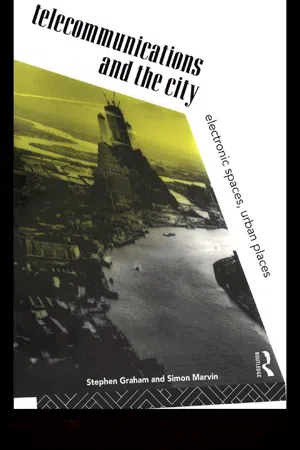
Telecommunications and the City
Electronic Spaces, Urban Places
- 456 pages
- English
- ePUB (mobile friendly)
- Available on iOS & Android
eBook - ePub
About this book
Telecommunications and the City provides the first critical and state-of-the-art review of the relations between telecommunications and all aspects of city development and management.
Drawing on a range of theoretical approaches and a wide body of recent research, the book addresses key academic and policy debates about technological change and the future of cities with a fresh perspective. Through this approach, the complex and crucial transformations underway in cities in which telecommunications have central importance are mapped out and illustrated. Key areas where telecommunications impinge on the economic, social, physical, enviromental and institutional development of cities are illustrated by using boxed extracts and wide range of case study examples from Europe, Japan and North America.
Rejecting the extremes of optimism and pessimism in current hype about cities and telecommunications, Telecommunications and the City offers a sophisticated new perspective through which city-telecommunications relations can be understood.
Information
1
INTRODUCTION
Telecommunications and the city: parallel transformations
TELECOMMUNICATIONS AND URBAN TRANSFORMATIONS
A rapid transformation is currently overtaking advanced industrial cities. As we approach the verge of a new millennium, old ideas and assumptions about the development, planning and management of the modern, industrial city seem less and less useful. Accepted notions about the nature of space, time, distance and the processes of urban life are similarly under question. The boundaries separating what is private and what is public within cities are shifting fast. Urban life seems more volatile and speeded up, more uncertain, more fragmented and more bewildering than at any time since the end of the last century.
Apparently central to this transformation, according to nearly all commentators, are remarkable leaps in the capability and significance of telecommunications. Much of contemporary urban change seems to involve, at least in part, the application of new telecommunications infrastructures and services to transcend spatial barriers instantaneously. Telecommunications—literally communications from afar— fundamentally adjust space and time barriers—the basic dimensions of human life (Abler, 1977). They connect widely separated points and places together with very little delay—that is, in ways that approach ‘real time’.
As telecommunications themselves become digital and based on microelectronics, they are merging with digital computer and media technologies. These are diffusing into a growing proportion of homes, institutions, workplaces, machines and infrastructures. The result of this merging is a process of technological convergence and a wide and fast-growing range of so-called ‘telematics’ networks and services. Following the French word télématique, coined in 1978 by Nora and Minc (1978), ‘telematics’ refers to services and infrastructures which link computer and digital media equipment over telecommunications links. Telematics are providing the technological foundations for rapid innovation in computer networking and voice, data, image and video communications. It is increasingly obvious that telematics are being applied across all the social and economic sectors and functions that combine to make up contemporary cities. It is also clear that telematics operate at all geographical scales—from within single buildings to transglobal networks. As William Melody argues, ‘information gathering, processing, storage and transmission over efficient telecommunications networks is the foundation on which developed economies will close the twentieth century’ (Melody, 1986).
As part of this transformation, cities are being filled with what Judy Hillman calls ‘gigantic invisible cobwebs’ of optic fibre, copper cable, wireless, microwave and satellite communications networks (Hillman, 1991; 1). The corridors between cities, whether they be made up of land, ocean or space, are in turn developing to house giant lattices of advanced telecommunications links. These connect the urban hubs together into global electronic grids. Such grids now encircle the planet and provide the technological basis for the burgeoning flows of global telecommunications traffic: voice flows, faxes, data flows, image flows, TV and video signals. Instantaneous electronic flows now explode into the physical spaces of cities and buildings and seem to underpin and cross-cut all elements of urban life.
Clearly, then, contemporary cities are not just dense physical agglomerations of buildings, the crossroads of transportation networks, or the main centres of economic, social and cultural life. The roles of cities as electronic hubs for telecommunications and telematics networks also needs to be considered. Urban areas are the dominant centres of demand for telecommunications and the nerve centres of the electronic grids that radiate from them. In fact, there tends to be a strong and synergistic connection between cities and these new infrastructure networks. Cities—the great physical artefacts built up by industrial civilisation—are now the powerhouses of communications whose traffic floods across global telecommunications networks—the largest technological systems ever devised by humans.
Many have argued that these shifts are part of a wider technological and economic revolution which seems to be underway within advanced industrial societies and within which both the development of telecommunications and urban change hold central significance (see Miles and Robins, 1992). A wide and sometimes confusing range of analytical perspectives have developed that try to chart this transformation from an industrial, manufacturing dominated society to one dominated by information, communications, symbols and services.1 Because western societies are fundamentally urban societies—with between 60 and 90 per cent of their populations living in towns and cities—cities are at the front line of this revolution. Cities are the dominant population, communication, transaction and business concentrations of our society. This makes them the central arenas within which we would expect the effects of current telecommunications innovations to be felt. As we move towards an urban society based more and more on the rapid circulation of messages, signs and information via global electronic networks, it would therefore be hard to pinpoint a more important set of technology—society relations than those which link cities to telecommunications.
THE URBAN ‘IMPACTS’ OF TELECOMMUNICATIONS
But what are the implications of these shifts? What becomes of cities in an era dominated by electronic flows and networks? What fate lies in store for our urban areas in the world where ‘virtual corporations’, ‘virtual communities’ and the abstract ‘electronic territory’ of ‘cyberspace’ are developing, based fundamentally on the use of telematics as space and time transcending technologies?
The growing use and significance of telecommunications throws up many profound and fundamental questions which go to the heart of current debates about cities and urban life both today and in the future. For example, how do cities and urban life interrelate with the proliferation of electronic networks in all walks of life and at all geographical scales? What happens to cities in the shift away from an economy based on the production and the circulation of material goods to one based more and more on the circulation and consumption of symbolic and ‘informational’ goods? (Lash and Urry, 1994). How are cities to sustain themselves economically given that more and more of their traditional economic advantages seem to be accessible, ‘on-line’, from virtually any location? Are cities being affected physically by advances in telecommunications as many claim they were in previous eras by the railway and the automobile? How does the movement from physical, local neighbourhoods to specialised social communities sustained over electronic networks—such as those on the Internet—affect the social life of cities? How are social power relations and the traditional social struggles within cities reflected in the new era of telecommunications? What is the relevance of telecommunications for burgeoning current debates about the ‘environmental sustainability’ of industrial cities? And what do all these changes imply for the ways in which cities are planned, managed and governed?
Such questions have recently stimulated much speculation and debate about the future of cities and the role of advances in telecommunications in urban change. Many commentators excitedly predict very radical changes in the nature of the city and urban life as advanced telecommunications, telematics and computers weave into every corner of urban life and so ‘impact’ on cities. Arguments that this will mean the dissolution of the cities and the emergence of decentralised networks of small-scale communities or ‘electronic cottages’ are widespread. In fact they are so common that visions of the end of cities seem almost to have reached the status of accepted orthodoxy within some elements of the popular media. Here, speculations abound surrounding the apparently revolutionary importance of the ‘communications revolution’, the ‘information age’, the ‘information superhighway’, ‘cyberspace’ or the ‘virtual community’ for the future of cities.
Unfortunately, however, these debates tend to be heavily clouded by hype and half-truth. They have generated much more heat than light. Such debates often tend also to be extremely simplistic, relying on assumed and unjustified assumptions about how telecommunications impact on cities. Many accounts of city— telecommunications relations amount to little more than poorly informed technological forecasts. Often, these are aimed at attracting media attention or generating sales and glamour for technological equipment. As a result, remarkably little real progress has been made in debates about telecommunications and cities. Amidst all the general hype about telecommunications and cities, remarkably little real empirical analysis of city—telecommunications relations exists.
This leaves the terrain open to extremes of optimism and pessimism. On the one hand, utopianists and futurologists herald telecommunications as the quick-fix solution to the social, environmental or political ills of the industrial city and industrial society more widely. On the other, dystopians or anti-utopians paint portraits of an increasingly polarised and depressing urban era dominated by global corporations who shape telematics and the new urban forces in their own image. Meanwhile, the increasing importance of telecommunications in cities has stimulated urban policy-makers, managers and planners to begin to get involved in the development of telecommunications within their cities. But they, too, often remain confused about how their cities are really affected by developments in telecommunications. This, and the need to be seen to be successful means that they themselves can become prone to hyping up their urban telecommunications policies in the language of the quick technical fix.
The immaturity and neglect of urban telecommunications studies means that there has been a tendency to approach the whole subject without trying to justify the theory or methodologies adopted. In the excitement to address these neglected and important areas, Warren (1989) notes what he calls a ‘candy store effect’:
The topic [of telematics and urban development] creates a ‘candy store’ effect by providing license to deal with a range of phenomena. The result is an effort to cover far too much with no logic or theory offered to explain why some consequences are discussed and others are not and why some evidence is presented and other findings are not…. We are left with an analysis which lacks any theoretical base and an explicit methodology, gives more attention to marginal than primary effects of telematics, and, in many instances, is in conflict with a significant body of research.
(Warren, 1989; 339)
THE NEGLECT OF TELECOMMUNICATIONS IN URBAN STUDIES
This ‘candy store’ effect is one symptom of the wider immaturity and neglect of telecommunications issues in both urban studies and urban planning and policy-making. In many ways, cities can be thought of as giant engines of communication—physical, social and electronic (Meier, 1962; Pool, 1977). We might therefore expect technologies that allow communication over distances—that is tele communications—to be a central focus of disciplines which aim to understand the city and professions involved in urban planning and management. This is especially so given that telecommunications are absolutely central to current innovation and restructuring all of the activities that combine to make cities: in manufacturing, transportation, consumer and producer services; in leisure, media and entertainment industries; in education, urban government, public services and urban utilities; and in social and cultural life.
But, despite these two points, telecommunications remain far from being a central focus in urban studies or urban policy-making. The subject of telecommunications and cities is a curiously neglected and extremely immature field of policy and research. Urban telecommunications studies remains perhaps the most underdeveloped field of urban studies. Telecommunications is also one of the least developed areas of urban policy (Mandlebaum, 1986). Recently Michael Batty argued that ‘interest and insights into the impact of communications patterns on the city with respect to information flow have…been virtually non-existent’ (Batty, 1990a; 248) and that current ‘understanding of the impacts of information technology on cities is still woefully inadequate’ (ibid.; 250).
Urban studies and policy remain remarkably blind to telecommunications issues. Compared to the enormous effort expended by urban analysts and policy-makers on, say, urban transportation, urban telecommunications have received only a tiny amount of attention. Vast libraries and many professional bodies and dedicated journals now exist in the field of urban transport issues; only a handful of books have directly looked at telecommunications and the city.2 Things have not greatly changed since Bertram Gross argued in 1973 that ‘urban planners seem most comfortable when dealing with urban problems in terms of transportation. Indeed, the most advanced techniques and the most “scientific” body of knowledge readily available to such decision makers are those of transport…. Urban planners…must become aware of the problems and possibilities of telecommunications’ (Gross, 1973; 29). ‘Urban analyst’ or ‘commentator’ could easily replace ‘planner’ here. At most only about a dozen urban commentators in the Anglo-Saxon world have directly researched the relationships between telecommunications and urban development since Gross made that statement. Only rarely have these had much impact of the urban disciplines.
This relative neglect means that the field has been left open to other non-urban specialists who have developed very influential speculations on how cities might relate to telecommunications. Importantly, though, these speculations have not been based on any particular under...
Table of contents
- COVER PAGE
- TITLE PAGE
- COPYRIGHT PAGE
- PLATES
- FIGURES
- BOXES
- PREFACE
- ACKNOWLEDGEMENTS
- 1. INTRODUCTION: TELECOMMUNICATIONS AND THE CITY: PARALLEL TRANSFORMATIONS
- 2. TELECOMMUNICATIONS AS A PARADIGM CHALLENGE FOR URBAN STUDIES AND POLICY
- 3. APPROACHING TELECOMMUNICATIONS AND THE CITY: COMPETING PERSPECTIVES
- 4. URBAN ECONOMIES
- 5. THE SOCIAL AND CULTURAL LIFE OF THE CITY
- 6. URBAN ENVIRONMENTS
- 7. URBAN INFRASTRUCTURE AND TRANSPORTATION
- 8. URBAN PHYSICAL FORM
- 9. URBAN PLANNING, POLICY AND GOVERNANCE
- 10. CONCLUSIONS: TELECOMMUNICATIONS AND URBAN FUTURES
- GUIDE TO FURTHER READING
- BIBLIOGRAPHY
Trusted by 375,005 students
Access to over 1.5 million titles for a fair monthly price.
Study more efficiently using our study tools.
Frequently asked questions
Yes, you can cancel anytime from the Subscription tab in your account settings on the Perlego website. Your subscription will stay active until the end of your current billing period. Learn how to cancel your subscription
No, books cannot be downloaded as external files, such as PDFs, for use outside of Perlego. However, you can download books within the Perlego app for offline reading on mobile or tablet. Learn how to download books offline
Perlego offers two plans: Essential and Complete
- Essential is ideal for learners and professionals who enjoy exploring a wide range of subjects. Access the Essential Library with 800,000+ trusted titles and best-sellers across business, personal growth, and the humanities. Includes unlimited reading time and Standard Read Aloud voice.
- Complete: Perfect for advanced learners and researchers needing full, unrestricted access. Unlock 1.5M+ books across hundreds of subjects, including academic and specialized titles. The Complete Plan also includes advanced features like Premium Read Aloud and Research Assistant.
We are an online textbook subscription service, where you can get access to an entire online library for less than the price of a single book per month. With over 1.5 million books across 990+ topics, we’ve got you covered! Learn about our mission
Look out for the read-aloud symbol on your next book to see if you can listen to it. The read-aloud tool reads text aloud for you, highlighting the text as it is being read. You can pause it, speed it up and slow it down. Learn more about Read Aloud
Yes! You can use the Perlego app on both iOS and Android devices to read anytime, anywhere — even offline. Perfect for commutes or when you’re on the go.
Please note we cannot support devices running on iOS 13 and Android 7 or earlier. Learn more about using the app
Please note we cannot support devices running on iOS 13 and Android 7 or earlier. Learn more about using the app
Yes, you can access Telecommunications and the City by Steve Graham,Simon Marvin in PDF and/or ePUB format, as well as other popular books in Politics & International Relations & Urban Planning & Landscaping. We have over 1.5 million books available in our catalogue for you to explore.