- 224 pages
- English
- ePUB (mobile friendly)
- Available on iOS & Android
eBook - ePub
About this book
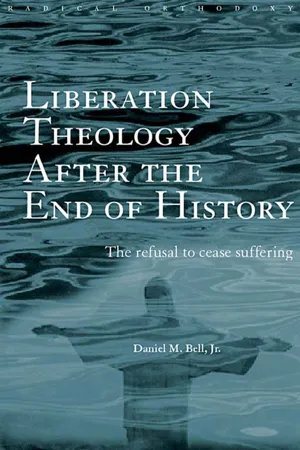
Daniel Bell assesses the impact of Christian resistance to capitalism in Latin America, and the implications of theological debates that have emerged from this. He uses postmodern critical theory to investigate capitalism, its effect upon human desire and the Church's response to it, in a thorough account of the rise, failure and future prospects of Latin American liberation theology.
Information
1
THE INFINITE UNDULATIONS
OF THE SNAKE
THE INFINITE UNDULATIONS
OF THE SNAKE
Capitalism, desire, and the state-form
Latin American liberationists insist that theological reflection carefully attend to the contours of contemporary reality. Accordingly, I begin this account of Christianity as a font of resistance to capitalism with an analysis of contemporary capitalism. Specifically, the principal task of this chapter is to display contemporary capitalism as a discipline of desire. This display proceeds in several steps. First, I introduce contemporary capitalism by taking up Franz Hinkelammert's analysis of “savage capitalism.” Hinkelammert's work is useful insofar as it serves as a salutary introduction both to the Latin American liberationists, who are the primary foil for my argument, and to several themes that will occupy center stage throughout this work. Moreover, given that the benevolence of capitalism has attained the status of a veritable truism today, Hinkelammert's unflinchingly critical (and some might be tempted to add, unnuanced) appraisal of capitalism serves as a poignant reminder that capitalism's triumph has not been achieved without a certain cost being borne by those whom Fukuyama dismisses as still “mired in history.”1 Second, I engage the work of Gilles Deleuze on capitalism and desire. Deleuze's work suggests the victory of savage capitalism is not simply economic; it is, more insidiously, ontological. Capitalism, Deleuze argues, extends its dominion over humanity not merely through the extraction of labor and production of wealth, but by capturing and distorting the constitutive human power, desire. Moreover, Deleuze's analysis implicates the state-form in the capitalist capture of desire, which brings us to Michel Foucault and his work on “governmentality.” This complements Deleuze's account and completes the display of contemporary capitalism as a discipline of desire by showing that the state-form encompasses much more than that ensemble of institutions called “the state,” that it encompasses a whole host of “technologies of desire”: technologies present in the social, cultural, and religious as well as political and economic registers that shape and form desire in particular ways. Finally, I conclude by briefly suggesting why even as we learn from Deleuze and Foucault, we must look beyond them if there is to be any hope of desire escaping capitalist discipline and attaining its true end.
Savage capitalism
Even as Fukuyama lauds neoliberal capitalism as the beacon of prosperity and hope astride the pinnacle of history, Latin American liberationists denounce global capitalism as a brutal and oppressive force responsible for the misery and premature death of much of the world's population. Given that the Latin American liberationists have long been concerned with the expansion of the capitalist order on account of the suffering and misery that it has perpetrated and is perpetuating, this is unsurprising. Indeed one could cogently argue that it is precisely the bold and uncompromising critique to which the capitalist order was subjected by theologians such as Hugo Assmann, Gustavo Gutiérrez, and Juan Luis Segundo that first attracted attention to liberation theology.
In the years since the end of history was announced, one of the bolder analyses of contemporary capitalism to emerge from the Latin American liberationists is that of Franz Hinkelammert. In an article that has resonated in the work of many liberationists, entitled “The crisis of socialism and the Third World,” Hinkelammert exposes the underside of the “end of history”.2 In bold strokes that indubitably would inflame capitalism's partisans, Hinkelammert develops three theses on recent changes in the international capitalist order, changes that amount to the advent of a new era he calls “savage capitalism.”
Three theses on contemporary capitalism
The first thesis is nothing less than a concession of defeat. Hinkelammert acknowledges capitalism's victory. Capitalism has won. Its rivals have been soundly defeated. “The world that now appears and announces itself is a world in which there exists only one lord and master, and only one system,” writes Hinkelammert. “[T]here no longer remains any place of asylum … The empire is everywhere. It has total power and it knows it … The consciousness that an alternative exists is lost. It seems there are no longer alternatives.”3 For the Third World, this amounts to being cut loose from even the minimal assistance it had previously received. With the ascendancy of the capitalist order, with the extension of its empire, Third World countries lost the strategic importance they once possessed as pawns that the competing superpowers would play off against each other.
The Third World now finds itself adrift in the midst of what Hinkelammert calls “wild” or “savage” capitalism.4 In the 1950s and 1960s capitalism was tempered by a reformist current that went by the name of developmentalism. At that time, even as the capitalist market was acknowledged to be largely self-regulating, it was nevertheless recognized that the market, left to its own devices, was unable to assure development and solve the grave socio-economic problems that afflicted the Latin American continent. Consequently, the welfare state, public investment, and industrialization by means of import substitution were all accepted components of this “capitalism with a human face.”5 The 1970s, however, marked a shift towards a more extreme, unfettered capitalism. This was the beginning of the era of Milton Friedman's “total capitalism,” of neoliberal economics, and “structural adjustment.” This is the capitalism of the era for which Ronald Reagan and Margaret Thatcher are icons: anti-interventionist, anti-reformist, anti-populist. In short, capitalism shorn of its human face.
One of the central precepts of this naked capitalism is an aggressive anti-statism. In contrast to the earlier phase of capitalism, which conceded a necessary regulatory role to the state, savage capitalism denounces all state intervention in the market and sets about dismantling the welfare state and selling off state-owned enterprises. In Latin America this anti-statism was incarnate in the national security states that appeared in the 1970s and 1980s, Chile under Pinochet being the paradigmatic example. This anti-statism, however, is deceptive. It amounts to a minimalist state that only renounces its regulatory and welfare role. While savage capitalism's advocates say they are anti-statist, in truth, what they favor is a “small-state, strong-state.”6 That is, they are advocates of a state that is long on repressive capability and short on social assistance. What is forsaken, in other words, is not intervention, but intervention that obstructs the free operation of the market. The neoliberal state is a police state or anti-state, the function of which is essentially negative. It exists as a repressive tool of the market, used to deliver society to the market.
With the advent of this savage capitalism, states Hinkelammert's second thesis, the population of the Third World is rendered largely redundant. It is no longer needed; it is excluded. Production in the Third World has traditionally developed on the basis of its labor force and its raw materials. Today, however, that labor force is increasingly being rendered superfluous. Advances in productive technology mean that capitalism needs less of the available labor. “The First World still needs the Third World,” Hinkelammert writes, “its seas, its air, its nature, even if only as a garbage dump for the First World's poisonous garbage. Its raw materials continue being needed. What is no longer needed is the greater part of the population of the Third World.”7 The market's logic of maximum efficiency entails the sacrifice of redundant populations. Capitalism simply does not need this many people — all these unnecessary, dangerous people. They are excess. Hence, with the arrival of savage capitalism, it becomes a privilege to be exploited: Hinkelammert cites a Latin American saying, “It is bad to be exploited by the multinationals. It is worse, however, not to be exploited by them.”8 Third World countries increasingly find themselves competing with one another for limited openings in the international capitalist market, with the consequence that more and more people are not even able to find a place on the margins of this system. They are excluded, discarded to wander outside the productive system, foraging in the garbage dumps and making newspaper cakes for their children.9
In this situation development is not possible for Third World countries; indeed, the central countries consider Third World development on the basis of industrial integration into the world market a threat. This is Hinkelammert's third thesis.10 Third World development is no longer perceived as a goal to be attained, but a threat to be squelched. With its arrival in the 1970s, savage capitalism did not establish industry that could competitively enter the world market. Rather, it renounced industrialization and silenced the masses with the terrorism of the national security state. Instead of fostering efficient enterprise, it reduced Latin America, once again, to the exportation of raw materials and agricultural products. Instead of overcoming underdevelopment, an efficient underdevelopment was pursued.11 Even if a few small countries have escaped the First World's grip, the visible tendency in the Third World is away from self-sustainable industrialization. Even those industries that were established in prior decades have been targeted for destruction or stagnation. The First World countries simply no longer see any advantage to be gained from allowing and encouraging this kind of development. Accordingly, savage capitalism opts for the maximization of profit over development. Perhaps the clearest example of this policy is the collection of the Third World's foreign debt. The debt is the primary tool with which Third World development is suppressed. The structural adjustment policies that are part and parcel of that debt insure that the debtor country will be unable to develop in a manner that would allow it to achieve a favorable insertion into the world market. In this way, Hinkelammert argues, the West has found a method of shedding blood that easily allows it to wash any stain off its hands.12
What conclusions does Hinkelammert draw in the face of savage capitalism's triumph? There are no visible, viable alternatives to the current vicious order. We are, as he suggests in the title of another article, stuck in a moment of uncertainty, “¿Capitalismo sin Alternativas?”13 We remain in the grip of a “mysticism of death,” a madness, a culture that in its destruction of people and nature amounts to a celebration of collective suicide.14
A savage capitalism, repressive states, excluded populations, madness, sacrifice, and the absence of alternatives. These are matters that will occupy our attention for much of the remainder of this work. But first we must ask, how did we arrive in this condition? How has capitalism accomplished this victory? For the beginning of an answer we turn to Gilles Deleuze and his history of desire and capitalism.
Capitalism and desire
Gilles Deleuze is frequently characterized as a postmodern philosopher; about such philosophers there is a debate over the extent to which they are or are not political.15 In the case of Deleuze, there can be little dispute. His philosophy is political through and through.16 This is perhaps nowhere more apparent than in his account of capitalism and desire. In the wake of the failed revolution of 1968 in Fran...
Table of contents
- Cover
- Half Title
- RADICAL ORTHODOXY SERIES
- Full Title
- Copyright
- Dedication
- CONTENTS
- Acknowledgments
- Introduction: the end of history
- 1 The infinite undulations of the snake: capitalism, desire, and the state-form
- 2 The Church of the poor in the wake of capitalism's triumph
- 3 Christianity, desire, and the terror of justice
- 4 The refusal to cease suffering: forgiveness and the liberation of desire
- Index
Trusted by 375,005 students
Access to over 1.5 million titles for a fair monthly price.
Study more efficiently using our study tools.
Frequently asked questions
Yes, you can cancel anytime from the Subscription tab in your account settings on the Perlego website. Your subscription will stay active until the end of your current billing period. Learn how to cancel your subscription
No, books cannot be downloaded as external files, such as PDFs, for use outside of Perlego. However, you can download books within the Perlego app for offline reading on mobile or tablet. Learn how to download books offline
Perlego offers two plans: Essential and Complete
- Essential is ideal for learners and professionals who enjoy exploring a wide range of subjects. Access the Essential Library with 800,000+ trusted titles and best-sellers across business, personal growth, and the humanities. Includes unlimited reading time and Standard Read Aloud voice.
- Complete: Perfect for advanced learners and researchers needing full, unrestricted access. Unlock 1.5M+ books across hundreds of subjects, including academic and specialized titles. The Complete Plan also includes advanced features like Premium Read Aloud and Research Assistant.
We are an online textbook subscription service, where you can get access to an entire online library for less than the price of a single book per month. With over 1.5 million books across 990+ topics, we’ve got you covered! Learn about our mission
Look out for the read-aloud symbol on your next book to see if you can listen to it. The read-aloud tool reads text aloud for you, highlighting the text as it is being read. You can pause it, speed it up and slow it down. Learn more about Read Aloud
Yes! You can use the Perlego app on both iOS and Android devices to read anytime, anywhere — even offline. Perfect for commutes or when you’re on the go.
Please note we cannot support devices running on iOS 13 and Android 7 or earlier. Learn more about using the app
Please note we cannot support devices running on iOS 13 and Android 7 or earlier. Learn more about using the app
Yes, you can access Liberation Theology after the End of History by Daniel Bell in PDF and/or ePUB format, as well as other popular books in Theology & Religion & Christian Theology. We have over 1.5 million books available in our catalogue for you to explore.