- 232 pages
- English
- ePUB (mobile friendly)
- Available on iOS & Android
eBook - ePub
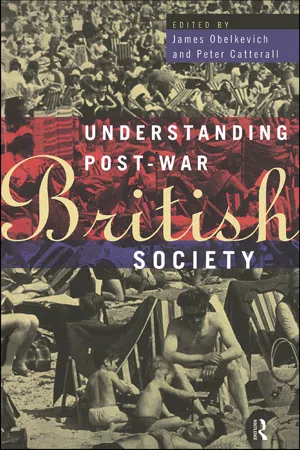
Understanding Post-War British Society
About this book
Too many sociology textbooks begin and end with how society is structured. To understand how society operates it is necessary to explore not only its constituent structures and relationships, but how these structures emerge and why changes occur within them. By bringing together a group of distinguished sociologists and social historians, this book critically appraises the usefulness of current theories in advancing our understanding of contemporary society. It explores British society as dynamic and developing. In the process the authors draw our attention to the fact that society is shaped not just by social policy and structures, but by how far these influence people's life-patterns, attitudes, experience and conduct. Celia Brackenridge (Cheltenham & Gloucester College of Higher Education, Joan C Brown, Robert G Burgess (University of Warwick), Rosemary Crompton (University of Kent), John Curtice (University of Str
Chapter 1
Trends In post-war British social history
Edward Royle
INTRODUCTION
All ages are ages of transition and only rarely and coincidentally does history see decisive breaks at century ends or, in modern times at least, at the change of a monarch. Indeed, it would be strange if such breaks were evident in social history. The ‘nineteenth century’ or the ‘twentieth century’ are meaningless concepts, though they have some mythic power: we expect change and so to some extent we create it. In this chapter I shall argue that, in several important respects, the decisive break with what we think of as the nineteenth century, or the late-Victorian world, does not come with the death of Victoria a few days into the twentieth century, nor even with the First World War, but in the period after 1945. The major trend in this latter age of transition, has been an accelerating discontinuity with the past.1
Dating this watershed in modern British social history is not easy, for change occurred at different times and rates in different areas of society. One problem is that, because of the war, no national census was conducted in 1941, with the result that one of the social historian’s standard sources of information is missing. Clearly there were many changes in society between 1931 and 1951: were these the products of the 1930s, or of the war, or of the immediate post-war period? The answer is, in different cases and to different degrees, all three. But if there were trends emerging in 1951 compared with 1931, these had become much more marked by 1961, which suggests that it is in the post-war period—and especially the 1950s—that the most significant developments occured to create our own period of rapid social change. As Britain recovered, not only from the Second World War but from the aftermath of the war, the deep-seated nature of these changes became fully apparent.
By coincidence there was a new reign beginning in 1952, hailed by contemporaries as ‘the new Elizabethan age’. Things may not have turned out quite as those publicists of change intended to imply, but they were right to see how the cumulative effects of social change through successive periods of depression, war and austerity were now leading to a new era which those same pedlars of popular images were later to identify rather belatedly—and with a singular lack of originality—as ‘the swinging sixties’.
What were these major trends? In the rest of this chapter I want briefly to introduce several of the cultural aspects of social change: the family, household structure, consumerism and its associated technologies, the position of women, class, race, religion and education. Finally I shall end with a few comments on what I see to be the political importance of studying contemporary social history.
FAMILY AND HOUSEHOLD STRUCTURE
Although demography is outside the scope of this chapter, a few pertinent statistics will help to provide a context for the argument that follows. After all, demographic change is, in part at least, itself a function of cultural change. The age of marriage began to fall after 1931, and by 1951 the number of married men and women aged under 24 was 84 per cent greater than in 1931—an average annual increase of 4.2 per cent. The comparable annual figure for the 1950s was even higher—4.7 per cent. Although this increase in early marriage saw some rise in the crude birth-rate, with the 1947 post-war peak in births coinciding with the demobilisation of fathers, these years nevertheless also saw the breaking of the link between the number of births and the number of women in the population of childbearing age. Methods of contraception, increasingly in use from the 1870s, were becoming by the 1950s the principal regulator of population—a social fact which led to the quest for more efficient methods of contraception and the marketing of the birth-control pill in 1963—one of the major technological revolutions in post-war British society.2
The link between marriage and childbirth also began to be broken. The proportion of registered illegitimate births in England and Wales rose only slightly, from 4.2 per cent to 4.9 per cent, between the beginning of the century and the early 1950s. But by the beginning of the 1960s it was 5.9 per cent and by the early 1980s it was 12.9 per cent. In the 1980s this proportion continued to increase at an accelerating rate and by 1991 had reached 31.7 per cent. The rates for abortion, divorce and remarriage also increased in these years, though with some levelling off in the 1980s: abortions rose from 11.9 per cent of conceptions in 1971, to 17.0 per cent in 1981, and 19.7 per cent in 1988; divorces rose from 0.6 per cent of all marriages in 1971, to 1.19 per cent in 1981 and 1.27 per cent in 1989; and remarriage rose from 20 per cent of all weddings in 1971, to 34 per cent in 1981, and 36 per cent in 1991.
Of course, to a large extent these figures reflect changes in the law, but the historian still has to ask why such marked changes in social behaviour occurred. The law is itself an expression of the attitudes and values of society: it is not simply a historical cause but also a historical consequence. What those attitudes might be can be gathered from the increasing numbers of births outside marriage which were registered in the names of both father and mother, rising from about one-third the number of registered illegitimate births in the 1950s to over three-quarters of the number of registered illegitimate births by 1991, around half of these joint registrations being by parents who shared the same address. Similarly, whereas in 1972 only 16 per cent of women who married had co-habited with their future husbands before marriage, this figure had more than doubled by 1980 and had exceeded 50 per cent by the end of the 1980s. In brief, a major cultural shift in the nature, function and expectations of the family has occurred in British society since the 1950s.
This has had many important consequences, not least for the formation of households. The older pattern, prolonged by depression, war and housing shortages, was for the relatively late formation of households—occurring even after marriage and thus acting as a brake on the birth rate. The more recent trend has been for households to be formed not simply at marriage, but before marriage. In the 1970s the number of households increased by 6.5 per cent while the population increased by under 1 per cent. In the 1980s a 10 per cent increase in households was produced by an estimated increase of only 1.4 per cent in the population. The number of households containing only one person has more than doubled in the past thirty years. A quarter of all households now contain only one person and a further third no more than two. This, of course, in part reflects the increasing proportion of old people in the population—another significant trend in the post-war years— but in part it reflects the determination of young people to form separate individual or co-habiting households on or shortly after achieving adulthood.
Cause and consequence are here, as in all social history, inextricably mixed. Changes in the family have both caused changes in household formation and been caused by the possibility of different patterns of household formation. This, in turn, has had important economic consequences for the nature of the housing market, population densities, and the growth and spread of towns and suburbs. Above all, changes in the pattern of household formation have been of enormous significance for the extent and nature of consumer spending. The latter has, in turn, been underpinned by rising real incomes for the bulk of the population and, in the critical 1950s and 1960s when modern expectations became fixed, by full employment.
THE CONSUMER REVOLUTION AND TECHNOLOGICAL CHANGE
The consumption patterns of modern society have been radically different from those of pre-war society. Assisted by such legislation as the Holidays with Pay Act of 1938, people have been able to extend and diversify their leisure-time activities beyond the hopes of all but a few in pre-war society. It was Sir Billy Butlin, just before the war, who perceived the potential of the new mass holiday market which he exploited with great success in the post-war years. By the early 1950s, some 25 million people in Britain were spending a few days away from home on holiday each year. With growing affluence this pattern then changed again. In 1951 about 2 million people took their holidays abroad; by the early 1970s this had reached 7 million; and it now stands at three times that figure. Whereas in 1971 a third of people living in Britain had been on holiday abroad, by the late 1980s less than a third had not done so.
This aspect of the consumer revolution has been made possible by technological change. Travel by air on any significant scale is a post-war phenomenon. Heathrow Airport, the busiest in the world, was not opened until 1946. The first jet-propelled passenger air service across the Atlantic dates only from 1958. Technology also affected transport services on land. When the railways were nationalised in 1948 their track mileage was scarcely below its nineteenth-century peak. Now it is half that level; and railways—those bringers of civilisation to the nineteenth-century countryside—have disappeared from many parts, especially rural Wales, Scotland and eastern England. A cul-de-sac of modern bungalows on the site of the demolished railway station in one small Lincolnshire town is charmingly named, ‘Beeching Close’, after the chairman of the report that led to wholesale closures in the 1960s. Such closures were occasioned by, but also gave rise to, an increasing use of road transport and, in particular, of private motor cars. Whereas before the war there had been only 2 million private motor cars, there were 9 million by the mid-1960s and there are now more than twice that number. Approaching two-thirds of households in Britain own at least one motor car, with revolutionary consequences for the individual’s freedom to choose where to live in relation to work and how to spend leisure time.
Technology has had an enormous impact on consumption, leisure and culture. By the beginning of the Second World War two-thirds of households had an electricity supply; now almost all do. Moreover, almost all households now have a wide range of (largely female) labour-saving devices to plug into the system. In 1950, only 4.7 per cent of consumer expenditure went on furniture, electrical and other consumer goods and motor cars. This figure is now almost 12.0 per cent. Four out of every five homes in the late 1980s had a washing machine and almost all a refrigerator and at least one television set. The ramifications of this are numerous. With domestic fridges and freezers has come a transformation in the marketing and range of foodstuffs. Frozen foods have brought convenience cooking and an end to seasonality in diet, completing by extension that earlier revolution which came with the development of canned foodstuffs in the later nineteenth century.
Television has, perhaps, brought the greatest revolution of all. Despite a slight fall in viewing hours in the later 1980s, the average person over the age of 4 watches twenty-five hours of television a week—two-thirds as much time as that spent weekly (including overtime) in paid employment. In the first full year after television licences were issued in 1946, there were just 15,000 of them. By the mid-1950s there were 4.5 million; today the figure is five times as many. With remarkable faith in an electronic miracle that most do not begin to understand, almost the entire nation can be entertained, informed and brought to witness events as they happen on the other side of the world and beyond. This has given to just a few people tremendous power to shape our politics and our culture. It is no coincidence that, in political revolutions across the modern world, the first target of the insurrectionaries is the television station.
Since 1955 advertising has been permitted on television and this has had an important impact on consumer culture. Consumerism is itself not a new or even a recent phenomenon; but the power of actors to enter homes electronically and sell products from cornflakes to politicians, using all the illusions of controlled realism, is new beyond the wildest dreams of the chapman, pedlar or brush-salesman of old. Furthermore, the money generated by television has had an important effect on other forms of leisure. Fees paid for showing sporting events, for example, have transformed the fortunes of—and in some cases helped to preserve—professional sport and sportspersons of almost every description. Another consequence of television has been the targeting of programmes and products towards the younger generation. The consumer society survives economically by creating new and ever-expanding markets for its goods. In 1961 there were 22 per cent more teenagers in the population than in 1951. The 1960s were created for them by the promoters of the consumer society—special clothes, music, literature, all prone to fashion and obsolescence. In more recent times, with the decline in this age group in the population, attention has been extended on the one hand to the pre-teen group and, on the other, to the elderly retired market of ‘senior citizens’.
GENDER, CLASS AND RACE
Most of the changes so far described, from the birth-control pill to washing machines, have had an even greater impact on the female half of society than on the male. Women’s liberation as a cultural and political movement should be understood as part of a much wider change which has made possible and realistic the demand for alterations in attitudes and the law with respect to women. The form which the sexual division of labour assumed in the nineteenth century may have been dictated by male control of the decision-making processes, but the fact of some division of labour was rationally based in the struggle of most of the population—male and female—for survival. That struggle has today ceased to dominate the lives of the great majority of the population and with it has gone much of the basis for traditional divisions of labour. One consequence of the opportunity for liberating women from the home and childrearing has been a change in the structure of employment. In 1951 the female participation rate in the labour force was around one-third. It had not much changed in the preceding half-century but in the 1950s it began to climb, reaching 40 per cent in the early 1960s and over 50 per cent by the later 1980s—second only to Denmark in the European Union. The participation of women in the labour market has been particularly marked, as one might expect, in white-collar employment and in the service industries—expanding areas at a time when the demand for unskilled manual (and therefore male) labour has been in decline. At the same time, however, it is true to say that much female labour is still concentrated in part-time and low-paid employment. Of the 13 million men in employment in 1993, almost all were in full-time jobs but of the 11 million women, nearly half had only part-time employment. Moreover, the gap between male and female wages has not changed for the past two decades. In this respect the employment position of women is changing only slowly.
Broad social changes, especially in consumption patterns and rising disposable family incomes, led many commentators in the 1960s to start talking and writing about the demise of class in Britain. With abundant evidence of the rise of the affluent worker, able to buy his own house on a private housing estate and increasingly willing to vote Conservative, the thesis had some attractions. Certainly, Conservative policy in the 1980s was to extend the numbers of such affluent, property-owning workers, and the Labour Party, after three successive electoral disasters in 1979, 1983 and 1987, likewise felt driven to change its policies to court the votes of such people. However, what the sociologists still debate is whether the embourgeoisement of the affluent worker is more myth than reality. A major survey, by John Goldthorpe and others in the 1960s, certainly challenged the view at the height of its popularity. Since then the radical departure of the Conservative Party under Mrs Thatcher’s leadership from traditional liberal conservatism somewhat confused the issue in the 1980s; and the return of economic recession at the end of the decade produced some evidence to suggest that Britain has not by the early 1990s progressed very far down the road to a classless society (Goldthorpe et al. 1969).3 Indeed, the earnings gap between the highest and lowest paid has increased; and the distribution of disposable income has fallen for the poorest fifth of the population from 10 per cent to 6 per cent since 1979, whereas it has risen for the richest from 35 per cent to 43 per cent.
One major social division which certainly has increased in post-war British society is the racial one. Cultural and racial diversity is not new, as the presence of large numbers of Irish and Jewish immigrants in the nineteenth century confirms. Not even the presence of black people is new, for there have been blacks in Britain since the eighteenth century and earlier. What is new is that highly visible presence of non-white people which has become such a feature of post-war society, and the wide measure of cultural diversity which they have brought with them. The Irish, with their pigs, potatoes and popery, were a culture shock to nineteenth-century Protestant Englishmen; but the languages and religions of the East are even stranger to the British man and woman of the later twentieth century. Black immigration did not begin on a large scale until the late 1940s, when West Indian and then Indian workers were recruited by British employers at a time of acute labour shortages as the post-war economy began to revive. By the late 1950s, for the first time, immigration to Britain was exceeding emigration and between 1962 and 1971 governments of both parties began to impose restrictions. By the late 1980s the combined black community had reached about 4.8 per cent of the total population. However, nearly half of these were not immigrants but British born; conversely, half of those born outside the United Kingdom were in fact white—mainly Irish, who still constituted the largest immigrant group.
RELIGION
One of the most visible forms which this cultural diversity has taken is religious. Indeed, one of the most significant trends in post-war society concerns the transformation in the social position of religion. Sociologists have long debated whether ‘secularisation’ exists and, if so, whether it has taken place; others prefer to use the term ‘de-Christianisation’, which is historically speaking the more defensible concept (Gilbert 1980).4 Although there has been a steady decline of religious observance since at least the latter decades of the nineteenth century, and although there have been temporary revivals such as occurred in the late 1940s and early 1950s, the prolonged and steep decline in religious practices that has taken place in most Christian churches since the late 1950s must stand not only as one of the most significant social trends of our time, but also as one of the greatest cultural breaks with the past. In the quarter century between the start of the 1960s and the mid-1980s, the number of baptisms in the Church of England fell by nearly half—far more than the falling number of births alone would suggest—and the number of confirmations fell by over half. The Church of Scotland and the Methodists fared even worse; the Roman Catholics did only a little better. Between 1970 and 1990 the combined membership of the Christian churches fell from 8.5 million to 6.7 million—18 per cent of the adult population—and the age structure and sluggish recruitment patterns of the churches suggest this will continue to be the trend for the foreseeable future. Church attendance is even less— 14 per cent of the population are reckoned to be ‘active’ members of the Christian churches and possibly as few as 10 per cent go to church at least once a month. Though initially the major immigrant religion, Catholicism, did rather better than Protestantism, it too has experienced a steep decline in the past fifteen years, with a 23 per cent drop in adult membership. By contrast the newer immigrant religions have grown strongly. Between 1975 and 1992 the number of Muslims more than doubled to over half a million—compared with around 460,000 Methodists, the largest denomination of Protestant Nonconformists. For every hundred adult members of the Christian churches in the United Kingdom in 1992, there are almost eight followers o...
Table of contents
- Cover Page
- Title Page
- Copyright Page
- List of figures
- List of tables
- Contributors
- Introduction Understanding British society
- Chapter 1: Trends In post-war British social history
- Chapter 2: Elements of demographic change in Britain since 1945
- Chapter 3: Political sociology 1945–92
- Chapter 4: The family in post-war Britain
- Chapter 5: Women in Britain since 1945: companionate marriage and the double burden
- Chapter 6: Old age and gerontology
- Chapter 7: Employment and industrial structure
- Chapter 8: Non-manual labour
- Chapter 9: Poverty in post-war Britain
- Chapter 10: Aspects of education in post-war Britain
- Chapter 11: Consumption
- Chapter 12: Food and nutrition in post-war Britain
- Chapter 13: Religion in post-war Britain: a sociological view
- Chapter 14: The arts, books, media and entertainments in Britain since 1945
- Chapter 15: Gender inequalities in leisure and sport in post-war Britain
Trusted by 375,005 students
Access to over 1.5 million titles for a fair monthly price.
Study more efficiently using our study tools.
Frequently asked questions
Yes, you can cancel anytime from the Subscription tab in your account settings on the Perlego website. Your subscription will stay active until the end of your current billing period. Learn how to cancel your subscription
No, books cannot be downloaded as external files, such as PDFs, for use outside of Perlego. However, you can download books within the Perlego app for offline reading on mobile or tablet. Learn how to download books offline
Perlego offers two plans: Essential and Complete
- Essential is ideal for learners and professionals who enjoy exploring a wide range of subjects. Access the Essential Library with 800,000+ trusted titles and best-sellers across business, personal growth, and the humanities. Includes unlimited reading time and Standard Read Aloud voice.
- Complete: Perfect for advanced learners and researchers needing full, unrestricted access. Unlock 1.5M+ books across hundreds of subjects, including academic and specialized titles. The Complete Plan also includes advanced features like Premium Read Aloud and Research Assistant.
We are an online textbook subscription service, where you can get access to an entire online library for less than the price of a single book per month. With over 1.5 million books across 990+ topics, we’ve got you covered! Learn about our mission
Look out for the read-aloud symbol on your next book to see if you can listen to it. The read-aloud tool reads text aloud for you, highlighting the text as it is being read. You can pause it, speed it up and slow it down. Learn more about Read Aloud
Yes! You can use the Perlego app on both iOS and Android devices to read anytime, anywhere — even offline. Perfect for commutes or when you’re on the go.
Please note we cannot support devices running on iOS 13 and Android 7 or earlier. Learn more about using the app
Please note we cannot support devices running on iOS 13 and Android 7 or earlier. Learn more about using the app
Yes, you can access Understanding Post-War British Society by Peter Catterall,James Obelkevich in PDF and/or ePUB format, as well as other popular books in History & British History. We have over 1.5 million books available in our catalogue for you to explore.