- 240 pages
- English
- ePUB (mobile friendly)
- Available on iOS & Android
eBook - ePub
About this book
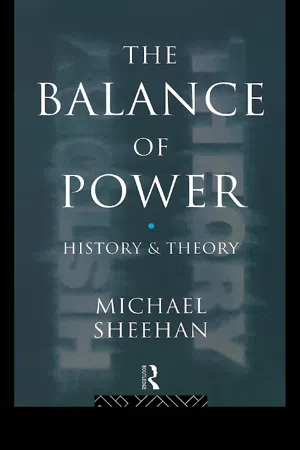
The balance of power principle has been central to both the study and practice of international politics for over 300 years. It has guided governments in the conduct of foreign policy and provided a structure for explanations of some of the recurring patterns of international relations. This study examines the various meanings given to the balance of power over the centuries and traces the historical evolution of its theory and practice through steadily more complex forms. It describes the balance principle in practice, both as a guiding light of national foreign policies and as a structural explanation of how the international system operates. The reader is provided with an understanding of the various meanings of the balance principle and the key thinkers and politicians who have influenced its development. The text presents the essence of arguments concerning the morality of the principle as a foreign policy guide and its value as a structural explanation of the fundamental reality of international relations.
Information
1
The meaning of the balance of power
Students of international politics do not need to be told of the unsatisfactory state of balance of power theory. The problems are well known: the ambiguous nature of the concept and the numerous ways it has been defined, the various distinct and partly contradictory meanings given to it in practice and the divergent purposes it serves (description, analysis, prescription and propaganda); and the apparent failure of attempts clearly to define balance of power as a system and specify its operating rules.
Schroeder, 1989:135
INTRODUCTION
If the idea of the balance of power is so laden with contradictions, why then should we study it at all? The answer to that question is that, for all its faults, the balance of power has been one of the most important ideas in history. It is a concept which for centuries students of international relations believed held the key to understanding the recurrent patterns of behaviour of states living in a condition of ‘international anarchy’. At the same time, it was a guide for many statesmen, who saw in it a method for securing the continuing independence of their states. This is the critical importance of the balance of power concept, that whatever its limitations as a tool for analysis or a guide to policy, it has historically been a reality; a reality that deserves to be analysed and understood.
However, when it comes to seeking the essence of the idea of the balance of power, the difficulty is not that its meaning cannot be discovered, but rather, as Inis Claude (1962:13) has pointed out, that it has too many meanings. At its heart the balance of power seems a simple concept, readily understandable by statesmen and ordinary citizens. Confusion exists, however, because throughout history its advocates and critics alike have used the term too freely, so that an analysis of the countless references to it in the literature throws up a host of examples which confuse rather than enlighten. Ernst Haas uncovered eight different meanings of the phrase ‘balance of power’ (1953:447–57) while Wight (1966:151) went one better with nine. George Liska (1977: 5) has argued that it is counter-productive to attempt to pin down the balance of power concept too exactly and that there is ‘a misplaced desire for precision in a concept that is at once the dominant myth and the fundamental law of interstate relations, and as such with some reason, highly elastic’. Nevertheless, this elasticity has contributed to the confusion surrounding the concept.
DEFINITIONS
Before plunging into the trackless swamp of the alternative interpretations, it is worth noting at the outset that at the heart of the balance of power idea is a straightforward concept as, following the approach used by Zinnes (1967:270–85), a select number of definitions will suffice to make clear.
- ‘An equal distribution of Power among the Princes of Europe as makes it impractical for the one to disturb the repose of the other’. Anonymous, Europe’s Catechism, 1741
- ‘action by a state to keep its neighbours from becoming too strong… because the aggrandisement of one nation beyond a certain limit changes the general system of all the other neighbours…attention to the maintenance of a kind of equality and equilibrium between neighbouring states’. Fenelon, 1835
- ‘The balance of power, however it be defined, that is, whatever the powers were between which it was necessary to maintain such equilibrium, that the weaker should not be crushed by the union of the stronger, is the principle which gives unity to the political plot of modern European history’. Stubbs, 1886
- ‘History shows that the danger threatening the independence of this or that nation has generally arisen, at least in part, out of the momentary predominance of a neighbouring state at once militarily powerful, economically efficient, and ambitious to extend its frontiers or spread its influence, the danger being directly proportional to the degree of its power and efficiency, and to the spontaneity and “inevitableness” of its ambitions. The only check on the abuse of political predominance derived from such a position has always consisted in the opposition of an equally formidable rival, or of a combination of several countries forming leagues of defence. The equilibrium established by such a grouping of forces is technically known as the balance of power’. Crowe, 1928
- ‘an arrangement of affairs so that no state shall be in a position to have absolute mastery and dominate the others’. Vattel, 1916
- ‘the balance of power assumes that through shifting alliances and countervailing pressures no one power or combination of powers will be allowed to grow so strong as to threaten the security of the rest’. Palmer and Perkins, 1954
- ‘The balance of power ‘operates in a general way to keep the average calibre of states low in terms of every criterion for the measurement of political power…a state which threatens to increase its calibre above the prevailing average becomes subject, almost automatically to pressure from all the other states that are members of the same political constellation’. Toynbee, 1934
- ‘The balance of power ‘refers to an actual state of affairs in which power is distributed among several nations with approximate equality’. Morgenthau, 1978
- ‘when any state or bloc becomes, or threatens to become, inordinately powerful, other states should recognise this as a threat to their security and respond by taking equivalent measures, individually and jointly, to enhance their power’. Claude, 1962
- ‘The balance’s underlying principle…was that all the nth disengaged powers would tend to intervene on the side that seemed in danger of losing any ongoing war, to ensure that such a loser was not eliminated from the system and absorbed into an emerging colossus’.
Quester, 1977
As Dina Zinnes notes, a listing of definitions in this way shows almost complete agreement on the key feature of a balance of power system. A balance of power involves ‘a particular distribution of power among the states of that system such that no single state and no existing alliance has an “overwhelming” or “preponderant” amount of power’ (Zinnes, 1967:272).
When the essence of the concept is distilled in this way, it is easy to agree with Hume that the balance of power is founded upon ‘common sense and obvious reasoning’. Although it must be said that Hume’s argument is based upon a crucial assumption, which is that the independence of states is a more important goal to pursue than a process of political unification under a hegemonic power. This may indeed be a desirable goal, but it is a goal identifiable with a particular post Renaissance European manner of looking at international relations.
There are a variety of methods by which this basic objective might be sought, generating alternative policies and different balance of power systems. For example, in the unusual case of a two-power system, only an equality of power can prevent preponderance, in the manner called for by the balance of power approach. As the number of states in the system increases beyond this, however, a wide variety of distributions of power becomes acceptable. ‘In effect, any distribution is permissible as long as the power of each unit—state or alliance of states—in the system is less than the combined power of all the remaining units’ (Zinnes, 1967:272).
BALANCE OF POWER AND ‘REALISM’
Balance of power thinking is usually conceived of as belonging within a particular tradition of thinking about international relations, that of ‘power polities’ or ‘realism’. Dougherty and Pfaltzgraff (1990:81) have listed what they see as being the four basic tenets of this perspective.
- Nation-states are the key actors in an international system composed of independent sovereign states.
- Domestic and foreign policy are clearly separated areas of national policy.
- International politics is a struggle for power in an anarchic international environment.
- States have different capabilities to achieve goals and defend interests.
These four assumptions draw upon a particular interpretation of older traditions. It could be argued that Thucydides, Machiavelli, Hobbes and Rousseau fall within the power politics world-view. A classic statement of this perspective was Hans Morgenthau’s Politics Among Nations (1978). Morgenthau asserted that the world is the result of forces inherent in human nature and that:
moral principles can never be fully realised, but must at best be approximated through the ever temporary balancing of interests and the ever precarious settlement of conflicts. This school, then, sees in a system of checks and balances a universal principle for all pluralist societies. It appeals to historic precedent rather than to abstract principles, and aims at the realisation of the lesser evil rather than that of the absolute good.
(Morgenthau, 1978:1–2)
Morganthau laid out six principles which he felt distinguished the concept of political realism.
- Politics, like human nature, is seen as being governed by objective laws that have their roots in human nature. Once identified, these ‘laws’ will be of enduring value—‘the fact that a theory of politics was developed hundreds or even thousands of years ago—as was the theory of the balance of power —does not create a presumption that it must be outmoded and obsolete’ (1978:4). Statesmen will make decisions on the basis of rational choices between alternative options.
- The key concept which enables the realist to make sense of the complexities of international politics is the concept of interest defined in terms of power (1978:5). Morgenthau admits that realism emphasises a rational foreign policy which is never quite attainable in practice, but he argues that this does not detract from its utility. Far from being invalidated by the fact that, for instance, a perfect balance of power policy will scarcely be found in reality, it assumes that reality, being deficient in this respect, must be understood and evaluated as an approximation to an ideal system of balance of power.(Morgenthau, 1978:8)
- The kind of interest determining political action in a particular period of history depends upon the political and cultural context within which foreign policy is formed. The same applies to the concept of power. Therefore, Morgenthau accepts that power and the use of power can change during periods of time, but argues that this will be more likely to result from a general shift in the balance of power within the international system. Power here is defined as ‘anything that establishes and maintains the control of man over man’ (1978:9). The contemporary connection between interest and the nation-state is seen as the product of a particular period of history. Alternatives to the nation-state could evolve in the future and, by implication, could have been key actors in the past.
- Realism does not accept the validity of universal moral principles in an abstract sense, but argues that they must be ‘filtered through the concrete circumstances of time and place’ (1978: 173). Above all, Morgenthau argues that the state has no right to allow moral principles to get in the way of, or detract from, its duty to pursue the objective national interest.
- However, Morgenthau qualifies this by arguing that, in fact, states’ policies are influenced by their moral judgements in a way that tends to encourage moderation, and that this encourages a live-and let-live approach where states recognise that just as they are pursuing their own national power aspirations, so too are other states. Individual states should therefore respect each other.
- Morgenthau goes on to argue that realists and politicians should subordinate non-political criteria such as morality to the requirements of political reality.
The realist image of international relations is one of inevitable clashes between nation-states as they seek to maintain their autonomy and increase their wealth and power. ‘The fundamental nature of international relations is seen as being unchanged over the millennia. International relations continues to be a recurring struggle for wealth and power among independent actors in a state of anarchy’ (Gilpin, 1981:7). This latter point is a feature of most balance of power thinking.
There is a tendency to argue that balance of power politics is an inevitable feature of any international system, because it reflects the nature of mankind and human nature is seen as being essentially unchanging. This view was expressed in the eighteenth century by David Hume when he argued that the ancient Greeks, who understood human nature so well, must therefore have been familiar exponents of balance of power politics.
There is a major problem involved here. Classical realist thought looks at the world in a particular way. Realists have identified this approach as being a natural or inevitable way for human beings to look at the world of interstate relations. Perhaps inevitably, they have projected this particular image of international relations back into history, finding evidence from past eras which support their world-view and citing earlier thinkers such as Thucydides, Machiavelli and Rousseau, as well as statesmen in many eras, as supporting their perspective.
However, as later sections of this study will demonstrate, the balance of power approach, which is central to realist theorising, is far from being an instinctive human approach to international politics. On the contrary, it appears to be the product of a peculiar combination of factors in seventeenth-century Europe, and the particular model of the balance of power which realists promote is significantly different from the concept as it originally emerged and as it periodically reasserted itself. Moreover, for the majority of recorded human history, the balance of power approach has been conspicuously absent from the record of interstate relations.
THE CENTRALITY OF POWER
The concept and measurement of power, together with the ability of states to translate this power into defined national goals, is one of the most fundamental characteristics of realist perspectives. Most realists assume that it is in the interests of the state to acquire as much power as possible and, having acquired it, to exercise and maintain that power.
One intellectual problem immediately thrown up by this assumption is that power is a concept, or term, interpreted differently by different people. For some it means the use of force, usually military force, but also political or economic force. For others, power is not a specific thing or activity, but is an ability to influence the behaviour of other states. Gilpin (1981) defines power as an actor’s ability to impose his or her will despite resistance, and defines prestige or authority as being different from power. Prestige and authority constitute only the ‘probability’ that a command will be obeyed. However, Gilpin still acknowledges that any prestige or authority eventually relies upon traditional measures of power, whether military or economic.
Closely related to the notion of power is the concept of national interests, and the objectives of using power. Realist assumptions regarding concepts such as sovereignty and anarchy lead the realists to argue that because international politics is anarchic, that is, there is no superior governing authority, then the independent sovereign states basically have to struggle to secure their own interests. Nicholas Spykman argued that the basic objective of a state’s foreign policy must be to preserve territorial integrity and political independence.
Thus, the processes and activities of states in the realist image of international relations become naturally limited to achieving the short term or immediate goals of security and survival, since no single state can reasonably plan for its long term future and security.
This condition of realist international politics has been described by some writers as the security politics paradigm or more generally as the security dilemma. It sees states perpetually competing, conflicting and fighting over issues of national security. The implication of this is that states must do whatever is necessary to survive in this highly dangerous environment. If most states are ruthlessly behaving in this way, then those that do not will become victims in the struggle for security. The nature of the system in which all the states exist then becomes a determining factor in their behaviour, forcing them to play the balance of power game if they are to survive. This characterisation is central to the explanation of the balance of power advanced by ‘structural’ or ‘neo’-realists such as Kenneth Waltz (1979:118).
The balance of power theory sees international society as unequal; power versus weakness. But this basic inequality among states can be balanced, that is, all states can be kept in check regarding each other’s position, and this can therefore prevent hegemony, allowing states to preserve their identity, integrity and independence, and perhaps deterring aggression or war.
Balance of power theory is thus closely in line with the traditional, realist image of international relations. The task of statesmen is to identify and prioritise the national interests according to any changes that occur. Because the international anarchy militates against any long-term security or stability, nation-states may well encourage balance of power systems, so that in absolute terms their security, stability, power and influence can be more readily enhanced. Morgenthau (1978) therefore argued that the balance of power and foreign policies which were designed to achieve or maintain it were not only inevitable, but were crucial mechanisms for stabilising international society.
Realism and balance of power thinking are linked because their assumptions...
Table of contents
- COVER PAGE
- TITLE PAGE
- COPYRIGHT PAGE
- PREFACE
- 1. THE MEANING OF THE BALANCE OF POWER
- 2. INTELLECTUAL ORIGINS AND EARLY DEVELOPMENT
- 3. BALANCE OF POWER POLICIES
- 4. BALANCE OF POWER SYSTEMS
- 5. THE EIGHTEENTH CENTURY: 1700–1815
- 6. THE NINETEENTH CENTURY: 1815–1914
- 7. COMPETING PERSPECTIVES
- 8. THE BALANCE OF POWER IN THE NUCLEAR ERA
- 9. THE FUTURE OF THE BALANCE OF POWER CONCEPT
- BIBLIOGRAPHY AND FURTHER READING
Trusted by 375,005 students
Access to over 1.5 million titles for a fair monthly price.
Study more efficiently using our study tools.
Frequently asked questions
Yes, you can cancel anytime from the Subscription tab in your account settings on the Perlego website. Your subscription will stay active until the end of your current billing period. Learn how to cancel your subscription
No, books cannot be downloaded as external files, such as PDFs, for use outside of Perlego. However, you can download books within the Perlego app for offline reading on mobile or tablet. Learn how to download books offline
Perlego offers two plans: Essential and Complete
- Essential is ideal for learners and professionals who enjoy exploring a wide range of subjects. Access the Essential Library with 800,000+ trusted titles and best-sellers across business, personal growth, and the humanities. Includes unlimited reading time and Standard Read Aloud voice.
- Complete: Perfect for advanced learners and researchers needing full, unrestricted access. Unlock 1.5M+ books across hundreds of subjects, including academic and specialized titles. The Complete Plan also includes advanced features like Premium Read Aloud and Research Assistant.
We are an online textbook subscription service, where you can get access to an entire online library for less than the price of a single book per month. With over 1.5 million books across 990+ topics, we’ve got you covered! Learn about our mission
Look out for the read-aloud symbol on your next book to see if you can listen to it. The read-aloud tool reads text aloud for you, highlighting the text as it is being read. You can pause it, speed it up and slow it down. Learn more about Read Aloud
Yes! You can use the Perlego app on both iOS and Android devices to read anytime, anywhere — even offline. Perfect for commutes or when you’re on the go.
Please note we cannot support devices running on iOS 13 and Android 7 or earlier. Learn more about using the app
Please note we cannot support devices running on iOS 13 and Android 7 or earlier. Learn more about using the app
Yes, you can access The Balance Of Power by Michael Sheehan in PDF and/or ePUB format, as well as other popular books in Politics & International Relations & International Relations. We have over 1.5 million books available in our catalogue for you to explore.