Written by experts, Sustainable Housing brings new perspectives on residential sustainability, using case studies of latest practice. This book is based upon the 'Housing and Sustainability' conference at the RIBA in 1998, which intended to guide action into the next century, setting down key principles, providing important new technical information and setting UK practices in a European context.
eBook - ePub
Sustainable Housing
Principles and Practice
- 154 pages
- English
- ePUB (mobile friendly)
- Available on iOS & Android
eBook - ePub
About this book
Information
The green context 1
Chapter 1
Sustainable housing: architecture, society and professionalism
BRIAN EDWARDS
No society is balanced and in harmony with nature unless housing is sustainable. Housing, as against individual houses, is central to perceptions of quality of life; attractive homes in well managed estates are as important as education and job security to urban satisfaction. Professional institutes have a duty to serve society in the provision of decent housing. This means housing that is desirable, well maintained, free of crime and of low energy design.
The provision of sustainable housing is fundamentally about the design and management of the housing stock. A decent home is essential for social cohesion, personal wellbeing and self-dependence. Housing impacts upon quality of life issues far more than any other form of architecture. The professions, particularly the RIBA, have played a large part in creating innovative, socially responsive housing in the past. Sustainability provides the impetus to give this inheritance a fresh cutting edge.
There is little genuine social progress without good quality housing. Housing is at the root of cultural and economic vitality because it is the agent that cements communities. The professions have been responsible for some of the finest and worst housing in the UK this century: urban housing that on some occasions has uplifted community spirit and on others damped it down.
It is one thing to design the fabric of buildings, quite another to sustain the fabric of communities through good environmental design. Architects, however; need to realise that buildings alone do not make sustainable neighbourhoods. There are areas outside the architects’ control that are equally important: road or estate layout; landscape design; density; and housing type.These are also areas outside the developers’ control: social mix; employment opportunities; and quality of schools. No matter how beautiful or low in energy usage the design may be, the creation of sustainable housing requires team effort and the ethos of partnership.
The government paper Opportunities for Change, published in 1998, signals the importance of social progress in attaining ‘sustainable development’. Architects and developers are encouraged to listen to tenants and owner occupiers when housing briefs are being drawn up. The concerns of tenants—crime, job opportunities, heating bills, rubbish and vandalism—are rarely heeded by those
| – | brownfield site redevelopment (50%) | |
| – | outward growth at urban periphery | Remaining 50% |
| – | greater intensification of suburbs | |
| – | new settlements in countryside |
Source: Sustainable Settlements and Shelter; HMSO, 1997
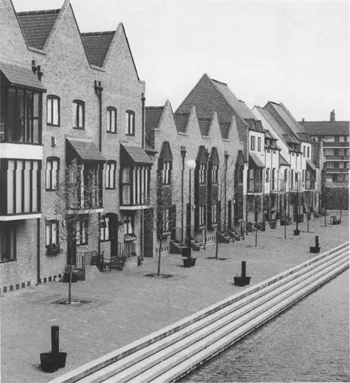
1.1 Housing is essential to quality of life.This example of mixed tenure, mixed income housing in London Docklands is designed by Pinchin Kellow.
who design or manage estates. Opportunities for Change suggests that the ownership of ‘sustainable housing’ must reside in people and tenant groups, not housing providers and their professional advisers. The split between social and private housing does not remove the obligation to talk to those whose communities are being fashioned by designers and developers. Local accountability is the first principle of sustainable housing and professional practices must learn to put the community first—not profit, fees or speed of construction. In theory, local accountability should provide the basis for decisions on design, construction method and layout as well as tenure mix, management and crime prevention strategy.
The professions need to ensure that the 4.1 million
| – | reduces pressure on undeveloped land, especially green belts |
| – | improves viability of public transport |
| – | raises density of cities thereby utilising infrastructure better |
| – | assists social and economic regeneration |
| – | enhances appearance and image of towns |
Source: Adapted from Planning for Sustainable
Development: Towards Better Practice, HMSO, 1998
new homes expected to be created by 2016 are in the right place, of the right type and well integrated with public transport. Location and design are the two key aspects of sustainable housing. New development is not sustainable if it is remote from transport connections and requires private forms of transport to join it to the fabric of society—jobs, shopping, leisure, schools. In fact, it is no longer ethical to engage in such housing given the international and national obligations towards sustainable development. It is also professionally unacceptable to design housing that is energy inefficient, encourages crime, does not provide for disabled access and ignores opportunities for recycling of waste or water
Housing, employment, education and leisure should not be separately zoned activities but integrated into attractive mixed use neighbourhoods. Physical separation has to be replaced by social integration—this is the second principle of sustainability. With integration will come improved levels of energy efficiency because compact development allows heat loss from one building to be the heat gain for another Compaction, high density, connection and liveability are held in mutually supporting cycles of sustainable benefit.
The government’s target of building 60% of new housing on existing developed land has several benefits for society and the design professions. For society, the preservation of green belt land helps preserve an agricultural and leisure resource for the future.Towns that do not coalesce into others keep their identity and this helps maintain social or community fabric. The professions benefit from brownfield site development because of the new specialist skills required—in site reclamation, in designing for the remediation of contamination, and in creating solutions on difficult parcels of land. Dealing with pollution, waste and recycling demands knowledge and skill of a high order So much new housing of recent years has been built on greenfield land that, although developers and architects are accomplished at the design of suburban estates, they have lost the knack of creating human-scaled urban development There are exceptions—Byker in Newcastle, some areas of London Docklands, the Merchant City in Glasgow —but generally the inner city has suffered as developers have targeted the urban fringe.
Too many inner city neighbourhoods are today blighted by traffic, with polluted air and water, and divided by fear Sustainable development offers the prospect of clean, healthy neighbourhoods as long as government, the professions and the building industry rise to the challenge. The urban renaissance brought about by the concept of sustainable development will change practice throughout the industry but it will
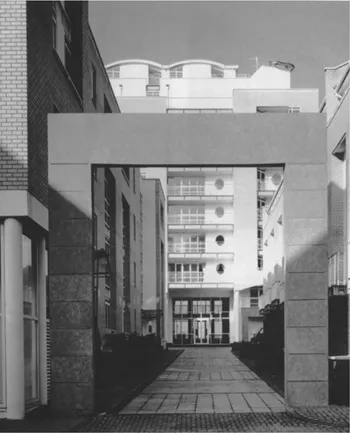
1.2 Density is a prerequisite for sustainable housing. Sufferance Quay in London Docklands by Michael Squire Associates on brownfield land.
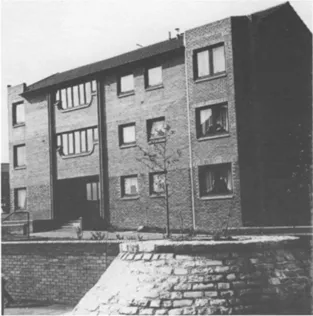
1.3 Robust social housing on brownfield land in central Glasgow.
Architect Glasgow City Council
take time to evolve new models of urban housing, new patterns of integrating living and working, and new ways of using urban design to achieve social integration.
Urban villages are part of the answer but it is important that the suburbanisation of the inner city—so prevalent in Liverpool—is avoided. Compact forms of living, common in France, The Netherlands, Germany and Scotland, are not part of the English way of life. Architects can lead the change in taste by using good design and demonstration projects to signal the cultural shift in favour of sustainability.Work by Urban Splash, the development company based in Manchester, points in the right direction.
The perception of sustainable housing remains a problem. Too often we have good sustainable housing in poor positions and poor housing in good positions. Since housing produces 27% of all CO2 emissions, generating 45 million tonnes of atmospheric carbon per year, it is important that we address residential energy consumption as a priority.The government’s crusade to raise urban densities is part of the answer The DETR report Planning for Sustainable Development suggests that housing densities should rise significantly from around 120 habitable rooms per hectare (HRH) to 225–275 HRH. In some urban areas even densities approaching 1,000 HRH are possible, though taking other factors ...
Table of contents
- Cover
- Half Title
- Full Title
- Copyright
- Contents
- The authors
- Acknowledgements
- Picture credits
- Foreword
- Introduction
- Part one the green context
- Part two case studies
- Part three the future
- Select bibliography
- Index
Trusted by 375,005 students
Access to over 1.5 million titles for a fair monthly price.
Study more efficiently using our study tools.
Frequently asked questions
Yes, you can cancel anytime from the Subscription tab in your account settings on the Perlego website. Your subscription will stay active until the end of your current billing period. Learn how to cancel your subscription
No, books cannot be downloaded as external files, such as PDFs, for use outside of Perlego. However, you can download books within the Perlego app for offline reading on mobile or tablet. Learn how to download books offline
We are an online textbook subscription service, where you can get access to an entire online library for less than the price of a single book per month. With over 1.5 million books across 990+ topics, we’ve got you covered! Learn about our mission
Look out for the read-aloud symbol on your next book to see if you can listen to it. The read-aloud tool reads text aloud for you, highlighting the text as it is being read. You can pause it, speed it up and slow it down. Learn more about Read Aloud
Yes! You can use the Perlego app on both iOS and Android devices to read anytime, anywhere — even offline. Perfect for commutes or when you’re on the go.
Please note we cannot support devices running on iOS 13 and Android 7 or earlier. Learn more about using the app
Please note we cannot support devices running on iOS 13 and Android 7 or earlier. Learn more about using the app
Yes, you can access Sustainable Housing by Brian Edwards, David Turrent, Brian Edwards,David Turrent in PDF and/or ePUB format, as well as other popular books in Architektur & Architektur Allgemein. We have over 1.5 million books available in our catalogue for you to explore.