eBook - ePub
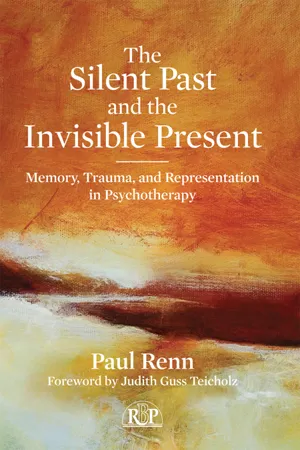
The Silent Past and the Invisible Present
Memory, Trauma, and Representation in Psychotherapy
- 256 pages
- English
- ePUB (mobile friendly)
- Available on iOS & Android
eBook - ePub
The Silent Past and the Invisible Present
Memory, Trauma, and Representation in Psychotherapy
About this book
Drawing on research in the fields of cognitive and developmental psychology, attachment, trauma, and neuroscience, as well as 20 years in forensic and private practice, Paul Renn deftly illustrates the ways in which this research may be used to inform an integrated empirical/hermeneutic model of clinical practice. He suggests that silent, invisible processes derived from the past maintain non-optimal ways of experiencing and relating in the present, and that a neuroscience understanding of the dynamic nature of memories, and of the way in which the implicit and explicit memory systems operate and interact, is salient to a concomitant understanding of trauma, personality development, and therapeutic action. Specifically, Renn argues that an intersubjective psychodynamic model can use the power of an emotionally meaningful therapeutic relationship to gradually facilitate both relational and neurological changes in patients with trauma histories. Taken as a whole, these themes reflect a paradigmatic shift in psychoanalytic thinking about clinical work and the process of change.
Information
Chapter 1
Memory and Freudian Psychoanalysis
INTRODUCTION
The way in which traumatic memories of childhood sexuality influence experience and behavior in later life has been a concern of psychoanalysis since its inception by Freud in the 1890s. This chapter explores the genesis of Freud’s thinking about the repression and recovery of traumatic memories of childhood sexual trauma and sets the scene for the discussion that follows on a contemporary understanding of memory, trauma, and representation.
Freud first conceptualized repression as a form of voluntary dissociation from consciousness of memories associated with emotions that were threatening to the person’s values and ideals. According to Freud’s theory, such memories became dynamically unconscious. His original therapeutic model was one of lifting repression and recovering memories into consciousness. In this context, Freud assumed that the conscious and pre-conscious representation in the internal mental space of an object, person, or event in the external world might become subject to repression. He further assumed that some trace of the external reality would be retained in memory; that a “memory trace” preserves its relation to the object represented through its resemblance to it (1894). By the turn of the century Freud (1900) was drawing a distinction between a pathogenic form of repression aimed at protecting consciousness from disturbing thoughts and feelings, and a normal form of repression that characterized everyday life. Moreover, in a broad sense, he also used the concept to describe the way in which the patient separates conscious awareness from aspects of his or her behavior, rather than as solely relating to the loss of specific memories (Laplanche & Pontalis, 1988). Indeed, contemporary Freudians have widened the concept of repression to include both conscious and unconscious dimensions (Erdelyi, 1994).
Freud, then, used the term memory-trace to denote how real events in early life are inscribed in memory and reappear during the “return of the repressed” in the form of a symptom. Moreover, he viewed nonverbal motor phenomena, as expressed in bodily and affective symptoms, as an unconscious form of memory that is repeated in action (1914). The attempt to overcome repression that has produced a failure of memory and the associated symptoms is one of the major themes in Freudian psychoanalysis. The therapeutic model to which Freud remained attached to the end of his life consisted of trauma/repression/forgetting/symptom/remembering/healing. This model may be seen in “Analysis Terminable and Interminable” (1937) in which Freud argued that, like hysterics, psychotics also suffer from reminiscences, implying that delusional representations were, in fact, the reappearance in consciousness of past experiences that were disguised or unrecognized as such. However, in a now famous letter to Wilhelm Fliess in 1897, Freud apparently repudiated his early belief that traumatic sexual experiences were the sole basis for hysteria.
By 1907 Freud largely took for granted the idea that sexual seduction was often a fantasy-based recollection representing the fulfillment of sexual wishes (Laplanche & Pontalis, 1988). Indeed, commenting on this topic in his “Autobiographical Study” (Freud, 1925, in Gay, 1995), he states: “the neurotic symptoms were not related to actual events but to wishful fantasies and that as far as the neurosis was concerned psychical reality was of more importance than material reality” (p. 111). In this same work, he also questioned whether he had perhaps “forced” the scenes of seduction onto his patients. The shift in Freud’s thinking from a belief in real events was paralleled by an emphasis on the interpretation of dreams, fantasies, and parapraxes (Schwartz, 1999).
Among the various reasons put forward to account for Freud’s repudiation of his seduction theory is the suggestion that he found it more congenial to work with the repression of fantasized sexual abuse rather than with the dissociation of real sexual trauma (Schwartz, 1999). While such motivations must remain in the realm of conjecture, Freud’s later writings reveal that he never fully abandoned his belief in the existence of real childhood experiences of seduction and abuse, nor in the role these experiences played in the aetiology of neuroses (Gay, 1995; Sandler & Sandler, 1997). This notwithstanding, in the wake of the partial renunciation of his seduction theory, it became unfashionable in psychoanalytic circles to attribute psychopathology to real-life experiences (Bowlby, 1984). This has led to an ongoing debate about the complex relationship between memory, fantasy, and reality, and about how to distinguish between true and false memories of childhood sexual abuse. I discuss the disputes surrounding these controversial issues in the concluding part of this chapter.
BREUER AND FREUD’S STUDIES IN HYSTERIA
Freud studied under Jean-Martin Charcot in Paris for four months in 1885–1886. Charcot was working with patients who had unexplained physical symptoms. He concluded that the symptoms were the result of a form of hysteria which had been induced by the patient’s emotional response to a traumatic event. Freud was impressed by Charcot’s work on traumatic hysteria and was also influenced by the thinking of Pierre Janet, who also studied under Charcot. On his return to Vienna and in collaboration with Joseph Breuer, Freud developed the theory that neurosis came about when a traumatic experience led to a process of symptom-formation.
Breuer and Freud acknowledged the influence of Charcot and Janet in their Studies in Hysteria (1895). Indeed, they refer to Janet’s concept of “dissociation” in their “Preliminary Statement” on the origins of hysterical phenomena, stating that the “tendency to dissociation and thereby to the emergence of abnormal states of consciousness … is the fundamental phenomenon of this neurosis” (p. 14). However, whereas Breuer found “dual consciousness” and “hypnoid states” to be compelling explanations of hysteria, Freud favored his concept of repression (Schwartz, 1999). Indeed, in the concluding pages of his case study of Frau Emmy von N., Freud states: “Janet has, I think, wrongly elevated those states resulting from changes in consciousness due to hysteria to the rank of primary conditions of hysteria” (p. 96). Thus, it would seem that the seeds for the more serious dispute that arose between the two men were already being sown.
Breuer and Freud’s original belief in the profound influence of traumatic childhood memories is reflected in their statement that “hysterics suffer for the most part from reminiscences” (p. 11). The first edition of their classic case studies of hysteria was published in 1893 and described five female patients whose conscious memories included experiences of grief and longing for lost or unrequited love, and, in one case, the sexual advances of an uncle/father in adolescence. The patients’ symptoms included tic-like movements, phobias, anorexia, stuttering, disabling fears, intrusive thoughts, and disturbing images.
Freud assumed that sexuality, as the “most powerful of all drives” (p. 95), was the likely source of the patients’ psychical trauma. He also assumed that the repression from consciousness of childhood sexual ideas and experiences was “more liable than any other to give rise to traumas” (p. 94) and therefore likely to play a major role in the pathogenesis of hysteria. Thus, despite the absence of any conscious memories of a traumatic sexual element as, for example, in the case of Freud’s patient, Frau Emmy von N., Freud assumed that such an experience undoubtedly must have occurred and had then been subject to repression. For Freud, the fact that Frau Emmy von N. could not remember the origin of her symptoms of hysteria meant that she had no sense of the causal connections between the precipitating event (sexual seduction) and the pathological phenomenon.
The therapeutic process, as described in Studies, consisted of the patient telling or reliving, retrospectively, her recovered history in conversation. Freud assumed that it was possible, through a process of consciously remembering, to reinterpret a past traumatic event and, thereby, to rid it of its pain and symptomatology. Breuer and Freud then considered that hysterical symptoms represented a mental conflict that could only be resolved through an active process of thinking and talking. Indeed, Breuer’s patient, “Anna O.” (Bertha Pappenheim), labeled this process the “talking cure,” a conversational process resulting in the modification of repressed memories.
Freud referred to this aspect of therapeutic action in a letter to Wilhelm Fliess in 1896, a year after the publication of the second edition of Studies. He used the term Nachträglichkeit to describe a form of deferred action by which the patient’s clinical material, in the form of memory traces, may be revised and rearranged at a later date to fit in with new experiences and thus be endowed with a new meaning and psychic efficiency. Indeed, Freud eventually came to acknowledge that every perception, every memory trace, and, therefore, every representation is “constructed” by the dynamics of the psyche itself and undergoes a constant process of retroactive reworking (Laplanche & Pontalis, 1988).
Freud’s thinking with regard to Nachträglichkeit may be seen in Studies in which he speaks of old events being newly translated and taking on a different significance at a later point. However, while initially Breuer and Freud considered that a disturbing reminiscence would vanish and not return if it had been talked away, the second edition of Studies concluded with the more modest promise that all analysis could do was try to transform “hysterical misery into common unhappiness” (p. 306). Freud subsequently developed his theories independently of Breuer. Indeed, the relationship between the two men grew increasingly strained because of their differences in style. Whereas Freud considered Breuer too cautious in developing theoretical formulations, Breuer, for his part, saw Freud as a man of fixed ideas and huge, presumptuous generalizations (Schwartz, 1999).
With respect to Freud’s theory of “infantile amnesia,” he did not consider this to be the result of any functional inability of the young child to record his or her impressions; instead, he attributed the absence of memories of early childhood to the repression of infantile sexuality (1905a). Similarly, he argued that “screen memories” are recollections that conceal repressed memories of sexual experiences or fantasies, viewing such memories as representing the forgotten years of childhood. Indeed, in “Remembering, Repeating, and Working-Through” (1914), Freud contends that all of what is essential, but which has been forgotten from childhood, has been retained in screen memories. However, he found it paradoxical that, whereas important events from childhood are not remembered, apparently insignificant memories, in the form of screen memories, sometimes are. Reflecting on childhood memories in particular, and on the origins of conscious memories in general, Freud (1899, in Gay, 1995) suggests that perhaps we do not have “memories at all from our childhood,” but rather that what we possess are “memories relating to our childhood” (p. 126, emphasis in original). He conceptualized the defensive process involved in screen memories as a “compromise-formation,” seeing this process as condensing a large number of real or fantasy childhood elements which became subject to repression and displacement.
Freud, then, argued that screen memories, infantile amnesia, and hysterical amnesia are formations produced by a compromise between repressed elements and defense against them, suggesting that the interpretation of screen memories leads back to indelible childhood experiences of a sexual nature (Laplanche & Pontalis, 1988). However, in “Inhibitions, Symptoms and Anxiety” (1926), Freud refers to “primal repression,” conceptualizing this as a fixation that exerts a continuous after-pressure on repression proper or secondary repression. He considered it unlikely that primal repression is derived from the superego, as this psychical agency develops subsequent to primal repression. Rather, primal repression should probably be sought in very intense archaic experiences, which, by their very nature, have broken through the protective shield against stimuli. Lacan (1993) subsequently theorized primal repression as a form of memory that remains inaccessible to the person. In this sense, primal repression and the theory that repetitive actions are a form of unconscious memory (Freud, 1914, 1926) may be seen as having certain phenomenological features in common with the performative and enactive features of implicit memory (Reis, 2009a). Moreover, Fonagy and Target (1997) argue that screen memories may be conceptualized as a manifestation of the implicit–procedural memory system “which can achieve no other phenomenal representation” (p. 215).
As noted above, Freud’s patient, Frau Emmy von N., had no conscious memories of sexual seduction to account for her symptoms of hysteria, but Freud assumed that such an experience must have occurred (Freud & Breuer, 1895). In so doing, he appears to have minimized the significance of her experience of multiple bereavements, which he describes in great detail in the case study. The clinical material in the case of “Dora” (Ida Bauer), who commenced an analysis with Freud in 1900, was quite different from that of Frau Emmy von N. in that she reported conscious memories of sexual seduction by Herr K., who was a neighbor and friend of the family (1905b). Freud accepted Dora’s story and seems to have been fully aware that her father had handed her over to Herr K., using her as currency in his sexual barter with the latter so that his liaison with Frau K. could continue undisturbed (Mitchell, 1993). Freud was also of the opinion that Herr K.’s seductive behavior towards Dora had caused the psychical trauma prerequisite for the production of hysterical symptoms.
However, despite knowing and accepting the details of Dora’s sexual trauma, Freud’s theoretical frame led him to focus on intrapsychic neurotic conflict. Thus, the root of the problem for Freud was Dora’s unconscious infantile sexual fantasies and impulses towards her father. He concluded that these repressed instinctual wishes had returned and that Dora was defending against the knowledge that she loved and desired her father and Herr K. For Freud (1905b), Dora’s cure was dependent on her awareness and acceptance of her repressed infantile sexual and aggressive fantasies and impulses. Once these childhood amnesias had become conscious, they could be made subject to rational, realistic control.
Mitchell (1993), on looking at the study from the vantage point of relational psychoanalysis, articulates our surprise at the lack of acknowledgement that Freud accorded Dora’s subjective experience of sexual abuse. However, he observes that it is easy to criticize the case study when taken out of its own conceptual and historical context. Given this, he argues that Freud’s model of the analytic process and set of theoretical premises concerning human knowledge and subjectivity made sense in his day. Indeed, as we have seen, Freud was well aware of the fact that Dora had been mistreated and seduced by Herr K., but, as Mitchell emphasizes, he (Freud) did not think this mattered as far as the analytic process was concerned. It may be thought that Mitchell’s apologia of Freud’s theory and practice from an historical perspective would be more compelling were it not for a contemporary critique of Freud’s theory and methodology by Janet, as discussed below.
MEMORY DISPUTES IN PSYCHOANALYSIS
Janet made a public critique of Freud and psychoanalysis in a paper given at the 17th International Congress of Medicine in London in 1913. In a similar vein to Breuer, Janet criticized Freud for making unrestricted generalizations about sexuality, and for what he saw as Freud’s tendency to select evidence to support his theories. He suggested that Freud’s eagerness to link hysterical trauma to repressed sexual wishes led to a subordination of obvious grief trauma. Thus, the symptoms deriving from the trauma of loss were instead interpreted in terms of frustrated unconscious sexuality (Janet, 1913, in Brown & van der Hart, 1998). This would appear to describe precisely Freud’s thinking and approach in his work with Frau Emmy von N. (Freud & Breuer, 1895). Indeed, Janet’s critique of Freud is supported by Israels and Schatzman (1993), whose close reading of The Aetiology of Hysteria (Freud, 1896) led them to conclude that his patients had not actually reported scenes of sexual seduction to him, but that Freud had imposed such stories onto them.
More specifically, Janet (1913, in Brown & van der Hart, 1998) argued that in most cases involving sexual trauma, the trauma is readily reported by the patient and thus does not need interpreting. It may be accepted that this was the clinical situation in the case of Dora. However, Janet conceded that in other cases the trauma may need to be uncovered, but he emphasized that in some instances the patient would be unable to recall memories of sexual trauma of any kind. Furthermore, as noted above, Janet held the view that hysteria may derive from nonsexual trauma, a position espoused by Charcot as well. Janet also criticized Freud for substituting repression for dissociation, arguing that repression is an active, independent process that results in dissociation, and that dissociation provides a more powerful explanation of the subconscious character of traumatic memories.
In Chapters 3 and 4, I elaborate on the way in which dissociated traumatic memories encoded in implicit memory may be expressed as sensory perceptions and affect states, and be reactivated and reenacted under state-specific trigger conditions. The concluding section of this chapter, however, examines the competing claims regarding the truth or falsity of childhood sexual abuse (CSA).
The dispute that arose between Freud and Janet at the beginning of the 20th century led to the two men going their separate ways. In the decades following Freud’s partial recantation of his seduction theory in 1897, interest in sexual abuse and sexual trauma waned and became something of a taboo subject (Bowlby, 1988). A notable exception to this trend was Ferenczi (1933), who complained about the neglect in psychoanalysis of such traumatic factors. In a paper given in Wiesbaden in 1932, he stated: “The sexual trauma, as the pathogenic factor cannot be valued highly enough. Even children of very respectable, sincerely puritanical families, fall victim to real violence or rape much more often than one had dared to suppose” (p. 161). However, it was not until the mid-1980s that the issue of sexual trauma erupted with full force. This was in a context of mounting evidence showing widespread sexual abuse of children in the domestic arena, and for the partial or complete amnesia of such abuse (Herman, 1981). Entrenched positions regarding the truth or falsity of such memories evolved with, on the one side, the recovered memory movement and on the other, those who regarded “recovered memories” as constituting a “false memory syndrome.”
As Webster (1995) points out, a crucial factor in the rise of the recovered memory movement was the extensive denial of the reality of CSA among lawyers and mental health professionals throughout most of the twentieth century. This made it extremely difficult for women and children to gain a hearing for accusations of sexual assault by men. This situation began to change with the rise of the second wave of feminism in the 1980s, as a result of which women felt more able to disclose their histories of sexual abuse in the knowledge that therapists were prepared to listen to their stories and believe them.
Whi...
Table of contents
- Cover
- Halftitle
- Title
- Copyright
- Dedication
- Contents
- Foreword
- Acknowledgments
- Introduction
- 1 Memory and Freudian Psychoanalysis
- 2 The Two Main Memory Systems: A Neuroscience Perspective
- 3 Contemporary Perspectives on Psychological Trauma and Affect Regulation
- 4 Memory, Trauma, and Dissociation: The Reemergence of Trauma-Related Childhood Memories
- 5 Psychoanalysis and the Internal World: How Different Theories Understand the Concept of Mind
- 6 Attachment and Intersubjectivity: Developmental Perspectives on the Internal World
- 7 A Contemporary Relational Model: Integrating Attachment, Trauma, and Neuroscience Research
- 8 Intersubjectivity, Attachment, and Implicit Memory: The Development of Representational Models
- 9 Attachment, Trauma, and Intimate Violence
- 10 Brief, Time-Limited Psychodynamic Psychotherapy: A Case of Intimate Violence From a Forensic Setting
- 11 The Role of Explicit and Implicit Memory in Therapeutic Action
- References
- Index
Trusted by 375,005 students
Access to over 1.5 million titles for a fair monthly price.
Study more efficiently using our study tools.
Frequently asked questions
Yes, you can cancel anytime from the Subscription tab in your account settings on the Perlego website. Your subscription will stay active until the end of your current billing period. Learn how to cancel your subscription
No, books cannot be downloaded as external files, such as PDFs, for use outside of Perlego. However, you can download books within the Perlego app for offline reading on mobile or tablet. Learn how to download books offline
Perlego offers two plans: Essential and Complete
- Essential is ideal for learners and professionals who enjoy exploring a wide range of subjects. Access the Essential Library with 800,000+ trusted titles and best-sellers across business, personal growth, and the humanities. Includes unlimited reading time and Standard Read Aloud voice.
- Complete: Perfect for advanced learners and researchers needing full, unrestricted access. Unlock 1.5M+ books across hundreds of subjects, including academic and specialized titles. The Complete Plan also includes advanced features like Premium Read Aloud and Research Assistant.
We are an online textbook subscription service, where you can get access to an entire online library for less than the price of a single book per month. With over 1.5 million books across 990+ topics, we’ve got you covered! Learn about our mission
Look out for the read-aloud symbol on your next book to see if you can listen to it. The read-aloud tool reads text aloud for you, highlighting the text as it is being read. You can pause it, speed it up and slow it down. Learn more about Read Aloud
Yes! You can use the Perlego app on both iOS and Android devices to read anytime, anywhere — even offline. Perfect for commutes or when you’re on the go.
Please note we cannot support devices running on iOS 13 and Android 7 or earlier. Learn more about using the app
Please note we cannot support devices running on iOS 13 and Android 7 or earlier. Learn more about using the app
Yes, you can access The Silent Past and the Invisible Present by Paul Renn in PDF and/or ePUB format, as well as other popular books in Psychology & Cognitive Neuroscience & Neuropsychology. We have over 1.5 million books available in our catalogue for you to explore.