- 240 pages
- English
- ePUB (mobile friendly)
- Available on iOS & Android
eBook - ePub
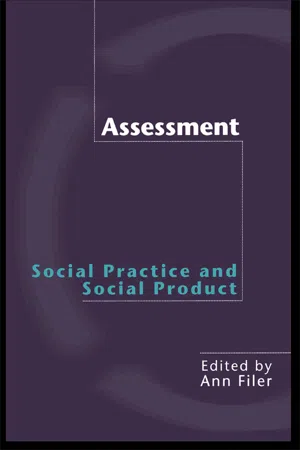
Assessment: Social Practice and Social Product
About this book
Assessment has become one of the most significant areas of interest in educational policy development, as well as the focus of complex political, economic and cultural expectations for change. Increasingly, governments worldwide have become aware that curricula and teachers can be indirectly controlled through programmes of assessment. Opponents of centralized systems of mass assessment claim they are ill-suited to the diverse and changing needs of learners and users of assessment. In this text, the UK and US writers take the reader beyond the obvious functions of assessment, and focus upon the roles it performs in the social structuring of society. They examine the myths and assumptions that underpin assessment and testing and draw attention to its cultural context. This collection is devoted explicitly to socio-cultural studies of assessment and attempts to map the terrain of some 30 years of study in the field. Chapters are organized thematically, with background text providing comparative perspectives, key issues and further reading. The book provides a wide-ranging, structured and accessible approach to the study of socio-cultural origins and impacts of assessment.
Information
Part I
Socio-Historical and Cultural Contexts of Assessment Policy
Editor’s Introduction
Ann Filer
Some Roles of Assessment in Modern Societies
Educational assessment fulfils a wider range of functions within modern societies than is generally recognized. Most political and public debate concerning assessment revolves around a limited number of purposes for assessment concerned with grading, selection and accountability. These purposes are generally associated with a nation’s need to promote the knowledge and skills deemed necessary for current and anticipated economic, national-cultural and personal-social development. However, notwithstanding any shared perceptions at this general level that different nations might have regarding the purposes and desired outcomes of assessment, the particular systems for mass testing that they employ to meet such ends are often starkly different. A simple comparison of some key assessment traditions in the United States and England serves to make the point. The status of public examination systems has remained particularly entrenched in the English education system, as has trust in their powers to predict future occupational success (Broadfoot 1996). Historically, the emphasis in England has been on functions of certification and the progressive segregation and selection of students. This traditional emphasis remains in place alongside, although increasingly conflicting with, a more recent emphasis on schools’ accountability for raising ‘standards’ for all, and on the concept of ‘lifelong learning’ (see Chapter 1). The history of mass education in the United States has seen much less overt emphasis on selecting educational elites than has been the case in England. Rather, its prime concerns have been with assessment for accountability and for monitoring and driving up ‘standards’ (see also Chapter 10). Underlying these historic concerns in the USA has been the expectation that schooling should function to socially integrate large immigrant populations into a common American identity. In that context, machine-scorable ‘multiple choice’ tests have prevailed, arising from the desire to collect ‘objective’ data for routinely monitoring and comparinglarge numbers of students, schools and educational districts cheaply and efficiently.
These examples, though brief and simplified, serve to illustrate some ways in which systems of assessment are more than a function of currently conceived educational and economic needs. Assessment processes and their educational and social outcomes are analysable as products of nations’ histories, cultures and shifting political imperatives. To examine systems of assessment in this way, to perceive them as socio-historical and cultural processes and products as well as educational processes and products, serves as a starting point for a broader conception of the functions of assessment. That is to say, they take us beyond the more obvious functions of grading or certification, selection and accountability, and focus our attention upon the key role that assessment plays in the social structuring of modern societies.
Because systems of assessment are required to fulfil complex roles in modern societies, there is frequently a mismatch between policy intentions and outcomes. For example, contrasting with the intentions described above, many people argue that frequent mass testing in American schools has actually served to compound and perpetuate educational and social disparity, rather than alleviate it (see for example, US Congress, Office of Technology Assessment 1992; Darling-Hammond 1994). In Chapter 2 can be found an example of this concern. There, Mark LaCelle-Peterson reveals ways in which policy and test technologies embody hidden values such that they fail to represent the broad range of educational experience and needs of students. He reveals that the number and proportion of students whose first language is not English are increasing in US schools. It would be thought, he argues, that the needs of such students would figure largely within a system that is seeking to improve academic standards. Yet ‘standards’ are being pursued through the expansion of large-scale, undifferentiated assessment programmes, a policy which assumes that learners are a homogenous population. LaCelle-Peterson discusses ways in which tests, inappropriately structured for English-language learners, with culturally inappropriate knowledge content, serve to limit and distort rather than reveal the attainments of language minorities. They serve to obscure the educational needs of such pupils rather than support them. Readers will find further discussions of the relationship between inequitable assessment outcomes and factors relating to social class, gender and racial or cultural difference throughout this book.
Thus studies of the role of mass assessment in compounding and perpetuating educational and social disparities help to illuminate the relationship between assessment and processes of social reproduction. They explore ways in which assessment policy and technical practices derive from, and help perpetuate, forms of knowledge associated with the most powerful social, cultural and political groups in societies. That is, systems of national assessment can be seen as an expression of the cultural capital (Bourdieu and Passeron 1977) that underpins and legitimizes the reproduction of social and power elites in modern societies.
Postmodern Perspectives and Implications This latter concern, relating to the role of assessment in legitimizing socially inequitable outcomes, is explored further in Part II.
Contradictions and Tensions in Current Assessment Policies
As I have described above, systems of mass assessment are required to fulfil complex and often contradictory roles in modern societies. In Chapter 1, Patricia Broadfoot and Andrew Pollard illustrate the tensions and contradictions arising from the incompatible requirements of current UK educational policy making. Their chapter also connects with important issues concerning the kinds of learning that societies wish to encourage and how that learning is assessed (see also Broadfoot 1998a, 1998b). Contrary to popular conceptions, assessment is not something that follows and is separable from learning. Rather, assessment shapes institutional learning. Different forms of assessment influence what is taught and how it is taught, what and how students learn. Throughout the twentieth century, many educationists have deplored the effects of public examinations on the quality of learning in English schools. Systems of assessment have been criticized for putting a premium on the reproduction of knowledge and passivity of mind at the expense of critical judgement and creative thinking (Broadfoot 1996:175). Since the introduction of multiple-choice tests into American schools in the 1930s, they have been criticized for encouraging teachers to set tasks that promote de-contextualized rote learning and that narrow the curriculum to basic skills with low cognitive demands (Kellaghan and Madaus 1991; Darling-Hammond 1994; Herman et al. 1997). Recently, moreover, the learning needed for employment in post-industrial societies is being conceptualized in new ways. The proliferation of service industries and the changing character of work have created demands for transferable skills such as those of communication, information retrieval, problem solving, critical analysis, self-monitoring and self-assessment. As a result, we see a fast growing interest in the more formative, holistic, contextualizedforms of assessment, often described under the umbrella terms of ‘authentic’ or ‘performance’ assessment. In vocational training, these are often referred to as ‘competence-based’ assessment. It remains the case, however, that traditional forms of assessment are not easily replaced, embedded as they are in complex histories, cultures and power relations of societies. Further, as Broadfoot(1988a:473) argues, these traditional forms with their emphasis on scientific rationality (see Part II) are so pervasive in modern societies that they blind us to the potential for alternative forms of assessment.
Thus in the chapter from Broadfoot and Pollard, we see ways in which the UK government maintains policies aimed at ‘raising standards’ alongside developing those aimed at encouraging ‘lifelong learning’. Both ‘standards’ and ‘lifelong learning’ are seen as key requirements for strengthening and maintaining a competitive UK economy. Yet as Broadfoot and Pollard show, there are very real contradictions between the forms of assessment needed to support these two different government policy initiatives. Hence, like governments worldwide, the
UK government continues to struggle to meet increasingly diverse and complex requirements for assessment. At the same time, it fails to address the inevitable tensions, contradictions and unintended, inequitable outcomes which flow from the policies it promotes.
Suggestions for Further Reading
Patricia Broadfoot in Education, Assessment and Society provides an in-depth sociological and historical analysis of the role of assessment in modern educational systems and societies through a comparison of England and France.
For a comparison of testing in the United States and other industrialized nations, including England and Wales, see Chapter 5, ‘How Other Countries Test’, in Testing in American Schools: Asking the Right Questions. Chapter 7, ‘Performance Assessment: Methods and Characteristics’, provides a useful background to the development of new forms of testing and the implementation of change in the USA. Assumptions that new forms of assessment will provide more equitable outcomes than traditional forms of testing in American schools are examined by US writers in the Harvard Educational Review (64(1)) symposium: ‘Equity in Educational Assessment’.
A background to the development of authentic testing in England and Wales, together with some problems and possibilities in implementing new approaches, is explored in Evaluating Authentic Assessment, edited by Harry Torrance.
References
Bourdieu, P. and Passeron, J.C. (1977) Reproduction, London: Sage.
Broadfoot, P. (1996) Education, Assessment and Society, Milton Keynes: Open University Press.
——(1998a) ‘Records of Achievement and the Learning Society: a Tale of Two Discourses’, Assessment in Education 5(3):447–77.
——(1998b) ‘Quality Standards and Control in Higher Education: What Price Life-Long Learning’, International Studies in Sociology of Education 8(2):155–80.
Darling-Hammond, L. (1994) ‘Performance-Based Assessment and Educational Equity’, Harvard Educational Review, Symposium: Equity in Educational Assessment, 64(1):5– 29.
Herman, J.L., Klein, D.C.D. and Wakai, S.T. (1997) ‘American Students’ Perspectives on Alternative Assessment: Do They Know It’s Different?’, Assessment in Education 4(3):339–52.
Kellaghan, T. and Madaus, G.F. (1991) ‘National Testing: Lessons for America from Europe’, Educational Leadership 49:87–93.
Europe’, Educational Leadership 49:87–93. Torrance, H. (ed.) (1995) Evaluating Authentic Assessment, Milton Keynes: Open University Press.
US Congress, Office of Technology Assessment (1992) Testing in American Schools: Asking the Right Questions, OTA-SET-519, Washington DC: US Government Printing Office, February.
1 The Changing Discourse ofAssessment Policy
The Case of English Primary Education
Patricia Broadfoot and Andrew Pollard
Introduction
The changing focuses of English education policy in the 1990s can be seen as a reflection of the complexities arising from the postmodern challenge to the established thinking and practices of late modernity. This challenge, and reactivity to challenge, has given rise to new priorities, new forms of contestation and regulation and new forms of discourse across post-industrial nations worldwide in the closing decades of the century. In this chapter we explore the nature of contemporary educational discourse, taking English primary schooling as a case study of some of the underlying trends and tensions in society. In particular, we focus on the significance of the gradual establishment of a new hegemony of ‘performance’1 which, though first established by ‘New Right’ Conservatives, has survived a change in governing party. The first part of this chapter presents a brief overview of some of the key elements of the legislative reforms of the early 1990s and the particular concatenation of historical and political circumstances which gave rise to them. Moving beyond this, we then draw on Bernstein’s work to highlight underlying consequences concerning school management, teacher professionalism and teaching and learning itself. Finally, in particular relation to the present New Labour government, we highlight the tension which exists between parallel discourses of ‘performance’ and ‘lifelong learning’. Given the power differentials between teacher and taught embedded in these forms of discourse, we speculate on some outcomes at the level of social product and practice.
Primary education in England and Wales will never be the same again. The decade of unremitting change which followed the 1988 Education Reform Act— the most significant piece of educational legislation in half a century—has ensured that this is so. By the late 1990s, as the major wave of new policy initiatives began to ebb, it revealed a shoreline in which many of the principal features had been rearranged: the role of the headteacher and the way schools are managed; teachers’ priorities and ways of working together; teaching methods and curriculum content. Perhaps to the casual observer, classroom practices and the activities of teachers and pupils appeared to have changed little. The constants of classrooms everywhere—talk, activity, display, a single teacher occupied with a large group of children— these are the defining characteristics of formal education today across the globe. Though it is possible that these too will begin to evolve as the technological developments of the information society become translated into institutional practice, for the present, schools and teachers, pupils and lessons are constants which we both recognize and understand, a familiar feature of our contemporary culture. It is all the more difficult, then, to appreciate the subtle yet profound redefining of the educational project that the last ten years has produced in English primary schools: the changes in relationships between headteacher and staff and between teachers themselves and between teachers and their pupils, and the product of these changes in terms of different attitudes, different goals, different concerns and different skills. This is an education system in which teachers’ priorities in practice reflect a hard-won, and often still uneasy, compromise between new obligations and an enduring vision that has its roots in a different era.
The Primary Assessment, Curriculum and Experience (PACE) project was established in 1989 to monitor the impact of the momentous changes then being put in place following the passing of the 1988 Education Reform Act. Funded by ESRC in three stages (1989–92; 1992–4 and 1994–7), the PACE project was uniquely placed to document the unfolding story of change in primary schools and, in particular, to analyse the impact of the new National Curriculum and Assessment requirements on headteachers, teachers and pupils. In 1994 we described the PACE project as ‘one of the many stepping stones in the quest to understand the nature of the educational enterprise and hence, how to provide for it most effectively’ (Pollard et al. 1997:4). Thus our research has been designed to help understand the origin and significance both of the policy initiatives imposed by Government and those which were the product of the attempts by teachers and headteachers to reconcile these requirements with their professional values and understandings. Why were these policy initiatives set in motion in the England of the late 1980s, and what, ultimately, is likely to be their significance for the nature and quality of pupils’ learning? How can a case study of English primary education, and the way in which assessment is approached, illuminate more widespread changes in the power relations and modes of control of modern societies at the end of the century?
The Context for Change
Until the current National Curriculum was introduced, the only formal control of the content of education in English primary schools concerned the requirement to teach religious education, which was specified in the 1944 Education Act. Historically, England seems to have been unique in not having a national curriculum. Instead, it has traditionally relied on various kinds of assessment, particularly public examinations, to control the system. As in other countries, the existence of so called ‘high-stakes’ public examinations of 11-plus, 16-plus and 18-plus had provided a powerful focus for schools which were otherwise free to
make their own decisions about content. However, there was a well recognized problem in providing coherence and continuity in the curriculum, with the result that children were sometimes exposed to the same curriculum content on several occasions. Entitlement and quality were also pressing issues (HMI 1978). Thus, one of the main stimuli for the introduction of a national curriculum was the desire to provide a broad, balanced and coherent curriculum for children aged between 5 and 16.
This concern had developed through the 1970s and 1980s from a sustained critique and sequence of moral panics concerning ‘progressive’ educational practices, an interpretation of the official recommendations o...
Table of contents
- Cover Page
- Title Page
- Copyright Page
- llustrations
- Preface
- Acknowledgements
- Introduction
- Part I: Socio-Historical and Cultural Contexts of Assessment Policy
- Part II: Technologies of Testing
- Part III: Classroom Contexts of Assessment
- Part IV: Assessment as Lived Experience Beyond the Classroom
- Part V: Postmodern Perspectives and Implications for Assessment Practice
- Contributors
Trusted by 375,005 students
Access to over 1.5 million titles for a fair monthly price.
Study more efficiently using our study tools.
Frequently asked questions
Yes, you can cancel anytime from the Subscription tab in your account settings on the Perlego website. Your subscription will stay active until the end of your current billing period. Learn how to cancel your subscription
No, books cannot be downloaded as external files, such as PDFs, for use outside of Perlego. However, you can download books within the Perlego app for offline reading on mobile or tablet. Learn how to download books offline
Perlego offers two plans: Essential and Complete
- Essential is ideal for learners and professionals who enjoy exploring a wide range of subjects. Access the Essential Library with 800,000+ trusted titles and best-sellers across business, personal growth, and the humanities. Includes unlimited reading time and Standard Read Aloud voice.
- Complete: Perfect for advanced learners and researchers needing full, unrestricted access. Unlock 1.5M+ books across hundreds of subjects, including academic and specialized titles. The Complete Plan also includes advanced features like Premium Read Aloud and Research Assistant.
We are an online textbook subscription service, where you can get access to an entire online library for less than the price of a single book per month. With over 1.5 million books across 990+ topics, we’ve got you covered! Learn about our mission
Look out for the read-aloud symbol on your next book to see if you can listen to it. The read-aloud tool reads text aloud for you, highlighting the text as it is being read. You can pause it, speed it up and slow it down. Learn more about Read Aloud
Yes! You can use the Perlego app on both iOS and Android devices to read anytime, anywhere — even offline. Perfect for commutes or when you’re on the go.
Please note we cannot support devices running on iOS 13 and Android 7 or earlier. Learn more about using the app
Please note we cannot support devices running on iOS 13 and Android 7 or earlier. Learn more about using the app
Yes, you can access Assessment: Social Practice and Social Product by Ann Filer in PDF and/or ePUB format, as well as other popular books in Education & Education General. We have over 1.5 million books available in our catalogue for you to explore.