eBook - ePub
Construction Ecology
Nature as a Basis for Green Buildings
- 336 pages
- English
- ePUB (mobile friendly)
- Available on iOS & Android
eBook - ePub
Construction Ecology
Nature as a Basis for Green Buildings
About this book
Industrial ecology provides a sound means of systematising the various ideas which come under the banner of sustainable construction and provides a model for the design, operation and ultimate disposal of buildings.
Information
1 Defining an ecology of construction
Charles J. Kibert, Jan Sendzimir, and G. Bradley Guy
The construction and operation of the built environment has disproportionate impacts on the natural environment relative to its role in the economy. Although it represents about 8% of gross domestic product (GDP) in the USA, the construction sector consumes 40% of all extracted materials, produces one-third of the total landfill waste stream, and accounts for 30% of national energy consumption for its operation. The sustainability of this industrial sector is dependent on a fundamental shift in the way in which resources are used, from non-renewables to renewables, from high levels of waste to high levels of reuse and recycling, and from products based on lowest first cost to those based on life cycle costs and full cost accounting, especially as applied to waste and emissions from the industrial processes that support construction activity. Construction, like other industries, would benefit from observing the metabolic behavior of natural systems, in which sustainability is a property of a complex web of niche elements. The emerging field of industrial ecology, which is examining Nature for its lessons for industry, provides some insights into sustainability in the built environment or sustainable construction. This book proposes and outlines the concept of construction ecology, a view of construction industry based on natural ecology and industrial ecology for the purpose of shifting construction industry and the materials and manufacturing industries supporting it onto a path much closer to the ideals of sustainability. Additionally, construction ecology would embrace a wide range of symbiotic, synergistic, built environment–natural environment relationships to include large-scale, bioregional, “green infrastructure” in which natural systems provide energy and materials flows for cities and towns and the human occupants provide nutrients for the supporting ecological systems.
Introduction
Ecosystems are the source of important lessons and models for transitioning human activities onto a sustainable path. Natural processes are predominantly cyclic rather than linear; operate off solar energy flux and organic storages; promote resilience within each range of scales by diversifying the execution of functions into arrays of narrow niches; maintain resilience across all scales by operating functions redundantly over different ranges of scale; promote efficient use of materials by developing cooperative webs of interactions between members of complex communities; and sustain sufficient diversity of information and function to adapt and evolve in response to changes in their external environment. A variety of approaches to considering the application of natural system design principles to the industrial subsystem of human activities is emerging to help redesign the conduct of a linear economy based largely on the consumption of nonrenewable resources.
Industrial ecology is an emerging discipline that is laying the groundwork for adapting ecosystem models to the design of industrial systems. In more recent thinking, industrial ecology is being redefined and extended to include industrial symbiosis, design for the environment (DFE), industrial metabolism, cleaner production, eco-efficiency, and a host of other emerging terms describing properties of a so-called “eco-industrial system.” Industrial symbiosis refers to the use of lessons learned from the observation of ecosystem behavior to make better use of resources by using existing industrial waste streams as resources for other industrial processes. An emerging discipline, DFE is altering the design process of human artifacts to enhance the reuse and recycling of material components of products. Industrial metabolism examines the inputs, processes, and outputs of industry to gain insights into resource utilization and waste production of industry, with an eye toward improving resource efficiency. Cleaner production is the systematic reduction in material use and the control and prevention of pollution throughout the chain of industrial processes from raw material use through product end of life (Business and the Environment 1998). Eco-efficiency calls on companies to reduce the material and energy output of goods and services, reduce toxic waste, make materials recyclable, maximize sustainable use of resources, increase product durability, and increase the service intensity of goods and services (Fiksel 1994).
Construction and operation of the built environment in the countries in the Organization for Economic Cooperation and Development (OECD), i.e. the major industrial countries, accounts for the greatest consumption of material and energy resources of all economic sectors and could benefit the most from employing natural systems models. Within the framework being defined by industrial ecology, construction industry would be well served by the definition of a subset, construction ecology, that spells out how this industry could achieve sustainability, both in the segment that manufactures the products that constitute the bulk of modern buildings and in the segment that demolishes existing buildings and assembles manufactured products into new or renovated buildings. As is the case with other industrial systems, construction would be aided in this effort by an examination of its throughput of resource, i.e. its “metabolism.”
This chapter examines the potential for construction industry to incorporate the lessons learned from both natural systems and the emerging field of industrial ecology, primarily in its materials cycles, but also at larger scale for regional energy and materials flows. It also explores the issue of dematerialization and its relevance to the built environment. In many respects, the construction industry is no different from other industrial sectors. However, there are enough differences, especially the long lifetime and enormous diversity of products and components constituting the built environment, that it requires special attention and treatment. Consequently, attempts to apply ecology to this industry and to understand its metabolism present some unique problems not encountered in other industrial sectors.
Construction industry compared with other industrial sectors
Buildings, the most significant components of the built environment, are complex systems that are perhaps the most significant embodiment of human culture, often lasting over time measured in centuries. Architecture can be a form of high art, and great buildings receive much the same attention and adoration as sculpture and painting. Their designers are revered and criticized in much the same manner as artists. This character of buildings as more than mere industrial products differentiates them from most other artifacts. Their ecology and metabolism is marked by a long lifetime, with large quantities of resources expended in their creation and significant resources consumed over their operational lives.
The main purpose of the built environment is to separate humans from natural systems by providing space for human functions protected from the elements and from physical danger. Modern buildings have increased the sense of separation from the natural climatic processes and have made the underlying biological and chemical processes of Nature irrelevant for their occupants. Until humans achieved space travel, the extraction and conversion of materials for building construction was the most powerful expression of humankind’s dominance over bioclimatic and material constraints. This has. in turn. created an ecological illiteracy and had profound psychological and human health impacts (Orr 1994). Concentrations of buildings affect microclimate (heat islands), hydrology (run-off), soils and plants (suffocation and compression), and create false natural habitats (nests on buildings). This increasing separation of ecological feedback loops inherent in the design, construction, and use of buildings since the Industrial Revolution has influenced many architects to reconsider this de-evolutionary and unsustainable path. The construction industry is extremely conservative and subject to slow rates of change because of regulatory and liability concerns as well as limited technology transfer from other sectors of society. The extended chain of responsibility and the separation of responsibilities for manufacturing materials, design and construction, operations and maintenance, and eventual adaptation or disposal have resulted in a breakdown of feedback loops among the parties involved in creating and operating the built environment.
Modern buildings, although products of industrial societies, are perhaps unique among modern technologies in terms of the diversity of components, unlimited forms and content, waste during the production process, land requirements, and long-term environmental impacts. In the USA, the construction industry, although representing only 8% of GDP, uses in excess of 40% of all extracted materials resources in creating buildings (Wernick and Ausubel 1995), which consume 30% of total US energy production in their operation. It is estimated that as much as 90% of the extracted stock of materials in the USA is contained in the built environment, making it a potential great resource or a future source of enormous waste.
The built environment interacts with the natural environment at a variety of levels. Individual structures may affect only their local environment, but cities can have an impact on the regional environment, by affecting the weather through changes in the Earth’s albedo (Wernick and Ausubel 1995) and other surface characteristics, altering natural hydrologic cycles, and degrading air, water, and land via the emissions of their energy systems, as well as through the behavior of their inhabitants.
Buildings can be distinguished from other artifacts by their individuality and the wide variety of constituent parts. Buildings are assembled from a wide array of components that can be generally divided into five general categories:
- manufactured, site-installed commodity products, systems, and components with little or no site processing (boilers, valves, electrical transformers, doors, windows, lighting, bricks);
- engineered, off-site fabricated, site-assembled components (structural steel, precast concrete elements, glulam beams, engineered wood products, wood or metal trusses);
- off-site processed, site-finished products (cast-in-place concrete, asphalt, aggregates, soil);
- manufactured, site-processed products (dimensional lumber, drywall, plywood, electrical wiring, insulation, metal and plastic piping, ductwork);
- manufactured, site-installed, low mass products (paints, sealers, varnishes, glues, mastics).
Each of these categories of building components has an influence on the potential for reuse or recycling at the end of the building’s useful life and the quantity of waste generated during site assembly. Category 1 components, because they are manufactured as complete systems, can be more easily designed for remanufacturing, reuse, and disassembly, and thus have a excellent potential for being placed into a closed materials loop. Category 2 products also have this potential although engineered wood products, a relatively new technology, have not been scrutinized as to their fate. Concrete products fit into the first three categories, and the extraction of aggregates for further use is technically and, in many cases, economically feasible (Figure 1.1). Category 4 products are in some cases more difficult to reuse or recycle, although metals in general are recycled at a very high rate in most countries. Category 5 products are virtually impossible to recycle, and in many cases are sources of contamination for other categories of products, making their recycling more difficult.
Buildings as artifacts of human society are also distinguished to a large extent by their relatively large land requirements and the environmental effects of the co-option of this valuable ecological resource. The built environment significantly modifies natural hydrologic cycles, contributes enormously to global environmental change, has tremendous effects on biodiversity, contributes to soil erosion, has major negative effects on water and air quality, and is the source of major quantities of solid waste. In the USA, construction and demolition waste accounts for the majority of industrial waste, amounting to perhaps 500 kg per capita or of the order of 136 million metric tons (MMT) annually. In the USA, the proportion of this waste that is reused or recycled is not known, but it is probably under 20% of the total mass and perhaps closer to 10%. Only concrete, recycled for its aggregates, and metals are recycled at high rates because of their relatively high economic value.
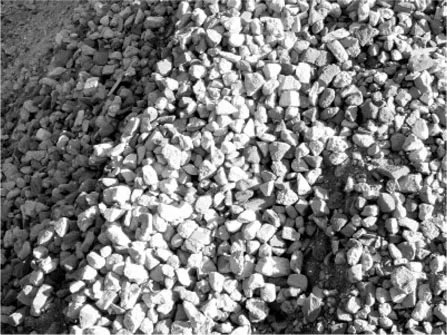
Figure 1.1 Mixed rubble including concrete aggregate, brick, masonry, and ceramic tile has substantial economic value when it can be reused in concrete mix design, as is the case with this material in The Netherlands.
The construction industry also differs from other industrial sectors in that the end products, buildings, are not factory produced with high tolerances, but are generally one-off products designed to relatively low tolerances by widely varying teams of architects and engineers, and assembled at the site using significant quantities of labor from a wide array of subcontractors and craftspeople. The end products or buildings are generally not subject to extensive quality checks and testing and they are not generally identified with their producers, unlike, for example, automobiles or refrigerators. Unlike the implementation of extended producer responsibility (EPR) in the German automobile industry, which is resulting in near closed-loop behavior for that industry, buildings are far less likely to have their components returned to their original producers for take-back at the end of their life cycle. Arguably, EPR could be applied to components that are routinely replaced during the building life cycle and that are readily able to be decoupled from the building structure (chillers, plumbing fixtures, elevators). The bulk of a building’s mass is not easily disassembled, and at present little thought is given in the design process to the fate of building materials at the end of the structure’s useful life (Figures 1.2 and 1.3).
Most industrial products have an associated lifetime that is a function of their design, the materials constituting them, and the character of their service life. The design life of buildings in the developed world is typically specified in the range of 50–100 years. However, the service lives of buildings are unpredictable because the major component parts of the built environment wear out at different rates, complicating replacement and repair schedules. Brand (1994) describes these variable decay rates as “shearing layers of change,” which create a constant temporal tension in buildings (Figure 1.4). Brand adapted O’Neill et al.’s (1986) hierarchical model of ecosystems to illustrate the issue of temporal hierarchy in buildings that can be related to the spatial decoupling of components. Faster cycling components such as space plan elements are in conflict with slower materials such as structure and site. Management of a building’s temporal tension might be achieved with more efficient use of materials through spatial decoupling of slow and fast components. Components with faster replacement cycles would be more readily accessible. This hierarchy is also a hierarchy of control, i.e. the slower components will control the faster components. However, when the physical or technical degradation of faster components surpasses critical thresholds, the faster components begin to drive changes to the slower components such that dynamic structural change can occur. For example, in a typical office building electrical and electronic components wear out or become obsolete at a fairly high rate compared with the long-lived building structure. At some critical threshold the motivation to maintain the overall building ebbs and the building rapidly falls into disuse and disrepair simply because of the degradation of the faster, more technology-dependent components. Odum (1983) developed the concept of “emergy,” the energy embodied in the creation and maintenance of a factor or process, as a means to quantify the relative contributions of different components to the operation of a hierarchy (see Chapter 2). Odum’s theory predicts that the control of faster components by slower components is reflected in the latter’s higher emergy transformity values. Transformity values are efficiency ratios of total emergy to actual energy, normalized in solar equivalent joules, that enumerate a process’s relative capacity to influence system behavior. Using emergy to distinguish more carefully between slower and faster components and processes would allow designers to couple buildings to external processes of manufacture, reuse, and recycling more rationally. As such, this theory provides a quantitative framework for relating building design to its material components based on their relative contributions to the functions of an “ecosystem” that includes the built environment and the materials and processes that sustain it.
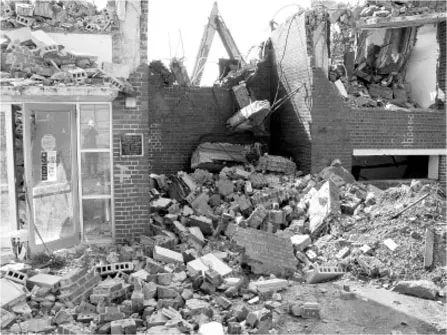
Figure 1.2 A 1960s era student residence hall at the University of Florida in the process of demolition. Although 12,000 bricks were recovered for reuse in new construction, in excess of 90% of the brick was unrecoverable because of the high-strength Portland cement mortar used to bind the bricks together and the lack of provisi...
Table of contents
- Cover Page
- Title Page
- Copyright Page
- Figures
- Tables
- Boxes
- Contributors
- Preface
- Foreword
- Introduction
- 1 Defining an ecology of construction
- Part 1 The ecologists
- Part 2 The industrial ecologists
- Part 3 The architects
- Conclusions
- Glossary
Trusted by 375,005 students
Access to over 1.5 million titles for a fair monthly price.
Study more efficiently using our study tools.
Frequently asked questions
Yes, you can cancel anytime from the Subscription tab in your account settings on the Perlego website. Your subscription will stay active until the end of your current billing period. Learn how to cancel your subscription
No, books cannot be downloaded as external files, such as PDFs, for use outside of Perlego. However, you can download books within the Perlego app for offline reading on mobile or tablet. Learn how to download books offline
Perlego offers two plans: Essential and Complete
- Essential is ideal for learners and professionals who enjoy exploring a wide range of subjects. Access the Essential Library with 800,000+ trusted titles and best-sellers across business, personal growth, and the humanities. Includes unlimited reading time and Standard Read Aloud voice.
- Complete: Perfect for advanced learners and researchers needing full, unrestricted access. Unlock 1.5M+ books across hundreds of subjects, including academic and specialized titles. The Complete Plan also includes advanced features like Premium Read Aloud and Research Assistant.
We are an online textbook subscription service, where you can get access to an entire online library for less than the price of a single book per month. With over 1.5 million books across 990+ topics, we’ve got you covered! Learn about our mission
Look out for the read-aloud symbol on your next book to see if you can listen to it. The read-aloud tool reads text aloud for you, highlighting the text as it is being read. You can pause it, speed it up and slow it down. Learn more about Read Aloud
Yes! You can use the Perlego app on both iOS and Android devices to read anytime, anywhere — even offline. Perfect for commutes or when you’re on the go.
Please note we cannot support devices running on iOS 13 and Android 7 or earlier. Learn more about using the app
Please note we cannot support devices running on iOS 13 and Android 7 or earlier. Learn more about using the app
Yes, you can access Construction Ecology by Charles J. Kibert,Jan Sendzimir,G. Bradley Guy in PDF and/or ePUB format, as well as other popular books in Architecture & Sustainability in Architecture. We have over 1.5 million books available in our catalogue for you to explore.