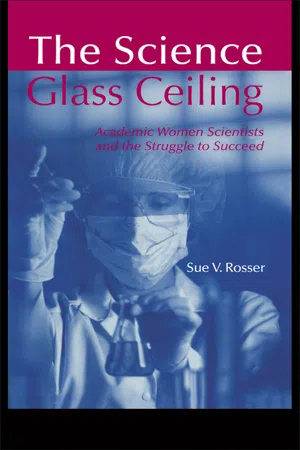
In The Science Glass Ceiling, Sue Rosser chronicles the plight of women faculty across the country. Noting difficulties, double standards, and backlash that they routinely face. Rosser interviewed some of the country's best female scientists about their research, love of science, and routing barriers faced. She offers suggestions and solutions for changing the science and technology culture at universities in order to establish a more level playing field. As the first woman Dean at a science/technical school, Rosser offers realistic solutions from an insider's perspective.
eBook - ePub
The Science Glass Ceiling
Academic Women Scientist and the Struggle to Succeed
- 166 pages
- English
- ePUB (mobile friendly)
- Available on iOS & Android
eBook - ePub
About this book
Trusted by 375,005 students
Access to over 1.5 million titles for a fair monthly price.
Study more efficiently using our study tools.
Information
Subtopic
Feminism & Feminist TheoryIndex
Social SciencesCHAPTER 1
WHO ARE THE WOMEN SCIENTISTS?
Women scientists and engineers, like women in other professions and their male counterparts in science and engineering, desire to have a satisfying career that enables them to explore the secrets of the physical, natural world while also leading a rewarding family life, rearing children, having a stable relationship with a partner, fulfilling obligations to their community, or pursuing interests important to them. Everyone struggles to turn this desire into a reality in daily life.
Many women wonder when, if ever, to have children. Having them early, while still in school, may make starting a career more difficult. Waiting until after achieving tenure increases the potential for “a high-risk pregnancy.” Some women decide early on that they must work at a Research I university to have access to the equipment they require for their research; others pursue the Ph.D. because they love teaching undergraduates and can’t wait to return to the environment of a small liberal arts college. For most, the type of institution that will best facilitate their careers and families becomes one of the pieces of the puzzle. Many attempt to pursue their personal career goals in tandem with those of a partner or spouse. Some have immigrated to the United States and attempt to intertwine this new culture and environment with that of the country of their birth. No clear-cut path or magic key opens success and satisfaction for all women. People puzzle over the timing of career and family decisions. As the subtitle of the anthology Journeys of Women in Science and Engineering (1997) by Susan Ambrose, Kristin Dunkle, Barbara Lazarus, Indira Nair, and Deborah Harkus suggests, there are No Universal Constants.
To learn more about the intertwining of the professional and personal career paths, I interviewed a sample of the almost 400 women who had received NSF POWRE awards and responded to an e-mail questionnaire that I sent; I neither had access to nor requested information regarding race/ethnicity, nationality, age, rank, marital or parental status, although sometimes the respondent revealed these in the e-mail response or interview. Individuals in the selected sample received the following e-mail:
E-mail Request to Interview
In 1998–99 [this varied, depending upon the year of the award] you were kind enough to respond to a brief e-mail questionnaire as an NSF POWRE awardee. As part of an ongoing effort to understand significant issues in the careers of women scientists and engineers, you are being asked to volunteer to participate in a research project as a follow-on to the e-mail questionnaire to which you responded. You have been selected as one of 40 volunteers to be interviewed from the almost 400 respondents to the initial questions.
The project consists of one telephone interview lasting approximately 45 minutes with me, arranged via e-mail at a time that is mutually convenient for both you and me. During the interview you will be asked 5 questions exploring significant issues women scientists and engineers face in their careers and/or laboratories, as well as the impact that you perceive that receiving the award has had on your career. Up to 7 follow-on questions may be asked to clarify your responses to the 5 general questions.
Although this study has no known risks, you may refuse to respond to any question that you prefer not to answer for any reason. If you are harmed as a result of being in this study, please contact me. Neither the Principal Investigator (me) nor Georgia Institute of Technology have made provision for payment of costs associated with any injury resulting from participation in this study. All information concerning you obtained from the interview, as well as your responses to the previous questionnaire, will be kept private. If information and quotations from your interview and/or questionnaire are published, you will be identified by number only and the information will be written in a way that maintains your confidentiality and prevents recognition of you individually. You will not be paid nor are there any costs to you by participating.
Your voluntary participation in this project is extremely important to shed light on issues important to the careers of women scientists and engineers. You may not benefit directly by participating in this study, but by underlining solutions, practices, and policies to attract and retain women in science and engineering, the results of this research should benefit institutions, funding agencies, and professional societies seeking to remove institutional barriers, policies, and practices that serve as obstacles for women scientists and engineers.
Please reply to this e-mail, indicating your willingness to participate in the interview. You may indicate times that would be especially convenient for the interview or I will request that information in a subsequent e-mail.
I would be happy to answer any questions you have about this project. Please contact me by e-mail or phone me at (xxx)xxx-xxxx for answers to any questions. If you have questions about your rights as a research subject please contact Alice Basler at (xxx) xxx-xxxx.
Thank you for your participation.
Sue V. Rosser, Dean and Professor
Ivan Allen College
Georgia Institute of Technology
Atlanta, GA 30332
Most responded to the e-mail immediately, and we negotiated a mutually convenient time for me to phone them. Recognizing that each woman was likely to have a fascinating, but unique story and set of experiences, in order to provide some uniformity for comparison among individuals, I asked each interviewee the same five questions:
Telephone Interview Questions
- Tell me the story of your professional career, including the major influences, opportunities, and challenges that enabled you to become the woman scientist (engineer) you are today. Example follow-on/clarification: Since you suggest that you are an exception, what do you think are the most significant issues/challenges/opportunities facing women scientists today as they plan their careers?
- How did receiving an NSF POWRE award impact your career? Example follow-on clarification: Although it seems that the award was very positive for your career overall, did it have any negative impacts?
- Do you think that the POWRE award you received helped to attract and retain other women in science? Example follow-on clarification: What other sorts of programs at your institution or others have you found to also be useful in attracting and retaining women in science (engineering)?
- What are the key institutional barriers to women in science and engineering having successful academic careers? Example follow-on clarification: What solutions can institutions pursue to remove those barriers? Does your institution have an NSF ADVANCE award? If so, are you involved with ADVANCE?
- What is the overall climate for women in your specific discipline? Example follow-on clarification: How does the laboratory climate (or its equivalent in your subdiscipline) impact upon the careers of women scientists?
The 11 interviews chosen for this chapter from the 40 women scientists and engineers interviewed for the project reveal multiple paths to success. This chapter only includes the interviews of NSF POWRE awardees; Chapter 5 includes interviews with Clare Boothe Luce professors. Although women scientists and engineers work at a variety of types of institutions, ranging from women’s colleges through comprehensive public institutions to elite private Research I universities, the POWRE awardees tend to work at larger institutions. The majority came from public universities. Some always knew that they would become a scientist or engineer; others combined their interest in humanities, social sciences, or arts with science and engineering. They entered graduate school immediately after college or after a successful career in another field. Some had their children late, after becoming a tenured full professor, while others became mothers in graduate school. The element common to all is their love for their work in science and engineering and their commitment to and love for their families. The names of the individuals have been changed throughout the book to protect their privacy.
Choosing Educational and Work Environments for Family-Friendliness: Physicist Jane Fields
As the data in Tables 1, 2, and 3 reveal, physics remains one of those fields with very few women, especially in the professoriate. Deciding to begin a family while still in graduate school, Jane Fields consciously sought mentors and laboratory environments that she thought would be supportive of her decision to combine family and work. As the following interview with Jane suggests, even though her department does not require continuous, major funding to achieve tenure, time demands still pose a challenge for balancing career and family
Jane Fields liked science and math during high school so when she entered college she was fairly certain that she wanted to go into science. During her freshman year at a very prestigious private Research I institution in the Northeast, she took chemistry, but the physics class she took as a sophomore really captured her interest.
After undergraduate school she took a year off and taught high school chemistry before entering graduate school in physics at a prestigious Research I public institution in California. She was fortunate to have a good advisor who was supportive of her even when she had kids while in graduate school. In selecting him, she had applied the office test—students sleeping in the office/lab signaled a negative omen. Although Jane categorizes herself in the group of women for whom seeing other women as role models doesn’t matter, she did remark that a nice group of women graduate students got together a couple of times each semester and that one or two women faculty often joined them.
Being 4 months pregnant with her second child as she searched for a postdoc became another test that she applied to determine the suitability of a lab. She ended up at a prestigious technical institution in the Northeast where she had a supportive male advisor during the 2 years of her postdoc.
As she applied for academic positions, she noted departments that did not require having continuous funding. Although the Ivy league institution where she is a faculty member does not have that requirement, she finds that the five-course per year teaching load, large number of committees on which she serves, and absence of graduate students make it very difficult to conduct the excellent research demanded to achieve tenure in less than a 50-hour workweek. She hopes she will be successful in her tenure bid later this year.
The NSF POWRE award permitted Jane to buy what she needed for her lab that had not been included in the start-up package provided by her institution. She believes that for many women, seeing women in science encourages them to enter the profession. For example, she taught in all three introductory courses of the first physics class to graduate more than 50% women. She reaches out to elementary schools and has an NSF grant to run a summer science camp for 14- to 16-year-old girls.
Jane perceives time as the biggest barrier for women in science who wish to have families. Unless work is limited to 50 hours per week and the tenure system is changed, she doubts that a significant number of women will enter science. Her typical day consists of 10 hours of work devoted to teaching, research, and service, 6 hours for her family, and 8 hours for sleeping, eating, and bathing. In short, she lacks adequate time.
Jane believes that women in physics receive equal treatment, although their minority status makes them very visible. However, women do experience systemic discrimination because of the expectations for length of the workday and -week for physics, which is unrealistic when coupled with family responsibilities.
Going Abroad as an Undergraduate Confirms Scientific Field Interest: Botanist Suzanne Hausmann
In contrast to Jane Fields, Suzanne Hausmann delayed having a child until she obtained a faculty position. Despite that delay and the higher percentage of women in botany compared to physics, Suzanne still felt isolated since few faculty in her department had children. In her interview, Suzanne emphasizes the crucial role that experiences in Europe had on attracting her initially to the field of botany and in midcareer, stimulating her to flourish.
Suzanne Hausmann attributes her interest in the natural world, developed from hiking, camping, and spending time outdoors as a child, as the initial motivator for her to become a scientist. While an undergraduate at a large, Midwestern Research I institution, she became fascinated by photosynthesis, finding chloroplasts really interesting.
Despite her fascination, she wonders in retrospect whether her interest in botany would have held had she not gone to Germany during her junior year of college. In contrast to the United States, where botany appears to be on the decline, veneration for the study of botany remained in Germany and Europe in the early 1970s. In Germany, Suzanne first used electron microscopy.
After graduation, she moved to the big city and worked as a technician. Since she did not come from an academic family, the idea of graduate school didn’t occur to her, until she received encouragement from the folks in the lab where she worked. While attending graduate school at the world-renowned private institution across town, she thought little about gender. With other women as half of her fellow students, she felt no bias as a graduate student. Time spent at Woods Hole in the summer provided her with very strong female role models who influenced her and motivated her to stay in graduate school.
During her postdoctoral experience at a large Southern university, she encountered her first experience of gender bias. At that institution, it seemed that men were in the labs, and women were in the offices as secretaries. In fact, people had difficulty distinguishing her from the only other female postdoc, since both of them wore jeans.
When she obtained her faculty position, she found that she was the second woman in the department in this large Research I public institution in the West. She became the first woman there, some 10 years ago, to have a child. At the time Suzanne gave birth to her child, it was a lonely and somewhat isolating experience, although now the department seems to be experiencing an explosion of children born to the faculty.
The receipt of the NSF POWRE award not only permitted her to turn her research in a different direction, it also allowed Suzanne to return to Europe. There she solidified multiple international collaborations and attended small European meetings, where she gave some 17 presentations and expanded her network. Since she was in Europe, she could not verify that her receipt of the POWRE award influenced other women to go into science; however, whenever she gives a talk, another woman from the audience will always come up to speak with her, often saying that it’s important to see a successful woman scientist who runs her own lab and does science.
Although she finds the climate for women in her discipline to be good, and that at her institution to be improving, she still finds some bias against women as power holders. Some concrete problems such as the lower salaries of women compared to men and the issues surrounding parenting and dual-career couples may be addressed by changing institutional policies. Suzanne believes that a major difficulty for women is that they are not in the loop of informal ...
Table of contents
- COVER PAGE
- TITLE PAGE
- COPYRIGHT PAGE
- ACKNOWLEDGMENTS
- INTRODUCTION
- CHAPTER 1: WHO ARE THE WOMEN SCIENTISTS?
- CHAPTER 2: OPPORTUNITIES AND CHALLENGES
- CHAPTER 3: LIFE IN THE LAB
- CHAPTER 4: DIFFERENCES ACROSS THE DISCIPLINES
- CHAPTER 5: THE DIFFERENCE AN INSTITUTION MAKES
- CHAPTER 6: A BRIGHTER FUTURE: CHANGE THE INSTITUTIONS, NOT THE WOMEN
- REFERENCES
Frequently asked questions
Yes, you can cancel anytime from the Subscription tab in your account settings on the Perlego website. Your subscription will stay active until the end of your current billing period. Learn how to cancel your subscription
No, books cannot be downloaded as external files, such as PDFs, for use outside of Perlego. However, you can download books within the Perlego app for offline reading on mobile or tablet. Learn how to download books offline
Perlego offers two plans: Essential and Complete
- Essential is ideal for learners and professionals who enjoy exploring a wide range of subjects. Access the Essential Library with 800,000+ trusted titles and best-sellers across business, personal growth, and the humanities. Includes unlimited reading time and Standard Read Aloud voice.
- Complete: Perfect for advanced learners and researchers needing full, unrestricted access. Unlock 1.5M+ books across hundreds of subjects, including academic and specialized titles. The Complete Plan also includes advanced features like Premium Read Aloud and Research Assistant.
We are an online textbook subscription service, where you can get access to an entire online library for less than the price of a single book per month. With over 1.5 million books across 990+ topics, we’ve got you covered! Learn about our mission
Look out for the read-aloud symbol on your next book to see if you can listen to it. The read-aloud tool reads text aloud for you, highlighting the text as it is being read. You can pause it, speed it up and slow it down. Learn more about Read Aloud
Yes! You can use the Perlego app on both iOS and Android devices to read anytime, anywhere — even offline. Perfect for commutes or when you’re on the go.
Please note we cannot support devices running on iOS 13 and Android 7 or earlier. Learn more about using the app
Please note we cannot support devices running on iOS 13 and Android 7 or earlier. Learn more about using the app
Yes, you can access The Science Glass Ceiling by Sue V. Rosser in PDF and/or ePUB format, as well as other popular books in Social Sciences & Feminism & Feminist Theory. We have over 1.5 million books available in our catalogue for you to explore.