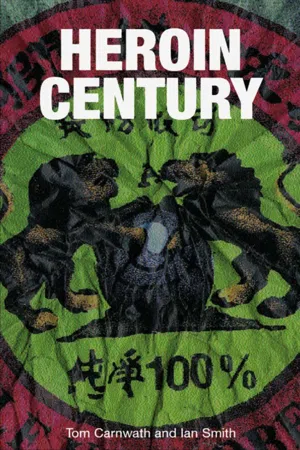
Heroin is a drug that myths are made of. Whether smuggled in the stomach of a camel or used as the ultimate symbol of lifestyle chic, no drug has been more argued over and legislated against, no drug has been more subject to misinformation and moral panic.
Heroin Century sets the record straight. It contains a wealth of historical and medical information about this drug which made its first appearance as a miracle medicine over a hundred years ago and makes recommendations for its future in the twenty-first century. Evidence shows that heroin is dangerous principally because it is illegal. The authors argue that a more relaxed relationship between society and the drug would benefit both the economy and public health and safely.
Individual chapters describe the history of heroin production; the makeup of heroin and evolving methods of use; the spread of heroin and international efforts at control; typical "career" patterns of users, ranging from occasional recreational use to destructive dependence; the subjective experience of taking heroin; the association between heroin and crime; the use of heroin in medicine and its effects on physical health; the history of the treatment of heroin dependence; and likely changes in heroin use in the future. The authors have drawn on literary and artistic sources as well as the large pool of scientific literature to compile a comprehensive and fascinating account of this world-changing drug.
Heroin Century makes available a wealth of information about the history, chemistry, pharmacology and medical aspects of heroin in a form accessible to anyone who wishes to participate in the contemporary debate bout society's attitude to drugs.
- 224 pages
- English
- ePUB (mobile friendly)
- Available on iOS & Android
eBook - ePub
Heroin Century
About this book
Information
1 Next add 5 ml human blood
The manufacture of heroin
The invention of heroin
Bunsen’s burner was not the only legacy of the great chemist. He could also be called the grandfather of heroin. It was his pupil Augustus Matthiessen who established the programme that led to its discovery. Both men had participated fully in the flowering of synthetic chemistry that took place in Germany, particularly in the second half of the nineteenth century. Throughout the century German scientists were unchallenged leaders in this field of science, starting with Serturner’s original isolation of morphine from opium. Matthiessen brought this knowledge to England when he came to work as a lecturer at St Mary’s Hospital, London. His chief English assistant was C.R. Alder Wright. Together they undertook a comprehensive exploration of codeine and morphine, synthesising hundreds of new compounds based on these molecules. Wright continued when Matthiessen retired. Their excitement still shines through the dry prose of the learned articles, as day by day they made substances that had never been previously created.
In early 1874, Wright was considering the effect of acetylation on codeine and morphine.1 He added large amounts of acetic anhydride to morphine and applied heat. His description of what happened is as detached as you would expect in a scientific report.
When morphine is brought into contact with excess acetic anhydride, tetra-acetylmorphine is produced, whether by heating a few hours at 100 degrees centigrade, or by leaving several days at room temperature. On adding sodium bicarbonate to the product dissolved in water, a precipitate is obtained, flocculent at first, but soon becoming crystalline.2
Looking over Wright’s shoulder, the modern reader experiences a twinge of apprehension, as this portentous chemical clumps together and crystallises for the first time in history.
For we now know that this powder was not tetra-acetylmorphine at all.3 At this date Wright was misinformed about the molecular structure of morphine, believing it to be a double molecule. Later analysis has shown that the new substance had two rather than four acetyl groups attached to each morphine molecule, and should therefore have been called diacetylmorphine.4 This name was later abbreviated to diamorphine, and much later the substance was christened ‘heroin’.
Wright did not concern himself overmuch with the use made of his new creations. For him, this was an exercise in chemical mapping, rather than practical medicine. After exhausting codeine and morphine, he moved on to the chemistry of Japanese camphor, and then to household soaps and fireworks. Nonetheless, some of his substances were tested on animals, in London and later in Edinburgh.5 The investigators concluded that none of Wright’s morphine compounds had any significant advantage over morphine itself. Diamorphine was therefore not used as a medicine in England until the German company Bayer marketed it as heroin in 1898.
The British frequently complain that they are good at making inventions, but bad at exploiting them. Other Wright creations included benzylmorphine, ethylmorphine and apomorphine. All had to wait many years before a medical use was found. None were used medically in Britain until reintroduced by German companies. When Bayer marketed heroin as a treatment for tuberculosis, it was other German firms that fought back by promoting benzylmorphine as Peronin and ethylmorphine as Dionin. Some Wright compounds had to wait longer. It was eighty years before the American writer William Burroughs proclaimed apomorphine to be the only effective cure for heroin addiction.6
Injured amour propre must have played a part in the lukewarm reception these medicines received in Britain, when they were trumpeted as German inventions in 1898. J.F. Macfarlan’s, the Scottish pharmaceutical company, wrote in disgust to the British Medical Journal:
The introduction and advertising of well-known esters of morphine under such fanciful names as ‘peronin’, ‘dionin’ & ‘heroin’ may mislead some members of the medical profession into the belief that they are new and proprietary preparations …. As a matter of fact, they are all prepared and supplied under their proper names by ourselves and other competent manufacturers. 7
The complaint was not justified. Although Macfarlan’s may have produced these substances as chemicals, there is no evidence that they sold them for medical use before the Germans stole their thunder.8
The Germans had in truth arrived at the formulation themselves. The end of the century was a creative time for medical chemistry. The German chemical industry had grown rich on aniline dyes. These had almost universally replaced natural dyes as colouring agents and could be made cheaply from the by-products of oil and gas manufacture. By 1890 this hegemony was under threat from increased competition and reduced access to primary materials. The companies wanted to diversify and find other outlets for their chemical production lines. Medicine was an obvious target. Many firms invested in state-of-theart laboratories and competed to employ the top pharmaceutical chemists. In this flurry of activity, diamorphine was reinvented on at least two occasions.
Joseph von Mering became famous for discovering hypnotic barbiturates. In 1897 he was working for E. Merck of Darmstadt. He synthesised a number of opioid alkaloids including diamorphine. He was probably the first to test diamorphine on human subjects, but he was not particularly impressed. He thought that ethylmorphine was better suited for treating pain and tubercular coughs. Diamorphine was dropped and later that year Merck marketed ethylmorphine under the name of Dionin.9
Bayer was another large dye firm that had invested heavily in pharmaceutical research. Their laboratory was considered the most advanced in the world and they had had the good fortune to attract a chemist of growing reputation named Heinrich Dreser. Dreser was particularly interested in acetylation. He believed this process reduced the side effects of medications and also increased their potency. In 1894 Bayer had acetylated tannic acid which was used for the treatment of diarrhoea. They called the resulting compound Tannigen. It was less bitter than tannic acid and was also more effective. It quickly became popular among doctors and patients.
Encouraged by his success, Dreser set up a research group to investigate the acetylation of other medicines. The leaders in this group were Felix Hoffman and Arthur Eichengrun. In August 1897 they acetylated salicylic acid, producing the compound which was later called aspirin. Just a fortnight later they acetylated morphine and produced diamorphine, later called heroin. Within the space of two weeks they had created two new substances of astounding importance. Both could be leading contenders for the title of most important drug of the twentieth century.10
Of the two new compounds, heroin progressed most easily. Dreser was soon convinced of its power as a treatment for tuberculosis. He developed it quickly through animal and human testing, and brought it to the market in 1898.11, 12 He thought it had a specific stimulatory effect on respiration, similar to that of digitalis on the heart, and he named it heroin in reference to the contemporary fashion for ‘heroic’ treatment, that is to say treatment that used powerful medicines in high doses.13 He was clearly proud of his new medicine. He took the credit entirely for himself, failing to mention the work of Hoffman and Eichengrun or of earlier pioneers.
He was not convinced by aspirin and vetoed its further development. Had not Eichengrun ignored Dreser’s instructions, aspirin might well have been abandoned and forgotten. It was only as a result of Eichengrun’s unofficial action that its extraordinary properties were eventually recognised. It was finally also marketed alongside heroin in 1898. Even though Eichengrun played the more important part, Hoffman was credited by the firm with the invention of aspirin and for the most part still enjoys this reputation. The neglect of Eichengrun may have been a result of anti-Semitism. He was Jewish and later interned in Theresienstadt concentration camp.14 Shortly before his death, he wrote a full account of his part in the discovery and development of aspirin. Understandably, he did not argue at this time that he was also the inventor of heroin. The subsequent history of the drug would have discouraged pride in this achievement. Nonetheless, Eichengrun has probably a good claim to the title, even if he did not want it.
Vats and funnels – industrial production of heroin
All the early makers of heroin basically used the same technique as Wright. They heated morphine with acetic anhydride and then used an alkali such as sodium bicarbonate to precipitate the powder. After its launch on the market, the manufacture of heroin was streamlined to enable industrial production but it still relied on morphine and acetic anhydride. Legitimate production increased rapidly, even after its use in medicine had become suspect. In spite of their initial scruples, British companies soon took over as the major producers. Companies such as Whiffens, T. & H. Smith and Macfarlan’s made huge profits principally by exporting heroin and morphine to China, where it was mostly consumed by drug addicts. It was noted at the time that ‘the Chinaman buys his morphia by the pound, and his predilection is for Macfarlan’s, which he must have in original pound bottles’.15
It was certainly a scandal that European firms were capitalising so handsomely from Chinese drug addiction. To many it seemed that pharmaceutical trade was a continuation of the Opium Wars by other means. Pressure grew for action, spearheaded by the Americans who were concerned about their own problem of addiction and their newly acquired territories in the Philippines.16 In 1912 the first international treaty was agreed and the first bricks laid in the increasingly cumbersome structure of international narcotic control.
As international controls started to bite, British production was reduced and Whiffens even had their manufacturing licence revoked following a smuggling scandal in 1923.15 La Société Roessler et Compagnie, Mulhouse, took over for a time as chief producer. In 1928 it produced 4.35 metric tons of heroin, considered to be enough to satisfy the medical needs of the whole population of the world three times over. At the same time a Dutch company named Chemische Fabriek Naarden was actively importing and exporting heroin and cocaine through an underground network designed to evade the regulatory efforts of the League of Nations. The Opium Commission claimed that in 1928 it controlled over half the world production of heroin. The local authorities did not prosecute the company because they judged that although it had acted contrary to the spirit of the law, no single Dutch law had in fact been broken.17
Swiss companies have traditionally enjoyed more freedom from international conventions. Factories in Basle and Zurich plugged the gap as French production subsided. After the Swiss had bowed to international representations, production passed to a factory licensed to the French but operating in Constantinople. When this was closed by the Turks, the gauntlet was taken up by the Bulgarians. A new factory started up in Sofia. It is reckoned that this factory produced nine tons a year, mostly destined for the illicit market in Egypt and China.18
The Bulgarians in turn acceded to pressure, and suppressed this factory in 1931. Thereafter the Japanese became the major manufacturers and kept this dubious distinction right up until the end of the war. Heroin was distributed freely in the occupied Chinese province of Manchuria as an aspect of official policy. Not only did it produce a compliant population, but it also greatly enriched the Manchukuo Monopoly Bureau which was the only authorised supplier. Between 1934 and 1937, 94 per cent of world heroin production came from a Japanese factory in Seoul, Korea.19 Japan at this time was aggressive and highly militarised. It was asserting its national identity after years of humiliation at the hands of Western powers. It was in no mood to bow to pressure from the League of Nations narcotic control programme. Indeed it had walked out of the League in 1931, after the League had condemned the Japanese invasion of Manchuria. It is ironic that in Japan itself heroin dependence was almost unknown.
It can be seen that there was little need for illicit production of heroin as long as the great trading countries of the world were taking turns to supply the burgeoning market created by heroin addiction. Nonetheless, some illicit production did begin in China before World War II, mostly in the region of Shanghai. After the war, the system of international controls passed to the newly formed United Nations in 1946. The Japanese were forced out of the market following their defeat in the war.
At long last, legitimate production of heroin was confined to supplying genuine medical need. World production plummeted and production was banned in many countries. Macfarlan’s of Edinburgh had survived as heroin producers, having complied strictly with international treaties from about 1921. They took over once again as the world’s leading licit manufacturer, a position which they have maintained until the present day. The amount they have produced since that time is tiny compared with their heyday around the time of World War I. It has been strictly for medical use in the few countries where heroin is still prescribed.
There was now a large number of heroin addicts, but no access to pharmaceutical heroin. Clandestine factories emerged across the world, for example in Turkey, France, Mexico, Greece, Hong Kong and the United States. By far the biggest producer at this time was the so-called Red Lion Company in Shanghai and its various offshoots. When the Communists took power in China, stringent penalties were imposed on drug trafficking. Most of the Shanghai chemists fled to Hong Kong and established their laboratories on British territory. This trade soon fell under the control of the Chiu Chau syndicate from Kwangtung, until their power base was weakened by huge drug seizures by the Hong Kong authorities in 1974. Many skilled heroin chemists left for Thailand and Malaysia from where they continued to export heroin into Hong Kong.20 When enforcement became more effective in these countries during the 1980s, the chemists again moved on – to Myanmar, Laos, Pakistan and Afghanistan.
Today, the vast majority of heroin is produced in Afghanistan and the Golden Triangle, although there is also increasing production in Mexico and Latin America. In the East, a large number of the heroin technicians are direct descendants and apprentices of the original Shanghai chemists. Knowledge of their techniques will therefore give a good idea of how most of the world’s illicit heroin is manufactured. Fortunately, both the Hong Kong Police and the US Department of Justice have provided detailed accounts based on their respective struggles with producers in Hong Kong and South-East Asia.21 These give a graphic picture of the whole chain of production from the opium poppy through to heroin, along with details of all the reagents involved. The account is...
Table of contents
- Cover Page
- Title Page
- Copyright Page
- Introduction and overview
- 1 Next add 5 ml human blood
- 2 From mouth-organs to bazookas
- 3 How to X-ray a camel
- 4 The righteous dope fiend
- 5 How to stop time
- 6 Ripping and running
- 7 The hardest drug or the gentle drug
- 8 Shots from the drug pub
- 9 Beyond the needle
Trusted by 375,005 students
Access to over 1.5 million titles for a fair monthly price.
Study more efficiently using our study tools.
Frequently asked questions
Yes, you can cancel anytime from the Subscription tab in your account settings on the Perlego website. Your subscription will stay active until the end of your current billing period. Learn how to cancel your subscription
No, books cannot be downloaded as external files, such as PDFs, for use outside of Perlego. However, you can download books within the Perlego app for offline reading on mobile or tablet. Learn how to download books offline
Perlego offers two plans: Essential and Complete
- Essential is ideal for learners and professionals who enjoy exploring a wide range of subjects. Access the Essential Library with 800,000+ trusted titles and best-sellers across business, personal growth, and the humanities. Includes unlimited reading time and Standard Read Aloud voice.
- Complete: Perfect for advanced learners and researchers needing full, unrestricted access. Unlock 1.5M+ books across hundreds of subjects, including academic and specialized titles. The Complete Plan also includes advanced features like Premium Read Aloud and Research Assistant.
We are an online textbook subscription service, where you can get access to an entire online library for less than the price of a single book per month. With over 1.5 million books across 990+ topics, we’ve got you covered! Learn about our mission
Look out for the read-aloud symbol on your next book to see if you can listen to it. The read-aloud tool reads text aloud for you, highlighting the text as it is being read. You can pause it, speed it up and slow it down. Learn more about Read Aloud
Yes! You can use the Perlego app on both iOS and Android devices to read anytime, anywhere — even offline. Perfect for commutes or when you’re on the go.
Please note we cannot support devices running on iOS 13 and Android 7 or earlier. Learn more about using the app
Please note we cannot support devices running on iOS 13 and Android 7 or earlier. Learn more about using the app
Yes, you can access Heroin Century by Tom Carnwath,Ian Smith in PDF and/or ePUB format, as well as other popular books in Psychology & 20th Century History. We have over 1.5 million books available in our catalogue for you to explore.