eBook - ePub
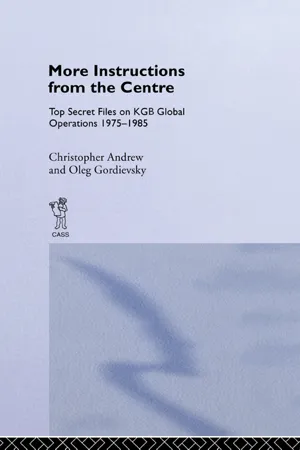
More Instructions from the Centre
Top Secret Files on KGB Global Operations 1975-1985
- 144 pages
- English
- ePUB (mobile friendly)
- Available on iOS & Android
eBook - ePub
More Instructions from the Centre
Top Secret Files on KGB Global Operations 1975-1985
About this book
During the decade that preceded Mr Gorbachev's era of glasnost and perestroika, the KGB headquarters in Moscow was putting out a constant stream of instructions to its Residencies abroad. Unknown to the KGB, however, many of these highly classified documents were being secretly copied by Oleg Gordievsky, at that time not only a high-ranking KGB officer based in London but also a long-serving undercover agent for the British. The selected documents in this volume, translated and analysed by the editors with a commentary by Christopher Andrew to set them in context, offer a revealing insight into the attitudes, prejudices and fears of the KGB during what were to prove its declining years.
Information
Ciphers and Counter-Intelligence
All Soviet missions in the West can expect surveillance by local security services. The Centre, however, had an apparently incurable tendency to exaggerate both its scale and intensity. Before leaving for foreign postings, all KGB officers went through a training course designed to prepare them for all manner of ‘provocations’ by Western intelligence agencies. The training, however, was based on a frequently false analogy with the huge KGB surveillance operations conducted within the Soviet Union.
In Gordievsky’s experience at London and Copenhagen, new arrivals began by suspecting even local shopkeepers and gardeners in nearby parks of being part of an elaborate network designed to keep them under constant surveillance. Most eventually grasped the fact that Western security services are tiny by Soviet standards and have to choose their targets far more selectively than the KGB. Directorate K at the Centre, however, continued to issue sometimes fanciful warnings about new forms of surveillance being devised in the West, and to interpret misfortunes suffered by Soviet citizens abroad as possible – or probable – provocations by local security services.
Among those who the Centre feared were the main targets for Western provocation were Soviet cipher personnel. The Centre’s fears were largely a reflection of its own successes in this field. Most major codebreaking successes on which evidence is available have been assisted in varying degrees by intelligence on foreign code and cipher systems obtained by espionage. Western intelligence agencies, however, did not make such intelligence a major priority until the Second World War. Russia already did so at the beginning of the century. The British ambassador to St. Petersburg, Sir Charles Hardinge, complained in 1906 that the Tsarist Okhrana had offered his head Chancery servant the then enormous sum of £1,000 to steal one of the British diplomatic ciphers.37 Between the wars Soviet intelligence revived and expanded Tsarist techniques for obtaining Western cipher materials and diplomatic documents to assist its codebreakers. Its first major success in penetrating Whitehall was to recruit two Foreign Office code clerks, Ernest Oldham in 1930 and John King in 1935.38
A generation later, the passing of the age of the brilliantly talented ideological mole in both Britain and the United States increased still further the relative importance of agents such as Oldham and King. The vast Anglo-American communications and sigint (signals intelligence) network contained thousands of comparatively junior employees with access to high-grade intelligence. By the 1970s the KGB’s most important moles in the United States and Britain were no longer high fliers like Kim Philby and Alger Hiss, but two cunning though not especially talented petty criminals. Chief Warrant Officer John Walker, a communications watch officer on the staff of the Commander of US Submarine Forces in the Atlantic, had joined the navy as a teenage high school dropout in order to escape imprisonment after committing four serious burglaries, and later tried to force his wife into prostitution. Corporal Geoffrey Prime of the Royal Air Force and, later, the British sigint agency GCHQ was a social and sexual misfit who graduated from making obscene telephone calls to molesting little girls. Both Walker and Prime occupied comparatively low-level jobs which gave them – and the KG B – access to some of the most important cipher and sigint secrets of the Atlantic Alliance.
The almost simultaneous recruitment of Walker and Prime in January 1968 helped to prompt a major reorganization of KGB sigint. Hitherto the Eighth Directorate had handled sigint as well as KGB ciphers and communications security. In 1969 a new Sixteenth Directorate was established to specialize exclusively in sigint. The new directorate worked closely with the Sixteenth Department of the First Chief Directorate which henceforth had exclusive control of all FCD operations to acquire foreign code and cipher systems, and to penetrate sigint agencies. Its officers in Residencies abroad handled only one case each which they kept entirely separate from other Residency operations.39
The Centre was haunted by the fear that Western intelligence agencies might discover Walkers and Primes within the Soviet cipher and sigint organization. These fears were sometimes taken to remarkable lengths. Even dry cleaning shops, Directorate K believed, might be used to target Soviet cipher clerks. In March 1985 the Centre began two elaborate operations, code-named Blesna 6 and Blesna 7, designed to detect this and other, mostly improbable, Western traps.
Comr YAN | No 161 |
[Ms.:] | Top Secret |
Lavrov, 21 March 85 | Copy No 1 |
LONDON | |
To Comrade LAVROV [NIKITENKO] (personal) | |
No 312/KR | |
13 March 1985 | |
IMPLEMENTATION OF MEASURES ‘BLESNA-6 AND 7
In compliance with the instructions from the heads of our Department for stepping up security in Soviet institutions and their secret cipher offices abroad, the Centre has been studying the question of applying special measures (codename ‘Blesna-6 and 7’) with the aim of uncovering any possible attempts by the adversary’s special services to introduce devices and markers into the personal effects of cipher staff while local consumer services firms have access to these articles.
Application of the measures will, in addition, be designed to obtain specimens of new equipment used by the adversary’s technical intelligence services to obtain information processed in UZTS* in Soviet missions abroad.
‘Blesna-6’ envisages setting up a suitable situation for the enemy to step up operations for technical processing of personal articles belonging to one of our cipher clerks, which have been given in for repair, dry cleaning or other services.
‘Blesna-7’ is applied when a cipher clerk purchases some personal article in local shops or from a commercial firm, after previously selecting or ordering it, so that the article remains outside our control for a certain length of time.
Ways of arousing the interest of the adversary’s special services will be devised by the Residency with reference to the operational situation in the country and local customs. At the same time, it is essential in the first place to concentrate on commercial firms, stores, studios, cleaners etc, where the adversary would (or could) carry out operations against Soviet nationals, and to analyse any incidents involving members of the Soviet community which may have taken place there.
It is also evident that a single visit to a selected objective will scarcely lead to the desired result. When planning these measures, therefore, one must envisage several calls, having regard to the usual pattern of visits by Soviet nationals to these places and the availability of goods on the local market.
In order to carry out these measures it is considered advisable that an operational team should be formed, consisting of a cipher clerk, or an engineer (if there is one) for the security of the UZTS, and a member of the Residency who speaks the local language. In our view one should involve in this operation any operational personnel who have been to some extent ‘blown’ to the adversary and whose repeated visits to the ‘consumer establishment’ must therefore come within the range of vision of the adversary’s special services. We also assume that, from knowledge of the functional duties and general behaviour of Referentura [Cipher section] officials, the adversary is able to distinguish a cipher clerk from other Soviet nationals visiting shops or consumer services. Cipher clerks could be used at the time when it is planned to replace them and this will enable us to provide a cover story for our operation, resulting from the need to purchase articles for personal use.
The following articles could be used for operations ‘Blesna-6 and 7’:
– shoes with heels
– electronic wristwatch with alarm
– jacket (suit)
– fountain pen (with a built-in electronic watch)
– lighter
– wallet and notebook (with hard covers) etc
The decision about the form of delivery of the goods (whether by those carrying out the operation or through a firm) will be taken locally. The expenses of the operation will be put down to the Centre’s account.
All articles obtained in the course of the operation or processed by consumer services must be despatched to the Centre for expert examination (this is not done locally).
Please assess your facilities, in the light of the above, for carrying out operations ‘Blesna-6 and 7’, examine the variants for mounting the operation, designate candidates for carrying it out, for submission to the corresponding subsections in the Centre for approval, and also inform us of the proposed expenditure.
Please exercise personal control over preparation for these set tasks; and inform only your ‘KR’ deputy of the nature of the assignment.
Please send your proposals by diplomatic bag addressed to Comrade Krylov and marked ‘Personal’.
VLADlMlROV
[A.T. KIREEV]
[Head of Directorate K, FCD]
Each Soviet diplomatic mission abroad had a secure cipher section known as the Referentura divided into separate departments handling diplomatic, KGB, GRU and other communications. Life for Referentura staff was more strictly regulated than for any other Soviet officials living abroad. When moving about the capitals in which they were stationed they had at all times to be accompanied by embassy staff. Unsurprisingly, alcoholism within Referenturas was a recurrent problem. A study by the Centre early in 1985 revealed that this and other problems were worst among those cipher staff who had spent most time abroad. General Kryuchkov, himself teetotal, was so concerned by the security risks involved that in March 1985 he sent personal directives to all Residents to insist on ‘standards and rules of conduct by cipher service personnel’.
No 5482/PR | No 201 |
23.3.1985 | Secret |
Copy No 1 |
To residents and KGB representatives
(according to list)
Personal
(according to list)
Personal
WORK WITH EMPLOYEES OF SECRET CIPHER SERVICES ABROAD
Cases of breaches of rules and regulations for conduct abroad on the part of members of secret cipher services have recently become more frequent and in 1984 alone made it necessary to send 12 employees in this category home to the Soviet Union before their time.
Analysis of the reasons for these dismissals has shown that as a rule the basic cause is misconduct due to abuse of alcohol, abnormal family relations, lack of discipline and slackness at work, and that it is most frequent of all among employees who have had three or more postings abroad.
For instance, in March 1984, a senior Referentura Officer at the USSR’s commercial mission in Mexico was sent home early from his posting abroad because during his period of residence in the country (since March 1983) he had consistently indulged in alcohol abuse, which was the reason for the unhappy situation in his family. In spite of educational work done with him, he did not draw the necessary conclusions for himself, but continued to drink heavily. Late in 1983 he went home during working hours, drank himself into a condition in which he was no longer responsible, and in consequence, was incapable of carrying out his duties.
In August 1984 a Referentura officer of the Soviet MFA was sent home early from Cameroon as a result of an abnormal family situation. His wife accused him of conjugal infidelity and declared her intention of dissolving the marriage, which gave rise to a serious scandal in the family, and on this account it proved impossible for the couple to remain abroad.
It is a disturbing fact that those who commit serious offences in Soviet communities are often the heads of Referenturas, i.e. the very persons who have to exercise control to see that cipher service officers observe the rules of conduct abroad, look after their training and be an example of behaviour for their subordinates.
Another instance occurred in August 1984, when the head of the Referentura at the Soviet Embassy in Mali committed suicide at night in his flat with a pistol taken from the Referentura.
Before this incident, he had several times indulged in alcohol abuse and been found in a state of intoxication and he was not always in control of his actions. For several days before his suicide, he had staye...
Table of contents
- Cover
- Halftitle
- Title
- Copyright
- Contents
- Foreword
- Abbreviations
- KGB Codenames of Centre Officers and Residents
- Format of KGB Communications from the Centre to Residencies
- The United States: The ‘Main Adversary’
- Military Priorities
- Residency Priorities: The Case of Denmark
- The Federal Republic of Germany
- Albania
- The Vatican
- The Arctic, the Antarctic and the World’s Oceans
- Africa
- Asia
- The Middle East
- Zionism and Israel
- Ciphers and Counter-intelligence
- The Threat from the ‘Main Adversary’
- Notes
Trusted by 375,005 students
Access to over 1.5 million titles for a fair monthly price.
Study more efficiently using our study tools.
Frequently asked questions
Yes, you can cancel anytime from the Subscription tab in your account settings on the Perlego website. Your subscription will stay active until the end of your current billing period. Learn how to cancel your subscription
No, books cannot be downloaded as external files, such as PDFs, for use outside of Perlego. However, you can download books within the Perlego app for offline reading on mobile or tablet. Learn how to download books offline
Perlego offers two plans: Essential and Complete
- Essential is ideal for learners and professionals who enjoy exploring a wide range of subjects. Access the Essential Library with 800,000+ trusted titles and best-sellers across business, personal growth, and the humanities. Includes unlimited reading time and Standard Read Aloud voice.
- Complete: Perfect for advanced learners and researchers needing full, unrestricted access. Unlock 1.5M+ books across hundreds of subjects, including academic and specialized titles. The Complete Plan also includes advanced features like Premium Read Aloud and Research Assistant.
We are an online textbook subscription service, where you can get access to an entire online library for less than the price of a single book per month. With over 1.5 million books across 990+ topics, we’ve got you covered! Learn about our mission
Look out for the read-aloud symbol on your next book to see if you can listen to it. The read-aloud tool reads text aloud for you, highlighting the text as it is being read. You can pause it, speed it up and slow it down. Learn more about Read Aloud
Yes! You can use the Perlego app on both iOS and Android devices to read anytime, anywhere — even offline. Perfect for commutes or when you’re on the go.
Please note we cannot support devices running on iOS 13 and Android 7 or earlier. Learn more about using the app
Please note we cannot support devices running on iOS 13 and Android 7 or earlier. Learn more about using the app
Yes, you can access More Instructions from the Centre by Christopher M. Andrew, Oleg Gordievsky, Christopher M. Andrew,Oleg Gordievsky in PDF and/or ePUB format, as well as other popular books in Politics & International Relations & Military & Maritime History. We have over 1.5 million books available in our catalogue for you to explore.