- 120 pages
- English
- ePUB (mobile friendly)
- Available on iOS & Android
eBook - ePub
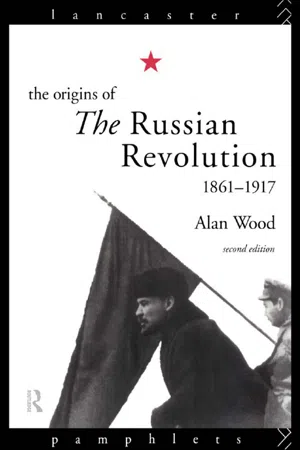
The Origins of the Russian Revolution, 1861-1917
About this book
Alan Wood provides a concise introduction to the Russian Revolution and its origins dating back to the emancipation of the Russian peasant serfs in 1861. The third edition of this successful pamphlet brings the historiography up to date to include the multitude of research in the last ten years that followed the collapse of the Soviet Union and the opening up of the archives.
1
Introduction
The Russian Revolution of 1917 is arguably the most important event in the political history of the twentieth century. A contemporary observer of the Revolution, the American journalist John Reed, entitled his famous account of those events Ten Days That Shook the World, and the tremors and reverberations of the upheaval still continue to be registered today. Seventy-six years after the event (at the time of writing) the shock-waves emanating from Russia in 1917 still have a direct or indirect impact on a whole range of political, economic, ideological, diplomatic, and military problems throughout the world. An appreciation of the causes, course and consequences of the Russian Revolution is not, therefore, merely a matter of historical interest, but something which is crucial to a proper and informed understanding of the political world in which we live, and in which the former Soviet Union – a state and society born of that Revolution – has played such a crucial role.
This pamphlet confines itself to an examination of the causes and course of the Revolution, from the emancipation of the Russian peasant serfs in 1861 to the Bolshevik seizure of political power and the establishment of the first Soviet government in October 1917. Why begin an examination of the 1917 Revolution in the year 1861? It is not necessary to subscribe to the Marxist–Leninist view of history to agree with Lenin’s own opinion that the origins of the Revolution can be traced back to the unsatisfactory legislation which abolished serfdom in Russia in 1861. The ambiguous and internally contradictory programme of administrative reform which followed the Act of Emancipation generated new social, political and intellectual forces which were, however, confined within the rigid political framework of an absolutist, autocratic state. It is a physical, if not a historical, law that an uncontrolled steamhead of pressure building up inside an inflexible container with no room for expansion, no structural elasticity and no in-built safety-valves will inevitably explode and shatter the vessel. Those dangerous pressures and forces, both latent and active, were there for everybody to see and feel in the decades preceding 1917. Both for the autocracy and for the opposition, revolution was always a real possibility. Russian intellectuals constantly wrote and talked about it; activists organized for it; the government legislated against it; and the combined forces of the military and the police were constantly on the alert to suppress it. But it was the masses, the Russian people, who eventually made it. What follows seeks to describe and analyse some of the objective circumstances and subjective factors which contributed to that process, and which created those tensions and contradictions within the Russian Empire which proved ultimately unsusceptible of any other than a revolutionary solution. First, though, it is necessary to identify some of the salient characteristics of the tsarist regime and to trace the earlier traditions of revolutionary opposition to it.
2
Autocracy and opposition
The imperial regime: contrasts and contradictions
The Russian Empire at the time of the Revolution was a land of glaring contrasts. It was the largest land-empire in the world. From the heart of eastern Europe to the Pacific coast, and from the Arctic Ocean to the deserts of Central Asia and the Chinese borders, it sprawled – like the Soviet Union after it – over an area which covers roughly one-sixth of the earth’s total land surface. A mismatch of territories and population, however, meant that whereas more than two-thirds of the country lay east of the Ural mountains in the vast, frozen expanses of Siberia, the bulk of the population resided and worked in the European provinces of Russia, Ukraine, Byelorussia, Poland (which was then an integral part of the Empire) and the Caucasus. The first Russian ruler to style himself Emperor (as distinct from tsar) was Peter I (Peter the Great, r. 1696–1725). The realm which he inherited from his seventeenth-century Muscovite forebears was already of considerable dimensions across the Eurasian landmass, but it was his most enduring achievement to establish Russia’s presence as the dominant power in northern and eastern Europe as a result of his victory over Sweden in the Great Northern War (1700–21).
The significance of Russia’s entry into Europe cannot be exaggerated. Equally portentous were the reciprocal effects of Europe’s impact on Russia. The main thrust of Peter’s reforms was to reshape the military and civilian administration of his country based on European models and to force the members of his landowning service nobility (dvoryanstvo) to adopt western-style habits, manners, education and attitudes. In this way Peter created a great division in Russian society – or, rather, he created two societies. On the one hand was the educated, westernized dvoryanstvo, which in the half-century after Peter’s death became transformed into a fully fledged, leisured, land-and serf-owning nobility enjoying most, if not all, of the privileges of a European aristocracy. On the other hand were the Russian people (narod), the enserfed peasants, who continued to be ruthlessly exploited, fleeced and conscripted, while at the same time remaining sunk in a vast swamp of ignorance, misery, superstition and periodic famine. This social and intellectual chasm separating the nobility from the narod was a manifestation of the complex and ambivalent nature of the relationship between ‘modern’ Europe and ‘backward’ Russia which was a major leitmotif of the country’s history throughout the nineteenth century.
Further examples of ambiguity and contradiction may be found in the political structure, economic relationships, military power and even the cultural achievements of Russia on the eve of revolution.
In the first place, the Russian emperor was an absolute autocrat. That is to say, there were no legal or constitutional constraints on his or her exercise of political power, choice of government ministers and officials, or formulation of national policies. A word from the tsar was sufficient to alter, override or abolish any existing legislation or institution. During the eighteenth and nineteenth centuries, several attempts had been made to draw up proposals for some kind of constitutional reform which would limit the tsar’s powers, but none of them was successful. It was not until the revolutionary disturbances of 1905 that the last Russian tsar, Nicholas II (r. 1894– 1917), was forced to authorize the holding of elections for a consultative and legislative national assembly known as the Imperial State Duma. However, despite the tsar’s reluctant concession to the principle of some kind of limited participatory politics, the legalization of political parties, and the promulgation of a set of Fundamental Laws, the form of government still remained an absolute autocracy. In other words, if the autocrat wished to abolish the constitution (and the Duma with it), then the constitution invested him with the authority to do precisely that. Neither fish nor fowl, the notion of a ‘constitutional autocracy’ was not only impractical, it was clearly a political absurdity which was doomed to failure.
In economic terms the situation was similarly problematic. Russia’s industrial backwardness in comparison with the other major European powers had been exposed and highlighted by its defeat in the Crimean War (1853–6). Consequently, although not immediately, the government embarked on an intensive programme of industrialization at the turn of the century which catapulted Russia from being one of the least economically developed countries in Europe to one of the world’s leading industrial producers. In the process Russia rapidly took on all the appearance and substance of a modern capitalist economy. For the first time in its history the country developed a large industrial labour force, or proletariat, and an economically powerful middle class of businessmen, bankers, lawyers, financiers, and factory-owners. At the same time, however, the great majority of the population, about 80 per cent, was still made up of communally organized peasants, working and living in their villages in conditions which had altered little since the eighteenth century. Even many town dwellers were officially registered as peasants, and Russia was still an overwhelmingly agrarian society. This existence of a modern, industrial society cheek-by-jowl with a large, land-hungry peasantry whose economic interests were long neglected by the government is a key factor in an understanding of the nature of the 1917 Revolution.
Also vital to an understanding of the events of that year is the role of the military. And here, too, we are faced with another apparent paradox. The power and prestige of the Russian Empire ultimately rested on the strength of its armed forces. The Russian army was the largest military force in the world, and was utilized not only for fighting foreign wars but also for maintaining internal order and suppressing civilian disturbances which threatened the stability of the regime. In the wake of Russia’s defeat in the Crimea, there followed a series of radical military reforms in the 1870s which sought to reorganize and reequip her forces for the tasks of modern warfare. Despite these changes, however, an overestimation of her strength resulted in further military disaster, this time at the hands of the Japanese in the war of 1904–5. The mighty Russian Empire was defeated by a relatively tiny Asiatic country which had, however, modernized itself more successfully and efficiently than its enormous, and apparently more powerful neighbour. The omens for Russia’s involvement in the First World War were therefore hardly auspicious. Whether her disastrous performance in that conflict precipitated the Revolution of 1917 or not is a question that will be discussed in a later section, but the paradox is clear: on the one hand a great imperial power still with formidable military resources at its disposal, and on the other an army that seemed increasingly incapable of fulfilling its tasks, either of waging victorious war or of containing the internecine forces of civil unrest.
Culturally and intellectually, too, Russia during the reign of Nicholas II was a country which presented two different faces to the world. The two decades or so before 1917 have been described as the ‘Silver Age’ of Russian culture, the ‘Russian Renaissance’, and similar expressions which emphasize the innovative nature and high aesthetic quality of its artistic and literary achievements. Indeed, many of Russia’s poets, painters and musicians formed the avant-garde of contemporary European culture. The plays and short stories of Anton Chekhov and Maxim Gorky, the poetry of Alexander Blok and the symbolist school, the music of Scriabin, Stravinsky and Prokofiev, new dramatic techniques pioneered by Stanislavsky and Meyerhold and the philosophical–religious ideas of Berdyaev and Rozanov, as well as the scientific discoveries of such scholars as Mendeleyev and Pavlov, were all of them characteristic of this age of intense cultural activity and attainment. The achievements are undeniable, but they were of course the exclusive preserve of the educated upper classes and intellectual élite. By contemporary western standards, levels of popular education and literacy in Russia were distressingly low. The majority of the peasant population was still illiterate, and in any case had far more urgent problems of sheer day-to-day survival to struggle with. There was little lyricism, learning or beauty in the life of the masses, and to many it seemed that the elegant outpourings of the intelligentsia were a self-indulgent abnegation of social and moral responsibility before the Russian people. Once again we are faced with a contradiction: that of a country whose brilliant artistic, scientific and literary achievements were in the forefront of European civilization, but the majority of whose population could not read or write its own language.
A further complicating factor in considering the state of the Russian Empire on the eve of revolution is the ethnic composition of the population. Out of a population in 1917 of 163 million, Russians accounted for only 40 per cent of the total. The rest was composed of a huge heterogeneous and multilingual collection of national minorities of widely differing size and levels of civilization. Throughout the history of the Empire these had periodically expressed their discontent at their subject status and at continuing Russian domination. This manifested itself in many forms from acts of individual protest and civil disobedience to full-scale and fully-armed national insurrections calling for separation and autonomy. These were always mercilessly suppressed. The Polish uprisings of 1830 and 1863, for instance, were followed by executions and the exile of tens of thousands of Polish patriots to permanent exile in Siberia. Among the other nationalities, the Jews in particular suffered from a variety of restrictions on their residence, education, professional opportunities and economic activities. They were, too, the regular victims of officially connived-at campaigns of mob violence, arson, looting, and rape – the notorious pogroms. Apart from Poland and the ‘Jewish pale’, anti-Russian feelings ran high elsewhere in the Empire, and among the centrifugal forces impelling the tsarist regime towards its final collapse, the movements for national independence among the non-Russian peoples were an emotionally charged and extremely potent factor.
The Russian Empire at the beginning of the twentieth century, therefore, contained a highly volatile mixture of ostentatious wealth and grinding poverty; power and debility; backwardness and modernity; despotism and urgent demand for change. Examples were everywhere to be found of juxtaposed barbarism and sophistication; European and Asiatic traditions; advanced technology and primitive techniques; enlightenment and ignorance. This is of course not a situation which is historically peculiar to Russia, and is indeed to be found in many underdeveloped or developing societies throughout the world today. However, the stark contrasts and contradictions existing in Russia in the inter-revolutionary period between 1905 and 1917 led the great Russian writer, Leo Tols...
Table of contents
- Cover Page
- Title Page
- Copyright Page
- Foreword
- Preface to the Second Edition
- Notes and Acknowledgements
- Chronological Table of Events
- Glossary of Russian Technical Terms
- 1. Introduction
- 2. Autocracy and Opposition
- 3. Reform and Reaction
- 4. Rebellion and Constitution
- 5. War and Revolution
- 6. Interpretations and Conclusions
- Suggestions for Further Reading
Trusted by 375,005 students
Access to over 1.5 million titles for a fair monthly price.
Study more efficiently using our study tools.
Frequently asked questions
Yes, you can cancel anytime from the Subscription tab in your account settings on the Perlego website. Your subscription will stay active until the end of your current billing period. Learn how to cancel your subscription
No, books cannot be downloaded as external files, such as PDFs, for use outside of Perlego. However, you can download books within the Perlego app for offline reading on mobile or tablet. Learn how to download books offline
Perlego offers two plans: Essential and Complete
- Essential is ideal for learners and professionals who enjoy exploring a wide range of subjects. Access the Essential Library with 800,000+ trusted titles and best-sellers across business, personal growth, and the humanities. Includes unlimited reading time and Standard Read Aloud voice.
- Complete: Perfect for advanced learners and researchers needing full, unrestricted access. Unlock 1.5M+ books across hundreds of subjects, including academic and specialized titles. The Complete Plan also includes advanced features like Premium Read Aloud and Research Assistant.
We are an online textbook subscription service, where you can get access to an entire online library for less than the price of a single book per month. With over 1.5 million books across 990+ topics, we’ve got you covered! Learn about our mission
Look out for the read-aloud symbol on your next book to see if you can listen to it. The read-aloud tool reads text aloud for you, highlighting the text as it is being read. You can pause it, speed it up and slow it down. Learn more about Read Aloud
Yes! You can use the Perlego app on both iOS and Android devices to read anytime, anywhere — even offline. Perfect for commutes or when you’re on the go.
Please note we cannot support devices running on iOS 13 and Android 7 or earlier. Learn more about using the app
Please note we cannot support devices running on iOS 13 and Android 7 or earlier. Learn more about using the app
Yes, you can access The Origins of the Russian Revolution, 1861-1917 by Alan Wood in PDF and/or ePUB format, as well as other popular books in History & 20th Century History. We have over 1.5 million books available in our catalogue for you to explore.