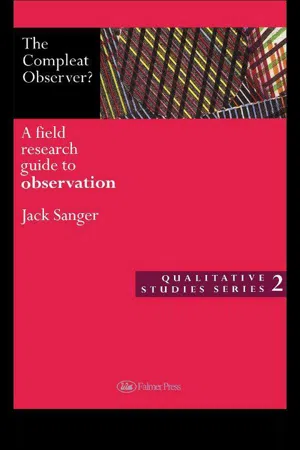
- 152 pages
- English
- ePUB (mobile friendly)
- Available on iOS & Android
eBook - ePub
About this book
Combining anecdotal accounts, inter-professional experiences, critical debate and practical pointers to being a good observer, this book explores issues surrounding observation in social science-orientated research.
Information
1 Problems and Pitfalls
The Aristotelian tradition also held that one could work out all the laws that govern the universe by pure thought: it was not necessary to check by observation. (Hawking, 1988)
It was not until 1980, thirty-seven years after being born, that I first realized that there was a world of difference between seeing and observing. All those years I had found my way around with unconscious lack of precision, only observing when I needed to remember a route, or a page for an exam or the face of someone who might turn out to be important to me. I was a doctoral student, in a classroom in London, supposedly in search of the way that teachers introduce complex concepts to learners. I remember vividly the sense of frustration of wondering when and how I might be able to record a complex concept. It was as though I was one of those lead-lined receptacles deep beneath the earth’s surface, filled with a liquid which would capture the momentary path of a neutrino as it winged its way through matter. A section of my notes for the event, looked like this:
Snippets of conversation drift by and attract my attention. ‘A mate of mine fell forty feet off a tree on Saturday…’
The two girls next to me are doing graphs for mathematics’ homework.
One says, ‘Oh I see…!’ She corrects her homework. Peer teaching. A sign, a further sign, of the bond between them. They touch regularly.
They talk a great deal and share private jokes. Their eyes meet and they smile. They dress almost identically in pale green V-necked jumpers and blue jeans. Watches. Necklaces. Hairstyles.
One says, ‘Oh I see…!’ She corrects her homework. Peer teaching. A sign, a further sign, of the bond between them. They touch regularly.
They talk a great deal and share private jokes. Their eyes meet and they smile. They dress almost identically in pale green V-necked jumpers and blue jeans. Watches. Necklaces. Hairstyles.
The teacher begins to read out two poems, by Rupert Brooke and James Kirkup. She reads the former. The two girls read and follow.
The class is quiet. While the group answers questions and discuss phrases, descriptions, images of an idyllic England, the two girls remain stoically silent staring at the words, eyes refusing contact with the teacher while their fingers fiddle with their ornaments.
The class is quiet. While the group answers questions and discuss phrases, descriptions, images of an idyllic England, the two girls remain stoically silent staring at the words, eyes refusing contact with the teacher while their fingers fiddle with their ornaments.
Decoding the poems’ meanings takes place through dialogue between the teacher and individuals—whoever can manage the act of analysis.
The teacher is always part of the dialogue and the pupils have at best only partial participation. Most learning is by proxy and by later emulation. The bulk of first hand learning will take place in different surroundings—those of their own homes or the backs of buses or in the library. In the classroom the stage metaphor tends to take hold of the observer’s understanding. A few of the class have gradually assumed prominent roles in dialogue with the teacher. For the rest of them there are walk on parts or audience passivity.
The teacher is always part of the dialogue and the pupils have at best only partial participation. Most learning is by proxy and by later emulation. The bulk of first hand learning will take place in different surroundings—those of their own homes or the backs of buses or in the library. In the classroom the stage metaphor tends to take hold of the observer’s understanding. A few of the class have gradually assumed prominent roles in dialogue with the teacher. For the rest of them there are walk on parts or audience passivity.
One pupil says of the first poem, ‘People don’t think like that any more.’ It becomes a lost statement, trapped in mid-air between the teacher’s need to hurry on with her own line of knowledge and the clamour of other offerings. The girl next to me writes a note to her friend. I can’t see what she is writing.
The second poem seems to induce a shock of recognition. It is a simpler, cruder, more aggressive statement. The teacher leads the group (willingly on their part) into an agreement with the poet’s statements… and then begins to unpack meanings. She offers a belated aside, ‘Oh, put a full stop at the end of the first line. The typist missed it out.’
The girl next to me does this for her friend, too, with a smile. She completes her note and folds it into an aeroplane. Then she unfolds it and places it under the poem. In the classroom a girl is suspecting the author of not really knowing the reality of war. Meanwhile, the girl next to me has placed a small hand mirror against her bag. She does not appear to want to stare at it but catches the occasional reflection of herself in a less aware state. She suddenly sits up and smiles. An expression of recognition when she hears the teacher say…‘Children often say to their parent, “I didn’t ask to be born!”’
A chuckle runs round the class. There is a feeling of identification with the statement. There is more discussion of the poem and Jesus dying for Mankind. The girl next to me checks her bangles. The atmosphere in the room is more electric as the discussion covers the act of dying for a cause: hunger strikers in Northern Ireland, suffragettes… The girls beside me become animated with each other but they talk in whispers.
A girl says she would die to save two others but not one. The last line of the poem says, ‘Only nothing is worth dying for.’ The class reject this without any dissension. The teacher gives an interpretation. That there is no purpose to life. She introduces ‘nihilistic’ as a term. The lesson never discusses the quality of the poetry and therefore never moves towards a critical awareness of its authority. The insertion of a comma is like the appending of QED to a theorem.
The lesson completed, I manage to retrieve the girl’s words from the waste bin. I wanted confirmation of her own idiosyncratic hidden agenda of learning. The note read: ‘THAT MAN HAS WRITTEN TWO FULL PAGES AND IN THIS LESSON—ABOUT WHAT WE ARE DOING. HE’S WRITING NON-STOP HE MUST BE BORED OUT OF HIS MIND.’
Afterwards I talk to the teacher in the staffroom. I feel elated at my acute observation of the two girls and the irony of the note. But the teacher tells me that a boy, in full view of the class, gave her a present at the start of the session. An apple. She was invited to squeeze it but refused. She gave it back. He squeezed. A plastic penis burst through a hole. The present was from ex-pupils, now at university. The same perpetrators have written on the boy’s piece of work, ‘Poor work. Not surprising, considering the teacher’. These ex-offenders left five years previously but the memory of the teacher seems to have remained, undiminished.
It was only when I began to reflect upon my notes did I realise that observation and seeing were two different activities which, though obviously connected, nevertheless conflicted. Just as Britain and America are said to be divided only by language, so observation and seeing are divided only by the desire to perceive.
What did I see and what did I observe? Well, I observed some of the goings on between the two girls next to me. I observed bits and pieces of the teacher interacting with pupils, What I saw is not in the notes. Maybe it registered for some brief, indeterminate length of time in my short term memory before being dumped in the bin labelled ‘insignificant’. We obviously circumnavigate the world by seeing, primarily, and become trained to do it without too much thought, relegating much of our visual mapping of our environment to the hind brain. Observation is brought on by the stimulus to be necessarily aware. Finding our way in a strange town. Being faced by the trauma of a hospital visit. Walking through a dangerous precinct. Or by doing research. If the actions we are engaged in are significant to us, then we slip the gear of seeing and engage observation.
How did I come to observe what I did? Because it was part of the contract I had with my researching self? However, this contract involved selection based on the naiveté of my understanding. And, therefore, the denial of other classroom activities. It was as if the particular focus of observation had been forced upon me. No subtle, informed and experienced Sherlock Holmes, here, such as is found in the following dialogue from Silver Blaze by Conan Doyle and quoted by Zizek (1991).
‘Is there any point to which you wish to draw my attention?’
‘To the curious incident of the dog in the night.’
‘The dog did nothing in the night.’
‘That was the curious incident,’ remarked Holmes.
Notions of observing the absence of something never even occurred to me at this time! Indeed, my interest in absence came a few years later, once I began to read Barthes, Foucault, Eco, Derrida and Lacan.
If it was complex concepts I was after, why didn’t I home in on the teacher’s introduction of ‘nihilism’, rather than being magnetized by the cloning girls next to me? Was it an unconscious heuristic leap back to adolescence, when such girls were on the other side of the classroom, remote and mysterious? Was I exploring the hidden curriculum? Was I case-studying two learners as they were being taught—now known as ‘pupil-pursuit? Was I making conscious selection of observational subjects or was the whole process prejudiced by unknown, unconscious Freudian drives?
Doing observation for professional purposes is not as easy as it at first appears. Far from being a first line of defence in the search for objectivity, it can be a leaky, permeable membrane. One which allows as much to issue from the observer as hits her wall of consciousness from the outside with that satisfying but deceptive thump of factuality. The key motif in much art and philosophy, not to mention psychology, is that of the observer seeking and discovering aspects of the self in the Other. By the Other, I mean that which is outside, novel, strange or unknown. An image which sums it up is Escher’s drawing of an eye staring back at the viewer (Eye, Mezzotint, 1946), in whose pupil is the reflection of the viewer, only the image is that of a skull. I, the observer, searching for fundamental truths about the nature of existence and my own mortality.
And yet? Isn’t there a place for the kind of research illuminated by my early classroom notes, where the eye roams in apparent random and the moving finger writes what it will? There are a 1001 stories in any half-hour in the classroom and this is just one that the net drags in. It depends, researchers would say, on who your audience is. And what kind of research you are doing. Sometimes these amount to the same thing.
We write for an audience; ourselves or one or more significant others. We, likewise, observe for an audience. And, in the main, we are reconstructing what we see for this audience, whether we do it through the medium of oral recall, video-tape or notes.
My field notes probably wouldn’t satisfy a scientist but they might prove interesting to a teacher, a journalist, a naturalistic enquirer or a phenomenologist …they might help to stimulate a discourse. And making people think may be more important to me than pinning down what a scientist might regard as objective truth. Thus, observation may be inextricably tied to a sense of its eventual use. The processes of planning, selecting, ordering and eventually recording events may determine what we observe in the first place.
The field notes also tell us something about the complexity of time. Events that were occurring in the classroom were related to events five years previously. A contingency was being revealed, though not to me. Had I not talked to the teacher I would never have known about the apple incident in the classroom, anyway, never mind its historical antecedents. We blithely talk about case study, for example, being representatives of instances in time. But the effects of historical contingency may be less than palpable.
As for myself, this observer of life as it is happening, what of me and my fly on the wall role? Blissfully unaware of the major event at the front of the class, I sat in a seat in one corner at the back, attempting a covert recording of significant proceedings. A bit like a Star Trek captain, intending to have no effect upon a culture I was visiting. The girl’s note is a salutary reminder that invisibility is more fantasy than reality for the observer. We can minimize our effect but would be foolish to claim that we have no effect at all.
Observation is a slippery business. The world is exponentially messier than a laboratory and the latter has proven more ambiguous and error-strewn than science would ever admit. Just this one set of well-meant field notes have thrown up validity problems which include the history underpinning events, the biography of the observer and the nature of selection of events to witness. And we haven’t begun to look at the language of recording yet!
Foreground and Background
Nazruddin crosses the border between two countries with his donkey and his cart of straw. He never returns by this route. The chief of the border guards notices that Nazruddin looks wealthier at each crossing and suspects him of smuggling. One day he orders the straw to be searched. There is nothing to be found. Another day he has the straw cut up into tiny pieces. Nothing. Yet another day he has the straw burned. Nothing. A further day be boils the straw. No evidence. Embarrassed, he gives up and watches Nazruddin grow rich enough to retire. Years later he meets the wealthy Nazruddin in a beautiful part of the country, outside his large white house. He asks him whether he was smuggling something across the border. Nazruddin smiles and says that he was. The chief of the border guards asks what. ‘Donkeys!’ laughs Nazruddin.
Sometimes, observation falls foul of the same false logic as that used by the chief of the border guards. We look where we expect to find rather than opening ourselves to any possibility that might turn up. For the chief, the donkey was too every day a creature, too obviously part of life’s continuing background, to be significant. Despite the fact that it was a major aspect of his observational picture, he merely saw it and did not observe it.
Key features in the process of observation seem to be foreground and background. There is overwhelming evidence to the effect that human cognition adopts a patterning approach to the potentially chaotic data which confronts it, every moment of the waking day. At all times the brain functions to create order among the deluge of signals reaching it (Vernon, 1970). It observes what the mind-set requires it to observe. Donkeys become invisible. We always have to ask ourselves whether we are looking in the right place for what we want to find. And in the right way.
Nazruddin was found by his neighbour one night, on hands and knees under the light, outside his house. The neighbour, too, dropped on all fours. He asked what Nazruddin had lost and was told that the old man had mislaid his house key. After an hour’s search, nothing was found. The neighbour asked Nazruddin where he had last seen the key. ‘Over there, in the bushes.’ ‘Then why are we looking here?’ Nazruddin smiled cagily. ‘Because there is no light over there to find anything.’
Apart from looking in the wrong place, this s...
Table of contents
- Cover Page
- Title Page
- Copyright Page
- Dedication
- 1: Problems and Pitfalls
- 2: ‘You Are Here!’
- 3: ‘Inside Out or Outside In?’
- 4: The Ethics of Entry
- 5: Validity and Invalidity Benefits
- 6: Checking It Out
- 7: Seeing Through The Interview
- 8: Research In the Technological Sense
- 9: Seven Types Of Creativity: Observation And Data Analysis54
- 10: Closely Observed Training
- 11: Administering Poison: Reporting Observations
- 12: Tales of Future Past
- Bibliography
Trusted by 375,005 students
Access to over 1.5 million titles for a fair monthly price.
Study more efficiently using our study tools.
Frequently asked questions
Yes, you can cancel anytime from the Subscription tab in your account settings on the Perlego website. Your subscription will stay active until the end of your current billing period. Learn how to cancel your subscription
No, books cannot be downloaded as external files, such as PDFs, for use outside of Perlego. However, you can download books within the Perlego app for offline reading on mobile or tablet. Learn how to download books offline
Perlego offers two plans: Essential and Complete
- Essential is ideal for learners and professionals who enjoy exploring a wide range of subjects. Access the Essential Library with 800,000+ trusted titles and best-sellers across business, personal growth, and the humanities. Includes unlimited reading time and Standard Read Aloud voice.
- Complete: Perfect for advanced learners and researchers needing full, unrestricted access. Unlock 1.5M+ books across hundreds of subjects, including academic and specialized titles. The Complete Plan also includes advanced features like Premium Read Aloud and Research Assistant.
We are an online textbook subscription service, where you can get access to an entire online library for less than the price of a single book per month. With over 1.5 million books across 990+ topics, we’ve got you covered! Learn about our mission
Look out for the read-aloud symbol on your next book to see if you can listen to it. The read-aloud tool reads text aloud for you, highlighting the text as it is being read. You can pause it, speed it up and slow it down. Learn more about Read Aloud
Yes! You can use the Perlego app on both iOS and Android devices to read anytime, anywhere — even offline. Perfect for commutes or when you’re on the go.
Please note we cannot support devices running on iOS 13 and Android 7 or earlier. Learn more about using the app
Please note we cannot support devices running on iOS 13 and Android 7 or earlier. Learn more about using the app
Yes, you can access The Compleat Observer? by Dr Jack Sanger,Jack Sanger in PDF and/or ePUB format, as well as other popular books in Education & Education General. We have over 1.5 million books available in our catalogue for you to explore.