Although the world population faces movement, mixing and displacement on a larger scale than ever before, the result has not been a collapse of boundaries but an increase in the rise of new forms of ethnic, cultural and religious identity. Those based in the highly developed countries can extend global influence through wealth and sophisticated technology.
The Pursuit of Certainty presents original case studies which explore the effect anthropology's inherited tradition of tolerance and cross-cultural understanding has on the new pursuits of truth. Several chapters focus on the rise of new certainties while others examine notions of diversity providing a critical perspective on the new religious movements and current popular orthodoxies relating to society and culture.
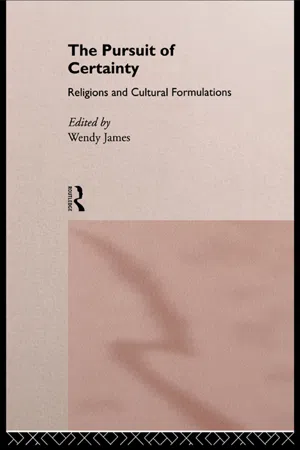
- 328 pages
- English
- ePUB (mobile friendly)
- Available on iOS & Android
eBook - ePub
About this book
Information
Part I
Displacement and the search for redefinition
‘Western Civilization Starts Here.’
‘Who are the Nubians?’
Signs welcoming Janice Boddy to the
ancient civilization hall of the Royal Ontario Museum
1
Managing tradition
‘Superstition’ and the making of national identity among Sudanese women refugees
Janice Boddy
What it all comes down to is that we are the sum of our efforts to change who we are. Identity is no museum piece sitting stock-still in a display case, but rather the endlessly astonishing synthesis of the contradictions of everyday life.
(Eduardo Galeano, The Book of Embraces)
A simple hand-drawn flyer reads:
Sudanese Women Community Invite You to See Superstition and Traditional Dancing—Free *****
Mid-page, tendrils of smoke rise from a fire to embrace the disembodied head of a woman—eyes closed, restful; hair, uncovered, fanning out from her head as if shocked. Below the picture:
International Women’s Day, March 8th at 8:00 pm, Location: Eritrea Restaurant 1278 Bloor St. West [Toronto]
The flyers are displayed in downtown ethnic restaurants, in cornershop windows beside provincial lottery signs and the prices of milk, in specialist travel agencies that broker services for arrivals from North-East Africa. They are distributed among the women’s friends and neighbours: Egyptians, Ethiopians, fellow Sudanese. Any and all, but especially AngloCanadians, are encouraged to come. The evening is a success; the restaurant fills to overflowing. Yet those who attend see more than a demonstration of ethnicity: they witness a drama of political resistance, one that skilfully seeks to strengthen the resolve of disparate Sudani refugees and forge them into a unified ‘we’, a nation in absentia. And the community thus imagined (Anderson 1991; see Appadurai 1990:5) consists of a partnership of women and men.
The women’s performance that night and the overlapping contexts that engulf it—the homeland versus ‘the West’, various social interests in Toronto, the horror of Sudan’s continuing north-south divide—expose a subtle interweaving of global and local concerns. Indeed, the events I detail and attempt to render intelligible raise questions about this analytical dichotomy, suggesting that, just as importations are interpreted and transformed within a local context, what is claimed to be universal is firmly rooted in specific sites and societies (see Amin 1989). Both the refugees and the Islamist government in Khartoum are using increasingly globalized culture-technologies—written history, ethnography, museums—as means of articulating their positions vis-à-vis each other and the world at large, yet in ways that make sense in decidedly localized terms. Toronto, of course, is one of these locales. It resists depiction as an essentialized, monolithic entity—’the West’, both ground and by-product of Orientalist discourse—for in its specificity it is at once more than this and less. The actions, statements, indeed silences of the refugees must be viewed in relation to their ambivalently multicultural host as well as to the hostile regime at home.
The events I discuss took place between 1991 and 1992. They condense to a singular moment an unremitting contest for certainty that is also a struggle over cultural probity; it is a dispute over knowledge, over power and social discipline, over the practices that are ‘authentically’ Sudanese. Enemies are identified, ‘customs’ endorsed or excluded; yet the lines that are drawn remain malleable, imprecise. For refugees, uncertain of their future abroad, there is and must be room for rapprochement. Caught in a web of opposed certainties suspended between two worlds, seeking a future that rejects the present but both valorizes and meliorates the past, they are forced to rethink themselves. So their argument is not without contradiction and ironies abound.
Because my own involvement in this episode was integral to its development, the following discussion parallels that process to some extent. Here ‘at home’, in the city where I teach, I realized more than ever how perforated are the barriers that separate the anthropologist’s reality and her informants’; how each of us might simultaneously realize and rethink herself in the other’s representations; how local and how global we all, perforce, must be.
ZAR
The ceremony staged by the women of the Sudanese refugee community in Toronto on 8 March 1992, in celebration of International Women’s Day, was a zar, a spirit possession ritual. But it was a zar transformed in the context of refugee existence abroad.
Between 1976 and 1977 and again from 1983 to 1984,1 studied the cult called zar as it was practised in a group of villages situated on the Nile some 200 km north of Khartoum. In Sudan, a zar is a healing rite; the term also applies to the condition that it addresses and to the spirits whose capricious appropriation of a human body (i.e. ‘spirit possession’) is deemed to have caused that illness. Both illness and cult are overwhelmingly the province of women. My findings were later published as Wombs and Alien Spirits: Women, Men and the Zar Cult in Northern Sudan (Boddy 1989); I summarize a few of its points below.
From an analytical perspective, a woman’s dysphoria, precipitated by untoward or anomalous experience that has challenged the culturally constructed self, is converted into a conventional narrative of spirit ingress and appeasement in the process of undergoing a possession cure. Continuing participation in the cult—attending ceremonies, heeding her spirits’ requests—supplies a thread of coherence to her life, persuasively affirming once problematic selfhood by providing direct and dramatic experience of what it is not. Spirits who become manifest during a zar are alien beings; though they parallel humanity in having ages, genders, religions and nationalities, they are both ontologically different from humans1 and culturally foreign to northern Arabic-speaking Muslim Sudanese. Their antics and identities, performed during the patient’s and fellow adepts’ temporally limited bouts of ritual trance, caricature a range of human possibility other than that deemed normal, natural and moral for the women in whose bodies such behaviours appear. Thus the ritual has collective implications as well as individual ones: it is an elaborate dramatization of foreignness that catalyses group understandings, through which women mutually construct an image-in-relief of northern Sudanese identity and experience. At the same time zar implicitly domesticates the foreign, enabling its incorporation into the familiar and everyday.
Women’s bodies are icons and repositories of community values and morality, conceived of in highly localized terms;2 possession both challenges and expresses that embodied knowledge, providing those whom it claims with occasion to distance themselves from themselves, yet also to critique, for themselves and the community at large, domination and oppression by a range of historical and contemporary powers. Issues of power that reflect on daily life—the power of some humans over others, the power of religion, custom, gender—are raised during spirit performances but obliquely, via metaphors contained in particular spirit chants or the spirits’ complex self-presentations. For instance, a married Sudanese woman may be seized by a male homosexual Arab zar who, now in control of her body, dons a man’s long shirt, yet who in performance plays hilariously and unsuccessfully at being a married Sudanese woman dressed in a towb, the head-to-foot wrap-around veil that women wear in public. The zar provokes the taken-for-granted and assumed, throws open to question everyday practices like wearing the towb, or the customary social arrangements that privilege men, even men who act as women. In this way a subtle protest is lodged against the constraints that govern women’s lives; in exposing these as mutable, however morally appropriate—in opening a space for uncertainty—such constraints are recontextualized, perhaps limited, though not of course undone. For to an extent this means that women are contesting themselves.
SUDANESE WOMEN AND THE PRESENT REGIME
Until 1991 there were only three Sudanese women living in greater Toronto (a city of some 4 million). But as the Islamist regime that had seized power in Sudan at the end of June 19893 enacted ever more coercive legislation, setting curfews, sartorial requirements and ‘morality’ rules, and limiting women’s participation in public life, educational institutions and the like, that number grew to thirty. All sought political asylum. Such women hardly represent the majority of Muslim Sudanese; they are not impoverished, illiterate villagers but women of the urban bourgeoisie, some of the lucky few with resources enough to get out. Four are single women who by 1992 had made their way to Canada on their own.4 All are educated to standards far beyond the norm for Sudanese women: all have high school leaving certificates, half have university degrees or professional qualifications. Several are pious Muslims, others not overtly religious, a few are acknowledged secularists; yet all are culturally and emotionally northern Sudanese. Still, whatever their private convictions, these are women who, in the cities where most of them used to reside, would probably wince at the thought of being seen attending a zar, or would publicly disavow having done so except in jest. Zar, whether by Western or strict Islamic criteria, is to them ‘superstition’.
I noted that until 1991 there were only three Sudanese women living in Toronto. But there were some 600 Sudanese men. They all knew one another, met regularly, periodically held musical evenings enabling them to socialize and activate their Sudani roots. Yet the community was decidedly skewed, so few were its womenfolk. Earlier I pointed out that women embody local values. Elsewhere (Boddy 1989), along with observers like Sondra Hale (1985), I have noted that in northern Sudan women are regarded as ‘symbols of the homeland’; in the villages especially, they are the moral heart of their communities. It is they who keep the home-fires burning while men emigrate for work; it is they who are responsible for the ceremonies (surrounding weddings, births, circumcisions) and daily acts of hospitality and etiquette that punctuate and weave the social world. These are the ‘adat or customs of dunya, earthly life. Men’s role is to provide the means to sustain such activity and oversee affairs linked to religious concerns (din) having properly to do with Islam—such as funerals, or the slaughter of a ram for the Great Feast. Although 1992’s ten-fold boost to the refugee community’s cohort of women has by no means redressed its lop-sidedness, their number has now, it seems, achieved a critical mass and their presence has become crucial to the community’s self-definition in the present context. Women are the homeland, and now they are here.
For they cannot be what they are in Sudan of the present day. The present regime sees women’s customary roles, duties, privileges, as immoral, or religious ‘innovation’ and is attempting their reform. In Sudan, for example, women are officially and forcefully discouraged from wearing the towb, typically made of a cool, light fabric and worn atop a dress, as this is considered too revealing of the hair, forearms and neck (Gruenbaum 1992:29).5 Nor may younger (school-aged) women wear the tarha, or head scarf. Anthropologist Ellen Gruenbaum, who revisited Sudan in May 1992, describes the case of a woman who, the previous October,
was arrested on the street and taken to a ‘public order’ court for violating the unwritten dress code. Although she was dressed in a modestly long skirt, loose mid-length sleeved shirt and the light scarf which many women allow to fall to the shoulders, she was found guilty of creating public disorder and sentenced to receive lashes and a fine. The woman had no way to defend herself since she had violated no specific statute. Her father paid the fine and successfully begged the judge to suspend the lashing.
(1992:30)
One month later the head of the Revolutionary Command Council and Prime Minister of the country, General Omar Al-Bashir, ostensibly answering public criticism that the behaviour and appearance of Muslim women had so far failed to conform to Shari’a law, declared that ‘all women in offices, public places, streets, educational institutions, etc., should wear long loose garments and cover their heads. This Islamic style of dress is known as “Hijab” and is defined in the Quran’ (Sudanow1991b: 6). To offset the cost to women of acquiring these new clothes, the government undertook to provide them with loans from the ‘Shari’a Support Fund’, repayable through payroll deductions (ibid.; Gruenbaum 1992:30). If by 1 July 1992 they had not complied with ‘Islamic dress’ codes, women employees and students risked being fired or expelled from school and arrested. Pressures to withdraw from participation in the public domain and adopt properly ‘Islamic’ gender roles are tangible. In 1992, visiting Iranian President Rafsanjani, as a gesture of Iran’s financial and ideological solidarity with the Sudanese regime, provided 1,000 chadors (facial veils) to be distributed among Sudanese women.
In 1991, in an effort to curb the exorbitant cost of customary marriage rites,6 the government began to sponsor group weddings. The project aimed ‘to combat undesirable traditions’ as well as ‘to create stability among young people and follow the example of the Prophet Mohammed, who condemned bachelorhood’ (Abdelrahman 1991b: 24). What was formerly a family matter, involving extended networks of kin, has now become an affair of the state; thus has a crucial basis of women’s power, their mastery of kinship rituals, been eroded.
Beliefs and practices long associated with vernacular Islam are now decried as unacceptable by the National Islamic Front-backed ‘Salvation Revolution Government’ and regarded as sad evidence of the need to improve educational standards. (This is despite the fact that professionals of all sorts are labelled Western, hence subversive, and are encouraged to leave the country).7 Illiterate women’s lack of religious awareness is seen to impel them, for example, to visit the graves of holy men in order to alleviate illness, and to engage in practices of the zar. Although zar has always been a matter of dispute between those who regard themselves as pious and those they consider unschooled—and so, in large part, between women and men—until recently it was tolerated, if reluctantly, by the Sudanese religious establishment. Spirits were too much a part of everyday life—their existence indisputable, banal, based on patently Islamic precepts8—for clerics and laymen to oppose the cult successfully.
Between 1983, when Islamic law was enacted in the dying days of Nimeiri’s regime, and the 1989 coup d’état that inaugurated rule by the National Islamic Front, zar underwent a process of folklorization in Sudan’s urban zones. Its subtle transformation from religiously informed cult to less threatening theatrical club is instructive. Hurreiz (1991:1524) documents how in 1987 a leading zar shaikh (male curer) was instrumental in founding the Association of Zar and Folklore Shaikhs, an officially registered society representing dozens of town cult groups. Once formed, the Association sought affiliation with the National Council for Arts and Letters. This, Hurreiz notes, was granted ‘in accordance with article (b) of the council’s constitution of 1976: “The promotion of theatrical activities, music and folk arts”’ (ibid.: 153). Both the zar practitioners in question, two-thirds of whom were male,9 and the authorities at the National Council clearly considered the associated cult groups to be an artistic dramatic society (ibid.).10 Although patients still behave as patients seeking treatment through the zar, the Association’s founders
are evidently…seeking respectability in the modern idiom of drama and psychodrama and a leading role in their public relations amongst the intelligentsia is played by an influential committee member who is a prominent Sudanese actress and graduate of the Institute of Music and Drama.
(ibid.: 154)
Not only was the zar being routinized as official theatre, it was also being removed from the religious domain, its healing practices rationalized, perhaps trivialized, and dissociated from Islam. Yet in seeming to question zar’s reality by making it ‘for show’, the shift effectively disguised the fact that zar continues to be an essential religious force in countless women’s lives. Moreover, the upshot of such Procrustean constraints was public acknowledgement that zar is an authentic part of northern Sudanese ‘culture’.
Ironically, the process of ‘folklorizing’ a cult based on resolutely local understandings of society and human existence was an attempt to mould it to the dimensions and categories by which ‘cultures’ are contained in the West;11 forms of culture, as Hannerz (1992) and others have shown, are becoming increasingly globalized even if their con...
Table of contents
- Cover Page
- The Pursuit of Certainty
- ASA Decennial Conference Series
- Title Page
- Copyright Page
- Contributors
- Preface
- Foreword
- Introduction: Whatever happened to the Enlightenment?
- Part I: Displacement and the search for redefinition
- Part II: Emerging world forms
- Part III: Vernacular contexts of public reason and critique
- Part IV Epilogue: a professional dilemma?
Trusted by 375,005 students
Access to over 1.5 million titles for a fair monthly price.
Study more efficiently using our study tools.
Frequently asked questions
Yes, you can cancel anytime from the Subscription tab in your account settings on the Perlego website. Your subscription will stay active until the end of your current billing period. Learn how to cancel your subscription
No, books cannot be downloaded as external files, such as PDFs, for use outside of Perlego. However, you can download books within the Perlego app for offline reading on mobile or tablet. Learn how to download books offline
Perlego offers two plans: Essential and Complete
- Essential is ideal for learners and professionals who enjoy exploring a wide range of subjects. Access the Essential Library with 800,000+ trusted titles and best-sellers across business, personal growth, and the humanities. Includes unlimited reading time and Standard Read Aloud voice.
- Complete: Perfect for advanced learners and researchers needing full, unrestricted access. Unlock 1.5M+ books across hundreds of subjects, including academic and specialized titles. The Complete Plan also includes advanced features like Premium Read Aloud and Research Assistant.
We are an online textbook subscription service, where you can get access to an entire online library for less than the price of a single book per month. With over 1.5 million books across 990+ topics, we’ve got you covered! Learn about our mission
Look out for the read-aloud symbol on your next book to see if you can listen to it. The read-aloud tool reads text aloud for you, highlighting the text as it is being read. You can pause it, speed it up and slow it down. Learn more about Read Aloud
Yes! You can use the Perlego app on both iOS and Android devices to read anytime, anywhere — even offline. Perfect for commutes or when you’re on the go.
Please note we cannot support devices running on iOS 13 and Android 7 or earlier. Learn more about using the app
Please note we cannot support devices running on iOS 13 and Android 7 or earlier. Learn more about using the app
Yes, you can access The Pursuit of Certainty by Wendy James in PDF and/or ePUB format, as well as other popular books in Social Sciences & Comparative Religion. We have over 1.5 million books available in our catalogue for you to explore.