- 192 pages
- English
- ePUB (mobile friendly)
- Available on iOS & Android
eBook - ePub
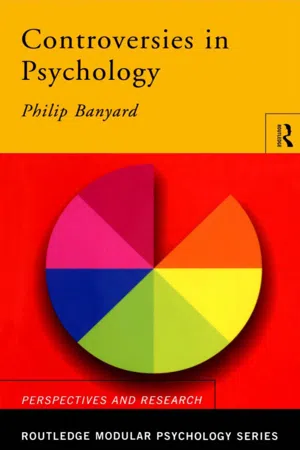
Controversies in Psychology
About this book
An introduction to the areas that have been studied in psychology that have excited controversy, including advertising, psychometric testing, propoganda and warfare.
Information
1
Psychology and warfare
Introduction
War! What is it good for? Well, I guess it must be good for something because it has been part of human societies since they first appeared. It appears to be an inevitable part of human behaviour because whatever time in history you choose to look at, there will be armies marching across some part of the world in an attempt to gain control over another group of people or another territory. It is also fair to say, however, that living peacefully is another inevitable part of human behaviour, and societies spend much more time at peace than they do at war. Most people in the Western world have enjoyed a relatively peaceful existence for the last fifty years or more. We have been able to negotiate serious political difficulties in such a way that large armies have not been mobilised and our countries have not been invaded or attacked. It is possible to argue that this has only been achieved by exporting our disputes and conducting them in other parts of the world, but that argument is not really the subject of this text.
The experience of war over the last fifty years has brought us to a point where Western peoples regard war as a specialised activity carried out by expert soldiers with high-tech weapons in a place far away from their own countries. We therefore tend to see war as a dramatic event much like a film, rather than a personal event with real danger for ourselves or our families and property. This is not how warfare was conducted in the past, nor how it is conducted in most parts of the world today. For many people, warfare is a potential threat to their personal safety.
Over the last fifty years the Western viewer has been shown images of war that are either amusing (Dad’s Army, It Ain’t Half Hot Mum), or heroic (A Bridge Too Far, The Great Escape, The Guns of Navarone). For most people who experience war, however, it is neither amusing nor heroic. It is made up of frightening events, mass death, mass injury, the loss of loved ones and the loss of property and homes. On 1 July 1916 during one day at the Battle of the Somme in the First World War (1914–18) over 20,000 British troops were slaughtered due to the tactics of their commanders (Taylor, 1963). The troops were required to come out of their trenches carrying heavy equipment and charge towards the enemy trenches where they were cut down by machine gun fire. Not content with this, the tactic was repeated the next day, and for the next four months until the battle was finally brought to end with no obvious strategic advantage but at the loss of 420,000 British casualties. By the end of this war, around one-quarter of all British men of military age were casualties. It is not possible to convey in this text the horror of war and its consequences. We will, however look at some of the contributions (good and bad) that psychology has made to our understanding of war and the conduct of war.
The three questions we will look at in this chapter are:
- What can psychology tell us about warfare?
- How has psychology been used in warfare?
- What can psychology tell us about the effects of war?
What can psychology tell us about warfare?
Are we born to start wars or do we learn to do this? What is it about people that leads us into conflicts that are resolved with mass destruc tion and mass death? We might start by observing that aggression is an important part of our behaviour and that this attribute has considerable survival value. Aggression, however, is not war. Animals can be aggressive to each other, but most of them do not organise into groups to wage an aggressive campaign on another group of the same species. A number of psychologists have looked at the issue of warfare and offered theories about it. In this section we will briefly look at contributions from William James, William McDougall, Sigmund Freud, John Bowlby and Margaret Mead. The list reads like a Who’s Who in the history of psychology, and their contributions give a flavour of the range of ideas that have been put forward to explain this very human activity.
The Williams (James and McDougall)
William James and William McDougall were both influential psychologists working in the early years of the twentieth century. They had very different political beliefs and these were reflected in their contributions to the topic of war. James was a pacifist and was therefore opposed to all forms of warfare. McDougall, on the other hand, believed in eugenics and so favoured the development of genetically superior people through selective breeding.
In James’s essay ‘The Moral Equivalent of War’, he set out his analysis of war and how it can be avoided. This essay was written before the First World War (1914–19) at a time when this conflict was becoming inevitable and when politicians were talking about having a ‘war to end all war’. James pointed out how war makes history, and that it is largely described in terms of heroic events even though it is often irrational and far from noble. Early descriptions of warfare, for example those of the Ancient Greeks, tell of pirate wars of incredible brutality. Groups of men fought for the spoils of another city or island and if they won, they plundered the goods and murdered or enslaved the inhabitants. By the turn of the twentieth century, the fight for goods and people was not seen as an adequate justification for war and different arguments were used. One argument that is still used today is that we have to go to war in order to get peace.
James suggested that wars bring some benefits and he argued that we have to find an equivalent to war that brings about the same benefits. He argued that the military values of strength, bravery, discipline and collective action are the foundation of any successful enduring society. His suggestion of a substitution for war was a mass mobilisation of young men to carry out physical labour and public works for a set number of years. This would encourage all the perceived virtues of military service without war. This view implies that people have certain qualities that have to be addressed though physical action and struggle, and without this struggle our society will become vulnerable to attack from outside and from within.
William McDougall’s view was not so different in some respects. In his account of ‘The Instinct of Pugnacity’, he also argued that we are predisposed towards fighting. He argued that it is an important feature in the development of human beings, and he put forward the evolutionary argument the fittest survive and the weakest are removed. He suggested that this is the main reason that we fight, rather than for possessions or for ideals. He illustrated his argument with anthropological evidence of peoples who go to war but take no spoils from the war.
The solution that McDougall proposed is very different from the one suggested by James. McDougall saw warfare as an important aid to the development of a healthy society. He argued against the liberal idea that an advanced society will find other ways of resolving conflict than through war. Again using anthropological evidence, he suggested that amongst the peoples of Borneo it is the groups who were most warlike that had the superior societies. He saw evidence for this in their bigger and cleaner houses, and their stronger and braver behaviour. He therefore saw the removal of war as a dangerous development that would lead to the degeneration of our society. He therefore argued for natural selection to be re-introduced through another means, that of selective breeding where the fittest and best (presumably including McDougall himself) have more children and the weakest and the worst (fill in the list to your taste) are discouraged from breeding or killed.
The argument for a eugenic solution attracted a lot of support across Europe and the USA during the 1920s and the 1930s. It was taken to its logical and horrific conclusion by the Nazis in Germany during the 1930s until their final defeat in 1945. They dealt with the eugenics issue by murdering people they perceived to be inferior or weak, including the Jews, Slav and Gypsy peoples, homosexuals and the mentally ill.
The psychoanalysts
Freud’s thoughts on war are summarised in a letter he wrote to Albert Einstein as part of an academic exchange on the subject. It was written in 1932 when the horror of the killing fields of the First World War were still having an effect on the way people thought and acted. In the letter, Freud pointed out that aggressive behaviour by one strong individual can only be challenged through collective action. A community can come together and overthrow a tyrant, though it will only avoid a new tyrant if the community stays together and is well organised. These communities can be aggressive towards each other, and this is the basis of warfare.
Freud argued that some wars have a positive effect because they establish large empires. In our recorded history, these empires have often imposed order within their boundaries and provided a peaceful existence for their citizens. There are sometimes, however, a few unfortunate down sides to large empires, such as the persecution of minorities and the suppression of civil liberties. Freud wondered whether the development of international organisations would allow nations to develop a world order that removed the rationale for warfare. At the time he was writing the League of Nations (an early version of the United Nations) was attempting, unsuccessfully as it happened, to do just that. Freud suggested that such an organisation needed to have a supreme court and also enough force to enact its judgements. It was on the second point that the League of Nations failed.
Freud believed that human beings have two basic instincts: the instinct to conserve and unify, and the instinct to destroy and kill. He suggested we might see these as the opposing forces of love and hate. He believed that we cannot suppress our aggressive tendencies, so we must divert them if we are to avoid continual conflict. He also believed that it is possible to divide people into those who are leaders and those who are led. The led ‘constitutes the vast majority: they need a high command to make decisions for them, and to which they for the most part offer an unqualified submission’ ([1993]1985, p. 359). He argued that we should, therefore, try to educate ‘an upper stratum of men with independent minds’ ([1933]1985, p. 359) to guide the masses. These independent thinkers needed to channel all their energies into rational thinking even if it involved the loss of any emotional attachments. Freud seems to be arguing that we will develop as people by becoming less influenced by our emotional side and more guided by rational thought. He believed that rational thought will turn us all into pacifists as we grasp the horror of warfare.
John Bowlby put forward another psychoanalytic explanation in an article, written with E.F.M. Durbin, in 1938. Bowlby and Durbin observed that aggression and warfare have been observed in most cultures and at most times of history. They also observed that warfare and aggression form a far smaller proportion of activity than does cooperation. They argue that warfare is just an extension of aggressive behaviours shown by individuals. The primary causes of these behaviours are identical in adults to the causes in children and also animals.
The primary causes are to do with:
(a) possession
owning property and territory, taking property and territory, and defending it;
(b) frustration
negative feelings when ambitions and desires are blocked;
(c) arrival of strangers
often associated with fear;
(d) attack of a scapegoat
picking on the weak and the outsider.
These four causes are seen as the root of all aggression whether it is between individuals, or groups or even nation-states.
Durbin and Bowlby went on to point out how the defence mechanisms of psychoanalytic theory can be used to explain the features of modern human conflict. For example, fears and hatreds that exist within a group of people can be projected on to a despised group. In this way, the nation-state can show all the aggressive behaviours of an individual.
Although Durbin and Bowlby believed that war is a chronic social disease, they did not believe that this disease was incurable. They pointed out that most nations spend far more time in peaceful and cooperative activities than they do at war. The problem then is to strengthen and develop these peaceful impulses and behaviour. It also seems possible that societies can be adjusted so that the people in them do not develop so much aggression.
The anthropologist
Margaret Mead wrote extensively about the customs and behaviour of different peoples around the world. She argued that warfare is not inevitable and not part of our nature, but a human invention (Mead, 1940). She argued that many institutions such as marriage are almost universal amongst peoples, but we must have originally lived without marriage and then at some point invented it. She suggested the same is true for warfare, and cites the Eskimos as evidence for this.
The Eskimos are a nomadic people who have no concept of war, even though they cannot be described as pacifists. Mead described how fights, theft of wives (!), murder and cannibalism were a part of Eskimo life. What was not part of Eskimo life was the organisation of one group of people to maim and kill another group of people. It might be possible to argue that Eskimos do not have war because they are nomadic and because they have few possessions. (It also might be because they are so chuffing cold.) However, to challenge this, Mead presented examples of other nomadic groups with few possessions who have developed all the rituals of warfare.
Mead’s account is a little more optimistic than the others in this section because it suggests we are not the victims of our nature. She does, however, point out that once people have invented something they rarely go back and stop using it. The way forward, she suggests, is to invent a better way of dealing with conflict than warfare. She observed the development of justice in Western society over the last few hundred years from trial by ordeal through to trial by jury. People invented new ways of dealing with justice when the old way no longer worked and a better way was available. She suggested the same might be possible for the elimination of warfare.
Summary
The above historical contributions on the nature of human warfare present a largely pessimistic view of the future. The general picture appears to be that war is likely to continue because we have natural tendencies to be aggressive or we have, at least, learnt how effective warfare can be. The theories produce few, if any, testable hypotheses and they depend on whether we are the victims of our biology or whether we are able to shape our own destiny through the development of better ways of living. I believe in the second view and I’m prepared to fight anyone who disagrees with me (weak ironic humour).
Progress exercise
Imagine all the people...
Use the above information along with your skill and judgement to answer the following question. If we had a world without war, what difference would it make to
(a) everyday behaviour in a shopping centre
(b) international trade
(c) major sports events like the Olympics
(d) how we settle disputes between groups of people
How has psychology been used in warfare?
Psychology has been involved in many aspects of warfare throughout the twentieth century. In this section, I will try to give you a flavour of that involvement and relate it where possible to psychological concepts and studies from the mainstream of psychology.
Early work in military psychology
Up until the 1960s, military psychology was mainly concerned with the same issues that would concern any major employer of people:
- selection of appropriate staff;
- matching people (soldiers) to machines;
- training (military) specialists;
- staff welfare.
The selection of the right person for the right job is a concern of any employer, and none more so than the military. In fact, the first mass IQ testing was carried out on the soldiers of the US Army during the First World War (1914–18). This work is described by Gould (1981), who noted how the data from this mass testing was used to promote a range of unpleasant political ideas including racist immigration laws in the USA. The testing also marked the start of the extensive military use of psychometric testing for the selection of staff (for more details on this work see Chapter 5).
On the issue of matching soldiers to machines, it is very important that any machine should be as easy to use as possible and as free from error as possible. For those of you who drive more than one car, you might well have come across a vehicle with the indicator control on the opposite side to your usual vehicle. This means that you keep switching on the window wipers every time you want to turn right. This is not a big problem, but it would be a different story if pressing the wrong lever didn’t turn the wipers on, but instead launched a thermo-nuclear attack on Bournemouth.
An illustration of this problem occurred during the Second World War (1939–45), and it came about because the military had concentrated on training pilots to fly aircraft rather than designing aircraft that could be flown by pilots. They discovered that even very experienced pilots were prone to make errors with the poorly designed control systems. For example, similar-looking controls operating the landing gear and the steering flaps on some B-25 bombers were placed next to each other. The unfortunate consequence of this was that several B-25s were brought into land without the landing gear in place and so landed on their bellies. The pilots believed that they had activated the landing gear, but in fact they had just steered the plane (Mark et al., 1987). Observations like this led to the de...
Table of contents
- Cover Page
- Title Page
- Copyright Page
- Illustrations
- Acknowledgements
- Introduction
- 1 Psychology and warfare
- 2 Psychology and propaganda
- 3 Psychology and advertising
- 4 Bias in psychology
- 5 Psychometric testing
- 6 Study aids
- Glossary
- Bibliography
Trusted by 375,005 students
Access to over 1.5 million titles for a fair monthly price.
Study more efficiently using our study tools.
Frequently asked questions
Yes, you can cancel anytime from the Subscription tab in your account settings on the Perlego website. Your subscription will stay active until the end of your current billing period. Learn how to cancel your subscription
No, books cannot be downloaded as external files, such as PDFs, for use outside of Perlego. However, you can download books within the Perlego app for offline reading on mobile or tablet. Learn how to download books offline
Perlego offers two plans: Essential and Complete
- Essential is ideal for learners and professionals who enjoy exploring a wide range of subjects. Access the Essential Library with 800,000+ trusted titles and best-sellers across business, personal growth, and the humanities. Includes unlimited reading time and Standard Read Aloud voice.
- Complete: Perfect for advanced learners and researchers needing full, unrestricted access. Unlock 1.5M+ books across hundreds of subjects, including academic and specialized titles. The Complete Plan also includes advanced features like Premium Read Aloud and Research Assistant.
We are an online textbook subscription service, where you can get access to an entire online library for less than the price of a single book per month. With over 1.5 million books across 990+ topics, we’ve got you covered! Learn about our mission
Look out for the read-aloud symbol on your next book to see if you can listen to it. The read-aloud tool reads text aloud for you, highlighting the text as it is being read. You can pause it, speed it up and slow it down. Learn more about Read Aloud
Yes! You can use the Perlego app on both iOS and Android devices to read anytime, anywhere — even offline. Perfect for commutes or when you’re on the go.
Please note we cannot support devices running on iOS 13 and Android 7 or earlier. Learn more about using the app
Please note we cannot support devices running on iOS 13 and Android 7 or earlier. Learn more about using the app
Yes, you can access Controversies in Psychology by Phil Banyard in PDF and/or ePUB format, as well as other popular books in Psychology & History & Theory in Psychology. We have over 1.5 million books available in our catalogue for you to explore.