- 464 pages
- English
- ePUB (mobile friendly)
- Available on iOS & Android
eBook - ePub
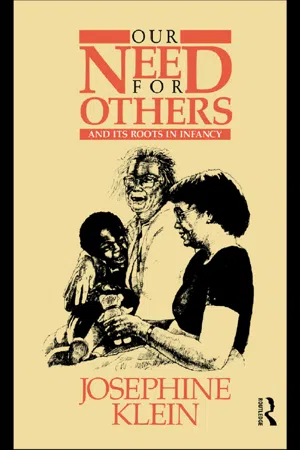
Our Needs for Others and Its Roots in Infancy
About this book
In this original and highly readable book Josephine Klein provides a detailed picture of how young infants experience life and how this lays the foundations for later personality structures.
Information
1
Introduction and overview
‘I have no name;
I am but two days old.’
(William Blake, Songs of Innocence and Experience)
How mysterious a baby is, its personality still largely potential, and how helpless. Yet how powerfully it reaches out to us and touches the heart – for sustenance and for the relief of its distresses, but also for recognition.
‘What shall I call thee?
“I happy am,
Joy is my name”.’
“I happy am,
Joy is my name”.’
A baby seems to reach out for validation and confirmation that it is already a person. And we respond.
‘Thou dost smile;
I sing the while,
Sweet joy befall thee!
Pretty joy!
Sweet joy, but two days old;
Sweet joy I call thee.’
I sing the while,
Sweet joy befall thee!
Pretty joy!
Sweet joy, but two days old;
Sweet joy I call thee.’
Sweet joy I call thee – we respond and recognize and validate.
Blake celebrates the lovely and loving side of infant and adult. But he also knows of the despairing, devastated, hating, and envying side of the relationship.
‘Oh rose thou art sick.
The invisible worm
That flies in the night
In the howling storm:
Has found out thy bed
Of crimson joy;
And his dark secret love
Does thy life destroy.’
The invisible worm
That flies in the night
In the howling storm:
Has found out thy bed
Of crimson joy;
And his dark secret love
Does thy life destroy.’
(The Sick Rose)
Joy, but also fear, pain, loss, and hate, may be a baby’s everyday experiences. How can it manage such feelings, helpless as it is? It cannot – that is what the adult is for. The fortunate infant has adults whose care goes beyond managing its appetites and distresses. Such a baby will still be subject to misery and terror – we all are – but it will meet them in a context of love and acceptance. Its pains and rages will be surrounded, contained, and modified by memories of joy and bliss, and by expectations of more happiness to come. Indeed, I shall argue that memories of bliss are converted into expectations of bliss, as also, alas, memories of distress turn into expectations of more grief. Good memories give a baby a better chance of continuing to feel appealing and acceptable in all circumstances, in sorrow as well as joy, when it is bad as well as when it is good.
The infant is helpless. It is the adult who mainly provides the context of its experiences. For a context within which the infant can hold on to its experiences and not be devastated by them when they are bad, the infant needs adults who, consciously or unconsciously, understand how the baby feels. Adults who recognize the depths of their baby’s feelings, good and bad, give solidity to that baby’s experience of itself. Such recognition helps consolidate the baby’s integrity and sense of self: its identity. Joyous recognition will encourage a joyous identity.
I shall be suggesting that there is a strong connection between the way adults see a child, and behave toward it, and the child’s identity (that is the way the child sees itself and feels about itself), and the basic structures of its personality. The very structures of the personality are determined by early experiences. Differences between adults, differences in the nature of our feelings, and in our need for others, and in our relationships with others, have roots in the different ways in which our minds are structured.
If the mind is a structure, what is it a structure of? There are answers to this question at different levels of complexity; in order of increasing complexity, there will be answers in Chapters 2, 3, 4, 8, 10, 14, and 18.
I shall argue that there is more than one good way of being an integrated person with a unique identity, self-image, and personality-structure. For instance, we often tend, in our culture, to think of ourselves as rather like a computer or a motor car, with the parts organized so that they fit together to do some work, or calculate something, or take us somewhere. In this phantasy we may include a driver to keep the motor car moving towards our objective, or we may think of our machine as self-starting and self-motivated but, essentially, we assume that there is a point in being what we are and that we should be organized around that point. However, as far as some of us are concerned, our experience of ourselves may be much more like a landscape, a stormy and volcanic one or a quiet one with hills, hedges, meadows, rivers, roads, and settlements – many varied features in specific relationships with one another, and integrated, but not organized in any obvious or purposeful way.
Our love and recognition of a child may also lean more to one or other of these models. Is the child a motor car to us or a landscape? The child’s experience of itself – its self-image and indeed the very structure of its personality – will be affected accordingly (though not necessarily in ways we intend).
In all these processes and influences, words are unimportant. What happens between adult and infant is not primarily conversational or intellectual. The foundations of our personality are not composed of words, and do not derive from conversational or intellectual apprehensions. How poor we would be if we needed words to appreciate a landscape! And how hard it is to put our appreciation into words.
The non-verbal nature of infant experience is similarly hard to apprehend and put into words. This makes it easy to neglect the non-verbal elements from which our personality is built up. In order to carry conviction when writing of our non-verbal life, I have had to lay some solid foundations. The book’s first part, its Conceptual foundations, contains three chapters on non-verbal, and indeed barely psychological, processes. In the fascinating area of neurophysiology, we can find the elements which will eventually combine into the more recognizable psychological structures which we call thoughts, words, feelings, images, symbols, emotions, motives. Each of these is a structure of more basic elements, and we shall see them built into more complex organizations at different points in the book.
The part which follows, The e-merging of self from (m)other, is also preparatory to the main narrative of this book, though a little less remote from human experience. One chapter is mainly on the infant handicapped by being born into a world which its neurophysiology cannot cope with; one is mainly on the infancy of animals whose species seem destined never to be conscious and verbal; and one is on the human infant in the very moment of its individuation and separation from the mother.
The human infant is, relatively speaking, quite sophisticated and complex by the time it experiences itself as separate from others.
‘The baby new to earth and sky,
What time his tender palm is prest
Against the circle of the breast,
Has never thought that “this is I”.
But as he grows he gathers much,
And learns the use of “I” and “me”,
And finds “I am not what I see
And other than the things I touch”.
So rounds he to a separate mind
From when clear memory may begin,
As thro’ the frame that binds him in
His isolation grows defined.’
What time his tender palm is prest
Against the circle of the breast,
Has never thought that “this is I”.
But as he grows he gathers much,
And learns the use of “I” and “me”,
And finds “I am not what I see
And other than the things I touch”.
So rounds he to a separate mind
From when clear memory may begin,
As thro’ the frame that binds him in
His isolation grows defined.’
(Tennyson, In Memoriam A. H. xlv)
The third group of chapters, on The relation of self to others, looks at this individuation in more detail. The neurophysiological elements reviewed in the earlier chapters are now elaborated into true psychological structures, in the course of which some interesting questions are considered: How are we to think of human experience? What are its basic units? What is an integrated person? What is it that integrates? How are we to describe the difference between the integrity of a motor car and the integrity of a landscape? What does it means to be an individual? When is differentiaton mere lack of integration and when is it accurate and useful individuation?
Once this is clarified, our focus can finally come to rest on recognizable adult experiences, albeit on those adult experiences in which the effects of our childhood are very apparent. We are now in the second half of the book, and moving toward conclusions which help us understand new things about ourselves and our need for others. A fourth section looks at our Sources of strength, and in particular at the parent–child relationships associated with a durable sense of well-being and an integrated optimistic identity. Wordsworth described these good feelings with wonderful accuracy in his Ode on Intimations of Immortality from Recollections of Early Childhood, though he attributes them to memories of our time with God (before we were born) rather than to memories of our early life with loving adults:
‘There was a time when meadow, grove, and stream,
The earth, and every common sight,
To me did seem
Apparell’d in celestial light
The glory and the freshness of a dream.’
The earth, and every common sight,
To me did seem
Apparell’d in celestial light
The glory and the freshness of a dream.’
This sunny section is necessarily followed by one which looks at Splits, at the sources of weakness, at what can go wrong and cause breakdown and disintegration. Where does it come from, the invisible worm that flies in the night and gnaws at our capacity for joy? It is here that our motor car versus landscape analogy of personality-structure comes back into the argument. People operating on the model of a machine, a model in which we are organized around some point, have a somewhat easier time when feeling disturbed or unwell: if the car will not go, there must be something wrong with it – find the part that has gone wrong and mend or replace it. But landscapes cannot go wrong in quite the same way. And what will make them feel better? In this section, which takes the landscape as its model of personality-structure, an attempt is made both to list some ideas about the various lines along which a person may fall apart, and to contribute to a theory of personality-structure in which these ideas can find convenient lodging.
The argument, which has been slowly building up from chapter to chapter, reaches its culmination in the final part, on Holding and healing. Here the influences are examined which make for integration, and either prevent splits or go some way toward mending them. Some conclusions are drawn which may seem obvious in the light of what has gone before, about caring for ourselves and others, about the use of the intellect (called ‘ego-functioning’ in this book), and about the nature of psychotherapy.
I shall argue that, in the course of development, there is a transfer of functions from the adult to the child. Care and nurture must be the adult response to the tiny helpless infant if it is to survive at all: if this is done with joy, so much the better – there will be joy at the heart of that person’s identity. A little later, adults can lend encouragement and support to the busy crawling baby who is beginning to communicate in words, and to the toddler trying for intellectual understanding. Not much later, some mutual consideration and recognition of the other’s needs becomes possible. A little later yet, adult and child can begin to share responsibility for setting goals, the adult giving support when control is needed to sustain the pursuit of a chosen goal. All these things are first brought to the relationship by the adult. That is the origin of our need for others. But in the course of development, the fortunate child begins to want to do for itself the things which were first done for it by loving and competent adults. In this way we learn how to care for, and how to take care of, ourselves and others. We do this, for good or for ill, in the manner and in the spirit we learnt from others. We do as we were done to.
What, then, of the children who took over the functioning of unloving and incompetent adults? Can later relationships help them? Later teachers, friends, and lovers may indeed be able to stir buried memories of good functioning into life: there may be seeds from which hopeful expectations for the future may spring. But early insufficiencies can leave structural weaknesses which lead people to experience themselves as fragmented, liable to fall apart, not really alive, only pretending to be people. They need holding before they can be healed. They need a considerable period of very secure attachment. They need to experience some limit to their feelings of endless disconnectedness and lack of direction. It is not often possible for others to do this in the normal course of living, at least for the very long time that may be needed. And they may be further hindered because sometimes people’s capacity to learn, to have friends and use them, and to relate in love, has not developed or has a destructive invisible worm at its core. Then professional help has to be looked for.
Yet until recently this kind of help did not fall within the sphere normally allotted to psychotherapists, psycho-analysts, or counsellors: their help was more directed toward helping people to understand themselves in their world, to accept themselves as they are and perhaps as they might become. But the people we are now considering cannot be helped by this, any more than a baby who has had a bad fall can be helped by being made to understand itself. From the point of view of the person giving help, there is no point in aiming at the capacity to understand intellectually (because it is not there). More is therefore required of the professional help than in the otherwise often excellent ways of listening and talking currently taught to students training to be analysts, counsellors, or therapists. Of course, in practice many of these do more than they were formally taught to do. They recognize intuitively that, since the elements which went into the construction of the personality were so largely non-verbal and non-intellectual, the damage wrought in those early days cannot be mended by purely intellectual understanding. But there are many gaps in the theories which might back them up.
In this book I have tried to add further substance to such intuitions. The parallels I draw in the final chapters, between what good parents do and what good psychotherapists do, may be obvious. I hope the conclusions drawn there will seem equally obvious when the reader gets to them. Yet it seems to me that at present we do not give them the place they should have, either in theory or in practice. However, our understanding of psychotherapeutics, evolving over a hundred years, is being perfected all the time. Though it is a slow process, the trend continues towards understanding and achievin...
Table of contents
- Cover Page
- Title Page
- Copyright Page
- Acknowledgements
- Preamble
- 1. Introduction and Overview
- Part 1: Conceptual Foundations: The Physical Perspective the Formation of Concepts Intentional Behaviour
- Part 2: The E-Merging of Self: From (M)Other ‘i Am Not Yet Born’ the Unattached Infant Holding On to Safety Versus Steering Clear of Danger
- Part 3: The Relation of Self to Others: The Basic Units of Experience the Emerging of Painful Relationships the Language of Splitting
- Part 4: Sources of Strength Feeling ‘Grand’ the Joy of Being the Language of Elationships Discovering, Inventing, Creating, and Using Symbols
- Part 5: Splits: Renée Inadequate Environment and Fragile Self Basic Faults As the Cause of Plits Being Schizoid
- Part 6: Holding and Healing: Holding and Integrating New Beginnings: Implications for Psychotherapists
- Appendices
- Bibliographical References
Trusted by 375,005 students
Access to over 1.5 million titles for a fair monthly price.
Study more efficiently using our study tools.
Frequently asked questions
Yes, you can cancel anytime from the Subscription tab in your account settings on the Perlego website. Your subscription will stay active until the end of your current billing period. Learn how to cancel your subscription
No, books cannot be downloaded as external files, such as PDFs, for use outside of Perlego. However, you can download books within the Perlego app for offline reading on mobile or tablet. Learn how to download books offline
Perlego offers two plans: Essential and Complete
- Essential is ideal for learners and professionals who enjoy exploring a wide range of subjects. Access the Essential Library with 800,000+ trusted titles and best-sellers across business, personal growth, and the humanities. Includes unlimited reading time and Standard Read Aloud voice.
- Complete: Perfect for advanced learners and researchers needing full, unrestricted access. Unlock 1.5M+ books across hundreds of subjects, including academic and specialized titles. The Complete Plan also includes advanced features like Premium Read Aloud and Research Assistant.
We are an online textbook subscription service, where you can get access to an entire online library for less than the price of a single book per month. With over 1.5 million books across 990+ topics, we’ve got you covered! Learn about our mission
Look out for the read-aloud symbol on your next book to see if you can listen to it. The read-aloud tool reads text aloud for you, highlighting the text as it is being read. You can pause it, speed it up and slow it down. Learn more about Read Aloud
Yes! You can use the Perlego app on both iOS and Android devices to read anytime, anywhere — even offline. Perfect for commutes or when you’re on the go.
Please note we cannot support devices running on iOS 13 and Android 7 or earlier. Learn more about using the app
Please note we cannot support devices running on iOS 13 and Android 7 or earlier. Learn more about using the app
Yes, you can access Our Needs for Others and Its Roots in Infancy by Josephine Klein in PDF and/or ePUB format, as well as other popular books in Psychology & Developmental Psychology. We have over 1.5 million books available in our catalogue for you to explore.