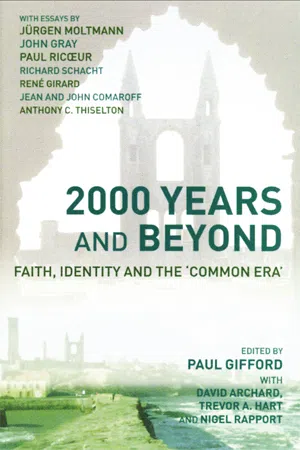
2000 Years and Beyond brings together some of the most eminent thinkers of our time - specialists in philosophy, theology, anthropology and cultural theory. In a horizon-scanning work, they look backwards and forwards to explore what links us to the matrix of the Judaeo-Christian tradition from which Western cultural identity has evolved.
Their plural reflections raise searching questions about how we move from past to future - and about who 'we' are. What do the catastrophes of the twentieth century signify for hopes of progress? Can post - Enlightment humanism and its notion of human nature survive without faith? If the 'numinous magic global capitalism' is our own giant shadow cast abroad, does that shadow offer hope enough of a communal future? Has the modern, secularized West now outgrown its originating faith matrix?
Often controversial and sometimes visionary, these seven new essays ask: how do we tell - and rewrite - the story of the Common Era? Introduced by Paul Gifford, and discussed in a lively dialogic conclusion, they add their distinctive voices to a debate of profound and urgent topicality.
eBook - ePub
2000 Years and Beyond
Faith, Identity and the 'Commmon Era'
- 240 pages
- English
- ePUB (mobile friendly)
- Available on iOS & Android
eBook - ePub
2000 Years and Beyond
Faith, Identity and the 'Commmon Era'
About this book
Information
Topic
Theology & ReligionSubtopic
Historiography1: 2000 YEARS: Looking backwards and forwards
Paul Gifford
The present volume of essays is an exercise in a neglected art: that of exploring the relationship between evolving secular culture and the matrix of thought, sensibility and social practice derived from the ongoing religious traditions of Judaism and Christianity.
The essays themselves find their origin in a much-followed public lecture series held at the University of St Andrews to mark the bimillennial year. As the first of our essayists, Jürgen Moltmann, points out, the year 2000 signified very little in its own right, except the poetic stardust of those three noughts. The misadventures of London’s Millennium Dome at Greenwich – now fast retreating from memory – no doubt demonstrated the poverty of that slight magic. With the possible exception of its star attraction, the ‘Body Zone’ (which happened to feature an authentic natural wonder), the Dome failed to address anything vital in collective memory or in spiritual imagination. It offered no point of deeper human self-recognition. It found little to celebrate or commemorate beyond a kaleidoscope of acceptable contemporary images. What it in fact – and briefly – memorialized was the ethos of a passing political moment, and its own monument-making.
Meanwhile, almost unnoticed, the year 2000 offered a landmark of very different interest: a point of overview, properly bi-millennial and pertinently symbolic in character; a point from which to reappraise not the empty arithmetic of one more millennium added to other millennia, but our own collective identity, past, present and future. Symbolically, the year in question invited consideration of this theme with reference to an actual, historically affirmed and dated inheritance of religious belief, value and self-understanding. It was a good time to acknowledge and appraise something much forgotten: the informing presence in our culture of a Judaeo-Christian matrix that has traditionally offered to give human time its horizon of transcultural significance, its deeper intuitions of community and of sense-making.
It is this formative antecedence, together with its programmatic framing or mapping of human time, that is often, albeit imprecisely and ambiguously, evoked by the expression the ‘Common Era’. This expression engages, most obviously, a periodization dating the historical era in which we stand from the birth of the – Jewish – founder of the Christian religion. The term is, of course, intensely problematic from many viewpoints, at many levels. Within the Christian faithtradition itself, the notion is likely to raise ambivalent echoes: of Constantine’s state religion, for instance, and of the mediaeval ideal of ‘Christendom’. It smacks of a framework of thought encompassing all things temporal within a single spiritual order interpreted and directed by the church. In this sense it is likely to convey, at best, a period-specific account of the relation between culture and faith, time and eternity, the world and God. At worst it might connote the secret confusion between the Kingdom which is ‘not of this world’ with a socio-cultural dispensation that unquestionably – and often most unchristianly – was. For Jews, of course, the resonance of the ‘Common Era’ understood in these same terms is largely one of cultural marginalization and exclusion. As one editor of the present volume attests: ‘In my Jewish education, we thought of the “common” bit of CE as meaning “vulgar” – the bright and glorious bit was “BCE” . . .’ Beyond that, Jewish memory may well register a millenarian triumphalism rewriting Jewish messianic expectation; hence, an alienating ‘era’ of dispossession, insecurity and political scapegoating within an officially Christianized Europe.
As believers or as secularists, our modern ambivalence towards the Common Era is compounded by echoes in collective memory of the countless attempts made to write into the course of human history a secretly millenarian Sense that promised human community and delivered instead some form of political, social or cultural takeover. Not just the attempts pursued by the Holy Roman Empire in the name of Christendom; but also those of the French Revolution, the British Empire, the Positivist Era, the Thousand Year Reich, World Revolution and no doubt even ‘the Free World’. We nurture a deep suspicion of any envisaged ‘commonality’ which, being in and of historical time, is, or looks as if it might be, a sketch for some form of political or cultural hegemony. Only when this potent ghost is exorcized can we recover the deeply desirable principle of ‘community’ which is also enfolded, hauntingly, within the notion of our ‘Common Era’.
The Christian churches have in recent times largely recognized the problem by dropping the public use of the notation AD (anno Domini: ‘the year of our Lord’). This is a significant adjustment, marking a retreat from the lingering nostalgia for temporal hegemony and cultural privilege; it puts a decent interval of distinction – and of ‘Advent’! – between a common era of globalized ‘modernity’ which is an observable historico-cultural fact and the Kingdom of Heaven. This distinction did not, of course, prevent Christians from marking the bi-millennial year with their own Jubilee celebrations; but it did and does point to the sharp hiatus now existing in the countries of Europe and North America between the (relatively) few who stand in continuity with the matricial faith-tradition (thinking of it as transcultural and inclusive, at least in vocation) and the many who do not (often regarding it as culture-specific, exclusive, even divisive).
Grappling with this hiatus between outlooks, the media (arbiters of the common culture) typically relegated Christian commemoration of the bi-millennium to a ‘correct’, pluralist marginality. So, for instance, in Britain, Melvyn Bragg’s TV series 2000 Years, which recalled landmarks of Christian history, with following studio discussions, was broadcast mainly in the wee small hours of the morning. In the language of media scheduling, this was a ‘minority interest programme’.
What price, then, the question of ‘our’ own cultural identity – past, present and future? Was it destined to disappear down the gulf between the secular commemoration of one thousand years and the Christian remembrance of two? Could it be addressed at all, in any serious way, in common and in public? Could it, in some form, look backwards to, and forwards from, the shaping antecedence of the faith-matrix that has historically nourished our culture? Or were we – are we – henceforth condemned to unmindfulness of, and disconnection from, our own past?
Uncomfortable reflexive questionings are often the least and the last items of any subject’s agenda. Collective cultural subjects (the ‘we’ envisaged above) are no exception to the rule. Managing a tolerant and tolerable coexistence within our Western multicultural, pluri-faith societies is as much – perhaps more! – than we can cope with; any transcendence of the present seems an unnecessary, and potentially contentious, extra burden. Most characteristically, perhaps, we were and are genuinely at a loss as to how to conceive of a ‘Common Era’: dubious about how to envisage its commonality, perplexed as to whether its carrying hope of inclusive community may be endorsed or assumed; if so, in which terms – and, we feel immediately constrained to add – whose?
Is CE just – as Bergson said a century ago of Renan’s concept of ‘nation’ – a convenient notation without definable content? Is it an officialized public memory, merely? an inheritance of great weight, perhaps? even a genuine key to ourselves, but no longer quite receivable as the key to a vocation for the future? Is it something analogous, perhaps, to cultural particularities such as the use of a common language in the ‘English-speaking world’ or, more broadly, to the shared ‘nation-state story’ which, from the Renaissance onwards, masqueraded as history and which, within the last 150 years, has served, with sometimes dire consequences, to cement the national identities of the peoples of Europe? What, in that case, of other cultures and their common eras?
Or are the periodizing and the programme implied in the ‘Common Era’ something really quite different from the suggestions generated by these hand-me-down analogies: something learned otherwise, known and unknown, narrativized ever anew, ever more deeply and inclusively? Should we, on this alternative hypothesis, think of CE by analogy with changing narratives of the natural world: those given of biological evolution, perhaps; or else akin to the way in which cosmologists are reconceiving the physical universe, which is now recognized indubitably to have, amid the unfathomable complexities of relativity, its own ‘common era’ . . .?
Certainly, the notion of a ‘common era’ of Judaeo-Christian antecedence remains entirely intelligible to the cultural historian. It is indeed a fundamental and founding reality of the European and Western past, hence an indispensable dimension of collective selfunderstanding. The underlying fact remains that the universe of transmitted references, practices and values we call ‘culture’ has, historically, been massively imprinted with Judaeo-Christian perspectives and values. More invisibly, subtly and tenaciously so, perhaps, than the ready-made analogy with the ‘nation-state story’ would prepare us to understand; to the point where even our secularizing thought-forms have often represented attempts to reclaim its values, or else to print off, within a ‘non-believing’ mindspace, secular equivalents for personal or collective use.
Our ethical dilemmas, our difficulties of civilization, have frequently appeared to be symptoms of a loss or lack of the frame of reference furnished to the common culture by this same tradition of religious faith. Our social and political inventions tend to model it allusively, even to reinvent it as an energizing source and resource. The presence of a Judaeo-Christian matrix, arguably, is imprinted in the very logic of secularization itself, so that the simple project of repudiating this matrix seems insufficient quite to efface it. Is it perhaps easier to shift one’s rational and discursive ground – as, for instance, the London-based Sunday newspaper the Observer has recently begun to do in declaring itself editorially ‘post-religious’ and ‘post-Christian’ – than it is to unpick the most intimate constitution and tissue of subject-memory in ourselves?
It seems importantly true, at any rate, that the twentieth century, now closed, brought to most of Western Europe (and, to a lesser extent, North America) the working-out of a deep-seated crisis of cultural identity, radicalizing post-Enlightenment scepticism to the point where it became a normal and norm-setting disaffection for all transmitted and founding programmes of self-understanding. If the problem is posed in sociological terms alone, the possibility clearly exists that the common source and resource constituted by religious faith within our Western culture could be disavowed completely and disappear from view in the next millennium. This prospect is, indeed, embraced by three contributors to the present volume. Nietzsche, one of the undoubted prophets of our ‘postmodernity’, spoke in very much this sense of the ‘death of God’, an event in culture which he viewed as the springboard for a heroic adventure of self-invention. ‘Post-Christian theologies’ have taken up the cry. Jewish and Christian believers will certainly argue that his prophecy constitutes a basic misreading of cultural sources and a misidentification of their own common origins. Yet to them also, Nietzsche is indubitably tonic and pertinent. He addresses the awesome withering in secularized cultural memory and representation of the ultimate Referent-Explicator- Respondent of Western inheritance; he focuses dramatically the hypothesis that human identity as such might be entirely established by natural accident and creative human will, within the sole dimension of history.
If anything, however, this comparatively recent development should increase – rather than decrease – the claims to our attention of a cultural imprint that survives the modern crisis of identity and of faith. For, as we cross the threshold into the third millennium, the residual presence of this informing cultural matrix is liable to pass purely and simply unrecognized by the majority of those it inhabits. It is open to being misapprehended and misconstrued, by virtue of the very estrangement involved in so significant a dislocation to the continuity of collective memory. It would be instructive – to take a searching and central example (not irrelevant to Nietzsche himself) – to conduct a survey of public opinion enquiring what proportion of our contemporaries consider the ‘immortality of the soul’ to be a Christian doctrine. The likelihood is of a 90 per cent affirmative response – i.e. of a mistaken and misleading identification. If so, this may imply that enquiring about faith-identities in a postmodern cultural mindspace is likely to involve a crucial element of quiproquo and not a little ‘blind man’s buff’.
The same consideration is relevant, in a more radical sense, if the question asked is no longer that of a residual cultural imprint merely, but now of the distinctiveness of the Judaic and Christian faithtraditions; and, in particular, the question of their ability to address relevantly in the third millennium the common culture which currently stands so estranged from them. By a signal oddity of our times, the same Judaeo-Christian distinctiveness or particularity which is so mistily apprehended by the common contemporary cultural mind, has never been more fully investigated and, perhaps, never more firmly grasped, than by the theologians and the cultural theorists of the age of critical reflexivity. Their task has been to sift out painstakingly (though not without prophecy), within the ‘grand narratives’ of our Western past – and first of all in the perceptions and practices of former centuries which were culturally and misleadingly labelled ‘Christian’ – what belongs to the persuasions of the common culture, and what belongs to the transcending continuities of authentic faith. The very foregrounding of the term ‘Judaeo-Christian’ exemplifies just such a process at work.
Again, the question may be: what alternative commonality, and from which ‘elsewhere’? Where Nietzsche has passed, many other twentiethcentury critiques of the inheritance of the Common Era have also followed. Many ‘deconstructions’ of Western culture and identity have been practised (Marxist, Freudian, structuralist, Derridian, Lacanian . . .); many forms of fruitful rediscovery explored (feminism, post-colonialism, ecology, alternative spiritualities, to name a significant few); many ‘other’ faith traditions emanating from other culture zones of our rapidly globalizing time and space have been questioned – so many clues essayed towards a renewal of our ‘European’ or our ‘Western’ cultural identity. The future of the ‘Common Era’ promised by the very globalization of communications, economies and cultural exchanges engages all such viewpoints in a matter of common concern, of common hope.
A pluralism of belief and value may, in the long term, be the best and ineluctable condition of moral growth, enlarged horizons of thought, fruitful Other-recognitions; it may even usher in a common, fully communal – a fully human – identity. Yet not, perhaps, without vitalizing reconnection to some human potential that is both before and beyond our merely wishing that it were so. For, of itself, most immediately, our relativistic and pluralist present often appears marked by negativities. It bears, indeed, the symptoms of trauma: amnesia or selective memory in respect of the past, a loss of roots and of the sense of community, an inaptitude for common memory or common hope, an insecure sense of provisionality, together with a widespread confusion about who ‘we’ are. The common culture right now is a rather Dome-like sort of space . . .
Given this landscape of dislocation, provisionality and tentative renewal, it has seemed highly pertinent to ask leading academic specialists in philosophy, theology, social anthropology, literature and culture theory to look both backwards and forwards and to give a strategic account of the presence and significance for our times of a Judaeo-Christian inheritance which they may, or may not, see as surviving vitally in the new millennium.
What perspectives of understanding (reflexivity, recognition of cultural diversity, the historicity of knowledge, value pluralism, the advent of feminism, globalization, the imprint of neoliberal capitalism, the vagaries of collective memory itself, etc.) have gone into the making of the modern (and ‘postmodern’) mind? Can we define its mind-set and temper? Its preferred models of social and personal identity? Most significantly: do these tend to relativize and dissipate ‘Judaeo-Christian particularity’ or, on the contrary, to disengage, liberate and valorize it?
It is hoped to offer here a representative diversity of views on these questions from many disciplinary perspectives; it being well understood that dialogue on this and all matters of collective subjectidentity (‘where have we come from, where are we now, where are we headed?’) lends itself to an almost infinite variety of viewpoints and voices. There was – and is – no natural limit to potentially valid and interesting contributions on questions of such centrality; and the editors will readily agree with those readers who find themselves regretting the absence here of a direct echo of their own preferred perspective.
The list of actual contributors is, of course, in part contingent. Many eminent names were approached who, though highly sympathetic to the enterprise, were unable in the event to contribute. ‘Absent voices’ include: Julia Kristeva, Margaret Drabble, Mary Robinson, Martha Nussbaum, George Steiner, Frank Kermode . . . In other cases, contributors have preferred to keep the reflections they confided to audiences in St Andrews for forthcoming major works of their own: thus Alvin Plantinga on the current relation of religion and science (‘Conflict or concord?’), and Zygmunt Bauman on ‘Identity and religion in a globalizing world’. The representative credentials of the viewpoints exemplified here cannot, in this sense, claim to be impeccable; and any felt deficiencies are best considered an invitation to further dialogue . . .
The contributors are, at least, of rare authority in the academic disciplines illustrated.
Jürgen Moltmann is Emeritus Professor of Systematic Christian Theology at the University of Tübingen and one of the foremost names of contemporary Christian theology. His work has had enormous influence in the English-speaking world and the Third World as well as in his native Germany. Moltmann’s first major book, Theology of Hope, published in 1964, was responsible for restoring to an important place on the theological agenda the Christian hope for the future of the world. He is characteristically insistent upon allowing the treatment of each of his themes to be shaped by the orientation of the gospel (and of Christian faith generally) towards a promised future which is not just of our doing and making, but God’s. The theme of hope pervades his writings from first to last: by no means a common feature among the thinkers and writers of the latter end of the twentieth century.
Moltmann argues here that if we are to retrieve something of the hopefulness of the early modern age, it cannot be in disregard of the horrors to which nineteenth-century progress has, in some sense, led in the twentieth century. Hopeful ‘bridges’ to the future must now ‘be built over the abysses of destruction we have experienced in the twentieth century’. The latter is powerfully symbolized for Moltmann by Walter Benjamin’s image of the ‘angel of history’, who is driven into the future by a ‘storm from paradise’. With wings outstretched, he faces backward to the past, and sees wreckage piled on wreckage, all the rubble of history mounting up as ‘progress’ drives history onwards. Driven forward by progress, the angel cannot stop, as he would if he could. He would like to remain in order to lift up the downtrodden, but he is propelled helplessly on. Turning to the transcendent hope of Christian faith, Moltmann sets beside this image from Benjamin a biblical image: the vision of resurrection in Ezekiel’s valley of dry bones. The juxtaposition of the two images graphically makes the point that the Christian hope of resurrection offers what the secular hope of the modern age on its own could never provide: hope for the past and for the dead: ‘In order to live with this wreckageladen and victim-laden past without repressing it or repeating it, we need these transcendent hopes of the resurrection of the dead and the healing of the downtrodden . . . Without hope for the past, there can be no hope for the future.’ The transcendent hope of the Christian tradition does not inhibit the smaller hopes of a better future in time; rather it empowers and energizes them.
John Gray is Professor of Modern European Thought at the London School of Economics. He was previously a Fellow at Jesus College, Oxford. He is one of the most distinguished English-speaking political philosophers of his generation, and also an influential political commentator. His early work was markedly libertarian in character and sympathetic to the New Right project of Margaret Thatcher in the United Kingdom and Ronald Reagan in the United States of America. From these early political dispositions he has moved to a nuanced defence of social democratic liberalism and is now a passionat...
Table of contents
- COVER PAGE
- TITLE PAGE
- COPYRIGHT PAGE
- ACKNOWLEDGEMENTS
- 1: 2000 YEARS: LOOKING BACKWARDS AND FORWARDS
- 2: PROGRESS AND ABYSS: REMEMBERING THE FUTURE OF THE MODERN WORLD
- 3: ENLIGHTENMENT HUMANISM AS A RELIC OF CHRISTIAN MONOTHEISM
- 4: HISTORIOGRAPHY AND THE REPRESENTATION OF THE PAST
- 5: THE FUTURE OF HUMAN NATURE
- 6: THE MIMETIC THEORY OF RELIGION: AN OUTLINE
- 7: SECOND COMINGS: NEO-PROTESTANT ETHICS AND MILLENNIAL CAPITALISM IN AFRICA, AND ELSEWHERE
- 8: CAN A PREMODERN BIBLE ADDRESS A POSTMODERN WORLD?
- CONCLUSION: DIALOGUE ON THE ‘COMMON ERA’
- NOTES
- BIBLIOGRAPHY AND FURTHER READING
Trusted by 375,005 students
Access to over 1.5 million titles for a fair monthly price.
Study more efficiently using our study tools.
Frequently asked questions
Yes, you can cancel anytime from the Subscription tab in your account settings on the Perlego website. Your subscription will stay active until the end of your current billing period. Learn how to cancel your subscription
No, books cannot be downloaded as external files, such as PDFs, for use outside of Perlego. However, you can download books within the Perlego app for offline reading on mobile or tablet. Learn how to download books offline
Perlego offers two plans: Essential and Complete
- Essential is ideal for learners and professionals who enjoy exploring a wide range of subjects. Access the Essential Library with 800,000+ trusted titles and best-sellers across business, personal growth, and the humanities. Includes unlimited reading time and Standard Read Aloud voice.
- Complete: Perfect for advanced learners and researchers needing full, unrestricted access. Unlock 1.5M+ books across hundreds of subjects, including academic and specialized titles. The Complete Plan also includes advanced features like Premium Read Aloud and Research Assistant.
We are an online textbook subscription service, where you can get access to an entire online library for less than the price of a single book per month. With over 1.5 million books across 990+ topics, we’ve got you covered! Learn about our mission
Look out for the read-aloud symbol on your next book to see if you can listen to it. The read-aloud tool reads text aloud for you, highlighting the text as it is being read. You can pause it, speed it up and slow it down. Learn more about Read Aloud
Yes! You can use the Perlego app on both iOS and Android devices to read anytime, anywhere — even offline. Perfect for commutes or when you’re on the go.
Please note we cannot support devices running on iOS 13 and Android 7 or earlier. Learn more about using the app
Please note we cannot support devices running on iOS 13 and Android 7 or earlier. Learn more about using the app
Yes, you can access 2000 Years and Beyond by David Archard,Trevor A. Hart,Nigel Rapport,Paul Gifford in PDF and/or ePUB format, as well as other popular books in Theology & Religion & Historiography. We have over 1.5 million books available in our catalogue for you to explore.