`This eagerly awaited book is an outstanding and right up-to-date summary of every excavation and investigation undertaken in Ireland into the earthworks, castles, ecclesiastical buildings and towns of the period from the arrival of the Anglo-Normans to the mid-sixteenth century...a most welcome synthesis and will be valued by the layperson, student and professional archaeologist, historical geographer and historian alike.' Archaeology Ireland
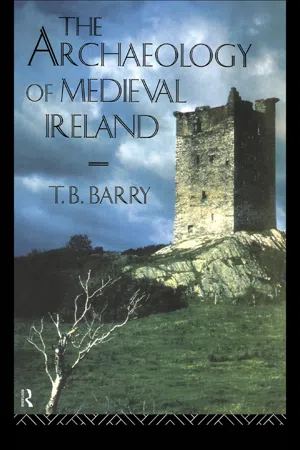
- 254 pages
- English
- ePUB (mobile friendly)
- Available on iOS & Android
eBook - ePub
The Archaeology of Medieval Ireland
About this book
Information
1 Introduction
This book is broadly aimed at the questioning person in the street as the great Irish archaeologist, Sean P.Ó Ríordáin, intended his now classic Antiquities of the Irish Countryside, first published in 1942 and now in its fifth edition revised by the late Ruaidhri de Valera. It is an attempt to synthesize the explosion which has taken place in our knowledge of the medieval period in Ireland, roughly from 1170 until 1531, which has been provided by archaeological excavation and field-work over the last generation or so.
If medieval archaeology is a young discipline in mainland Britain and in continental Europe it is in its infancy in Ireland where the first lecturer in medieval archaeology was appointed at Queen’s University, Belfast, only in the early 1970s. That it is such a recent development in Ireland is due in large measure to the history and the politics of the island in the present century and this is probably why the first impetus came from Northern Ireland. The Irish Republic only gained its political freedom from Britain in 1922 and since then Irish archaeologists have naturally tended to concentrate on the prehistoric and the Early Christian periods before the coming of the Scandinavian and later the Anglo-Norman invaders. It was understandable for a new state, finding its way among the community of nations in the troubled early years of this century, to wish to emphasize its own unique cultural identity free from the impact of later invaders and colonizers. But in recent years, with Ireland’s increasing involvement with the United Nations and latterly with the EC, a more mature approach has been pursued by her scholars in that there is now a general acceptance of the positive contributions that all newcomers to this island, including incidentally the Celtic influx, have made to its culture and historical development. Thus as a result both of this greater pluralistic approach to the study of Ireland’s past and with the growing awareness that historical methods of enquiry were insufficient to ensure answers to all the complex questions about medieval society, lectureships in medieval archaeology were also set up in University College, Cork, University College, Galway, and Trinity College, Dublin.
Perhaps the most symbolic and public example of this change in attitude was the controversy over the future of the Wood Quay site in central Dublin from 1975 into the 1980s. With it came a re-evaluation of the contribution of the Norse settlers to the development of trade in the city of Dublin and indeed of their major contribution to the origins and development of urban life in general on this island. It also inevitably led to an increasing interest in the Anglo-Norman period of urban settlement.
An outline analysis of the settlement and economy of Ireland in the years immediately before 1169 will be the first task to be addressed, because no true appreciation of the impact of the Anglo-Normans can be gained without an examination of the major features of pre-Norman native settlement. A thematic approach to the archaeology of medieval settlement will then be pursued so that the broader issues of continuity, urbanization and the evolution of the economy can be more fully appreciated by an understanding of the material remains of the period. Nevertheless, a chronological framework will be observed as far as possible throughout this thematic approach in order to emphasize medieval archaeology’s essential interrelationships with the historical process.
It will soon become apparent that this work concentrates on the settlements of the medieval period and only utilizes artefactual evidence in so far as it elucidates the chronology and socio-economic development of the medieval settlement pattern. Thus the very limited archaeological evidence for medieval industry, whether rural or urban, is examined from this perspective. Secondly, the vast majority of medieval excavations have concentrated on Anglo-Norman sites and the documentary sources relating to settlement are almost totally Anglo-Norman so that the bias of this book is towards an examination of Anglo-Norman settlement sites. However, where there is some evidence for indigenous settlement forms in the medieval period I have attempted to weld it into a coherent pattern.
In many respects the medieval archaeologist is in a unique position vis-à-vis his colleagues in earlier fields of research as he has to be able to understand the significance and importance of the documentary sources of the medieval period. The documentary assistance given or constraints imposed upon the archaeologist of medieval Ireland are, however, fewer than they might have been because of the destruction wrought upon the Public Record Office in the Four Courts in Dublin in 1922 when it was ignited by artillery shells during the Civil War. This compounded the miscellaneous fires and the general neglect of all types of documents in earlier centuries. Thus for large classes of medieval documents which had no copies in the Public Records Office in London the scholar is dependent upon the published calendared summaries. However, in some cases it is also true that researchers, and especially archaeologists, have often not looked far enough in secondary publications printed prior to 1922 for portions of these now destroyed records. This omission is presently being rectified in the Department of Medieval History in Trinity College, Dublin, where a major research project is being undertaken on the reconstruction of the rolls of the Irish Chancery from both secondary published sources and from material located in other archives.
The following is a very general survey of these medieval documentary sources; those readers who wish to be more adequately informed about the actual records themselves should refer to the works of acknowledged scholars such as MacNiocaill for the Irish annals,1 Lydon for the Survey of the Memoranda Rolls,2 Curtis for the Ormond Deeds,3 as well as the all embracing compass of such writers as Sweetman,4 Gilbert,5 McNeill6 and Brooks,7 to name but a few of the most important.
Written sources
It is the records of the central government, especially those of the lordship of Ireland emanating from Dublin, which probably suffered the greatest destruction in 1922. However, these classes of documents are usually of such a general nature that they are of little direct use to the archaeologist digging a particular site unless it had particular royal or important aristocratic connections. These surviving records of the Crown and of the higher nobility have been most usefully employed by those archaeologists who have excavated some of the major medieval castles such as Trim and Limerick and more recently by A.Lynch and C.Manning of the OPW at Dublin Castle. Thus D.Sweetman, also of the OPW, was able to chart the main historical developments of the stone castle at Trim from the mandate of 12248 issued by the Justiciar presenting the castle to Walter de Lacy, through the de Geneville ownership and on until the beginning of the fourteenth century when it passed to the powerful Mortimer family. Then, like many other Anglo-Norman settlements, it ceased to be permanently occupied from the middle of the fourteenth century until it was reoccupied in the early seventeenth century by the Confederate forces. It was never again to be used as the residence of a great family as it was throughout most of the middle ages. However, from the surviving records Sweetman was still able to chart the owners of the castle all the way from the Mortimers, who held the liberty until 1425, through the ownership of Richard Plantagenet and then from 1460 when the lands and liberty of Trim passed into the hands of the Crown who held it for the rest of the middle ages.9 And because it is known from the documentary records that Geoffrey de Geneville made Trim Castle his demesne manor soon after he had been granted the liberty in 1254 Sweetman was able to tie in the first phase of occupation of the castle to Geoffrey de Geneville’s ownership from then until his death in 1302. In fact, Sweetman argued, it was during this period that a large plinth was added to the base of the keep to protect it from attack by mining, and either at the same time or slightly earlier the upper portion of the keep was constructed.10 Sweetman also noted that the only pottery found associated with the temporary structures and post holes for the scaffolding was from Ham Green which indicated that the masons for this major construction job ‘may well have come from the Bristol area’.11
Sweetman relied for his documentary information upon the great published calendared collection of medieval documents of Ireland by H.S. Sweetman (no relation), the then Deputy Keeper of the Public Records in Ireland, called the Calendar of Documents relating to Ireland, 1171–1307, and published in five volumes between 1875 and 1886. The other important published lists and calendars include the Calendar of the Justiciary Rolls of Ireland, 1295–1314, published in three volumes between 1904 and 1950, and the Calendar of Inquisitions Post Mortem, which include Irish estates of the tenants-in-chief of the Crown, the first volume of which was published in 1904. These major calendars augment an earlier calendar of some of the close and patent rolls of Ireland compiled by Tresham in 1828, which contains various inaccuracies, as well as the Reports of the Deputy Keeper of the Public Records, Ireland, 1903–21, which contain extracts from the pipe rolls and other classes of medieval documents under his care. All these published calendars and lists are of inestimable value to the scholar of the medieval past in Ireland as most of the originals on which they were based were totally destroyed in 1922. Also of great use to the medieval settlement archaeologist is the only known surviving Irish pipe roll of 1211–12, translated and edited by Davies and Quinn in 1941, particularly because of the financial information and construction details it gives about major castles and settlements. Apart from some scattered survivals the only other original collections of medieval documents relating to the King’s government of his lordship of Ireland to have survived are those which, for a variety of reasons, were kept in London.
There have also been modern collections of different classes of documents such as that of the borough charters of Ireland, with a commentary in Irish, compiled by MacNiocaill in 1964. The two cities of Dublin and Kilkenny have probably the largest number of surviving early urban records that have been edited and published. For Dublin, Gilbert produced the Calendar of the Ancient Records of Dublin, covering the period between 1228 and 1841 which was published in nineteen volumes from 1889 to 1944. Records of the medieval city of Dublin also feature prominently in Gilbert’s Historic and Municipal Documents of Ireland, 1172–1300, which he edited in 1870. One such important document contained in it is the only known early roll of the citizens of Dublin, possibly dating to the end of the twelfth century, which by listing the names of approximately 1,600 citizens has allowed historians to locate their probable origins. Hardly surprisingly, the roll shows that the majority of them came from England, particularly from the south-west. Other citizens came from South Wales and a few from Scottish and French towns.
When the surviving urban records for Kilkenny are examined it immediately becomes apparent that it is the Liber Primus Kilkenniensis, a contemporary record of many of the major events affecting the city from 1223 until 1573, that is a source of unparalleled importance. It is a vellum book bound in oak boards which was written in various hands from the middle of the fourteenth century until the ‘Liber 2’ takes over in 1540. The Liber Primus not only reproduces the charters but also records the proceedings of the town courts as well as the elections of the sovereigns and the other officers of the borough, the admission of burgesses, the city’s by-laws and the rentals of town property in addition to many other matters that directly affected the ordering of the town in the medieval period. Fortunately for the archaeologist it was edited in 1931 by McNeill for the Irish Manuscripts Commission, and a translation into English and a chronological reordering of it was completed in 1961 by Otway-Ruthven. Unluckily the page references correlating this translation with McNeill’s edition were not printed.
Generally the most informative class of documents for the medieval archaeologist are those manorial extents, surveys and accounts produced for the great landowning families of Anglo-Norman Ireland. However, the major problem about the surviving manorial documents is that they are regionally imbalanced. Thus the Ormond estates in Counties Tipperary and Kilkenny are the best documented because of the survival of the family right up to the present day. This has led to the publication by the Irish Manuscripts Commission of such volumes as The Red Book of Ormond in 1932. This is a cartulary, probably compiled in the fourteenth century, containing rentals and deeds of the family from about 1192 to 1547. Its publication was regarded as a supplementary volume to the six volumes of the Calendar of Ormond Deeds, published between 1932 and 1970, which were designed to cover the medieval portion (1172–1603) of the large number of family documents then in the Muniments Room in Kilkenny Castle.
Other important collections of manorial documents include the Calendar of the Gormanston Register, published in 1916, which is basically an entry book of the title deeds of the estates of the Lords of Gormanston in Counties Meath and Dublin, originally compiled at the end of the fourteenth century. Parts of the neighbouring county of Louth, including Dundalk, are also well documented in the Dowdall Deeds, which were edited by McNeill and Otway-Ruthven in 1960. There is also a collection of the manorial documents of the Fitzgeralds, dating mainly from the late thirteenth and fourteenth centuries but continuing into the early sixteenth century, collated in The Red Book of the Earls of Kildare (recently acquired by Trinity College, Dublin). There is also a modern edition published by the Irish Manuscript Commission in 1965 under the editorship of MacNiocaill. The only other part of the country to have an adequate collection of published manorial documents is again in Leinster and concerns the large estates of the Archbishop of Dublin in Counties Dublin and Wicklow which are contained in the Calendar of Archbishop Alen’s Register and in the ‘Calendar of the Liber Niger’.
The cartularies and registers of several important monastic houses have also survived and these are also important sources for settlement evidence because of the large areas controlled by some of these religious foundations. Significantly, collections of documents have survived for four important houses in the city of Dublin. The Register of the Hospital of St John the Baptist, published by the Irish Manuscripts Commission in 1936, contains most of the deeds of the holdings of this Hospital dating from the end of the thirteenth century up until 1486. The original register was almost entirely written in two identifiable hands at the end of the fourteenth century and seems to have been compiled from the original charters of the Hospital. The deeds are grouped together according to their locality, with half of them being from the city of Dublin and its surrounding area and the bulk of the remainder from Co. Tipperary. The other important Dublin religious houses whose medieval documents have survived to a considerable extent were the Cistercian abbey of St Mary’s,12 the Augustinian priory of the Holy Trinity at Christ Church13 and the house of the Victorine canons at St Thomas’s.14 Other monastic cartularies and registers which contain significant information for the settlement archaeologist include those for the Co. Meath holdings of the Augustinian canons of Llanthony Prima and Secunda,15 which largely date to the thirteenth century, the register of the priory at Tristernagh, Co. Westmeath,16 and the charters of the Cistercian abbey of Duiske or Graiguenamanagh in Co. Kilkenny.17
The medieval manorial documents of the Augustinian priory of the Holy Trinity at Christ Church, Dublin, are mainly account rolls of the period 1337–46. They are especially important to the medieval archaeologist as they contain some of the most detailed information about the socio-economic workings of several Leinster manors just before the destructive impact of the Black Death. For the archaeologist it is a pity that these manors, and especially their manor houses and associated farm buildings, are now under the modern suburbs of the city of Dublin. For instance, at Grangegorman the accounts describe a hall with rooms off it and a yard with a barn, malthouse, workshop and a cow byre and haggard.18 At the manor farm of Clonk...
Table of contents
- Cover page
- Title page
- Copyright page
- Figures
- Plates
- Preface and acknowledgements
- Abbreviations
- 1: Introduction
- 2: Pre-norman settlement c.1000–1169
- 3: Anglo-norman military fortifications
- 4: Anglo-norman rural settlement
- 5: The growth of medieval towns
- 6: The archaeology of the medieval church
- 7: The later middle ages: Growth or decline?
- 8: Future horizons
- Notes
- Bibliography
Trusted by 375,005 students
Access to over 1.5 million titles for a fair monthly price.
Study more efficiently using our study tools.
Frequently asked questions
Yes, you can cancel anytime from the Subscription tab in your account settings on the Perlego website. Your subscription will stay active until the end of your current billing period. Learn how to cancel your subscription
No, books cannot be downloaded as external files, such as PDFs, for use outside of Perlego. However, you can download books within the Perlego app for offline reading on mobile or tablet. Learn how to download books offline
Perlego offers two plans: Essential and Complete
- Essential is ideal for learners and professionals who enjoy exploring a wide range of subjects. Access the Essential Library with 800,000+ trusted titles and best-sellers across business, personal growth, and the humanities. Includes unlimited reading time and Standard Read Aloud voice.
- Complete: Perfect for advanced learners and researchers needing full, unrestricted access. Unlock 1.5M+ books across hundreds of subjects, including academic and specialized titles. The Complete Plan also includes advanced features like Premium Read Aloud and Research Assistant.
We are an online textbook subscription service, where you can get access to an entire online library for less than the price of a single book per month. With over 1.5 million books across 990+ topics, we’ve got you covered! Learn about our mission
Look out for the read-aloud symbol on your next book to see if you can listen to it. The read-aloud tool reads text aloud for you, highlighting the text as it is being read. You can pause it, speed it up and slow it down. Learn more about Read Aloud
Yes! You can use the Perlego app on both iOS and Android devices to read anytime, anywhere — even offline. Perfect for commutes or when you’re on the go.
Please note we cannot support devices running on iOS 13 and Android 7 or earlier. Learn more about using the app
Please note we cannot support devices running on iOS 13 and Android 7 or earlier. Learn more about using the app
Yes, you can access The Archaeology of Medieval Ireland by Terry B. Barry in PDF and/or ePUB format, as well as other popular books in Social Sciences & European Medieval History. We have over 1.5 million books available in our catalogue for you to explore.