eBook - ePub
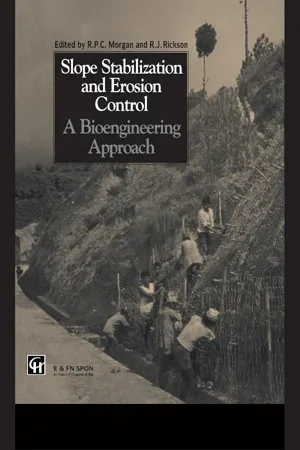
Slope Stabilization and Erosion Control: A Bioengineering Approach
A Bioengineering Approach
- 288 pages
- English
- ePUB (mobile friendly)
- Available on iOS & Android
eBook - ePub
Slope Stabilization and Erosion Control: A Bioengineering Approach
A Bioengineering Approach
About this book
This book is an up-to-date review of research and practice on the use of vegetation for slope stabilization and control of surface erosion caused by water and wind. From a basic understanding of the principles and practices of vegetation growth and establishment, it describes how vegetation can be treated as an engineering material and used to solve erosion and slope stability problems.
Information
Publisher
Taylor & FrancisYear
2003Print ISBN
9780415511766
9780419156307
Edition
1eBook ISBN
9781135831899
INTRODUCTION
1
R.J.Rickson and R.P.C.Morgan
Slope instability and erosion of the soil by water and wind are major environmental hazards. Although they are the result of natural geomorphological processes, they are both affected by and have consequences for human activity, often incurring economic and social damage. In nature, vegetation is one factor maintaining equilibrium in the landscape between the destructive forces of landscape instability and the constructive or regenerative forces of stability. The risk of slope failures and erosion is enhanced when the vegetation cover is removed. The question is whether the situation can be repaired if the vegetation cover is restored. This book aims at tackling this important issue by examining the mechanisms by which vegetation plays its protective role in the landscape.
The use of vegetation for slope stabilization and erosion control can be referred to as bioengineering. Bioengineering and biotechnical engineering are terms which are commonly found in the literature, but there is much confusion as to their precise definitions. In this book, bioengineering refers to the use of any form of vegetation, whether a single plant or a collection of plants, as an engineering material (i.e. one that has quantifiable characteristics and behaviour). Biotechnical engineering refers to techniques where vegetation is combined with inert structures such as crib walls, so combining the structural benefits of both the vegetative and non-vegetative components of the scheme.
Bioengineering is a classic example of where there is a significant gap between the ‘art’ (or application of the techniques proposed) and the ‘science’ (or the scientific quantification and hence objective justification of the practices). In Europe (especially in Germany, Switzerland and Austria) and in the United States of America, pioneers have been using bioengineering and biotechnical engineering techniques for many decades (Schiechtl, 1973, 1980). These relatively few, but significant case studies have illustrated the success of bioengineering, but we cannot continue to wait a further 50 years or so, whilst new schemes become established and fully matured, to evaluate the potential of these techniques. This book aims to state the potential of bioengineering and demonstrate the science behind it as a means of justifying the techniques involved to practitioners.
As such, the book is not intended as a ‘stand-alone’ practical handbook of how to apply the diverse techniques of bioengineering. Instead, it aims to describe and analyse the research base underlying bioengineering in order to provide a better understanding of the role of vegetation and how it can be regarded as an engineering material. It is intended, therefore, that the book will answer many of the questions that engineers raise when expressing their uncertainty about the potential of bioengineering techniques and go some way towards showing how vegetation can be incorporated as quantifiable inputs to landscape engineering design procedures.
The book was partially prompted by the increasing awareness of the environment, and the sustainability of landscape management practice. Traditional civil engineering techniques (‘grey solutions’, such as concreting of welded wire walls for slope stabilization) may not be sustainable in the long term due to high initial capital expenditure and (more importantly) increasing maintenance requirements over time. Carefully selected and implemented bioengineering techniques are bound to be more sustainable over time as vegetation is self-regenerating and able to respond dynamically and naturally to changing site conditions, ideally without compromising or losing the engineering properties of that selected vegetation. Indeed, there are examples where a grey solution to a landscaping problem has been wholly replaced with a more natural, environmentally sensitive vegetative approach. Schürholz (1992) outlines a scheme for river channelization of the River Enz using vegetation and natural geotextiles, which were shown to have significant advantages hydraulically, aesthetically and financially compared with the original, concrete-based channelization scheme.
Any attempt to answer the question of whether vegetation can be used to alleviate landscape instability will be of interest to a wide audience, for whom this book is intended. Prior to the publication of this book, the only major reviews of bioengineering are those of Schiechtl (1973, 1980), Gray and Leiser (1982) and Bache and MacAskill (1984). This means that there has not been a substantive publication for nearly a decade, during which time much state-of-art material concerning vegetation and its effect on slope stability and erosion processes has been published in diverse and in some cases obscure academic journals. These are often not easily accessible to non-academics, and the formal presentation of such work is not in a format that is readily usable by the practitioner in the field. At the other extreme, our knowledge is often confined to a few experts’ experiences, whose work may not have received the widespread exposure it deserves.
This is one consequence of the multi- and interdisciplinary nature of the subject matter being addressed. There are few publications or journals whose subject matter ranges from the detailed physics of soil erosion processes (important when attempting to understand the nature of the problem being faced) through to the techniques of vegetation establishment, for example. This book aims to encompass and integrate the diversity and complexity of the role and use vegetation for landscape protection and management.
There is increasing awareness by civil engineers of the potential role of vegetation in construction work, over and above the aesthetic qualities the vegetation may have. This awareness is reflected by the publication of books such as Coppin and Richard’s Use of Vegetation in Civil Engineering (1990), initiated and supported by the United Kingdom’s Construction Industry Research and Information Association (CIRIA). Geomorphologists will also find helpful the synthesis of the most recent research on the complex relationships between vegetation and erosion processes presented in this book. In this respect, the book will complement other recent expositions on the role of vegetation, notably those edited by Viles (1988) and Thornes (1990). Other users of the book may be involved with the expansion of the landscaping industry. The number of sites and applications where the techniques presented in this book could be utilized is growing rapidly, such as land reclamation of landfill and mine spoil. Such sites require environmentally sensitive solutions to reclamation, given the public’s concerns over the ways we manage and restore our diverse and everincreasing wastelands. Recreational sites such as golf courses and ski slopes also have to be designed and maintained to cope with the increasing pressure as leisure time expands.
Although the book deals primarily with the engineering and geomorphological roles of vegetation, the cost implications of using bioengineering are not ignored. The economic differentials between conventional, grey solutions and the use of vegetation may be significant in areas where the availability of products such as concrete, sheet piling, rip-rap and gabions is severely restricted, as in inaccessible areas of developing countries. Already, bioengineering techniques have been used in developing counties such as Nepal, where experience has shown the conventional methods of slope stabilization are prohibitively expensive on implementation and in maintenance, as well as being inappropriate to the local technology and expertise used to combat slope instability of the area.
The book is organized into sections covering firstly the principles behind the use of vegetation, and secondly, the practices which have been founded on these principles. Chapter 2 reviews the scientific research which has built up a quantified database on the interactions between vegetation and both surface erosion and deeper seated processes and leads to a discussion on the salient properties of vegetation for engineering purposes. Chapter 3 covers the main considerations of whether the vegetation will establish and develop into a form which meets these engineering needs. No matter how effective vegetation may be in controlling rainsplash erosion, for example, the vegetation will never reach the design requirements unless the correct growing conditions exist for that vegetation type to establish and develop successfully. Chapter 4 concentrates on the practice of using simulated vegetation, which may circumvent the problems of achieving the required vegetation characteristics in hostile areas, or when time is limited for the vegetation to establish and reach maturity at which it realizes its potential, as outlined in Chapter 2. Chapters 5 and 6 report on the practices used for the control of erosion by water and wind, based on bioengineering and biotechnical engineering principles. Many of these techniques have been adapted from agricultural engineering practice, again reflecting the multidisciplinary nature of the subject, and the fact that the detrimental impacts of erosion were first felt on agricultural land. Hence the experience and expertise on using vegetation to control soil erosion originate from this discipline. This book aims to widen the audience to whom these proven techniques may be helpful. With increasing concern over sediment production from non-agricultural land uses, it is wise to adopt techniques already proven to be successful. The role of vegetation in slope stability is covered in Chapter 7, where particular emphasis is placed on how conventional approaches to modelling and calculating slope stability and instability can be modified and adapted to account for the role of vegetation.
REFERENCES
Bache, D.H. and MacAskill, I.A. (1984) Vegetation in Civil and Landscape Engineering. Granada, London.
Coppin, N.J. and Richards, I.G. (1990) Use of Vegetation in Civil Engineering. CIRIA/Butterworths, London.
Gray, D.H. and Leiser, A.T. (1982) Biotechnical Slope Protection and Erosion Control. Van Nostrand Reinhold, New York.
Schiechtl, H.M. (1973) Sicherungsarbeiten im Landschaftsbau. Callway, München.
Schiechtl, H.M. (1980) Bioengineering for Land Reclamation and Conservation. University of Alberta Press, Edmonton.
Schürholz, H. (1992) Use of woven coir geotextiles in Europe. Paper presented to UK Coir Geotextile Seminar, Organised by ITC, UNCTAD/GATT, Coir Board of India and SIDA.
Thornes, J.B. (1990) Vegetation and Erosion. Wiley, Chichester.
Viles, H.A. (1988) Biogeomorphology. Blackwell, Oxford.
Slope Stabilization and Erosion Control: A Bioengineering Approach. Edited by R.P.C.Morgan and R.J.Rickson. Published in 1995 by E & FN Spon, 2–6 Boundary Row, London, SE1 8HN. ISBN 0 419 15630 5.
ENGINEERING PROPERTIES OF VEGETATION
2
M.E.Styczen and R.P.C.Morgan
2.1
INTRODUCTION
Vegetation provides a protective layer or buffer between the atmosphere and the soil. Through the hydrological cycle, it affects the transfer of water from the atmosphere to the earth’s surface, soil and underlying rock. It therefore influences the volume of water contained in rivers, lakes, the soil and groundwater reserves. The above-ground components of the vegetation, such as leaves and stems, partially absorb the energy of the erosive agents of water and wind, so that less is directed at the soil, whilst the below-ground components, comprising the rooting system, contribute to the mechanical strength of the soil.
Traditionally, the role of vegetation has been viewed rather simplistically, as seen by the somewhat superficial way it is dealt with in water erosion studies. The most commonly used approach has been to assign to it a coefficient, such as the C-factor in the Universal Soil Loss Equation (Wischmeier and Smith, 1978) which, for a certain stage of growth and plant density, describes the ratio of soil loss when vegetation is present to the amount lost on a bare soil. Values of this soil loss ratio are derived experimentally from field trials and, while they are true values for those situations, they cannot be readily used to predict the effect of the same or other vegetation in different climatic and pedological conditions.
Wischmeier (1975) tried to split the C-factor into CI, CII and CIII subfactors (Figure 2.1). CI describes the effect of the presence of a plant canopy at some elevation above the soil. CII is defined as the effect of a mulch or close-growing vegetation in direct contact with the soil surface. Root effects are not included. CIII represents the residual effects of land use on soil structure, organic matter content and soil density, the effects of tillage or lack of tillage on surface roughness and soil porosity, and the effects of roots, subsurface stems and biological a...
Table of contents
- COVER PAGE
- TITLE PAGE
- COPYRIGHT PAGE
- CONTRIBUTORS
- PREFACE
- 1. INTRODUCTION
- 2. ENGINEERING PROPERTIES OF VEGETATION
- 3. ECOLOGICAL PRINCIPLES FOR VEGETATION ESTABLISHMENT AND MAINTENANCE
- 4. SIMULATED VEGETATION AND GEOTEXTILES
- 5. WATER EROSION CONTROL
- 6. WIND EROSION CONTROL
- 7. SLOPE STABILIZATION
- 8. CONCLUSIONS
Trusted by 375,005 students
Access to over 1.5 million titles for a fair monthly price.
Study more efficiently using our study tools.
Frequently asked questions
Yes, you can cancel anytime from the Subscription tab in your account settings on the Perlego website. Your subscription will stay active until the end of your current billing period. Learn how to cancel your subscription
No, books cannot be downloaded as external files, such as PDFs, for use outside of Perlego. However, you can download books within the Perlego app for offline reading on mobile or tablet. Learn how to download books offline
We are an online textbook subscription service, where you can get access to an entire online library for less than the price of a single book per month. With over 1.5 million books across 990+ topics, we’ve got you covered! Learn about our mission
Look out for the read-aloud symbol on your next book to see if you can listen to it. The read-aloud tool reads text aloud for you, highlighting the text as it is being read. You can pause it, speed it up and slow it down. Learn more about Read Aloud
Yes! You can use the Perlego app on both iOS and Android devices to read anytime, anywhere — even offline. Perfect for commutes or when you’re on the go.
Please note we cannot support devices running on iOS 13 and Android 7 or earlier. Learn more about using the app
Please note we cannot support devices running on iOS 13 and Android 7 or earlier. Learn more about using the app
Yes, you can access Slope Stabilization and Erosion Control: A Bioengineering Approach by Roy P.C. Morgan,R.J. Rickson in PDF and/or ePUB format, as well as other popular books in Technology & Engineering & Urban Planning & Landscaping. We have over 1.5 million books available in our catalogue for you to explore.