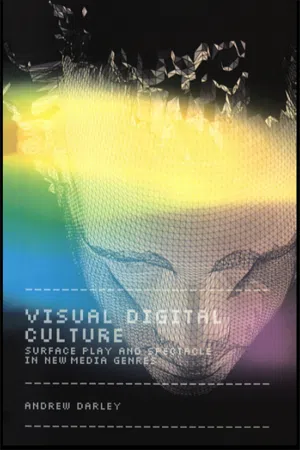
Digital entertainment, from video games to simulation rides, is now a central feature of popular culture. Computer-based or digital technologies are supplanting the traditional production methods of television, film and video, provoking intense speculation about their impact on the character of art. Examining the digital imaging techniques across a wide range of media, including film, music video, computer games, theme parks and simulation rides, Visual Digital Culture explores the relationship between evolving digital technologies and existing media and considers the effect of these new image forms on the experience of visual culture.
Andrew Darley first traces the development of digital computing from the 1960s and its use in the production of visual digital entertainment. Through case studies of films such as Toy Story, key pop videos such as Michael Jackson's Black or White, and computer games like Quake and Blade Runner, Andrew Darley asks whether digital visual forms mark a break with traditional emphases on story, representation, meaning and reading towards a focus on style, image performance and sensation. He questions the implications of digital culture for theories of spectatorship, suggesting that these new visual forms create new forms of spectatorship within mass culture.
- 240 pages
- English
- ePUB (mobile friendly)
- Available on iOS & Android
eBook - ePub
About this book
Information
Subtopic
Art GeneralIndex
Social SciencesPart I
HISTORY
1
A BACK STORY: REALISM, SIMULATION, INTERACTION
From a purely technological perspective the 1960s, a formative stage in the history of the modern computer, can be said to constitute the prehistorical era of the cultural forms and genres that I am concerned to explore here.1 As functional performance improved and computation technologies became much more practicable (smaller, faster, more powerful and less expensive) it became possible to discern within the field a multiplication of possible lines of development, a focusing-in on areas for further research. This was coupled with a greatly increased alertness as to the nascent and future commercial opportunities that were opening up as work in the field progressed. The work undertaken in the research laboratories of the 1960s in areas such as information processing, modelling, remote control and manipulation, and graphic displays seems a far cry from today’s computer animated cinema, arcade games and special venue attractions. Yet this is precisely where the technological link with these contemporary cultural forms resides.
Beginnings
One important example of the kind of focusing that commenced at this time is computer graphics. Highly sophisticated techniques of computer imaging are absolutely vital to the digital visual genres under investigation in these pages. At the beginning of their technological evolution, in the late 1950s, however, they consisted of little more than lines and dots on a cathode ray display screen. Efforts to improve and develop both the display screen itself and its graphics capabilities began at this time: both with respect to the visualisation of calculations under way in the computer, and in terms of its advantages as a user input mode. Similarly, the computer’s ability – given the correct program and enough computing power – to model processes, events, states and so forth was another significant motive for pursuing visualisation technologies.
Engineers and artists
Most of the early work put into developing such potential came from engineers and computer scientists working in corporate or academic research environments. A key example of such research was that into real-time interactive computer graphics. This came to practical fruition in 1963 in a system called Sketchpad, which allowed a user to draw directly on to a cathode display screen with a ‘light-pen’ and then to modify or ‘tidy-up’ the geometrical image possibilities so obtained with a keyboard. Though extremely primitive by today’s standards, Sketchpad is viewed as a crucial breakthrough from which have sprung most of the later technical developments in the areas of so-called ‘paint’ and interactive graphics systems. By the mid-1960s, a similar system involving computer image modification was being used in the design of car bodies – a precursor of current CAD/CAM (Computer Aided Design/Computer Aided Manufacture) systems. And by 1963, computer generated wire-frame animation films – visual simulations of scientific and technical ideas – were being produced using the early vector display technique.
Many of the digital technologies and techniques underpinning current forms of visual digital culture were first developed in relation to research goals and technical problems that were construed in ways which had little to do with aesthetic applications. For the most part, the concern of those early computer scientists involved with computer graphics research was with perfecting and developing further what they saw as the computer’s latent and extensive functional potential. Such work was undertaken in relation to ongoing research on commercial and military applications such as flight simulators and computer aided design. It would be incorrect, however, to claim that there was no aesthetic impulse operating in connection to these early centres of computer research. Some of the scientists and technicians involved in this nascent field of computer imaging began to look at their graphics in aesthetic as well as functional terms (see, for example, Franke 1971; Davis 1973: 97–105). In addition to concerted efforts aimed at various computer design processes and applications on the part of scientists, artists of the time began to see in the computer a new and potentially exciting means of aesthetic experimentation.
Those artists who began to explore this new means of image production did so as a way of augmenting their current aesthetic practices. For the most part the individuals concerned were mainstream modernists in aesthetic outlook and approach. Committed to modes of formalist image-making involving a sort of continual reworking of the self-same aesthetic axiom through experimentation with technique, they saw the computer as an instrument with great potential for the production of innovation in aesthetic form (see, for example, Vanderbeek 1970; Le Grice 1974).
Perhaps the best known of these early computer-artist experimenters is the late John Whitney.2 Whitney’s computer film work was guided by his attempts to draw a working analogy between abstract visual experimentation and music with its power to ‘evoke the most explicit emotions directly by its simple patterned configurations of tones in time’ (Whitney 1971: 26). His involvement in computer imaging began in the 1950s. Utilising outdated computing equipment junked by the military after the war Whitney began to construct computerised drawing machines. This led to the development of a fully automated system involving high precision integrated coordination and control of the entire production process (including drawing, motions, lighting and exposures) – a mechanical analogue computer, specifically designed to produce complex abstract film animations.
Like Whitney the majority of artists involved with computer image production in the 1960s worked in close collaboration with computer scientists and program researchers.3 And many of the engineers and scientists who came into working contact with artists came to consider themselves – if they did not already do so – as producers of ‘computer art’ in their own right (see, for example, Noll 1967). To understand more fully the character of such collaborations and the shifting viewpoints they seem to represent, it is important to mention the broader context in which they were occurring.
Cybernetic serendipity
The 1960s is not only an era of intense practical development of new electronically and digitally based technologies, but also one of increased conjecture as to the nature of such technology and the promise it held for the future of society. Speculation was rife within the academic, political, cultural and business communities. The area was thought about in terms of the new cultural forms that would spring from it, the new aesthetics it would inaugurate, the new disciplines it would spawn, and the profound effects it would have on industry, work and leisure. The dominant tone of this thinking was of intense optimism: technology, particularly the new computer-based technology, was invoked as a panacea for the ills of the present.
Many within the artistic community shared this perspective towards the burgeoning new electronic technology and the cybernetic discourse surrounding it. Indeed, it is clear that the artist/technician collaboration already mentioned within the ambit of computer imaging, was an important aspect of a much broader ‘investment’ in new technology then being pursued by artists. Two exhibitions that now stand as emblematic of this tendency are the 9 Evenings: Theater and Engineering performance events held in New York in 1966 and the 1968 London based exhibition Cybernetic Serendipity (see Whitman and Kluver 1967; Reichardt 1968).
The former involved works that issued from a collaboration between a group of American artists (associated with diverse fields that ranged from painting, theatre and choreography, to music) and a group of engineers. The latter was less parochial, drawing on work from the United States, Japan and Europe, it differed significantly from the former insofar as its focus was exclusively the computer and computer-related (or cybernetic) systems (see Reichardt 1968, 1971). It was an exhibition that attempted to demonstrate that the new computer technologies were soldering the unification of art and technology; producing a hybridisation of engineering and more properly artistic concerns. At the time, perhaps the most important theoretical advocate of this new technological optimism – at least as far as artists were concerned – was the media and cultural theorist Marshall McLuhan (see McLuhan 1968).
Another event, however, displays the more mundane and pragmatic dimensions of a maturing field. At the international symposium, Computer Graphics 70, there was a session on computer art – though a glance at the proceedings (Parslow and Green 1970) reveals it to be almost wholly overshadowed by the more utilitarian and commercial considerations that characterised the event. Here, clearly, we are already in a different world: back in the space of applied research and development where computer graphics were being viewed either as ‘practical industrial tools’ or ‘research instruments’.
The proto-realists
It is within this functional/technical space of early computer imaging that we can locate the emergence of a problem that has preoccupied many of those working in the area to this day. It started out as a concern with the production of representational imagery by computer and, as the potential was realised, subsequently turned into a fixation with the perfection of simulated photorealism. This preoccupation has considerable bearing on the development of the forms at the heart of this study. By and large, figurative representation was not a problem that troubled the first artists to become involved with computer graphics, it was, rather, the serendipitous possibilities for formal experimentation offered up by computer programming that they seized upon. On the other hand, representational concerns were present almost from the first in many of the uses to which computer scientists wanted to put computer images.
The desire on the part of scientists to model or simulate physical processes and events in space (and time) was a central impulse in the production of the earliest computer graphics and films. Whilst concurrent with the initiation of applied forms, work was under way on computer produced figurative imagery as a research activity in its own right. Even the work conducted in collaboration with artists had a decided leaning towards more figurative kinds of imagery.4 At the end of the 1960s experimentation began into the production of algorithms for the production and manipulation of still, line-based figurative images.
Thus, a picture begins to emerge of computer imaging in the 1960s, which involves a complex and somewhat tangled set of interests and pursuits. There was the growing applied research and development into the area on the part of scientists, engineers and corporate researchers. But there was also an early and significant aesthetic interest on the part of experimental artists. There are clearly moments when the aims and explorations of artists and engineers appear to coincide. Indeed, it would seem that these mainly corporate-funded collaborations were highly productive, even when what the artist was getting out of them diverged from what the technician was learning. The artistic impulse certainly contributed to establishing and advancing the field in the first instance and undoubtedly the commitment of most of these early computer artist pioneers to a non-functional exploration of a pure visual aesthetic continues to this day as a certain marginal tendency within computer imaging.
Simulation and interaction
In the early 1970s the enthusiasm of certain of the ‘hard’ computer engineers for the possibilities that had been awakened in the previous decade begins to coincide with those of art critics and some of the artists themselves. At least this is so with respect to what were viewed as being the most likely aspects of future development in the field. Thus, computer scientist Ivan Sutherland, having extended his initial research on real-time interactive computer graphics into the realm of the simulated experience of three-dimensional space, claimed that through his computer displays he had, ‘landed an airplane on the deck of a moving carrier, observed a nuclear particle hit a potential wall and flown a rocket at the speed of light’ (cited in Davis 1973: 103). One can already discern in this statement a fascination with two key concerns: simulation and interaction. In this respect it is illuminating to compare Sutherland with McLuhanite art and technology critic Gene Youngblood. Writing at the same time about trends in computer imaging – or as he calls it, ‘cybernetic cinema’ – Youngblood argues:
If the visual subsystems exist today, it’s folly to assume that the computing hardware won’t exist tomorrow. The notion of ‘reality’ will be utterly and finally obscured when we reach that point … [of generating] totally convincing reality within the information processing system … We’re entering a Mythic age of electronic realities that exist only on a metaphysical plane.
(1970: 206)
Meanwhile, video artist Nam June Paik began, in the late 1960s, to talk of future art forms in which he anticipated completely new levels of interaction and interfacing between the artist and/or participant and the work itself, calling such work ‘Direct-Contact Art’ (see Davis 1973: 106).
Those engineers, artists and critics of the 1960s who, somewhat prophetically, saw a cultural future for the new computer-based technology in terms of interaction and simulation were quite right. More than anything else this formative or primitive era of computer graphics established a set of interests and research pursuits which form the basis for later developments in such areas as image manipulation, real-time interactive usage, three-dimensional image simulation, animation and realistic image synthesis. In their different ways these have become central to recent cultural forms such as computer games, special effects cinema and simulation experiences. Simulation, understood as the representational copying or modelling of phenomenal reality both on a two-dimensional screen and in terms of three-dimensional virtual space, has increasingly engaged the attention of computer image research since the turn of the 1980s.
However, the domains within which it has developed, the applications to which it has been put and the different cultural forms that have grown out of it, have diverged markedly from those anticipated by 1960s art. If anything, it is the enthusiastic remarks of the technician Sutherland which best capture what has subsequently taken place in the cultural domain: in terms both of content and form. As we shall see, it is in the mass cultural domain that the potential of interaction and simulation has been most extensively employed.
Digital cinema
The rise of mainstream digital cinema, computer animation and certain significant and related sub-genres of both music video and advertising are intimately tied to the development of computer imaging which I began to unfold above. Yet, how did we arrive at the current situation typified by the ultra-realistic animation and spectacular effects of films such as Jurassic Park (1993), The Mask (1994), Toy Story (1995), Mission: Impossible (1996) and Armageddon (1998)?
We left the story at the beginning of the 1970s having noted a growing interest in representational image production on the part of certain computer graphics researchers as the 1960s wore on. This interest was to turn into a fixation by the end of the 1970s. By then, however, certain technical developments, which had encouraged the attentions of the commercial cultural establishment, had conspired to shift this preoccupation with figurative imagery to another level.
Realism
The upshot of this became the dogged pursuit of a somewhat revised goal: the development of digital techniques for the production of so-called ‘realism’. The notion of ‘realism’ has dominated computer image research and practice from the late 1970s and by and large it still prevails today. Until the 1970s image production had come to rely on the vector display technique for image generation: a process that limited the kinds and complexity of images produced. Eventually a different process of image manufacture and display emerged. Turning upon the calculation and display of ‘pixel’ values – so-called ‘raster displays’ and ‘frame-store’ techniques – these were much more conducive to the production of ‘realistic’ imagery. There are, of course, a host of differing and often contradictory conceptions of what constitutes representational realism. The one that came to discursive prominence within computer image research and practice is perhaps the one with which we are all most familiar. Quite simply it turns upon the notion of the proximate or accurate image: the ‘realisticness’ or resemblance of an image to the phenomenal everyday world that we perceive and experience (partially) through sight. For the majority of those involved with digital imaging at the time, the yardstick of such verisimilitude was photographic and cinematographic imagery.
Beyond the ultimate goal of producing ‘photographic’ imagery by other means, the motives for such a fixation with realism are diverse and appear to depend upon imperatives that are active within the particular domain in which they develop.5 If the factors shaping the representational and ‘realist’ thrust in practical and scientific domains tended to have a functional basis, in the sphere of mass visual culture – the domain of entertainment cinema – the support for realism was part of a more general ideal, indeed, it comprised the predominant aesthetic regime. Clearly, computer imaging only really becomes interesting to the producers and distributors of Hollywood cinema when it can operate effectively within the parameters of its own established commercial aesthetic. By the middle of the 1980s the popular or journalistic criticism attached to Hollywood had, on the whole, embraced computer imaging and was enthusiastic in support of its potential. The pundits clearly believed they could see in this new imaging technology, intimations of novel extensions of the Hollywood aesthetic. They envisage the computer introducing a new degree of expressive ‘freedom’ to the established media of photography and cinema: one that would maintain the look of photography whilst cutting it loose from its referential ties (see, for example, Sutherland 1976; Sørenson 1984a and 1984b). Eventually, what began to fulfil such expectations was the computer’s phenomenal rejuvenation of special visual effects, so intimately tied to the perfection of photo-realism. But we are jumping ahead of ourselves.
A considerable time was to elapse before digital imaging techniques became firmly established within mainstream cinema and related domains such as television, advertising and music video. Work in both software (or program) and hardware (machinery) developme...
Table of contents
- COVER PAGE
- TITLE PAGE
- COPYRIGHT PAGE
- ILLUSTRATIONS
- ACKNOWLEDGEMENTS
- INTRODUCTION
- PART I: HISTORY
- PART II: AESTHETICS
- PART III: SPECTATORS
- CONCLUSION
- NOTES
- BIBLIOGRAPHY
Trusted by 375,005 students
Access to over 1.5 million titles for a fair monthly price.
Study more efficiently using our study tools.
Frequently asked questions
Yes, you can cancel anytime from the Subscription tab in your account settings on the Perlego website. Your subscription will stay active until the end of your current billing period. Learn how to cancel your subscription
No, books cannot be downloaded as external files, such as PDFs, for use outside of Perlego. However, you can download books within the Perlego app for offline reading on mobile or tablet. Learn how to download books offline
Perlego offers two plans: Essential and Complete
- Essential is ideal for learners and professionals who enjoy exploring a wide range of subjects. Access the Essential Library with 800,000+ trusted titles and best-sellers across business, personal growth, and the humanities. Includes unlimited reading time and Standard Read Aloud voice.
- Complete: Perfect for advanced learners and researchers needing full, unrestricted access. Unlock 1.5M+ books across hundreds of subjects, including academic and specialized titles. The Complete Plan also includes advanced features like Premium Read Aloud and Research Assistant.
We are an online textbook subscription service, where you can get access to an entire online library for less than the price of a single book per month. With over 1.5 million books across 990+ topics, we’ve got you covered! Learn about our mission
Look out for the read-aloud symbol on your next book to see if you can listen to it. The read-aloud tool reads text aloud for you, highlighting the text as it is being read. You can pause it, speed it up and slow it down. Learn more about Read Aloud
Yes! You can use the Perlego app on both iOS and Android devices to read anytime, anywhere — even offline. Perfect for commutes or when you’re on the go.
Please note we cannot support devices running on iOS 13 and Android 7 or earlier. Learn more about using the app
Please note we cannot support devices running on iOS 13 and Android 7 or earlier. Learn more about using the app
Yes, you can access Visual Digital Culture by Andrew Darley in PDF and/or ePUB format, as well as other popular books in Social Sciences & Art General. We have over 1.5 million books available in our catalogue for you to explore.