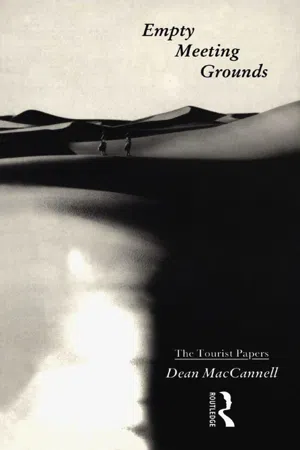
Empty Meeting Grounds continues Dean MacCannell's search for the cultural subject that is about to emerge from the encounter of the ex-primitive and the post-modern. It contains fascinating chapters on `Cannibal Tours', `The Desire to be Postmodern', the Vietnam Memorial in Washington D.C., the Statue of Liberty Restoration Project and the urbanization of Yosemite Park.
- 240 pages
- English
- ePUB (mobile friendly)
- Available on iOS & Android
eBook - ePub
About this book
Information
Subtopic
Human GeographyIndex
Social SciencesPart I
Ex-primitive and postmodern
Hamlet: A man may eat a fish with
the worm that hath eat of a king,
and eat of the fish that hath fed of
that worm.
the worm that hath eat of a king,
and eat of the fish that hath fed of
that worm.
King: What dost thou mean by this?
Hamlet: Nothing but to show you
how a king may go a progress
through the guts of a beggar.
how a king may go a progress
through the guts of a beggar.
(William Shakespeare)
Chapter 1
Cannibalism today1
The ‘primitive/modern’ opposition developed by sociology and anthropology for the study of the effects of nineteenth-century industrialization on European society, and for the study of the peoples ‘discovered’ during the period of European conquest and colonization, is not appropriate to the study of new cultural subjects. Tourism today occupies the gap between primitive and modern, routinely placing modernized and primitive peoples in direct, face-to-face interaction using intercultural English and other pidgins. Following is an excerpt from a brochure advertising a tour of tribal villages in Thailand:
KAREN TRIBAL TREKKING (Opposite Suriya Theatre Kotchasarn Rd.) If you feeling a pace…We’d like to offer you take a trip to the remote and unspoiled rained forest. Visit primitive hilltribes where the breezy from high mountain which surrounding will make you feel freshly and forget all of your troubles. So follow us now…. See their culture and live among them in their timelessness.
(Collected by Erik Cohen, English as in original)
It is not necessary for tourists to go to Thailand to come into direct contact with Southeast Asian tribal peoples. Highland Laotian villagers who fought as mercenaries on the side of the United States during the Vietnam War have been re-settled in apartment complexes in California and Wisconsin. Two Hmong youths, the first of their people to use writing, have taken my course on ‘The Community’ at the University of California. When actual contact between ‘primitives’ and ‘moderns’ occurs, there is clear evidence of economic rationality and cynical detachment on the part of the ‘primitives,’ and a corresponding emergence of a complex of beliefs on the part of the moderns that can be labeled ‘neo-totemism.’2
The destruction of savagery and nature is associated with the spread of capitalism, first in the form of natural resource and labor extraction, now in the form of tourism and ‘reverse’ (that is, periphery-to-center) migration.3 I have long been suspicious that advanced capitalism alone could not possibly accomplish the massive destruction of nature and the human spirit that is now occurring in its name. It must draw upon deeper ethnological resources for its savage aggressivity and its desire for total control.
THE END OF THE PRIMITIVE WORLD
Subsistence hunting and gathering can lay valid claim to having been the only common human heritage. It was certainly our most long-term collective adaptation going back over a million years, and it was the most geographically dispersed, occurring even in desert, mountain, jungle, and arctic areas that eventually proved to be illsuited to agriculture or industrial development. Of the estimated 80 billion people who have lived on earth, fewer than 10 per cent were (and are) engaged in agricultural and industrial occupations; the rest were savages.4 Twelve thousand years ago, the world population was 10 million people, all savages. One thousand years ago, after agriculture was established world-wide, 350 million people inhabited the earth but only 1 per cent, or 3.5 million, were still hunter-gatherers. At a conference of ethnologists and demographers in the 1960s it was estimated that the global population of true savages was fewer than 30,000 (calculated by Lee and DeVore, 1968: plate 1, no page). Even if this number has not diminished, we must add ‘acting in motion pictures’ and ‘tour guide’ to hunting and gathering as among the means by which these 30,000 souls gain a livelihood.
Enacted or staged savagery is already well established as a small but stable part of the world system of social and economic exchanges. Many formerly primitive groups earn their living by charging visitors admission to their sacred shrines, ritual performances, and displays of more or less ‘ethnologized’ everyday life. The commercialization of ethnological performance and display, co-developed by formerly primitive peoples and the international tourism and entertainment industries, is potentially a long-term economic adaptation. One can easily imagine a mutually beneficial deal being struck between, for example, the Masai of Kenya and MCI Incorporated, covering publicity, wage rates for contract dancers, admission fees, television and movie rights and residuals, profit sharing, and so on. If they could obtain good terms and aggressive promotion, the Masai could earn a living acting Masai in perpetuity. MCI already has a contract with the US Government, giving it the exclusive right to develop and market the visitors’ experience in Yosemite National Park (see ‘Nature Incorporated’ below). If an international entertainment business can profit from thematizing and marketing ‘nature,’ a logical next step would be the marketing of ‘savages,’ the imagined inhabitants of ‘unspoiled’ nature.
On the surface the institutionalization of primitive-performances-for-others appears as a simple hybrid cultural form. Such performances seem to combine modern elements of self-interested rational planning and economic calculation with primitive costumes, weapons, music, ritual objects and practices that once existed beyond the reach of economic rationality., this particular assimilation of primitive elements into the modern world would allow primitives to adapt and co-exist, to earn a living just by ‘being themselves,’ permitting them to avoid the kind of work in factories or as agricultural laborers that changes their lives forever. But on witnessing these displays and performances, one cannot escape a feeling of melancholia; the primitive does not really appear in these enactments of it. The ‘primitivistic’ performance contains the image of the primitive as a dead form. The alleged combination of modern and primitive elements is an abuse of the dead to promote the pretense of complexity as a cover for some rather simple-minded dealings based mainly on principles of accounting. It is a pseudohybrid characteristic of the ideology of ‘complexity’ found in postmodern groups and classes that want to think of themselves as being on the ‘cutting edge’ even as they no longer support, and even suppress, new and alternate ways of thinking. The image of the savage that emerges from these exprimitive performances completes the postmodern fantasy of ‘authentic alterity’ which is ideologically necessary in the promotion and development of global monoculture. The ‘primitivistic’ performance is our funerary marking of the passage of savagery. In the presence of these displays, there is only one thing we can know with certainty: we have witnessed the demise of the original form of humanity.5
Of course, the destruction of savagery did not begin with modern capitalism. Its origins can be found among the savages themselves. Here I give some evidence that late capitalism has aligned itself against humanity with the worst human impulse; that it is an only partly sublimated form of cannibalism.6 That capitalism has transformed itself into a metaphoric cannibalism should not be greeted as a positive development. I will argue that it is precisely its metaphoric character that protects it from having to admit its own gruesome excesses, empowering it in ways that the original form of cannibalism could not imagine. Metaphoric or reflexive cannibalism, driven by the same desire for absolute domination and control, now armed with high technology, need never look its victims in the face, or, even if by chance it does, it need never acknowledge what it sees.
Modernity’s guilt
What was the underlying theme or consciousness of the various movements, organizations, and new ways of thinking that constituted cultural modernity as it circled the globe? Let me begin with an observation of the obvious which usually goes unsaid: the modern conscience was a guilty conscience. This was not an imagined guilt. There was a real basis for it in modern society’s decadent assaults on savagery, peasantry, and on nature itself. Of course, as Freud and Alfred Hitchcock taught us, human beings refuse to live long with guilt as such.7 We carry guilt around in the guise of something else, usually a manic excess of distractive activity that is easy enough to spot as symptomatic. Also, there are excuses, justifications, and accounts. The primitives had to be converted because they were different: namely, not Christian, white, or clothed. They had to be removed because they were in the way; there simply was not enough room on this planet for both primitive and industrial life. They were occupying valuable real estate. Or perhaps the savages had to be destroyed because they were evil.
Alongside such vulgar expressions, one found, and still finds, enormous mental energy being expended to theorize the savage and now the peasant in such a way as to justify their eradication. Following are two passages written in the 1950s by men who were recognized for the highest achievements in Western letters, in physics, and psychoanalysis. They both make the same point as made in the unguardedly racist accounts, but here it is shrouded in sophistication. In a little book published at the summit of his distinguished career, Dr Carl G.Jung, described on the jacket as ‘the world’s greatest living psychiatrist,’ remarked:
Today we live in a unitary world where distances are reckoned by hours and no longer by weeks and months. Exotic races have ceased to be peep shows in ethnological museums. They have become our neighbors, and what was yesterday the prerogative of the ethnologist is today a political, social and psychological problem….
Everywhere in the West there are subversive minorities who, sheltered by our humanitarianism and our sense of justice, hold the incendiary torches ready, with nothing to stop the spread of their ideas except the critical reason of a single, fairly intelligent, mentally stable stratum of the population. One should not however overestimate the thickness of this stratum….
[T]he individual in his dissociated state needs a directing and ordering principle…. A religious symbol that comprehends and visibly represents what is seeking expression in modern man could probably do this; but our conception of the Christian symbol to date has certainly not been able to do so. On the contrary, that frightful world split runs right through the domains of the ‘Christian’ white man, and our Christian outlook on life has proved powerless to prevent the recrudescence of an archaic social order.
(Jung, 1959:12, 74, 104)
Also at the peak of his distinguished career, the great physicist Werner Heisenberg, creator of the ‘uncertainty principle’ in quantum mechanics, similarly remarked:
[M]odern science, then, penetrates in our time into other parts of the world where the cultural tradition has been very different from the European civilization. There the impact of this new activity in natural and technical science must make itself felt even more strongly than in Europe…. One should expect that in many places this new activity must appear as a decline of the older culture, as a ruthless and barbarian attitude, that upsets the sensitive balance on which all human happiness rests. Such consequences cannot be avoided; they must be taken as one aspect of our time.
(Heisenberg, 1958:202)8
Jung and Heisenberg suggest that not merely savagery but all non-European peoples have to be changed for their own good, to rescue them from their anti-scientific traditions, so they can be annexed to a world order unified by scientific and ‘Christian’ principles. Heisenberg is rhetorically brilliant in his acknowledgement that, in this Europeanizing process, it is the Europeans who will be regarded as ‘ruthless’ and ‘barbarian,’ to which he responds, in effect, ‘tough,’ it ‘cannot be avoided,’ it is an ‘aspect of our time.’ It should not go unnoticed that the individuals and groups who believe in this version of world events have sufficient wealth and power to make their dreams come true.9
There is a still more ingenious method of accounting that comes from the ‘writing culture’ school of anthropology: nothing actually happened involving the so-called ‘primitives’ (see the highly influential volume, Clifford and Marcus, 1986). How can anthropologists say this? By carefully demonstrating through close textual analysis that primitives never really existed as a distinct human type except as a diffuse and incidental effect of anthropological writing: ‘we wrote it, so we can erase it.’
What is the underlying motive in all this work? I suspect that the capital offense committed by the savages and the other non-European peoples was not that they were living a life entirely different from the Europeans who discovered them. It was that they were living a life entirely different, and evidently enjoying it. Human beings accept difference much more easily if those who are different from themselves also appear to be unhappy. White Americans and other Anglo-European peoples are often absolutely intolerant of the joy of others. Evidence of great pleasure on the part of another is as likely to be met by furious and destructive jealousy as by a request to join in the fun. While attention has been paid to this in the psychoanalytic literatures, it has been completely overlooked by sociology and anthropology where it probably has had greater impact on the subject matter. Renata Salecl (1990) argues that this hatred of enjoyment is based on an unanalyzed inhibition of one’s own pleasure that assumes the symptomatic form of attacks on the pleasure of others. Whatever its source might be, in virtually every early account, the pleasure of savages is an occasion for condemnation, not admiration.
This condemnation is palpably evident in Columbus’s first journal observations of the Indians he encountered in the Caribbean. So great was the admiral’s desire to get to China where, he fantasized, he would meet with the ‘Great Khan’ and convert him to Christianity, he became enormously frustrated when, on the occasion of his second voyage, he landed in Cuba, obviously another island, not China. In what was for him a characteristic act of total denial, he threatened to cut out the tongues of anyone who would not take a solemn oath swearing that Cuba was a mainland, not an island. When, even under threat, the Indians continued to maintain that their homeland was an island, he wrote in his journal: ‘And since these are bestial men who believe the whole world is an island and who do not know what the mainland is, and have neither letters or long-standing memories, and since they take pleasure only in eating and being with their women, they said this was an island’ (quoted in Todorov, 1984:21). I find it strange that no one seems to have noticed this hatred of the pleasure of others, absolute to the point of being expressed casually, without any felt need for justification. The ‘pleasures’ of the savages are simply listed in a litany of their despicable qualities along with their ‘bestiality’ and ‘ignorance.’ The same unconscious hostility marks the Heisenberg comment: we are going to have to upset the delicate balance of life in the non-European parts of the world, the balance ‘on which all human happiness rests.’ Why? So they will be our equals in unhappiness?
The collective guilt of modernized peoples is not technically a ‘Christian’ type of guilt, based on ‘original sin,’ although Christians may eventually bear it (in a juridical sense) more heavily than non-Christians. And it is not necessarily of an Oedipal kind although it can be re-inscribed into the family romance. Specifically, I am suggesting that our guilt is not for a fall from grace, or a metaphoric murder of the father, symbolic repetitions of allegedly real events that happened in the remote past. Rather, it is for the actual murder of our forefathers, our savage ancestors, something started about seven thousand years ago and just completed. Reinscription of this murder into the ‘family romance’ can be prefaced by Freud’s favorite aphorism, ‘The child is father of the man.’ By killing off the primitives (we are all witnesses to this deed, there are literally thousands of reliably obtained first-hand accounts on our library shelves), we have killed off the childhood of humanity. The guilt for this crime is projected onto our parents in the form of blame for having tricked us into growing up, for ‘killing of’ our own childhood. The personal loss of innocence that figures in the Oedipus story becomes a stand-in for the collective tragic destruction. We embrace Oedipal guilt in a kind of ‘plea bargain’ to a lesser offense, because it involves symbolic murder, not an actual genocide. But it is actual genocide that is now operative in the formation of guilt.
This is my reading of the extended reflection on Oedipus in Lévi-Strauss’s inaugural lecture on assuming the Chair of Anthropology at the Collège de France. He draws a parallel between brother-sister incest in Algonquin mythology and the Western Oedipus myth, focusing on non-standard sexual relations while excluding (without remarking on the exclusion) consideration of the Oedipal patricide (Lévi-Strauss, 1967:34–9). He concludes, in summary, that the prohibition of incest is universal because it leads to balance and equilibrium:
In the face of the two possibilities which might seduce the imagination—an eternal summer or a winter just as eternal, the former licentious to the point of corruption, the latter pure to the point of sterility—man must resign himself to choosing equilibrium and the periodicity of the seasonal rhythm. In the natural order, the latter fulfills the same function which is fulfilled in society by the exchange of women in marriage and the exchange of words in conversation, when these are practiced with the frank intention of communicating, that is to say, without trickery or perversity, and above all, without hidden motives.
(p. 39)
It is clear that Lévi-Strauss desires nothing so much as to heal the wounds inflicted upon our savage ancestors by modern peoples. The love for the savage so clearly expressed in his work grows out of human understanding that can only have a determined base in absolute identification. Perhaps it is based on the fact that he undertook his first ethnological expeditions while fleeing for his life from the Nazis and came to terms with his own fate as he made his observations of the Indians. His partial account of Oedipus, skipping over the killing of the father, expresses his deepest desires and also provides the motive for his research program: his drive to try to reconstruct the totality of American Indian religious beliefs. This is perhaps the place where anthropology ends, having exhausted its mental energy and good will.
No matter how hard we try to forget, modern civilization was built on the graves of our savage ancestors, and repression of the pleasure they took from one another, from the animals and the earth. I suspect our collective guilt and denial of responsibility for the destruction of savagery and pleasure can be found infused in every distinctively modern cultural form.
If we are ever to end this projection of evil onto innocent others, it will be necessary to find its source, which I will argue is a still operative cannibal ego and unconscious that stupidly thinks everyone shares its fantasies.
CANNIBAL TOURS: THE MOVIE
Dennis O’Rourke’s Cannibal Tours is the latest of his documentary films on Pacific peoples, following his Yumi Yet (1976), Ileksen (1978), Yap…How Did They Know We’d Like TV? (1980), Shark Callers of Kontu (1982), Couldn’t Be Fairer (1984), and Half Life (1986). The narrative structure of the film is unremarkable. A group of Western Europeans and North Americans, by appearance somewhat wealthier than ‘average’ international tourists, travel up the Sepik river in Papua New Guinea in an ultra-modern, air-conditioned luxury liner, and up tributaries in smaller motor launches, stopping at vill...
Table of contents
- Cover Page
- Title Page
- Copyright Page
- Preface
- Acknowledgements
- Introduction
- Part I Ex-primitive and postmodern
- Part II Majority discourse
- Part III Postmodernization and its discontents
- Afterword
- Bibliography
Trusted by 375,005 students
Access to over 1.5 million titles for a fair monthly price.
Study more efficiently using our study tools.
Frequently asked questions
Yes, you can cancel anytime from the Subscription tab in your account settings on the Perlego website. Your subscription will stay active until the end of your current billing period. Learn how to cancel your subscription
No, books cannot be downloaded as external files, such as PDFs, for use outside of Perlego. However, you can download books within the Perlego app for offline reading on mobile or tablet. Learn how to download books offline
Perlego offers two plans: Essential and Complete
- Essential is ideal for learners and professionals who enjoy exploring a wide range of subjects. Access the Essential Library with 800,000+ trusted titles and best-sellers across business, personal growth, and the humanities. Includes unlimited reading time and Standard Read Aloud voice.
- Complete: Perfect for advanced learners and researchers needing full, unrestricted access. Unlock 1.5M+ books across hundreds of subjects, including academic and specialized titles. The Complete Plan also includes advanced features like Premium Read Aloud and Research Assistant.
We are an online textbook subscription service, where you can get access to an entire online library for less than the price of a single book per month. With over 1.5 million books across 990+ topics, we’ve got you covered! Learn about our mission
Look out for the read-aloud symbol on your next book to see if you can listen to it. The read-aloud tool reads text aloud for you, highlighting the text as it is being read. You can pause it, speed it up and slow it down. Learn more about Read Aloud
Yes! You can use the Perlego app on both iOS and Android devices to read anytime, anywhere — even offline. Perfect for commutes or when you’re on the go.
Please note we cannot support devices running on iOS 13 and Android 7 or earlier. Learn more about using the app
Please note we cannot support devices running on iOS 13 and Android 7 or earlier. Learn more about using the app
Yes, you can access Empty Meeting Grounds by Dean MacCannell in PDF and/or ePUB format, as well as other popular books in Social Sciences & Human Geography. We have over 1.5 million books available in our catalogue for you to explore.