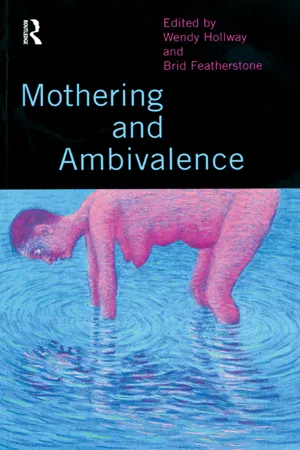
Children's rights, lone motherhood and the breakdown of families are all issues at the forefront of current social debate in the West, with little agreement on what constitutes good parenting, or how the needs of both mother and child are best met. The feminist contribution to this debate is particularly important in keeping in view the diverse identities of all those who provide mothering. The psychoanalytic contribution is often undervalued and misunderstood.
Mothering and Ambivalence brings together authors from therapeutic, academic and social work backgrounds to discuss dependency, anxiety and gender relations within families.
Drawing on extensive professional experience the contributors combine a psychoanalytic and feminist approach to mothering which transcends the polarized and simplistic political debate about women's and children's needs. They also show how such an approach can inform and improve professional practice.
eBook - ePub
Mothering and Ambivalence
- 216 pages
- English
- ePUB (mobile friendly)
- Available on iOS & Android
eBook - ePub
Mothering and Ambivalence
About this book
Information
Chapter 1
Introduction
Crisis in the western family
Brid Featherstone
Western cultural commentators appear to be preoccupied with how children are coping with changing family forms. They are worrying about what kind of future generation is being created; whether mothers’ and fathers’ claims to personal rights are undermining their responsibilities as parents; what is happening to men; how the crisis in masculinity is affecting boys; what it means to be a father; whether women can really have it all –motherhood, sexuality and a career; whether women still need men.
In this book we address these themes, using and developing insights from feminist psychoanalysis about mothering, fathering and gender relations in families, and also about needs and desires, dependencies and jealousies, anxiety and identity. We also use psychoanalysis to expose the unconscious dynamics which motivate political positions in this area – feminist positions as well as others. Children’s needs, for example, are understood by all of us through the prism of our own gendered and familial desires and identities. The idea of mothering in particular arouses anxieties which may be managed through defences which, reproduced at a cultural level, are manifested in the idealisation and denigration of mothers – neither set of images faithful to reality. Much of the British feminist literature on mothering is characterised by antipathy to psychoanalytic understandings and a related unwillingness to address the psychic difficulties men, women and children experience in changing patterns of gender relations, of parenting and work, and the resulting political implications. Here, we are trying to redress that balance.
Faced with the recent onslaught against any alternatives to the traditional nuclear family, especially if they involve women’s independence from men, the danger is that feminism will concentrate so fixedly on opposing that backlash that we will not address the widespread anxieties about what happens to children when parental care fails. To stress the importance of child-care facilities for working mothers and to ask rhetorically why fathers are not being held equally responsible when children suffer is necessary, but it is not sufficient.
For example, in her widely publicised book What about Us? An Open Letter to the Mothers Feminism Forgot (1995), Maureen Freely argued that feminists have been concerned only with the needs of ‘women’ and not with the needs of mothers or children. This may be interpreted as part of a backlash against feminism, but could also be viewed as opening up possibilities for feminism to reframe the politics of mothering.
As Stacey (1986) warned in relation to similar developments in the United States, disagreements among feminists provided clues to gaps and difficulties in feminist thinking and to areas of pain and conflict in women’s lives. In particular, she warned that feminists in the USA had relied too much upon voluntaristic strategies in relation to men and children, which led them to misconstrue the difficulties involved in constructing loving, egalitarian relations, and in meeting the needs for, and of, children.
A glance at the history of feminist writings on mothering bears out the difficulties feminists have with questions about women’s and children’s needs and rights. The role of men in relation to women and children also continues to be a lightning rod for tensions within feminism, and current debates on men’s relationships with children after separation or divorce indicate that there are two positions emerging. One emphasises well-resourced mediation facilities and constructing and supporting good fathering practices (see Orbach, Chapter 6). The other highlights the vulnerability of women and children to violence and abuse when men keep in contact with their children (Hester and Radford 1996).
In the next sections the book’s contribution will be located within feminist debates on mothering, on women’s and children’s needs and on the role of fathers and fathering.
CHANGING LIVES IN CHANGING WORLDS
Second-wave feminism’s early texts were highly critical of the role mothering played in women’s oppression (see, for example, Firestone 1970). They can be understood as a challenge to familialism, post-war idealisation of domesticity and a form of psychoanalytic thinking which seemed to prioritise children’s needs (Everingham 1994). If the objectives of 1960s’ and 1970s’ feminism were equality and greater personal autonomy for women, mothering was seen as the greatest obstacle to this:
The claim that mothers had rights and needs of their own provided a standard by which to assess psychological theories of child development. Feminist writers used this standard to highlight the innumerable ways in which psychological theories and models of child development oppressed women, through their failure to consider the mother’s separate set of needs and interests.
(Everingham 1994: 3)
In this period, ‘To be a person, for the most part, meant to be a person like a man … Personness and subjectivity necessitated moving beyond, or avoiding altogether, home and motherhood’ (Bassin, Honey and Mahrer Kaplan 1994: 6).
For Snitow (1992), this was the period of what became known as ‘the demon texts’ (for example, Friedan’s The Feminine Mystique (1963) and Firestone’s The Dialectic of Sex (1970)), which were accused of mother-hating. They were patriarchy-hating rather than mother-hating, according to Snitow, but they were limited in that they failed to speak the daily life of the mother. From a British perspective, Segal (1995) argues that the early period exposed many women’s silent sorrow at home. The stress, isolation and economic dependence of full-time mothers was explored, for example, in Oakley’s (1974) study of housewives. However, as bell hooks (1984) has pointed out, the specific circumstances of white middle-class women’s domestic isolation were mistaken, in many key texts, for the universal, thus occluding whole swathes of experience of work, poverty and racism.
A flowering of feminist work on mothering followed, initiating what Snitow called the second period. In the USA, 1976 saw the publication of works by Rich, Dinnerstein and Lazarre. For Snitow, this period opened up a key political question which still remains unanswered: What construction of motherhood is most helpful for feminism? If we follow Dinnerstein, we are trying to get men to mother; if we follow Rich, we are trying to build a female culture. This lack of clarity about the goals of feminism where mothering is concerned continues to have grave political consequences.
Chodorow and Contratto (1989) argue that many of the writings of this time reflected culturally held beliefs in the all-powerful mother; idealisation and blaming being two sides of this belief. These writings have an unprocessed quality in which infantile fantasy has become confused with the actuality of maternal behaviour:
Feminists take issue with the notion that a mother can be perfect in the here and now, given male dominance, lack of equality in marriage, and inadequate resources and support, but the fantasy of the perfect mother remains: If current limitations on mothers were eliminated mothers would know naturally how to be good.
(Chodorow and Contratto 1989: 90)
Chodorow’s The Reproduction of Mothering (1978) is itself a product of this period. Along with Dinnerstein’s The Rocking of the Cradle and the Ruling of the World (1976) and an early article by Flax (1978), it laid the groundwork for a blossoming of feminist psychoanalytic work in the USA. This work, later often called feminist object relations theory, emphasised the importance of the pre-Oedipal period, in particular the mother–daughter relationship, the persistence of infantile ties and the effects of women’s mothering on gender-based social relations (Bassin, Honey and Mahrer Kaplan 1994: 7).
The impact of this work in the UK was both theoretical and practical. The London Women’s Therapy Centre was the first to provide both a service and a focus for the ongoing development of feminist psychoanalytic work in the British context (see, for example, Ernst and Maguire 1987). However, because of a widespread antipathy to psychoanalysis, women’s studies and feminist work in the social sciences remained largely unaffected, continuing to approach mothering in a socially determinist vein.
According to Snitow (1992), a third period in feminist thinking on motherhood was ushered in with the publication of Ruddick’s article ‘Maternal Thinking’ (1980). This, Snitow claimed, really ended the taboo on speaking the life of the mother. Ruddick has gone on to argue (synthesised in Maternal Thinking: Towards a Politics of Peace 1989), that children’s demands for preservation, growth and social acceptability constitute maternal work and that to be a mother is to be committed to meeting these demands by practices of preservative love, nurturance and training. Conceptually and historically, preservation is pre-eminent in shaping mothering and it is neither historically nor culturally specific, unlike for example, the expectation that mothers should foster children’s growth. Ruddick argued that, although the idea of fostering children’s growth is culturally and historically specific, this does not mean that children’s needs are primarily a cultural creation. She was clear that maternal work could be carried out by men as well as women. In engaging with the relation between mothering and what children need, Ruddick’s work, though not in a psychoanalytic tradition, is a helpful model for this book.
However, the complexity of her insights became lost, alongside many others, in the polarised and politicised climate of the USA in the 1980s, where the politics of the family and relations between men and women moved centre-stage. High profile pro-family feminists such as Elshtain (1981) emerged, who charged feminism with demeaning motherhood and argued for the affirmation of family life as the locus of humanisation:
Mothers were demeaned under the guise of “liberating” them. In many early feminist accounts, mothering was portrayed as a condition of terminal, psychological and social decay, total self-abnegation, physical deterioration, and absence of self-respect. Women, already victims of an image that denigrated their social identity under the terms of the male American success ethos, now found themselves assaulted by the very group that would liberate them.
(Elshtain 1981: 333–4)
Writers from a variety of perspectives began to reassert a naturalistic view of mothering. The following wave of maternalism, hitched to the bandwagon of pro-natalism, fostered the valorising of motherhood as the site of women’s moral superiority over men (Segal 1995).
Stacey (1986) argued that the emergence in the USA of conservative pro-family feminism in the 1980s resulted from weaknesses in the feminist response to what she saw as a crisis in contemporary life. It reflected the inadequacy of feminist understandings of childhood, heterosexuality and female subjectivity. In particular, it reflected a voluntarism which assumed that changes could be effected without psychic consequences. She noted that many feminists who had served as the shock troops of family change had become victims of what she called the ‘failure of voluntarism’.
Avoiding marriage and motherhood proved far easier, of course, than attaining gender equality, let alone liberation. The social, structural and cultural changes necessary for the latter remain far from view …. Three sorts of personal traumas seem to be particularly widespread among those who shunned traditional marriage and childrearing arrangements: “involuntary” singlehood, involuntary childlessness, and single parenthood.
(Stacey 1986: 239)
Stacey called for further feminist work on intimacy, child rearing, childlessness and sexuality. She developed three themes. Firstly, she argued that efforts to reconcile egalitarian relationships with long-term commitment placed considerable strains on relationships. Secondly, she argued that there was a need for feminist theories of child development which did not neglect the question of what children need. This gap in existing feminist theory had been filled, she argued, by the conservatives. Thirdly, she argued that feminist theory was vulnerable in its treatment of heterosexuality and this related to deeper problems in feminist theory and politics. In particular, the notion of ‘false consciousness’ functioned to assume that heterosexuals were dopes and fostered arrogance on the part of feminist theorists. Paralleling Snitow’s question about what is required from men, Stacey asked: What are we looking for?
Is it woman or gender justice? Most … seem to presume that it is the former or that the two are indistinguishable. Thus many feminists have adopted a woman-identified stance as the best strategy toward the goal of equality between women and men. But for a good many feminists, woman identification has become an end-in-itself and one that can lead … to a retreat from politics or that can evolve into a simple affirmation of femaleness that turns readily into a variation on Elshtain’s “social feminism”. The latter approach tends to ignore, or even to thwart, the goal of gender justice.
(Stacey 1986: 242)
This passage seems prescient in the light of the strong criticism by writers such as Roiphe (1993) and Wolf (1993) against a feminism that has posed male sexuality as automatically aggressive and has seemed to have no positive vision of heterosexuality. (In the British context, see the debates in Feminism and Psychology, starting with the special issue on heterosexuality published in 1992.) Furthermore, implicit in the failure to countenance a positive role for heterosexuality was a failure to posit a positive role for men. This has had implications for men’s involvement with children. Whilst Stacey’s points are extremely important and I agree with them, the further feminist work she calls for cannot usefully be accomplished without using psychoanalysis, albeit critically.
In the UK, this kind of polarisation did not occur, although Coward (1993) noted the increasingly common phenomenon of high-profile women using motherhood to repudiate feminism and to demonstrate that feminism was wrong about what women really wanted. Only in the 1990s have debates on mothering, feminism and the family begun to take shape. These have focused on lone motheringand feminists have played a largely reactive role in them. The reasons for this include their marginalisation in the media, divisions about the role of men, the dominance of theoretical approaches which have been overly socially determinist and therefore unable to address questions about the impact of change at a psychological level, and antipathy towards considering children’s needs.
FEMINISM AND MOTHERING IN THE UK IN THE 1990s
British feminist work on mothering is marked by a pervasive dualism in which the individual and the society are juxtaposed in mutually exclusive (and mutually suspected) explanations. Explanations in terms of social forces have been privileged and there has not been a thoroughgoing critique of the ensuing social determinism (see Hollway 1995). There is a tendency to assume that the structures, institutions and practices of mothering have clear-cut and uniform effects (see, for example, Richardson 1993). What is lost in the process are accounts of maternal subjectivity which can take into account the ways that fantasy, meaning, biography and relational dynamics inform individual women’s po...
Table of contents
- Cover
- Halftitle
- Title Page
- Copyright
- Dedication
- Contents
- Notes on contributors
- 1 Introduction: crisis in the western family
- 2 The production and purposes of maternal ambivalence
- 3 Fathers’ ambivalence (too)
- 4 The maternal bed
- 5 Mothers and daughters within a changing world
- 6 Mothers, parenting, gender development and therapy
- 7 The heaven and hell of mothering: mothering and ambivalence in the mass media
- 8 In the company of women: experiences of working with the lost mother
- 9 Parting is such sweet sorrow: the romantic tragedy of a mother–child relationship
- 10 Group-analytic psychotherapy: a site for reworking the relationship between mothers and daughters
- 11 ‘I wouldn’t do your job!’: women, social work and child abuse
- Index
Trusted by 375,005 students
Access to over 1.5 million titles for a fair monthly price.
Study more efficiently using our study tools.
Frequently asked questions
Yes, you can cancel anytime from the Subscription tab in your account settings on the Perlego website. Your subscription will stay active until the end of your current billing period. Learn how to cancel your subscription
No, books cannot be downloaded as external files, such as PDFs, for use outside of Perlego. However, you can download books within the Perlego app for offline reading on mobile or tablet. Learn how to download books offline
Perlego offers two plans: Essential and Complete
- Essential is ideal for learners and professionals who enjoy exploring a wide range of subjects. Access the Essential Library with 800,000+ trusted titles and best-sellers across business, personal growth, and the humanities. Includes unlimited reading time and Standard Read Aloud voice.
- Complete: Perfect for advanced learners and researchers needing full, unrestricted access. Unlock 1.5M+ books across hundreds of subjects, including academic and specialized titles. The Complete Plan also includes advanced features like Premium Read Aloud and Research Assistant.
We are an online textbook subscription service, where you can get access to an entire online library for less than the price of a single book per month. With over 1.5 million books across 990+ topics, we’ve got you covered! Learn about our mission
Look out for the read-aloud symbol on your next book to see if you can listen to it. The read-aloud tool reads text aloud for you, highlighting the text as it is being read. You can pause it, speed it up and slow it down. Learn more about Read Aloud
Yes! You can use the Perlego app on both iOS and Android devices to read anytime, anywhere — even offline. Perfect for commutes or when you’re on the go.
Please note we cannot support devices running on iOS 13 and Android 7 or earlier. Learn more about using the app
Please note we cannot support devices running on iOS 13 and Android 7 or earlier. Learn more about using the app
Yes, you can access Mothering and Ambivalence by Brid Featherstone, Wendy Hollway, Brid Featherstone,Wendy Hollway in PDF and/or ePUB format, as well as other popular books in Psychology & History & Theory in Psychology. We have over 1.5 million books available in our catalogue for you to explore.