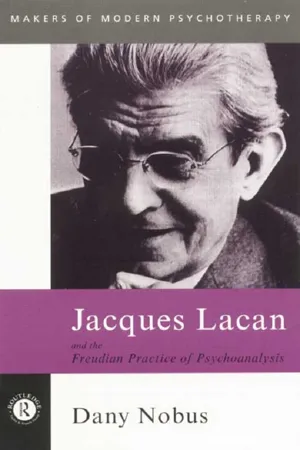
Jacques Lacan and the Freudian Practice of Psychoanalysis paints a completely new picture of the man and his ideas. The book suceeds in showing how ideas can become more accessible, and re-evaluates his significance within the field of psychodynamic psychotherapy.
The book is structured thematically around five key issues: diagnosis, the analyst's position during the treatment, the management of transference, the formulation of interpretations, and the organisation of analytic training. For each of these issues, Lacan's entire work both published and unpublished material, has been taken into account and theoretical principles have been illustrated with clinical examples. The book also contains the first complete bibliography of Lacan's works in English.
Clear, detailed, and wide ranging, Jacques Lacan and the Freudian Practice of Psychoanalysis will prove essential reading, not only for professionals and students within the fields of psychology and psychiatry, but for all those keen to discover a new Lacan.
- 272 pages
- English
- ePUB (mobile friendly)
- Available on iOS & Android
eBook - ePub
Jacques Lacan and the Freudian Practice of Psychoanalysis
About this book
Information
Chapter 1
Diagnosis via speech and transference
WHY DIAGNOSIS?
Throughout his works, Lacan insisted on the differences between various mental organizations, on the analyst’s need to recognize these differences, and on the mandatory adoption of a differential treatment approach in the light of the psychic economy the analyst has acknowledged in the patient. The ‘Lacanian analyst’ has to bear in mind some basic nosological categories and is held to diagnose patients at the earliest stage of the clinical process, because her position within the treatment should differ according to the psychic structure of the patient. Hence, the initial assessment of the patient is not merely a matter of registration, due to the fact that it has major clinical consequences.
Like so many other aspects of Lacan’s clinical theory, the importance of a correct diagnosis prior to the beginning of psychoanalytic treatment is rooted in Freud’s papers on technique. In ‘On Beginning the Treatment’ (Freud 1913c), Freud argued in favour of a trial period (Probezeit, Erprobung, Sondierung) of one or two weeks before the start of the treatment, for which he adduced the necessary, yet laborious diagnostic procedure as one of the main reasons. Until the end of his career, Freud remained convinced that the standard method of psychoanalysis was of no use to people suffering from paraphrenia—or some other form of psychosis—which prompted him to demand that the analyst recognize this contraindication during the trial period (ibid.: 124).1 Failure to do so, or making a diagnostic mistake, would be disastrous as some patients (neurotics wrongly diagnosed as paraphrenics) would be unjustly excluded from treatment, whereas others (paraphrenics erroneously qualified as neurotics) would be unjustly admitted.
Compared to Freud’s dual opposition of neurosis and psychosis, Lacan’s nosological framework is slightly more sophisticated and its categories more mutually exclusive. Whereas Freud also designated the psychoses as narcissistic neuroses (and the neuroses proper as transference neuroses) (Freud 1916–17a[1915–17]:420), Lacan defined neurosis and psychosis as fundamentally different psychic structures with separate causalities. To the Freudian neurosis/psychosis dualism he also added the distinct psychic structure of perversion, which Freud chiefly addressed on a purely phenomenological level—as sadism, masochism, exhibitionism, voyeurism, etc. Indeed, Freud never sharply discriminated between psychosis and perversion, and his only formal distinction between perversion and neurosis resides in his thesis that the latter is the negative of the former, which he defended for example in ‘Three Essays on the Theory of Sexuality’ (1905d:165). Lacan rationalized and systematized Freud’s diagnostic categories, ultimately constructing the triptych of neurosis, psychosis and perversion, in which each of the terms represents a separate clinical entity.
Furthermore, the clinical impact of these categories within Lacanian analysis no longer concerns the patient’s possible entry to the treatment, but rather the analyst’s prescribed position within the treatment and his preferable handling of transference. Unlike Freud, Lacan did not regard psychotics as unsuitable candidates for analysis. This does not imply that for Lacan the Freudian dispositions remain valid under all circumstances, but that the clinical premises of Freudian psychoanalysis can and should be modified, without therefore losing their vigour, to accommodate different types of patients.
DIAGNOSTIC CRITERIA
So how does the analyst actually arrive at a diagnosis? In ‘On Beginning the Treatment’, Freud was not very forthcoming about how to distinguish practically neurosis from psychosis, yet he did warn his readers about the deceitfulness of the clinical picture:
Often enough, when one sees a neurosis with hysterical or obsessional symptoms, which is not excessively marked and has not been in existence for long—just the type of case, that is, that one would regard as suitable for treatment—one has to reckon with the possibility that it may be a preliminary stage of what is known as dementia praecox (‘schizophrenia’, in Bleuler’s terminology; ‘paraphrenia’, as I have proposed to call it), and that sooner or later it will show a well-marked picture of that affection.
(Freud 1913c:124)
Freud contended that ostensibly neurotic symptoms (such as elusive bodily pains and compulsive behaviours) should not be taken as unambiguous signs of an underlying neurotic illness, however conspicuous they may be. A psychosis can hide under the mask of a neurosis, and the analyst should not be misled by the colours of the clinical guise.2 To many of his contemporaries, Freud’s admonition must have seemed odd, used as they were in privileging strict relationships between certain symptoms and certain disorders. Yet it may also surprise those contemporary clinicians who still believe that hallucinations are sufficient for diagnosing psychosis or that persistent offending is pathognomonic for psychopathy. None the less, Freud’s first, negative diagnostic rule read that one should not take symptoms at face value. Mental organization had to be dislodged from observable phenomena, and analysts were urged to suspend their judgement and to look for more reliable criteria.
Defining such criteria proved more onerous than exposing the misleading ones though. Freud was adamant that the psychoanalytic process is unpredictable and that the analyst’s initial diagnosis can always be disproved by the vicissitudes of the treatment, in which case analysts should be willing to change their minds about the patient’s psychic economy. Paradoxically, the most correct analytic diagnosis would be that which the analyst is able to formulate at the end of the treatment, which is unfortunately a point of no return. The whole diagnostic enterprise reminded Freud (1933a[1932]:155) of the medieval ordeal by water, albeit with the analyst rather than the patient in the position of the victim.
Despite these problems, and despite his advocacy of a ‘dynamic diagnosis’, Freud did suggest at least two positive diagnostic criteria. The first criterion can be inferred from his alternative tabulation of neuroses and psychoses as transference neuroses and narcissistic neuroses respectively. On the one hand, Freud classified anxiety hysteria (phobia), conversion hysteria and obsessional neurosis as transference neuroses, because the emotional tie connecting the patient to the analyst acquires in these cases an ‘extraordinary, and for the treatment, positively central, importance’ (Freud 1916–17a[1915–17]:445). On the other hand, patients suffering from a narcissistic neurosis—dementia praecox, paranoia or melancholia—‘have no capacity for transference or only insufficient residues of it’ (ibid.: 447). When faced with the task of distinguishing between neurosis and psychosis, the analyst should thus investigate whether the patient is capable of developing and maintaining an emotional tie, the absence of such an ability indicating psychosis and giving the analyst enough reason to rule out psychoanalytic treatment. Here Freud exchanged the objective diagnosis based on ‘symptoms interpreted as signs’ for an intersubjective diagnosis, resting on the evaluation of a relationship.
However, transference was not the only and perhaps not even the most significant criterion Freud employed to discriminate between neurosis and psychosis. In his metapsychological paper ‘The Unconscious’ (1915e), he opposed schizophrenia to hysteria and obsessional neurosis on no other grounds than the patient’s speech. According to Freud, a schizophrenic patient’s speech bears witness to a remarkable meticulousness, with expressions often displaying a degree of artificiality, sentences becoming disorganized and words getting strangely mixed up with the body. Schizophrenic patients appear to be using ‘condensed speech’, because whole series of thoughts find an outlet in single words, which consequently acquire massive meaning and become linked to a bodily organ or process.3 Freud attributed these extraordinary schizophrenic speech characteristics to the prevalence of word-connections over thing-connections in psychosis. In psychotic patients, the relationship between what Freud called ‘word-presentations’ (Wortvorstellungen) and ‘thing-presentations’ (Sachvorstellungen) has been severed, resulting in a closed circuit of symptomatic word-connections. Patients are no longer concerned about the actual ‘things’ that words represent in a particular language; they merely relate to their verbal content.4
A clear illustration of this radical inertia of thing-presentations in psychosis is offered by a girl who complains that her eyes have been twisted—an example Freud borrowed from Victor Tausk (1919)—because her lover is a genuine eye-twister (Augenverdreher). In German, an Augenverdreher is an arrant deceiver, and although the woman is aware of this meaning (the thing-presentation), she is unable to assimilate it. She can only relate to the literal meaning (the word-presentation) of Augenverdreher, through which she is forced to conclude that her lover has twisted her eyes physically.5 The woman’s conviction that she is suffering from twisted eyes (her symptom) is determined by the broken connection between the word-presentation and the thing-presentation. Although she knows the thing-presentation, it is impossible for her to use this meaning in order to relativize the literal one.
Another example of this linguistic mechanism, reported to me by a colleague, concerns a man who threatens to sabotage the central heating of the psychiatric clinic where he was based, and even to set the whole building on fire, in order to take revenge on those members of staff who have left him out in the cold. Like the female patient, this man is incapable of assimilating the thing-presentation of the expression ‘to be left out in the cold’, i.e. to be left behind, although he is perfectly aware of it. To him, ‘to be left out in the cold’ means that some people have tried to lower his body temperature, and therefore he feels that these scoundrels deserve tit for tat.
On the surface, neurotic patients can suffer from the same kinds of symptoms (twisted eyes, physical coldness) as psychotics, which is exactly what Freud intended to demonstrate, but the neurotic symptoms respond to an entirely different psychic economy. In neurosis, the word-presentation has not been cut off from the thing-presentation, but the word-presentation has been repressed. It has been driven out of the patient’s consciousness into the unconscious. The upshot is that the word-presentation exercises its influence without the patient being aware of what has produced the symptoms. In neurosis, symptoms are determined by a repressed, unconscious representation and it is the analyst’s task to bring the patient to the point where this hidden factor can be retrieved. Put differently, neurotic patients somehow suffer from a ‘lacking word’, which the analytic process can help to recover. In psychosis, matters are completely different. Although symptoms are also determined by word-presentations, the latter are not repressed and neither are the thing-presentations. Whereas a neurotic patient fails to find the building blocks of her symptoms, a psychotic patient has nothing to hide. All the materials are out in the open. This is why Freud, talking about the schizophrenic woman, observed: ‘The patient’s comments…have the value of an analysis…They throw light at the same time on the meaning and the genesis of schizophrenic word-formation’ (Freud 1915e:198). Of course, the drama is that in psychosis the ‘analytic’ value of the patient’s utterances has no bearing whatsoever on the destabilization of the symptoms.
Freud’s considerations on differential diagnostics form the nucleus of Lacan’s distinctions between neurosis, psychosis and perversion. Within a Lacanian orientation, psychic structures do not differ as far as the clinical picture is concerned, but on the basis of speech and language, and with respect to the subject’s relationships with his peers, family members, colleagues, lovers, therapists, etc. Lacan had already drawn attention to both these criteria in his earliest writings on paranoia (Lacan 1975a[1931]; 1975b[1932]; 1988d[1933]), but they did not start to gain momentum until the 1950s, as part of his ‘return to Freud’ and his aspiration to restore the value of speech and language in psychoanalysis. Perhaps as a result of his own training as a clinical psychiatrist working with psychotic patients, Lacan detailed these criteria most emphatically for the psychic structure of psychosis and he was least explicit concerning perversion. Moreover, in his discussion of the various psychic structures he usually highlighted the speech and language features, the nature of the transference being regarded as an effect of these characteristics.
In the subsequent sections of this chapter, I will follow a similar trajectory, from psychosis to neurosis and perversion, and from speech to transference. As Lacan’s comments on perversion are less elaborated and coherent than those on psychosis and neurosis, the section on perversion will necessarily be more tributary to others’ and my own interpretations of Lacan’s works than the preceding ones.
PSYCHOTIC COMMUNICATION
In his so-called ‘Rome Discourse’ (1977e[1953]), Lacan set out to revalue the function of speech within psychoanalytic treatment. Observing that psychoanalysis was drifting away towards some kind of enlightened behaviourism, he argued that psychoanalysts urgently needed to acknowledge that their clinical practice was invented as a ‘talking cure’ and that its salutary effects were predicated upon the power of speech. To Lacan, the truly Freudian revolution lay in the discovery that words have the potential to precipitate, perpetuate and eradicate both physical and mental symptoms, a conclusion which psychoanalysts were more and more neglecting in favour of pre-verbal, ‘behavioural engineering’. Redeeming Freud’s legacy, Lacan asserted that the power of speech is nothing magical, but a quality derived from the fact that a human being’s law is the law of language (ibid.: 61). The symbolic structure of language presides over human beings, who not only derive their speech but their entire ‘humanity’ from it, including their specific problems.
This being the kernel of Lacan’s 1953 discourse and his main argument for reorganizing psychoanalysis around speech and language, he at once pointed out that not every human being integrates these structuring components in the same manner. Lacan even went so far as to say that the relation between speech and language can sometimes be outright paradoxical in particular subjects (ibid.: 68). As a first example of this, he adduced the general clinical category of madness (folie). Here, the paradox is that people can talk freely about what bothers them, that they use language flexibly in order to construct extremely sophisticated delusional systems, and play with words uninhibitedly, whilst at the same time completely disowning their own language. Lacan indicated that in psychosis radical freedom of speech is paired with an absence of the spoken word, because the latter no longer addresses itself to somebody else: ‘the subject, one might say, is spoken rather tha...
Table of contents
- Cover
- Title
- Copyright
- Dedication
- Contents
- Acknowledgements
- Preface
- Introduction
- 1. Diagnosis via speech and transference
- 2. What does the analyst want?
- 3. Strategies of transference
- 4. Tactics of interpretation
- 5. Authorizing analysis
- Conclusion
- Chronology
- Bibliography of Works by Jacques Lacan in English
- General Bibliography
- Index
Trusted by 375,005 students
Access to over 1.5 million titles for a fair monthly price.
Study more efficiently using our study tools.
Frequently asked questions
Yes, you can cancel anytime from the Subscription tab in your account settings on the Perlego website. Your subscription will stay active until the end of your current billing period. Learn how to cancel your subscription
No, books cannot be downloaded as external files, such as PDFs, for use outside of Perlego. However, you can download books within the Perlego app for offline reading on mobile or tablet. Learn how to download books offline
Perlego offers two plans: Essential and Complete
- Essential is ideal for learners and professionals who enjoy exploring a wide range of subjects. Access the Essential Library with 800,000+ trusted titles and best-sellers across business, personal growth, and the humanities. Includes unlimited reading time and Standard Read Aloud voice.
- Complete: Perfect for advanced learners and researchers needing full, unrestricted access. Unlock 1.5M+ books across hundreds of subjects, including academic and specialized titles. The Complete Plan also includes advanced features like Premium Read Aloud and Research Assistant.
We are an online textbook subscription service, where you can get access to an entire online library for less than the price of a single book per month. With over 1.5 million books across 990+ topics, we’ve got you covered! Learn about our mission
Look out for the read-aloud symbol on your next book to see if you can listen to it. The read-aloud tool reads text aloud for you, highlighting the text as it is being read. You can pause it, speed it up and slow it down. Learn more about Read Aloud
Yes! You can use the Perlego app on both iOS and Android devices to read anytime, anywhere — even offline. Perfect for commutes or when you’re on the go.
Please note we cannot support devices running on iOS 13 and Android 7 or earlier. Learn more about using the app
Please note we cannot support devices running on iOS 13 and Android 7 or earlier. Learn more about using the app
Yes, you can access Jacques Lacan and the Freudian Practice of Psychoanalysis by Dany Nobus in PDF and/or ePUB format, as well as other popular books in Psychology & Education in Psychology. We have over 1.5 million books available in our catalogue for you to explore.