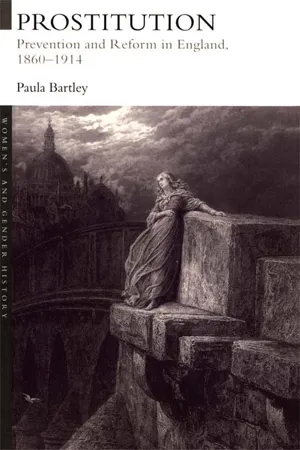
Prostitution: Prevention and Reform in England, 1860-1914 is the first comprehensive overview of attempts to eradicate prostitution from English society, including discussion of early attempts at reform and prevention through to the campaigns of the social purists.
Prostitution looks in depth at the various reform institutions which were set up to house prostitutes, analysing the motives of the reformers as well as daily life within these penitentiaries.
This indispensable book reveals:
* reformers' attitudes towards prostitutes and prostitution * daily life inside reform institutions
* attempts at moral education
* developments in moral health theories
* influence of eugenics
* attempts at suppressing prostitution.
- 248 pages
- English
- ePUB (mobile friendly)
- Available on iOS & Android
eBook - ePub
About this book
Part I
From sinners to Cinderellas
The reform of prostitutes
1 Reform institutions
Prostitution, it was believed, would be eliminated if there were no prostitutes. Reformers therefore founded a variety of institutions, ranging from large penitentiaries and asylums to smaller homes, to rehabilitate prostitutes and make them respectable once more. These establishments can be considered part of a Christian ‘archipelago’ of reform which stretched all over England:1 most cities and large towns had at least one institution dedicated to the reform of female prostitutes. Men, who used prostitutes or were prostitutes themselves, were never singled out in this way. It is the concern of this chapter to show that although the penitentiary system of reform was favoured in late-eighteenth- and early-nineteenth-century England there was an increasing diversification of institutions from the midnineteenth century onwards as a result of the establishment of several sisterhoods, an Evangelical revival and the development of the women's movement. Nevertheless, it will be argued that these institutions shared much in common. Reform was entirely about working-class women being saved by their middle-class ‘superiors’ since it was generally working-class women who were sought out, stigmatised and ultimately rescued by women and men who had the time, money, social connections and the desire or conscience to achieve this. Chapter 1 examines the various types of reform institutions, their belief systems and their entrance procedures while Chapter 2 focuses on the daily lives of the inmates incarcerated within them.
Types of reform institutions
Unquestionably, reformers believed that there were distinct differences between the institutions they founded: they called them particular names, created various management structures and built different sized institutions. The first method of reform, the penitentiary system, was the hallmark of both the established Church of England and the Roman Catholic Church. The earliest penitentiary, the Magdalen Hospital, was opened in Whitechapel, London, in 1758. Its ‘success’—alongside developments in social welfare policies—led to the establishment of other institutions, particularly in the first two decades of the nineteenth century.2 The mid-nineteenth century witnessed a further increase in the numbers of penitentiaries as a result of the formation of the Church Penitentiary Association (CPA)3 and, inspired by the Oxford Movement, the establishment of several sisterhoods devoted to the rescue and reform of prostitutes.4 By 1885 there were said to be fifty-three penitentiaries connected with the Church of England. However, this estimated number is probably low,5 since only the ones which sent in returns to the official journal of the Church of England reform movement, Seeking and Saving, were included. By the end of the nineteenth century, there were also thirteen Roman Catholic institutions for the reformation of upwards of 886 women.6
Historians, on the whole, have tended to focus on the penitentiary system of reform,7 but the Evangelical Church of England religious revival of the mid-nineteenth century provided a new impetus for reform work. Evangelicals advocated an alternative system of reform and tried to establish a family home system rather than a penitential one. The leading Evangelical Tory, Lord Shaftesbury, was patron of the first society, named the London Female Dormitory, which founded its first home in Camden Town, London, in 1850.8 Others swiftly followed.9 Evangelicals formed their own co-ordinating society in 1856, the Reformatory and Refuge Union, but this body dealt more with prevention than with reform, targeting young women perceived to be in moral danger rather than those who had ‘fallen’. By 1908 the Reformatory and Refuge Union was managing approximately 320 Magdalen Institutions. The Salvation Army, the Church Army and the Jewish Ladies’ Association, possibly influenced by their opposition to the Contagious Diseases Acts, also set up their own institutions. Mrs Catherine Booth opened the first English Salvation Army home in Whitechapel, East London, in 1884 and several small homes were founded subsequently elsewhere. The Jewish Ladies’ Association set up a rescue home for young Jewish girls in Shepherd's Bush in 1885, which was thought to be the only one of its kind in Britain.10
Not all institutions were connected so formally with religious organisations. Lock hospitals11 and hospitals with lock wards12 tried to reform unmarried female patients being treated for venereal disease.13 The Metropolitan Police and Cambridge Undergraduates founded reform institutions within their locality.14 Individuals, famous and otherwise, set up their own establishments or looked after prostitutes privately: Josephine Butler brought ailing prostitutes back to her home; Angela Burdett-Coutts provided the money for Charles Dickens to supervise Urania Cottage; Adeline, Duchess of Bedford founded and helped manage her own institution.15 Even the Prime Minister, William Gladstone, was a fervent rescuer of prostitutes. Many other, much less famous, individuals set up their own small, privately managed homes too.16 By the end of the nineteenth century, women, working in all kinds of institutional settings, met once a year at the National Union of Women Workers’ (NUWW) Rescue Work Conference to discuss strategies and compare practice.
Not surprisingly, given the varied nature of reform institutions, there were several different managerial structures but all, without question, were managed by the upper or middle class. There were three main methods of running reform institutions: some were managed by men who employed female workers as matrons and laundry workers;17 some were managed jointly by men and women; some were managed by women only. By the end of the nineteenth century, men-only-managed institutions were criticised:
This work among fallen women is distinctly women's work... I do not believe that this work among women can or ought to be done by men; not only is it contrary to our own sense of modesty and refinement that men should engage in it, but those most experienced know well that to these over-excited and wrongly-directed natures the very fact of being the subject of kindly interest to a man is in itself disturbing and prejudicial.18
Institutions set up by the Church of England tended to be governed by a mixture of clergy and lay men and women. Men remained in overall charge, acting as managing directors and public relations officers, representing the institution at annual meetings, writing the annual reports, administering the finances and talking to the press. The CPA, the co-ordinating body of the penitential movement, was certainly male dominated. The Archbishops of York and Canterbury were joint presidents with approximately twentyeight other bishops acting as vice-presidents. The CPA might have stated that it did not interfere with the internal management of their institutions but in practice it maintained a powerful presence. All institutions remained under the spiritual guidance of the Church of England, which gave grants to the institutions they favoured,19 and encouraged the bishopric to take an active role in the reform work of their diocese. Moreover each institution had a bishop as titular head: for example, the Archbishop of Canterbury was nominally president of the Dartford Penitentiary. Women, on the other hand, acted as middle managers, supervising the internal affairs of the establishment, purchasing the necessary articles and goods, superintending the employment, diet and dress of the inmates, and organising any leisure activities. At the Manchester and Salford Asylum for Female Penitents, as in many others, female committee members visited the institution daily, talked to all the inmates, inspected every department and entered their daily reports in an official book. As a rule, the CPA preferred nuns to run institutions, not only because they devoted their entire lives to the cause, but also because it was felt that none were so fit to redeem the prostitute than the ‘unfallen, upright, pure sisterhood’ who were without moral blemish.20 Susan Mumm suggests that ordinary women, who were either married or who were expected to marry, were thought unsuited to reform work because it might decrease their respect for men and thus undermine marital harmony.21 Nuns, generally recruited from the higher ranks of society, were thought more capable (because of their education and ‘habits of self-command’) of exercising authority than paid workers who were usually from an ‘inferior’ class.22 Of course, nuns, like paid workers from other institutions, still came under the authority of male clergy.
In female-managed institutions, which were not linked to religious foundations, women were responsible for both the public and the private work involved in running them and thus were not answerable directly to any man. From such work many female reformers—like Josephine Butler and the Duchess of Bedford—gained experience in public speaking, expertise in running organisations, a measure of financial acumen, administrative, marketing and social welfare skills. They attended regular committee meetings to discuss policy and practice, organised and spoke at annual meetings, collected and managed subscriptions and spent time in the homes that they had set up dispensing advice.
Not surprisingly, given the great diversity between institutions, there was a degree of rivalry within the reform movement, as each believed that their particular system was the most appropriate.23 Women who founded their own establishments thought that institutions managed by nuns were inadequate.24 One of the chief critics of the convent system, Ellice Hopkins, complained that
the fundamental principle of a sisterhood being life in community, and that of the Cottage Home being family life. I question the domestic character of Sisters...especially when their tastes have led them to adopt a dress borrowed from the dead-house to represent joyous consecration to God.25
In response, homes run by individual women were criticised by the Church Penitentiary Association because they were free from official constraints and were not sufficiently disciplined or controlled. This, it was believed, led to gross negligence and sometimes corruption. In the case of Miss Stride, who managed a number of homes in Tottenham, London, this criticism was perhaps warranted. After enduring a libellous attack by an anonymous member of the Charity Organisation, Miss Stride was accused of gross financial mismanagement a...
Table of contents
- Cover Page
- Half Title page
- Title Page
- Copyright Page
- Dedication
- Contents
- List of figures
- Acknowledgements
- Introduction
- Part I From sinners to Cinderellas The reform of prostitutes
- Part II Prevention is better than cure Ladies' Associations for the Care of Friendless Girls
- Part III The making of the mentally deficient Prostitution and the ‘feeble-minded'
- Part IV Purifying the nation
- Appendix: major laws concerning prostitution
- Bibliography
- Index
Trusted by 375,005 students
Access to over 1.5 million titles for a fair monthly price.
Study more efficiently using our study tools.
Frequently asked questions
Yes, you can cancel anytime from the Subscription tab in your account settings on the Perlego website. Your subscription will stay active until the end of your current billing period. Learn how to cancel your subscription
No, books cannot be downloaded as external files, such as PDFs, for use outside of Perlego. However, you can download books within the Perlego app for offline reading on mobile or tablet. Learn how to download books offline
Perlego offers two plans: Essential and Complete
- Essential is ideal for learners and professionals who enjoy exploring a wide range of subjects. Access the Essential Library with 800,000+ trusted titles and best-sellers across business, personal growth, and the humanities. Includes unlimited reading time and Standard Read Aloud voice.
- Complete: Perfect for advanced learners and researchers needing full, unrestricted access. Unlock 1.5M+ books across hundreds of subjects, including academic and specialized titles. The Complete Plan also includes advanced features like Premium Read Aloud and Research Assistant.
We are an online textbook subscription service, where you can get access to an entire online library for less than the price of a single book per month. With over 1.5 million books across 990+ topics, we’ve got you covered! Learn about our mission
Look out for the read-aloud symbol on your next book to see if you can listen to it. The read-aloud tool reads text aloud for you, highlighting the text as it is being read. You can pause it, speed it up and slow it down. Learn more about Read Aloud
Yes! You can use the Perlego app on both iOS and Android devices to read anytime, anywhere — even offline. Perfect for commutes or when you’re on the go.
Please note we cannot support devices running on iOS 13 and Android 7 or earlier. Learn more about using the app
Please note we cannot support devices running on iOS 13 and Android 7 or earlier. Learn more about using the app
Yes, you can access Prostitution by Dr Paula Bartley,Paula Bartley in PDF and/or ePUB format, as well as other popular books in History & Modern British History. We have over 1.5 million books available in our catalogue for you to explore.