Class Struggle and the Industrial Revolution represents both a continuation of, and a stark contrast to, the impressive tradition of social history which has grown up in Britain in the last two decades. Its use of sophisticated quantitative techniques for the dissection of urban social structures will serve as a model for subsequent research workers. This work examines the impact of industrialization on the social development of the cotton manufacturing town of Oldham from 1790-1860; in particular how the experience of industrial capitalism aided the formation of a coherent organized mass class consciousness capable by 1830 of controlling all the vital organs of local government in the town. This will be a useful study to any student of the industrial revolution.
eBook - ePub
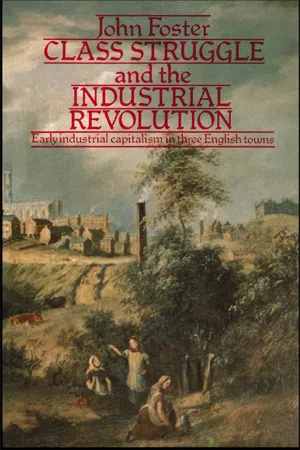
Class Struggle and the Industrial Revolution
Early Industrial Capitalism in Three English Towns
- 368 pages
- English
- ePUB (mobile friendly)
- Available on iOS & Android
eBook - ePub
Class Struggle and the Industrial Revolution
Early Industrial Capitalism in Three English Towns
About this book
Information
1 Introduction
In many ways this study is experimental. Its subject is the labour movement in three nineteenth-century towns: Northampton, South Shields and (above all) Oldham. Its central theme is the development and decline of a revolutionary class consciousness in the second quarter of the century. But its basic aim goes beyond this: to further our understanding of how industrial capitalism developed as a whole.
It is this overall aspect that supplies the main problem with which the book is concerned, namely the nature of the change which English capitalism underwent in the middle years of the last century. Many terms have been used to describe it. It has been made to represent ‘liberalization’, the achievement of mass citizenship, the arrival of a mature industrial society. And from another viewpoint the coming of social imperialism, the emergence of a labour aristocracy and a decisive shift within the economy from the export of commodities to the export of capital. But, whatever the terms, two things are certain: that a critical change did occur in the structure of English society in the middle years of the century; and that until recently there has been pitifully little serious investigation of why it should have occurred when it did—or even why it should have occurred at all.
This study tackles the problem from the perspective of three industrial towns. The towns were chosen because of their contrasting forms of economic organization, each representing a distinct form and phase of the country’s development. Oldham, the central town of the study, developed in the Pennine heartland of the industrial revolution, and its growth was closely associated with that of the cotton industry. Politically, it had a continuing history of radical activity from the 1790s to 1848. It was one of those areas where the United Englishmen had a mass base in the 1800s and during the guerilla campaign of 1812 it was the scene of a two-day battle between armed workers and troops. Throughout the second quarter of the century the town was more or less permanently under the control of the organized working class; much of its local government was subordinated to the trade unions, the new poor law was unenforced for well over a decade, and radicals like Cobbett and Fielden were elected as MPS. This situation did not change much until the end of the 1840s when the town moved remarkably quickly towards class collaboration and a ‘labour aristocracy’ type of social structure.
Northampton only became an industrial town as a result of the crisis of rural depopulation in the 1820s and 1830s. Its new grants, forced out of the surrounding villages, became a source of cheap labour for the shoe industry and in terms of outright poverty the town probably had few equals in the country. Politically, it combined a vigorous surface radicalism with a rather sickly and underdeveloped working-class movement. As the first industrial town on the route north from London, it received a fair share of political refugees and was a regular stopping place for London’s radical orators and journalists. Later in the century it also became the first town in the country to elect an avowedly atheist MP. On the other hand, industrially the great bulk of its labour force remained unorganized until at least the middle of the century and there was never any intervention in local politics of the the kind found in Oldham.
South Shields at least possessed a labour movement worthy of the name. As a Tyneside port town, it formed a meeting point for two naturally militant industries, mining and shipping, and possessed a labour force in close contact with London (the main destination of Shields colliers). Economically, it moved from high prosperity during the Napoleonic Wars to almost continual depression during the second quarter of the century. And although in the early years one finds local politics reflecting events like the Nore Mutiny quite strongly, the town’s labour force later became (despite its organization) increasingly non-radical and collaborationist.
These are the towns which supply the basic raw material for this study. and also—by the contrasts and contradictions in their experience —pose at least a portion of the questions that it will be concerned to answer. However, of the questions asked, the bulk must come from outside the orbit of the towns themselves and to this extent the study is experimental. In working from local material there are two levels of incompleteness which have to be taken into account. There is that of the individual ‘community’—never much more than an arbitary geographical bite out of a larger political system. And there is that of the system itself—seen statically at a particular moment in time. If adequate questions are to be directed at the material (and its full social significance grasped) both these levels of incompleteness have to be overcome.
The problem of ‘liberalization’ is an attempt to tackle the first (to relate community to political system) and is itself a typical example of how a process cutting across a number of areas—central government, economy, the local community—tends to escape systematic investigation. Obviously no study, local or otherwise, can provide any agreed summary of what happened at the ‘national’ level as a basis for research elsewhere. But it can at least project into it the main areas of controversy and this is what the following chapters will attempt to do.
As far as liberalization is concerned, the great question is whether it can be seen as a process at all. Many would claim that the developments assembled under this heading are quite unconnected. What we will be trying to establish here is the reverse: that liberalization was in fact a collective ruling-class response to a social system in crisis and integrally related to a preceding period of working-class consciousness. And while much of this cannot be tested at local level, there are other parts (like the existence of class consciousness itself and the deliberateness of subsequent attempts to develop an adequate reply) that can be tested there and nowhere else.
However, even this only takes us a certain distance. The second level of incompleteness—that of the system itself seen statically—is still unaccounted for, and though this level is undoubtedly more contentious it is also perhaps the most crucial. If basic social change did occur, what really needs to be settled is its precise significance in the overall development of capitalist society; the place of the forms of social structure it produced in relation to those that came before and after. In many ways it is this—rather than the mere establishment of liberalization—that would seem to be the most important task confronting a study of this kind, and dealing with it demands some discussion of capitalism as a system seen in its historical completion.
Most of those who have concerned themselves with this (and they start with Marx) would see capitalism’s social development as being determined by people’s response to it as a class system. It is the struggle against its class nature that helps drive the system forward and (on occasion) overthrows it. It is the response to the alienation it embodies that also (on occasion) helps sustain it. And it is finally the interplay of both with the underlying dimension of economic change which produces the system’s characteristic pattern of development. The way in which this takes place provides-in its detailed working—much of the perspective we are looking for.
To start with the response to alienation. Alienation occurs in any system of society which denies part of its population equal control over social development—a denial which ‘alienates’ their full humanity as social beings. Under capitalism this alienation takes place in the process of production. By having to sell their labour, the bulk of the population loses control over the use to which it is put, a loss most immediately expressed in the unequal wage they get in return. It is the usual (passive) response to this ‘alienation’ which produces capitalism’s typically fragmented social structure. In order to recreate the conditions for a meaningful ‘social’ existence—to establish apparent control over what society produces—people tend to limit their social contacts to those possessing roughly the same purchasing power as themselves. The result is a series of sectional groupings which—by possessing an approximate equality of consumption—serve to cancel out the most immediate expression of people’s larger social irrelevance and, within these limits, allow them to find some measure of social fulfilment.
That is the explanation put forward for the usual form of capitalism’s social structure: a method of restricting contact and comparison which provides a context for maintaining the appearance of real social participation. What is more difficult to explain is the content of the cultures that result: the great variety of sectional ‘false consciousnesses’ which—by insulating one section of the labour force from another— effectively block the development of any collective class consciousness.
On this level there is a good deal of disagreement. Some people would explain such false consciousness as purely and simply the result of bourgeois manipulation. Others would make the process considerably more complicated (and it is this line that is followed here). Obviously there can be no pretence that false consciousness does not work in favour of the ruling class. Clearly the particular cultural patterns—or codes of social recognition and rejection—developed by each grouping play a key part in filtering out disruptive contacts from society at large. And as their basic purpose is to obscure the reality of exploitation, they must also stand in fairly explicit opposition to any group that attempts to do the reverse. Indeed, more than this: because the whole process is based upon an unequal valuation of people’s worth (as well as upon the more open definition of one group against the other) it also offers a ready channel for the penetration of ruling-class attitudes and controls.
In most situations, therefore, false consciousness undoubtedly does serve as a major prop to capitalist stability. Yet it is also more than this, and certainly cannot be seen as solely the product of bourgeois manipulation. Such an interpretation would fail even at the elementary level of explaining the great variety of sectional cultures. Worse still, it would also make nonsense of the whole process of capitalist social change. Were the bourgeoisie able to determine exactly what labour ought to believe, it would also be free to turn the clock back historically —free to ignore the ‘legitimate’ rights and standards already won. And this it is manifestly unable to do (at least without upsetting the whole structure).
It is here that we come to the most immediately relevant aspect of the whole argument: the fact that false consciousness is essentially historical. The patterns of culture that define any group’s identity are not arbitrary but concrete, based upon particular historically determined levels of consumption. And the job of maintaining and defending this identity is clearly integral to the structure of any particular grouping. It cannot be imposed from outside. To maintain itself in a technologically changing society, a subgroup has to be able to both accept and reject. And within most it is possible to identify two distinct groupings (or ‘poles’) of leaders: one trying to open it up to developments in society at large (and especially to the rapidly changing occupational and cultural demands put upon it); the other—mediating at a more intense level— defending its traditional identity and particularly the objective rights and standards used to define it against others.
As a result each subgroup’s identity is fairly irrevocably geared into the larger sequence of historical change. And it is the same internal tension that also makes it so dangerous for the bourgeoisie to put the clock back. Any such attack disrupts the vital network by which group leaderships both maintain their own authority and act (as they usually do in some institutional way) as go-betweens and message boys for the establishment. If, therefore, the system’s economic contradictions force the ruling class to ask too much of these men—to countenance attacks on existing expectations and identities—then it runs the risk of forcing at least part of them into opposition. In these circumstances opponents of the system itself get the chance to take up their defence and, if the struggle goes on long enough, may even be able to merge sectional identities into a collective class identity developed around slogans incompatible with the existing order.
Hence false consciousness—while the antithesis of class consciousness—does contain within it (as a kind of historical ratchet stop) the crucial trigger capable of upsetting the whole system. And once this deeper organic crisis has occurred, once irreconcilably anti-capitalist ideas have been injected into it, there can be only two possible outcomes. Either the system is successfully overthrown or, if the old order is to survive, its whole political economy must be fundamentally modified—modified so that it can meet enough of the new demands to win back at least certain sections of the labour force. If this can be done, political stability may be restored (and new sectional identities developed), but at a higher level and around still more demanding expectations.
It is, therefore, this complex interplay between capitalism’s underlying economic contradictions and these two forms of social response that determines the system’s characteristically uneven, but usually progressive, pattern of development. In addition, however (and more immediately to the point), the essentially historical nature of the perspective that emerges ought also to have put a much sharper focus on the basic objects of this study. Above all, it should have underlined the importance of the specific. If the content of mass culture (and the effective form of any answering class ideology) necessarily change from one period to another, it is correspondingly futile to concentrate exclusively on establishing neat, all-embracing generalizations about the nature of ‘class consciousness’ or ‘restabilization’. Not that there will not be very important basic continuities. But the really vital task is rather the other way about: to chart the concrete, developing human potential—the actual process of humanity’s social self-creation—to which both changes and continuities relate.
It is from this angle that the potential richness of the material from the three towns finally becomes apparent.
As well as the overall process of liberalization itself, there were in the years between 1790 and 1860 three major (and unique) changes in English social structure. At the beginning of the century there was the development of what one might call ‘labour con sciousness’. As a result of the economic crises of the war years, one gets—for the very first time it seems—a major rupturing of capitalist authority systems and the continuing involvement of a large part of the labour force in economic struggle. Then, following renewed economic crises in the 1830s and 1840s, this ‘labour consciousness’ seems to have been converted (at least in certain areas) into a form of class consciousness sufficiently convincing for Marx and Engels to use it as a basis for their own political analysis. Finally, in the late 1840s and 1850s—and as part of the fundamental modification of the socio-economic system here called liberalization—one can trace the crystallization of an altogether new pattern of social subdivision within the labour force, a pattern which is of importance not just because it survived so long (in many cases until the First World War) but also because it provides a uniquely clear example of authority systems being rebuilt more or less from scratch around new sectional cultures.
It will be the precise content of these changes that will form our principal concern in what follows. Of the three towns, most attention will be focused on Oldham, the only one to go through all the stages mentioned. But comparison with the other two is also essential. Only by comparison—by a preliminary attempt to establish causes and connections—can one distinguish what is accidental and what essential, and while the scale on which this can be done is quite inadequate, the results will at least contribute to the growing body of work on which others can build.
The study will begin with an attempt to place Oldham within an overall perspective of capitalist development in England, so helping to break down the arbitrary incompleteness mentioned earlier. In particular, this opening chapter will examine the origin of those two key periods of crisis in which the ruling class was forced to attack labour’s existing rights and standards. This will be followed by a description of how the first of these attacks helped produce a labour consciousness. The two central chapters will be concerned with class consciousness. These will use material from all three towns to develop an explanation of Oldham’s exceptional militancy and define its specific characteristics as class consciousness. Finally, the two concluding chapters will focus on the process of liberalization itself.
2
Industrialization and society
The operative weavers…might truly be said to be placed in a higher state of ‘wealth, peace and godliness’ than they had ever before experienced…the men each had a watch in their pocket and the women dressed to their fancy…. When they [the weavers] brought their work in a sort of familiarity continued to exist between us which in those days was the case between all masters and men (Radcliffe, an ex-handloom weaver employer, writing in 1826 about the early 1790s). The relentless cruelty exercised by the fustian masters upon the poor weavers is such that it is unparalleled in the annals of cruelty, tyranny and oppression for it is a near impossibility for weavers to earn the common necessaries for life…(an Oldham handloom weaver writing in his diary for 11 August 1793).1
This chapter has two main tasks. One is to supply an outline perspective of capitalist development which can serve as a background for the rest of the study, and especially for understanding the economic origins of the two critical periods of conflict that occurred first in the 1790s and 1800s and then again in the 1830s. The other is to examine the detailed impact of the first of these periods in Oldham. This should help both to identify the structure of the labour community at the beginning of our period and pave the way for an analysis of the second, far more crucial, onslaught in the years after 1830.
The industrial revolution
In tackling capitalism’s larger development it might be useful to start with the focus very close, namely on Oldham during the first years of factory-building in the 1780s and 1790s. We begin here not because this period marked any decisive change in social organization, but to dispose of claims that it did, claims which dangerously telescope England’s very long road to fully fledged industrial capitalism and consequently obscure precisely those changes we are looking for.
Oldham stood in the classic heartland of England’s cotton-based industrial revolution. It was situated, like the other early cotton towns, in the coal-bearing Pennine foothills and lay across one of the main routes between Lancashire and the ports and towns of Yorkshire. While its experience was undoubtedly different from that of the great mercantile centres of Liverpool and Manchester (or of the industry’s outlying areas in Derby, Nottingham and Yorkshire), it seems to have be...
Table of contents
- Cover Page
- Title Page
- Copyright Page
- List of Figures
- Abbreviations
- List of Tables
- Foreword
- 1: Introduction
- 2: Industrialization and Society
- 3: Labour and State Power
- 4: Economics of Class Consciousness
- 5: Class Struggle and Social Structure
- 6: Crisis of the Bourgeoisie
- 7: Liberalization
- 8: Postscript
- Appendix 1: Poverty
- Appendix 2: Marriage and Neighbouring
- Appendix 3: Sources on the Oldham Bourgeosie
- Notes
- Bibliography
Trusted by 375,005 students
Access to over 1.5 million titles for a fair monthly price.
Study more efficiently using our study tools.
Frequently asked questions
Yes, you can cancel anytime from the Subscription tab in your account settings on the Perlego website. Your subscription will stay active until the end of your current billing period. Learn how to cancel your subscription
No, books cannot be downloaded as external files, such as PDFs, for use outside of Perlego. However, you can download books within the Perlego app for offline reading on mobile or tablet. Learn how to download books offline
Perlego offers two plans: Essential and Complete
- Essential is ideal for learners and professionals who enjoy exploring a wide range of subjects. Access the Essential Library with 800,000+ trusted titles and best-sellers across business, personal growth, and the humanities. Includes unlimited reading time and Standard Read Aloud voice.
- Complete: Perfect for advanced learners and researchers needing full, unrestricted access. Unlock 1.5M+ books across hundreds of subjects, including academic and specialized titles. The Complete Plan also includes advanced features like Premium Read Aloud and Research Assistant.
We are an online textbook subscription service, where you can get access to an entire online library for less than the price of a single book per month. With over 1.5 million books across 990+ topics, we’ve got you covered! Learn about our mission
Look out for the read-aloud symbol on your next book to see if you can listen to it. The read-aloud tool reads text aloud for you, highlighting the text as it is being read. You can pause it, speed it up and slow it down. Learn more about Read Aloud
Yes! You can use the Perlego app on both iOS and Android devices to read anytime, anywhere — even offline. Perfect for commutes or when you’re on the go.
Please note we cannot support devices running on iOS 13 and Android 7 or earlier. Learn more about using the app
Please note we cannot support devices running on iOS 13 and Android 7 or earlier. Learn more about using the app
Yes, you can access Class Struggle and the Industrial Revolution by John Foster in PDF and/or ePUB format, as well as other popular books in History & British History. We have over 1.5 million books available in our catalogue for you to explore.