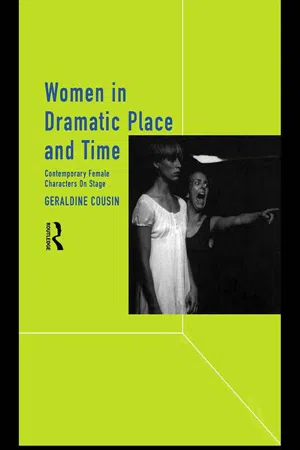
eBook - ePub
Women in Dramatic Place and Time
Contemporary Female Characters on Stage
- 224 pages
- English
- ePUB (mobile friendly)
- Available on iOS & Android
eBook - ePub
About this book
Presents detailed analysis of a wide range of plays by British women dramatists from the last two decades. It will be invaluable reading for students of contemporary British theatre, literature and Women's Studies.
Information
1
WILDERNESSES RECLAIMED
THE CAVE
The setting for Rona Munro’s 1985 play, Piper’s Cave, is based, as is the setting in Granite, on an actual place, in this case the remote tip of the Mull of Kintyre on the west coast of Scotland. The stage area is divided into two, one half representing the inside of a cave, the other the shore in front of it. The time is summer and, at the commencement of the action, as in Granite, a storm is raging. The three characters, Jo, Alisdair and Helen, are on stage from the beginning. Jo, who is in her early twenties, wears clothes suitable for hill-walking. Alisdair is in his ‘mid thirties [but] looks older’. He ‘wears black shabby clothes he’s slept in a lot’. Helen is described in the cast list as ‘the place, the landscape’(Munro 1986:110). At the beginning of the play Helen is standing centre stage, with Jo on her ‘shore side’ and ‘Alisdair on the cave side’. The two of them are watching Helen as she sways gently backwards and forwards, sucking in her breath and blowing it out again ‘in the same rhythm as her swaying—the sound of waves’ (ibid.: 111). Jo speaks first. Though she has never visited this part of the country before, it seems familiar. Every time she rounds a headland, she recognises what she sees. The previous night, whilst she was boiling a pan on a fire she had built, she watched a group of seals, playing and singing in the water, and the wind blew the flames so that her face ran with ‘smoky tears and soot’ (ibid.) and her eyes became black and smudged like those of the seals. The sound of the seals’ singing made her cry, because, like the place, it reminded her of something, somewhere she’d been before.
To Alisdair, too, the place is somehow familiar. It reminds him of a sound (like the sea) he heard in his head when, dizzy with food and alcohol, he stumbled through the maze of city streets, and also of a mental picture that accompanied the sound: a huge black shape that grew and grew until it devoured the sky. In their turn, the sound and picture evoke earlier sensations of a time ‘before anything happened’ (ibid.), prior to the existence of memory, when the sea-sound in his head was all there was. Alisdair has made himself a home of sorts in the cave that is the play’s setting and title. Though he knows very little about the cave (including its geographical location), he is certain of two seemingly paradoxical things: it is a source of terror, like the black shape that engulfed the sky, and it is his. This is ‘my place’ he tells Jo (ibid: 112, original emphasis).
As I indicated in the Prologue, Piper’s Cave has elements in common with Granite. Though clearly not as the result of a deliberate intention on the author’s part, the later play in a number of ways reworks the earlier one. Partly, this is because Rona Munro effectively rewrites the relationship between man, woman and place that Clemence Dane establishes in Granite. In Granite, Jordan defines Judith’s place as being with him, and his own place as being the Lundy farm: ‘a woman goes with her man, and a man goes with his land’ (Dane 1949:4). At the end of the play The Man steps into dead Jordan’s shoes, Lundy becomes his place and Judith his woman. Except as his chattel, his thing, Judith has no place. In Piper’s Cave, by contrast, though Alisdair claims the place as his, it is Jo who grasps its real nature. From the beginning Jo is a map-reader, first a literal one in that she names the cave and gives its precise geographical position, and then, by the end of the play, a skilled interpreter of the imaginative and ideological mindscapes of which the cave is the physical representation. At the end of Piper’s Cave it is not the woman who is a prisoner, as in Granite, but the man. Gender roles are not simply reversed, however. What confines Alisdair is not Jo but his own construction of the cave as both a source of primitive terror and the place that he is determined to own, even though it is the ‘last place in the world’ (Munro 1986:131).
The ‘maps’ by means of which Jo comes to understand the inner significance of the play’s setting—and to discover at the same time a topography of self—are primarily four stories: three legendary tales and an autobiographical story that I have called ‘The Naming’. The play’s major storyteller is Helen. It is Helen who acts as Jo’s guide along the pathways of narrative. In Granite Judith has no control over any aspect of her life. She owns nothing, not even her soul or her anger. Even the story of the devil-man who came out of the sea, which she tries to appropriate for her own purposes, turns to dust in her hands. The narrative which is at the heart of Granite is understood fully by Judith, and the audience, only at the moment of its completion, though all its elements were present from the beginning. It is a story manipulated and controlled by The Man, its subject matter the enslavement of the woman. The four interlinked stories in Piper’s Cave also depict relationships between a man and a woman (or male and female as in The Creation Story), but in this play it is the man who is imprisoned—within life-denying behavioural codes. For Jo, the stories together create a densely textured, allusive web upon which is written a haunting and deeply moving evocation of the possibility of transformation.
Four stories: (1) The Piper and the Cave (the first version)
This story is narrated twice in the play, the first time by Jo and the second time by Helen. Jo’s version concentrates primarily on how the cave got its name. There was ‘this guy’, she explains, who believed that ‘he was the greatest thing that ever blew down a chanter’. He thought that he could make better music than ‘anything in this world, or the next, anything above ground or below it…and he walked into that hill playing his pipes to prove it.’ But ‘the hill swallowed him up’, and it is said that he can still be heard playing, cursing and shouting as he goes round and round in the hillside, ‘forever trying to find a way out’ (ibid.: 118–19).
In the course of the play, Alisdair tells a number of stories about his previous life. In one version he is a paratrooper, in another a member of the crew of a nuclear submarine, or, alternatively, a worker on an oil rig or in a slaughter house. Eventually, he identifies himself with the piper whose music ‘Made the whole…fucking…world…dance’ (ibid.: 139). Unlike the piper, however, Alisdair is afraid to enter the cave fully. He inhabits a limbo space at the cave’s mouth, from which he is terrified to move in or out. All around him, he believes, is a destructive power which he identifies as female. Outside the cave is the realm of death. The beach is littered with wrecks of ships, and, on the hillside, there are the carcasses of planes that lost their way in the fog. All these ‘dead’ things are ‘toys’ that ‘she’ has gnawed and then spat out, and Alisdair is determined to remain where he is, so she can’t get her teeth into him. The innermost part of the cave is also a source of terror to him, for he genders and personifies this place exactly as he does the outer world beyond the cave, giving to each the same attributes. Physically weakened by alcohol and malnutrition, the helpless prey of a machismo-orientated set of values that have nothing to do with the reality of the options that are available to him, Alisdair is a kind of last man, in this ‘last place’. The most terrifying manifestation of the female monster that, for Alisdair, inhabits both the inner recesses of the cave and the world outside, is the darkness that creeps forward, inch by slow but inevitable inch. Over and over again he scores marks on the walls of the cave, so that he will always be on his guard, and, when the dark reaches his marks, he will ‘get her’. To his horror, however, the darkness instead eventually obliterates his marks, and, panicstricken, he concludes that the cave (as in the picture he saw in his head of the black shape swallowing the sky) is ‘sending the dark out to swallow’ him (ibid.: 130).
In addition to their function of providing him with markers by which to gauge the oncoming dark, Alisdair’s scratchings on the cave wall assert his ownership of the place and furnish him with proof of his existence: ‘Alisdair MacKerral is here. OK?’ (ibid.: 131). An essential component of Alisdair’s terror is his belief that ‘the sooty rain’ of the streets around which he tramped in endless circles has wiped out all trace of his name and voice—as the dark erases his marks on the cave walls. Alisdair has to endlessly make his mark, because he fears that otherwise he is invisible, voiceless, nameless. His only response to what he perceives as a destructive female energy that threatens to swallow him alive, whilst at the same time refusing to recognise his existence, is to tear, gouge, maim, rape, kill—in other words, to mark.
(2) The Creation Story and ‘The Naming’
The Creation Story and ‘The Naming’ explore further the desire to wound, to make one’s mark. Helen narrates The Creation Story in the form of a dream dreamed by Jo. In the dream a figure that is Jo and, at the same time, an elemental female force, lies asleep on a hillside and ‘he’ comes up the hill. He has torn rocks from the ground to make his legs and fashioned his hands and head out of mud, in which he has ‘dug pits’ for his eyes. From his open mouth water gushes. He touches the female and splits her, ‘like roots splitting rocks, water splitting ice’. He tears her limb from limb, and she yells and shows her teeth because she knows that she is stronger than he is. She knows that everywhere her blood falls she is ‘making life’. She is ‘bleeding life…bleeding the world’ (ibid.: 129).
The Creation Story is an account of the origins of life in which male and female energies are inextricably linked in a violence/anger nexus. From this connection the male makes himself while in the process of ripping apart the female, and, out of her mutilation, the female makes the world. ‘The Naming’ story is the creation legend transposed to a modern setting of mean, night-time city streets, with the difference that the primeval violence this depicts now terrorises both the man and the woman, whilst, at the same time, the woman has misplaced the savage anger that characterised the female force in The Creation Story. At the beginning of the play Jo wears a scarf tied around her bare upper arm. A little way into the action Alisdair aggressively pulls the scarf away, revealing a scar roughly shaped like a letter ‘J’. ‘The Naming’ is the story of how Jo got the scar.
Late one night, as Jo was walking home, a man began to follow her, and, though she screamed for help, no-one took any notice. She managed to reach the building where she lived and to lock the door, but the man kicked the door in and pinned her down on the stairs, with his hand on her throat. For a long time he talked, mostly quite normally, telling her details of his life, but, without warning, he would shake her madly, repeating over and over again that he was a killer, he had a killer inside him. He’d just beaten up his girlfriend, and was so petrified by the violence he’d discovered inside himself that he wanted to let it free to terrorise someone else. Then the man did two things. The first was that he took his hand away from Jo’s throat, rested his head on her shoulder and wept, out of his terror at the violence he had already committed, and was likely to commit in the future. The second was that he cut an initial in the flesh of Jo’s arm—he marked her. Jo’s response to his weeping was to touch the back of his head, to comfort him, because she understood a little of his terror. Along with fear and pain and humiliation, her reaction to the mark on her arm was the sense that it negated her, denied her sense of self. The man had not seen her, Jo, an individual woman with characteristic attributes and potentialities, but only a malleable substance on which he could make his mark. He had lost his own sense of self—his identity and name—somewhere within the maelstrom of violence he inhabited and inflicted, and he had written his name on Jo’s flesh so ‘he could find it again’ (ibid..- 134). Later that night, when the man had finally gone away, Jo went into the toilet. She tried to weep, but couldn’t. Instead, she watched as the blood from her wound dripped into the bowl. When Jo reaches this point in her recounting of the assault, Helen repeats the final words of the creation legend, ‘Bleeding the whole world’, then adds, ‘What’s the ‘J’ for?’ But Jo can’t, ‘won’t remember’ (ibid.).
In the two stories the woman/female force assumes a variety of identities: victim, mother, dark Other and the stronger. The bleeding female in the creation legend is the mother of the world. Jo touches the back of the man’s head, comforting him like a mother. In The Creation Story the female transforms her dismemberment into an energy that creates her vividly potent anger along with all forms of life, but in Jo’s memory of the attack she is unable to escape the role of victim. Jo’s remembered self is therefore very different from the Jo of the play who is physically strong and fit, well able to protect herself. When Alisdair threatens her with violence, she responds in kind, at one point, for example, producing from her pocket a clasp knife very similar to the one Alisdair has been flourishing. She is also confident and at ease in the environment that terrifies him. It is the inner terrain, the landscape of her victimhood, that Jo must renegotiate, and part of this involves a confrontation with her own capacity for violence.
At a fundamental level, despite Jo’s dissimilarities from Alisdair, there are ways in which the two resemble each other. Like Alisdair, Jo understands the fear of being nameless, without identity. This is clear not only from her description of her understanding of the source of her assailant’s terror when he marked her, but from other things she says. At one point in the play she almost drowns when she loses her footing and falls into the sea. Afterwards, her hands are so numb with cold that she is unable to feel them. ‘No hands,’ she says, and adds, ‘no body, no face, no Jo. What’s new?’ (ibid.: 127). Her job (stacking ware-house shelves) renders her faceless and nameless, partly, she explains, because the overall she is obliged to wear swallows her up and partly because she is constantly moved around in her huge place of work, an identical unit among many others.
Jo also resembles Alisdair in her capacity for violence: like him, she understands the desire to mark. In a moment of scalding rage towards Alisdair she constantly repeats that she will kill him, whilst at the same time underlining her words by pounding the ground with a rock. Shortly afterwards her anger is directed towards Helen, the representative, for Alisdair, of the female chaos that he fears will unmake him unless he first gouges his mark upon her. Unlike Alisdair, Jo respects and values the natural world, seeing it as characterised by both power and beauty. Throughout the play, however, Jo confuses Helen, the landscape, with the woman with whom she is in love, and this leads to a moment of aggression in which she temporarily replicates Alisdair’s attitude both to the focus of sexual desire and to the environment. As though she is about to stab Helen, Jo raises a stone above her head, and Helen equates this action with the mutilation of the earth: ‘Stabbing it, marking it and the earth sprays up like blood around your hand.’ In a voice suggestive of a ‘small quiet joke’, Jo replies, ‘Christ, Helen…I love you so much I’ve dug a hole in you’ (ibid.: 140).
Jo and Alisdair are linked by their common fear that they could become faceless and nameless, and also by their capacity for violence. What distinguishes them is their differing responses to these shared attributes. Alisdair carries out his desire to mark, whereas Jo does not. In addition, Alisdair constructs a piper self as a form of protection against his terror: Jo’s inner self is scarred by a sense of victimhood. Through her role as storyteller, Helen guides Jo into a different inner landscape, narrating first a fuller version of The Piper and the Cave story, then The Story of the Sealwoman. Following this, she asks Jo once again what the J-shaped scar on her arm is for, and, this time, Jo answers.
(3) Helen’s version of The Piper and the Cave, and The Story of the Sealwoman
Helen’s version of The Piper and the Cave story begins, like Jo’s, with the piper who thought he was ‘the greatest thing that ever blew down a chanter’ (ibid.: 130), but what it then adds is that this belief was correct. The piper could coax music out of everything. For every living thing he could create a voice, but what he failed to see was that he was also a part of everything. Being male and young and ‘thirty feet high in pride’ he wanted ‘to make his mark…to conquer the cave’ (ibid.), and in his blind arrogance he took the two things he loved most with him into the imprisoning darkness: his music and a little mongrel bitch that followed him everywhere. The music was swallowed up along with the piper, but, howling and with all the hair burnt off her back, the dog managed to struggle free.
Like the little mongrel bitch, to which at one point she compares herself, the Jo of ‘The Naming’ story is scarred. In addition to her connection with the little dog, Jo has, however, a seal-self, and it is this part of her being that makes her capable of transformation. In the story that Helen tells of the sealwoman, a hunter desires the sealwoman and steals her skin to force her to stay with him. In an attempt to escape from the hunter, the sealwoman transforms herself, first into a tree, then into a rock. She is part of everything—the earth, water, the piper himself, his bones and his blood—but, because he is unable to see her in these things, the man goes on hunting. Quietly, Jo supplies the end of the story. One morning the sealwoman discovered her skin that the hunter had hidden and she returned to the sea and her seal shape. It is at this point in the play that Helen asks Jo for a second time what the ‘J’ scored on her arm stands for. When Jo answers, claiming that the initial is in fact her own, Helen takes the scarf that Jo has used to cover up the scar, and leaves with it. Now that Jo has become her own storyteller, Helen’s presence is no longer necessary.
By concluding the sealwoman story, Jo shows that she has understood its meaning—the interconnection of all living things. The hunter cannot see this. Like the Piper and Alisdair, he makes his mark by destroying, not realising he is part of what he destroys. The sealwoman is representative of both transformation and rediscovery. She can transform herself into all things because she is all things. For Jo, the sealwoman embodies both reclamation and possibility. In taking back her name, she rescues herself from victimhood and affirms both the self she is now and other future selves.
At the end of the play, alone on stage, Jo compares herself to a seal, floating in salt water, breathing without gills or lungs. She can hear a beating sound, ‘like waves…like a heartbeat’. Sleek and silver, she hangs in the darkness. Someone who might be herself or another sings ‘in a voice that makes you cry…as though it reminded you of something you’ve lost’. The final words of the play are ‘Hanging in the dark, waiting…waiting …That’s all’ (ibid.: 142), and then the lights fade.
The voice that Jo hears is both her own and what Hélène Cixous describes as ‘the oldest, the loveliest Visitation’, the ‘first, nameless love’ that sings within every woman (Cixous and Clément 1986:93). Floating in the warm darkness, Jo hears the breathing that is not hers only, the singing of the ‘nameless love’, that can yet be named as the voice of the mother. Hanging in darkness, Jo waits. The seal represents transformation. Jo will change and grow. Having returned to her place of origin, she will voyage on—into further selves. Through her acquired map-reading and survival skills, Jo has both located the cave and freed it from its destructive burden of imagery. A cave is simply itself, not the site of birth or death, or the lair of the demonic Other. At the same time, we are our origins. We are a part of everything and this knowledge has its source in the half-remembered experience of birth.
For Alisdair there is only the terror of the dark, and his endless futile scratchings on the wall of the cave. Jo offers, if Alisdair will only come out of the cave, to be his guide, and lead him to a place where he can be cared for. Alisdair takes a few steps. He almost comes out, but then he stops. This is his place—all he knows—and here he will stay. ‘Then I can’t help you’, Jo tells him (ibid.: 142), and she leaves him, in the literal darkness of the cave, and the figurative darkness of his own making. Self-exiled to the marginalised wilderness that is the masculine-defined site of the feminine Other, he waits—not joyously, like Jo—but with dread. Unlike the granite island of Lundy, the cave is part of the mainland. No-one keeps Alisdair there—no-one but himself, that is—but he cannot move. In Granite, Judith claims that her ‘tongue’, her voice, is her own, only to discover that The Man has used her words, her voice, for his own ends. In Piper’s Cave, Jo finds her own voice through her understanding of the stories Helen tells. Alisdair’s voice, name and face are obliterated by the darkness he has created, and so over and over again he makes his mark—the only sign that he exists.
THE TARANTELLA
Like A Doll’s House,...
Table of contents
- COVER PAGE
- TITLE PAGE
- COPYRIGHT PAGE
- ACKNOWLEDGEMENTS
- LEY LINES
- PROLOGUE
- 1: WILDERNESSES RECLAIMED
- 2: RELATED SPACES, RELATED LIVES
- 3: TIME-TRAVELLERS AND DISORDERLY WOMEN
- 4: RETELLINGS
- 5: QUESTS FOR MAPS
- 6: CORRESPONDENT WORLDS: ENCOUNTERS WITH FAIRIES AND ANGELS
- RETROSPECTIVE
- END LINES
- BIBLIOGRAPHY
Trusted by 375,005 students
Access to over 1.5 million titles for a fair monthly price.
Study more efficiently using our study tools.
Frequently asked questions
Yes, you can cancel anytime from the Subscription tab in your account settings on the Perlego website. Your subscription will stay active until the end of your current billing period. Learn how to cancel your subscription
No, books cannot be downloaded as external files, such as PDFs, for use outside of Perlego. However, you can download books within the Perlego app for offline reading on mobile or tablet. Learn how to download books offline
Perlego offers two plans: Essential and Complete
- Essential is ideal for learners and professionals who enjoy exploring a wide range of subjects. Access the Essential Library with 800,000+ trusted titles and best-sellers across business, personal growth, and the humanities. Includes unlimited reading time and Standard Read Aloud voice.
- Complete: Perfect for advanced learners and researchers needing full, unrestricted access. Unlock 1.5M+ books across hundreds of subjects, including academic and specialized titles. The Complete Plan also includes advanced features like Premium Read Aloud and Research Assistant.
We are an online textbook subscription service, where you can get access to an entire online library for less than the price of a single book per month. With over 1.5 million books across 990+ topics, we’ve got you covered! Learn about our mission
Look out for the read-aloud symbol on your next book to see if you can listen to it. The read-aloud tool reads text aloud for you, highlighting the text as it is being read. You can pause it, speed it up and slow it down. Learn more about Read Aloud
Yes! You can use the Perlego app on both iOS and Android devices to read anytime, anywhere — even offline. Perfect for commutes or when you’re on the go.
Please note we cannot support devices running on iOS 13 and Android 7 or earlier. Learn more about using the app
Please note we cannot support devices running on iOS 13 and Android 7 or earlier. Learn more about using the app
Yes, you can access Women in Dramatic Place and Time by Geraldine Cousin in PDF and/or ePUB format, as well as other popular books in Literature & English Literary Criticism. We have over 1.5 million books available in our catalogue for you to explore.