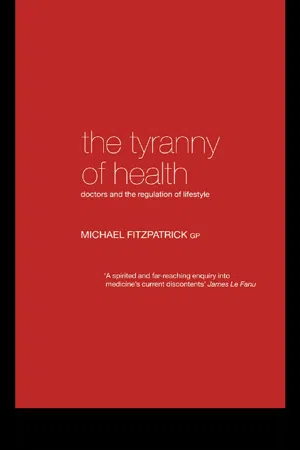
Topical and controversial The Tyranny of Health exposes the dangers of the explosion of health awareness for both patients and doctors, using straightforward language to explain the latest health statistics and research findings. Michael Fitzpatrick, a full-time inner-city GP, argues from his day-to-day experience in the surgery that health propaganda is having a very unhealthy effect on the nation. Patients are made unnecessarily anxious as a result of health scares which have greatly exaggerated the risks of everyday activities such as eating beef, sunbathing and having sex. Doctors no longer seem content with treating disease but are encouraged by the government to tell people how to live more and more aspects of their lives.
Michael Fitzpatrick concludes that doctors should stop trying to make people virtuous. He argues that we need to establish a clear boundary between the worlds of medicine and politics, so that doctors can concentrate on treating the sick - and leave the well alone.
- 208 pages
- English
- ePUB (mobile friendly)
- Available on iOS & Android
eBook - ePub
About this book
Information
1
INTRODUCTION
We live in strange times. People in Western society live longer and healthier lives than ever before. Yet people seem increasingly preoccupied by their health. There is a widespread conviction that the modern Western diet and lifestyle are uniquely unhealthy and are the main causes of the contemporary epidemics of cancer, heart disease and strokes. The fears provoked and sustained by an apparently endless series of health scares, backed up by government and public health campaigns, tend to encourage a sense of individual responsibility for disease. In exploring these trends, this book seeks to advance what to many will seem a counter-intuitive proposition— that the government’s public health policy is really a programme of social control packaged as health promotion. In responding to, and even more by fomenting, increasing public anxiety, the government is seizing the opportunity to introduce a new framework within which people can more comfortably live, so long as they adhere to new rules and accept an unprecedented degree of supervision of their personal lives.
In 1999 the New Labour government in Britain declared its commitment to the promotion of health and the prevention of disease in the White Paper Saving Lives: Our Healthier Nation (DoH 1999). The government set targets by which progress could be measured in reducing rates of heart disease and strokes, accidents, cancers and suicides. The public health White Paper put forward a strategy to link national targets to local initiatives, and it outlined plans to pursue health goals in schools, workplaces and neighbourhoods. It aimed to replace exhortations to behave virtuously (stop smoking, curtail drinking, take exercise, eat healthily, etc., etc.) with an effective system for regulating personal behaviour. In this way the government offered the prospect of a longer life—but at the cost of an even more extensive and intrusive system of state regulation of individual behaviour.
Working as a general practitioner, I am struck by the contrast between two types of patient. I see many young people, usually in professional occupations, who worry about their health, watch their diet and take regular exercise. They also seek regular check-ups and screening tests for various diseases. I also see many old people, often former manual workers, who have never been much concerned about their health and have rarely modified their lifestyles or consulted their doctors with a view to preserving it. If you congratulate them on their longevity, they often say that they only wish they had not lived so long. Sometimes they even request my help in assisting their escape from the misery of loneliness, infirmity and poverty. To the former, government health campaigns are a welcome response to a heightened sense of individual vulnerability to environmental dangers. The popular resonance for appeals for greater health awareness reflects the anxieties and insecurities that particularly afflict the younger and more prosperous sections of society. To an older and less affluent generation, these campaigns simply confirm the shift of the health service, as well as other institutions in society, away from any real concern for their needs.
The positive response to official public health documents, such as Saving Lives and earlier health promotion initiatives, from the medical profession and the media in general, indicates the widespread acceptance of the basic assumptions of these programmes. But, aside from the specific proposals, some questions arise concerning the underlying principles. We can begin by noting a striking paradox: at a time when, by any objective criterion, people enjoy better health than at any time in human history, the government appears driven to ever greater levels of intervention to improve people’s health. Take life expectancy: the commitment to increase it is the first of the ‘aims’ proclaimed by the White Paper. As this is widely taken as self-evident, it receives no justification. But why should this be the ultimate target of medical science, let alone of government policy, least of all at a time when the increasing longevity of the population has become a widely acknowledged social problem? (Mullan 1999). A boy born in Britain today can expect to live until he is nearly 75; a girl until over 80. Life expectancy has increased by more than 30 years over the past century and by around a decade since the Second World War, apparently without the benefit of government-sanctioned measures of health improvement. It is clear that we have not only exceeded the biblical lifespan of ‘three score and ten’ but that more and more of us are reaching closer and closer to the biological limit of the human species.
There is much scientific debate about whether further increase in life expectancy is possible. But is it desirable? For many of my patients, the prospect of prolonging their stay in a world that has little time or respect for them has little appeal. The controversy over euthanasia and the romanticisation of suicide among young men (such as rock stars Kurt Cobain and Michael Hutchence) reflect a deeply pessimistic current in contemporary society. The desire simply to live longer by taking health precautions may be interpreted as another way of responding to the perception that life in modern society lacks meaning and purpose. The promoters of health awareness will object that their emphasis is not so much on ensuring that people live longer as on preventing premature deaths. They will point out that, even though there is an average life expectancy of 75– 80, more than 90,000 people die every year in the UK before the age of 65. Furthermore, some 32,000 of these deaths are from cancer and 25,000 from heart disease and strokes, many of which could have been prevented. In this context, the concept of prevention is abused: death cannot be prevented, only postponed. Unfortunately, given the current state of medical science, death can generally be postponed only for a relatively short time by relatively intensive preventive measures.
In the nineteenth century, public health measures to improve sanitation and housing played a decisive role in curtailing the epidemics of infectious diseases that devastated the urban poor. Over the past two decades, proponents of the ‘new public health’ have emphasised the promotion of a healthy lifestyle as the key strategy to combat the modern epidemics of heart disease and cancer. The central weakness of the new public health is the fact that the scope for significant postponement of death from the major causes of premature mortality by preventive measures is limited, though the costs are often substantial. Thus, for example, the increase in average life expectancy to be gained from a 10 per cent reduction in the level of serum cholesterol in the population at large (a much vaunted target of the 1992 Health of the Nation White Paper, though dropped in the 1999 document) is between 2.5 and 5 months (Bonneux, Barendregt 1994). However, even to achieve this degree of reduction in cholesterol would require either drastic dietary modification or long-term drug treatment (with its attendant side-effects).
Advocates of the new public health will further object that their aim is not only to increase life expectancy, but also to improve the quality of life, to ‘increase the number of years lived free from illness’—in the words of the White Paper. Now it is true that the fact that old people live longer does not necessarily mean that they suffer worse health. However, it is also true that there is a tendency for the prevalence of common chronic degenerative conditions— heart disease, stroke, cancer, osteoarthritis, diabetes, dementia—to increase with age. What is by no means clear is the contribution of the various preventive measures favoured by the government to improving the quality—as distinct from the duration—of people’s lives. Indeed it may well be the case that an old person’s enjoyment of a cigarette, a cream bun and a bottle of Guinness is more important to them than the extra few weeks they might spend in a life of miserable abstinence.
A further aim of government public health policy is to ‘narrow the health gap’ between rich and poor by concentrating its efforts on improving the health of the ‘worst off in society’. Here is another paradox: the government and the medical profession have become more preoccupied with the relationship between inequality and health at a time when social differentials in health are less significant in real terms than ever before. No doubt it is true that people who are better off are healthier and that the poor are sicker. A vast edifice of epidemiological data has been erected in recent years substantiating these differentials in great detail in relation to every disease and health indicator. Yet the simple contrasts between the health gap that exists in Britain today and that between rich and poor in Victorian England, or that which still prevails between Western and Third World countries today, is enough to expose the lack of historical or social perspective of contemporary public health.
Take infant mortality, one of the most intensively studied indices of population health. The persistent gap between the rate of infant deaths among rich and poor has been a particular focus of the new public health since the publication of the Black Report in 1980 (Black 1980; Townsend, Davidson 1992). The 1990 figures reveal that the number of babies whose fathers are classified as ‘unskilled workers’ (social class V) who die in the first year of life is 11.7 per 1000 live births, whereas that among the professions (social class I) is 6.2 per 1000 (OPCS 1992). In other words, the infant mortality rate for the poor is nearly twice that among the rich. While there can be little doubt that the persistence of this differential is a pernicious effect of Britain’s class divided society, it is important to place it in a wider context. The overall rate of infant deaths in 1990 was slightly less than 8, by 1996 it had fallen below 6. At the turn of the century the figure was around 150, by the Second World War it was still above 50; it did not fall below 20 until the 1960s (Halsey 1988) In some Third World countries today, the infant mortality rate remains comparable with that of Britain in the early decades of this century: for example, India—94, Bangladesh—114, Egypt—61, Mali—164 (Gray 1993:11). Infant mortality has fallen dramatically among all social classes in Britain in the course of the twentieth century. In 1922 infant mortality among unskilled workers was 97; for the children of professionals, the rate was 38 (Halsey 1988). Over the past 70 years, the rate has fallen to roughly the same extent — between 80 and 90 per cent—among both the richest and the poorest. The infant mortality rate among the poorest families today is similar to that of the richest in the 1970s.
As new public health statisticians are well aware, it is possible, by carefully choosing your starting point and other manoeuvres, to reveal slight increases or decreases in class differentials in infant mortality. But what all such comparisons of mortality rates obscure is the dramatic decline in the absolute number of infant deaths. In 1990 the total number of babies dying in the first year of life in England and Wales was 3,390; in 1900 the figure was 142,912, in 1940 it was still higher by a factor of ten and in 1970 more than four times greater (OPCS 1990; Halsey 1988). The 1990 figure included 248 deaths among babies of parents in social class I and 243 in social class V (though the total number of babies born in this category was half that of class I). Though infant deaths may be relatively more common in poorer families, they are very uncommon in any section of society. A commonplace event within living memory in Britain, the death of an infant has now become a rarity. Furthermore many of these deaths result from conditions such as prematurity and congenital abnormalities, which are often difficult to prevent or treat, or are ‘cot deaths’, the causes of which are uncertain and preventive measures remain controversial. Again, it seems that the level of government and official medical intervention is out of all proportion to the scale of the problem.
The more closely you examine the new public health the more strange its focus on problems of vanishing significance appears. Yet, despite the limited scope for preventing disease by changing lifestyle, campaigns endorsed by the government and the medical profession to alter individual behaviour have had a major impact on society over the past decade. Nobody capable of watching television can now be in any doubt that smoking cigarettes, drinking alcohol, eating rich food and not taking enough exercise are not good for your health. These basic preoccupations have been supplemented and reinforced by numerous panics about other health dangers from HIV/Aids and BSE/CJD to sunlight, salmonella and listeria.
The expanding range of medical intervention characterised as the medicalisation of life involves two inter-related processes. On the one hand, there is a tendency to expand the definition of disease to include a wide range of social and biological phenomena. Thus, for example, while the inclusion of crime within the medical framework remains controversial, the excessive consumption of alcohol or the use of illicit drugs are now widely accepted as medical problems. So too is obesity, a biological variant which is acknowledged as a disease state: by American National Institutes of Health criteria, some two thirds of adult males are affected. According to some criteria, around two-thirds of the British population suffer from a raised cholesterol level (DoH 1992:56). In a similar way, substantial proportions of the population are arbitrarily designated as having a high blood pressure.
On the other hand, people suffering from this expanded range of disease states are increasingly evaluated in psychological or moral terms. Now that the causes of the old epidemic infectious diseases have largely been discovered and effective treatments developed, they have lost their menace and their mystery. By contrast, the causes of modern epidemics remain obscure and effective cures elusive. Today there is a tendency to believe that people become ill because they want to (as for example in the view that cancer results from ‘stress’ or depression) or because they deserve to (because they smoke or drink too much). While people who succumb to viruses or bacteria are generally regarded as unfortunate and worthy of sympathy, those who get cancer or heart disease are, at least to a degree, held up to blame for their unhealthy lifestyle. Infection with HIV, though a virus, is ideally suited to the prevailing discourse of individual moral culpability because of its major modes of transmission in Britain—through sex, particularly gay sex, and drug abuse.
If disease is the wages of sin in modern Britain, medicine has become a quasi-religious crusade against the old sins of the flesh. The trend for religion to give way to science and for the scientist to take over the role of the priest has been a feature of modern society since the Enlightenment. The success of scientific medicine in the twentieth century has particularly enhanced the social prestige of the medical profession. Yet it seems that the final triumph of doctors as guardians of public morality comes at a time when they are generally incapable of explaining or curing the major contemporary causes of death and disease.
Successive governments have taken up the issue of health as a convenient vehicle for promoting the gospel of individual responsibility in a period of increasing fragmentation and insecurity. From the late 1970s onwards, advocates of the new public health have promoted the World Health Organisation’s definition of health as ‘a state of complete physical, mental and social wellbeing’ to legitimise the expansion of state medical intervention into wider areas of the life of society (MacKenzie 1946). Though given some impetus by the Health of the Nation initiative of the early 1990s, there was always some Conservative reticence about the level of state intervention it demanded. It was not until after the Labour victory in 1997 that the agenda of the new public health could be implemented without restraint.
By the time of the 1998 public health Green Paper, the conception of health put forward by the government seemed to have little to do with disease at all. At the outset it defined good health as ‘the foundation of a good life’ (DoH February 1998:7). This recalls the classical motto, popularised in the Victorian era— ‘a healthy mind in a healthy body’—and establishes a link between physical condition and moral character. It implies that self-discipline and abstinence, the ‘mortification of the flesh’, can improve the quality of life, in a sense by purifying the soul. Even more insidiously and offensively, it also implies that physical impairment or disease either express or entail moral turpitude, a ‘bad’ life.
However, by contrast with the Victorian notion of a link between individual fitness and national efficiency, New Labour’s interest in health is not inspired by any wider social vision. On the contrary, it reflects the outlook of a society which has abandoned any grand project, in which the horizons of the individual have been reduced to their own body:
No matter what goes wrong in life—money, work or relationship problems—good health helps sustain us. How often have we all heard somebody say that although things may not be going well—at least they have their health. Good health is treasured. (DoH February 1998:7–8)
In this homily, health is reduced to a source of consolation for people who have given up on any higher ambition. In a society of low expectations, the goal of human existence is redefined as the quest to prolong its duration.
Once health is linked with virtue, then the regulation of lifestyle in the name of health becomes a mechanism for deterring vice and for disciplining society as a whole. The new government health policies no longer focus on health in the familiar sense of treating illness and disease, but rather encourage a redefinition of health in terms of the ways in which we live our lives. Under cover of the dubious notion that an extended life (at whatever cost to ourselves and to society) is good for us, the government is providing, and even imposing, its version of the good life. This good life is not simply a longer life, but a longer life lived healthily, which is to say, virtuously. This process is nonetheless insidious for being both well-intentioned and well-supported by many doctors, medical bodies and voluntary organisations. While answering the deep need of some for a framework through which to pull society together in troubled times, for those who are unable or unwilling to respond to the demands of the new public health, it may well be experienced as paternalistic if not overtly oppressive.
One of the few writers to comment on the moralising of disease from a liberal humanist viewpoint is the American critic Susan Sontag. In Illness as Metaphor, published in 1978 following her personal experience of cancer, she discussed the way in which the myth of individual responsibility has shifted in modern times from tuberculosis to cancer. In her 1989 sequel, Aids and its Metaphors, she noted that the main theme in the response to Aids in the USA is the backlash against the ‘permissiveness’ of the sixties: ‘fear of sexuality is the new, disease-sponsored register of the universe of fear in which everyone now lives’ (Sontag 1989:159). She regretted the impact of the Aids panic in America in both reinforcing moralistic attitudes towards sex and the wider culture of individualism.
Sontag also reflected on the reasons why the Aids panic had such a resonance in modern America. She noted the popularity of apocalyptic scenarios such as nuclear holocaust and ecological catastrophe, reflecting a sense of cultural distress and of society reaching a terminus: ‘There is a broad tendency in our culture, an end-of-an-era feeling, that Aids is reinforcing; an exhaustion for many of purely secular ideals’ (Sontag 1989:164). While people with Aids adopted programmes of self-management and selfdiscipline, diet and exercise, Sontag recognised that the wider Aids panic connected with a public mood of restraint, ‘a positive desire for stricter limits on the conduct of personal life’, encouraging attitudes such as ‘Watch your appetites. Take care of yourself. Don’t let yourself go’ (Sontag 1989:163). The prevailing climate of impending doom provided ideal conditions for health scares and for the promotion of virtuous life-styles.
In response to criticisms of the ‘victim-blaming’ character of much health promotion propaganda, its leading advocates have attempted to soften its individualistic emphasis. Thus the 1998 Green Paper insisted that ‘health is not about blame, but about opportunity and responsibility’ (DoH February 1998:28). In the same spirit, the 1999 White Paper Saving Lives acknowledged that past health promotion initiatives placed too much emphasis on simply trying to change individual behaviour and explicitly recognised the contribution of the government and local agencies — councils, health authorities, voluntary organisations, businesses— towards achieving targeted improvements in health. However, a glance at the detailed proposals suggests that the opportunities largely fall to the government and local agencies and the responsibilites fall on the individual. Where there are opportunities for individuals, these turn out to be opportunities to fulfil responsibilities as defined by the government.
The White Paper elaborates at considerable length the roles of different ‘players’ in the contract for health. In addition to providing the policy and legislative framework, the government also undertakes to evaluate the health implications of all its policies. Indeed it seems inclined to review its entire programme through the prism of health. Thus, for example, its ‘tough measures on crime’ may gain in popular approval by being presented as a contribution to public health. For local ‘players’, collaboration between health an...
Table of contents
- Cover Page
- Title Page
- Copyright Page
- Preface
- Glossary of Acronyms
- 1: Introduction
- 2: Health Scares and Moral Panics
- 3: The Regulation of Lifestyle
- 4: Screening
- 5: The Politics of Health Promotion
- 6: The Expansion of Health
- 7: The Personal Is the Medical
- 8: The Crisis of Modern Medicine
- 9: Conclusion
- Bibliography
Trusted by 375,005 students
Access to over 1.5 million titles for a fair monthly price.
Study more efficiently using our study tools.
Frequently asked questions
Yes, you can cancel anytime from the Subscription tab in your account settings on the Perlego website. Your subscription will stay active until the end of your current billing period. Learn how to cancel your subscription
No, books cannot be downloaded as external files, such as PDFs, for use outside of Perlego. However, you can download books within the Perlego app for offline reading on mobile or tablet. Learn how to download books offline
Perlego offers two plans: Essential and Complete
- Essential is ideal for learners and professionals who enjoy exploring a wide range of subjects. Access the Essential Library with 800,000+ trusted titles and best-sellers across business, personal growth, and the humanities. Includes unlimited reading time and Standard Read Aloud voice.
- Complete: Perfect for advanced learners and researchers needing full, unrestricted access. Unlock 1.5M+ books across hundreds of subjects, including academic and specialized titles. The Complete Plan also includes advanced features like Premium Read Aloud and Research Assistant.
We are an online textbook subscription service, where you can get access to an entire online library for less than the price of a single book per month. With over 1.5 million books across 990+ topics, we’ve got you covered! Learn about our mission
Look out for the read-aloud symbol on your next book to see if you can listen to it. The read-aloud tool reads text aloud for you, highlighting the text as it is being read. You can pause it, speed it up and slow it down. Learn more about Read Aloud
Yes! You can use the Perlego app on both iOS and Android devices to read anytime, anywhere — even offline. Perfect for commutes or when you’re on the go.
Please note we cannot support devices running on iOS 13 and Android 7 or earlier. Learn more about using the app
Please note we cannot support devices running on iOS 13 and Android 7 or earlier. Learn more about using the app
Yes, you can access The Tyranny of Health by Michael Fitzpatrick in PDF and/or ePUB format, as well as other popular books in Social Sciences & Health Care Delivery. We have over 1.5 million books available in our catalogue for you to explore.