eBook - ePub
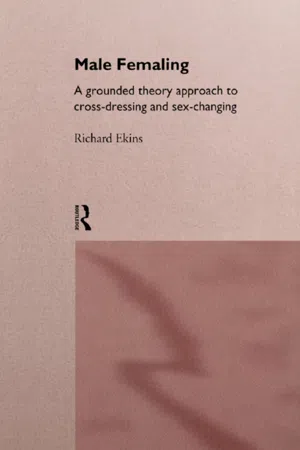
Male Femaling
A grounded theory approach to cross-dressing and sex-changing
- 208 pages
- English
- ePUB (mobile friendly)
- Available on iOS & Android
eBook - ePub
About this book
The glamour of transvestite fashion is the epitome of 90s style, but the significance of cross-dressing and sex-changing goes much deeper than the annals of fashion. Ekins vividly details the innermost desires and the varied practices of males who wear the clothes of women for the pleasure it gives them (cross-dressers), or who wish to change sex and are actively going about it (sex-changers). This unique and fascinating book transforms an area of study previously dominated by clinical models to look instead at cross-dressing and sex-changing as a highly variable social process. Giving precedence to the processual and ermergent nature of much cross-dressing and sex-changing phenomena, the book traces the phased femaling career path of the 'male femaler' from 'beginning femaling' through to 'consolidating femaling'. Based upon seventeen years of fieldwork, life history work, qualitative analysis, archival work and contact with several thousand cross-dressers and sex-changers, the book meticulously and systematically develops a theory of 'male femaling' which has major ramifications for both the field of 'transvestism' and 'transsexualism', and for the analysis of sex and gender more generally. Male-Femaling provides social and cultural theorists with a lively case study for the generation of new theory. Social psychologists and sociologists interested in seeing grounded theory applied to a particular case study will be well rewarded. It will be essential reading for students of gender studies who seek to explore the interrelations between sex, sexuality and gender from the informants' point of view.
Information
Part I
INTRODUCTION
1
THE PUBLIC AND PRIVATE FACES OF CROSS-DRESSING AND SEX-CHANGING
THE PUBLIC FACE OF CROSS-DRESSING AND SEX-CHANGING
Some personal observations
As I sit on the Belfast-London shuttle, shortly after signing the contract to write this book, cross-dressing and sex-changing seem far removed. The officers, crew and passengers are clearly either male or female. The pilot looks masculine, vigorous and authoritative. The hostesses are elegant, well groomed and made-up. They seem to be enjoying their femininity. I seem to be set within a firmly dichotomised world. Every page of the inflight reading material confirms it. Every stage of interaction I observe reinforces it and as I continue my journey it is confirmed over and over again.
However, if I take the trouble to look, a quite different world reveals itself. Although cross-dressing and sex-changing appear to be nowhere, actually they are everywhere. Fixing my gaze on a billboard as I descend the escalators into the London Underground, the image of a rather odd masculine ‘woman’ stares back at me. Just Like a Woman has been released in London. The internationally acclaimed Julie Walters stars as the landlady who falls in love with her transvestite lodger. A short while later, telephoning for a hotel reservation from a booth in Earl’s Court station, I see something which attracts my attention. Set amongst the dozens of prostitutes’ advertising cards, dotted about the telephone booth, are many which feature sketches of men in various stages of feminine undress: ‘New Young Mistress Loves Slaves—For TV [Transvestite] and CP [Corporal Punishment] Uniforms—546 029’; ‘Transformation—From He to She—Time and Care Taken—643 3191; ‘Young Mistress Wants TV Submissive Slave to Report Now—515 1558’; ‘Transvestite Gina—0171–240–5077—Uniform Fantasies—Massage’; Even, ‘Pre-Op Transexual Gina—Transforms, Dominates, Ties U Up—0171–511–2399’.
Withdrawing from the fascinations of this telephone booth, I go to buy an evening newspaper on the underground news-stand. Again I am distracted by yet another aspect of cross-dressing and sex-changing: Marie Claire, the women’s magazine and ‘winner of nine major awards’ is featuring ‘Samoa: Where Men Live as Women’ (Haworth 1993). Inside, the title becomes ‘Samoa: Where Men Think They are Women’.
In the South Pacific islands of Samoa, as many as one family in five has a son who lives as a woman. They are totally accepted by society, are usually highly educated and hold many key jobs. In their spare time they even date boys; they even enter beauty competitions.
I could go on for a very long time: entering the HMV Shop on Oxford Street I am met by a special ‘three for the price of two’ offer, which invites me to take home Victor/Victoria, Tootsie and Some Like it Hot (all major box office hits, based upon cross-dressing themes). As I enter Waterstones, I see a display of Andy Warhol books: A Low Life in High Heels is the biography of Andy Warhol’s transvestite protégé Holly Woodlawn (1991), immortalised in the Lou Reed song, ‘Walk on the Wild Side’. Back on the tube, and a woman reads a magazine article titled ‘Gossip! Gossip! Gossip! Madonna is to change sex and play a man in her next film’. Madonna is to play Holly who ‘came from Miami, FLA, hitchhiked her way across the USA, plucked her eyebrows on the way, shaved her legs then he was a she…’.
Also in Waterstones was the prominent display of New York photographer Nan Goldin’s (1993) book The Other Side. The cover blurb reads:
After years of experiencing and photographing the struggle of the two genders with their codes and definitions and their difficulties in relating to each other, it was liberating to meet people who had crossed these gender boundaries. Most people get scared when they can’t categorize others—by race, by age, and, most of all, by gender. It takes nerve to walk down the street when you fall between the racks. Some of my friends shift genders daily from boy to girl and back again. Some are transsexual before or after surgery, and among them some live entirely as women while others identify themselves as transsexuals. Others dress up openly for stage performances and live as gay boys by day. And still others make no attempt at all to fit in anywhere, but live in a genderfree zone, flaunting their third sex status. The pictures in this book are not of people suffering gender dysphoria but rather expressing gender euphoria. This book is about new possibilities and transcendence. The people in this book are truly revolutionary; they are the real winners of the battle of the sexes because they have stepped out of the ring.
It is striking just how publicly and openly this quite different world of sexchanging and cross-dressing reveals itself, once we take the trouble to look. It even pervades the private space of the public convenience I later use: on the wall beside me, written in an untidy childish hand, ‘TV Baby Susan likes to be treated like a baby girl for sex fun. Tel. 0181–857–8103. Ask for “Babs Susan”’.
Some popular press treatments
The ‘public face’ of cross-dressing and sex-changing is variously acceptable and unacceptable in different social contexts. However, though it may be celebrated by some, it is more likely to evoke a generalised uneasy mix between fascination and repulsion in others.
Many people, probably the vast majority, will never, knowingly, meet a cross-dresser or sex-changer. Yet, mass communication makes them available to everyone (King 1990). It is, perhaps, the mix of fascination and repulsion which explains the popularity of cross-dressing and sex-changing as themes dealt with again and again by the mass media. The News of the World of the 1940s and 1950s, for example, regularly featured legal cases in which crossdressing featured (Ekins 1990c; 1992a). What unites them all is that the reader is being invited to share in a sense of wonderment, to be amused, to be titillated, to be sympathetic, perhaps, even to feel admiration (King 1990).
From thousands of press cuttings in the Trans-Gender Archive, the following two have been chosen to illustrate typical treatments of crossdressing and sex-changing. One dates from the late 1940s, the period immediately prior to the emergence of sex-changing as a practical possibility; the other, from the 1980s, a contemporary report from a period in which sex-changing is relatively commonplace.
Headline: Barmaid Crooner was a Man: Wearing the New Look and Nylons on Night of Arrest
This week-end a man, aged 22, who had a flair for dressing up as an attractive girl, is in Wandsworth Gaol, starting to serve a sentence of 18 months’ imprisonment passed on him at Middlesex Sessions for house-breaking. Many people will remember him as ‘the charming Miss Pamela’.
In the course of his amazing female masquerade, Bird used to dress in the height of fashion, swathed in expensive furs and more recently wearing the new look.
He had been a bus conductress, barmaid and woman dance-band crooner. When he was employed as a barmaid at a public-house his hair was long and bleached and his finger nails were painted red.
It was stated by the prosecution that Bird was sent to a house by a domestic agency. He stole clothes belonging to Mr Roberts, and three days later broke into the house when it was unoccupied, discarded Mr Roberts’s clothes, and changed into Mrs Roberts’s attire, including her best underwear, and then walked out with property worth £800.
Bird’s first conviction was in 1943, when, at the age of 16, he embarked on a career of crime and decided to become a blonde ‘girl’ in a dual character role.
He had many jobs ranging from cook to crooner, but his favourite was that of domestic servant, working in different houses three or four hours a day.
On such occasions Bird always told the lady of the house: ‘Just call me Pamela’.
Carefully shaven and using powder and the right amount of lipstick, as well as a certain amount of padding in his woman’s dress, Bird always passed as an attractive young woman.
A fair singer, he persuaded various bands to give him a job as a woman crooner and actually attracted a flock of male admirers.
But Bird was not always in the glamorous limelight when he dressed as a girl. On one occasion, he was taken to a girl’s rescue home. There he actually shared a bedroom with another girl until suspicion was aroused.
Bird’s last job, before his arrest, was in a public-house, where he reigned as ‘queen of the bar’ for several weeks.
Here, too, he deceived a number of ‘admirers’ who liked to talk to the tall, slim, fashionably dressed and attractive ‘Pamela’.
One night, however, the attractive ‘Pamela’ decided to take a walk. ‘She’ was dressed in a new look blue frock, fur coat, black nylons and elbow-length black gloves. Round ‘her’ head was a scarf and ‘she’ wore ankle-strap white high-heeled shoes and carried a white leather handbag. All these fineries had been stolen.
This evening promenade was brought to a shattering stop when Sergt. Lindsay touched ‘Pamela’ on the arm. At the police station ‘she’ was charged as Mr Denis Bird.
(News of the World 3 July 1949)
The time-lapse since ‘Miss Pamela’s’ day has brought with it the practical possibility of ‘sex-change’ surgery as illustrated in the following report. The report is also more explicit and the deception more advanced. For all that, though, the close attention to detail and the prurience of the reporting makes the appeal of the two stories similar.
Headline: Boy Who Fooled The Top Women’s Prison
A man revealed yesterday that he had fooled police and medical authorities into believing he is a girl and admitting him to Holloway Prison, Britain’s top women’s jail.
Inside the jail he was made to strip for a medical and take a bath, guarded by a woman prison officer.
But the man, who uses the name Claire Morley and has taken hormone pills for three years to get a 36–24–36 figure, told me: ‘No-one had the slightest idea I was not really a girl’.
Blond, blue-eyed Mr Morley, who will be 20 next month, added: ‘In all respects except the vital one, I’m a girl.
I look like a girl, feel like a girl, think like a girl’.
His audacious deception started when he was accused of stealing skirts from a London store and was taken to Marlborough Street police-station.
Morley told me: ‘I was put in a room and told to take all my clothes off. A police matron looked at me but didn’t notice anything. When she asked me to take my panties down I just pulled them down a short way, then pulled them up quickly again’.
After a few hours he was allowed to leave. Next day he appeared before magistrates on the shoplifting charge and was remanded on bail.
Morley, who hopes to have a full sex-change operation later this year, then told me how he has always been haunted by the desire to be a woman.
‘I’ve felt myself to be a girl as long as I can remember’, he said. ‘Though I went to school as a boy I never played with other boys.
At 15 I left school and my home and have lived as a girl ever since. I don’t ever think of myself as a boy now.
I’m desperately hoping for the operation so I can complete the change and become a girl in the real sense of the word.
I know it isn’t possible under English law at present for a sex-change person to get married but it is possible abroad and this is what I shall do’.
(Source unknown)
Embedded within the above two media presentations are various aspects of the three central themes of the book: aspects of sex, sexuality and gender; self, identity and world; and the differing formulations of experts, members and lay folk. The remainder of this chapter introduces the interrelations between these three problems with a focus on the ‘private’ face of cross-dressing and sexchanging where the emphasis is upon ‘subjective’ private experience.
THE PRIVATE FACE OF CROSS-DRESSING AND SEX-CHANGING
Despite the desire to titillate, or, perhaps, because of it, press reports such as these are noticeably coy about the subjective erotic state of those they report. They may not mind if readers find their reporting sexually stimulating, but we learn nothing of the details of the private face of their subject’s erotic sexual life. The feature of the ‘public face’ of cross-dressing and sex-changing is its tendency to studiously avoid the issue.
Sex, sexuality and gender
To make the above point explicit, it is important to introduce the first threefold distinction which is absolutely central to the organisation of this book. This is the distinction between ‘sex’, ‘sexuality’ and ‘gender’. This study restricts the term ‘sex’ to the biological and physiological aspects of the division of humans into males and females; ‘sexuality’ to ‘those matters pertaining to the potential arousability and engorgement of the genitals’ (Plummer 1979:53); and ‘gender’ to the socio-cultural correlates of the division of the sexes. These definitions are sensitising rather than definitive. In particular, what follows is concerned to explore the neglected interrelations between them.
Once this distinction is made, it is evident that the particular feature of the ‘Miss Pamela’ piece is its preoccupation with ‘gender’. The emphasis is upon the accoutrements of femininity. The titillation comes from the fact that it is someone of the male sex who is so preoccupied with such things, for himself. On the other hand, the ‘Claire Morley’ piece is preoccupied with ‘sex’. The emphasis is upon a hinted—rather than stated—preoccupation with Mr Morley’s biology and physiology. We know he is male. He has, however, acquired a 36–24–36 figure in three years. He is ‘in all respects but one’, a girl. The bulk of the piece is taken up with the fact that his custodians repeatedly fail to see this one respect. He sees his sex-change operation as settling that last detail.
If, however, we approach the topic from the personal standpoint of the cross-dresser and sex-changer, himself, a very different emphasis is likely to emerge. Certainly, cross-dressers and sex-changers are likely to be pre-occupied with sex and gender. However, from their standpoint, it is quite inappropriate to ignore the question of sexuality. This more private face of cross-dressing and sex-changing is well illustrated by the following case of Barry. Unfolding with the various stages of Barry’s emerging sexuality is his increasing fascination and deepening involvement with various aspects of cross-dressing and sex-changing.
Barry was brought up in a conventional middle-class family in Cambridge, England. He recalls his first ‘cross-dressing incident’ as taking place when he was 5 years old. He was playing ‘schools’ with his sister. They were the ‘Browns’ and he was Anna Brown. What more natural than he should put on his sister’s school skirt and blouse? Lost in the game, and attaching no particular significance to it, the children are called to lunch by their mother. They bound into the dining room, to be met by the stony gaze of their father, seated at the head of the table. Barry becomes acutely aware of the tension in the air. He shuffles nervously, feeling the cold of the seat on his bare thighs. He looks down at ‘his’ skirt. Nothing is said. He knows he has done something dreadfully wrong. His parents disapprove. This is taboo. He will not do it again. Or will he?
Barry is now 12 and on a trip with his local Boy Scout troop. As they are supposed to be settling down to bed, one of the boys places a handkerchief on the bed and folds it over in various complicated ways. ‘Abracadabra’, he says as he flashes before the other boys eyes, what looks like a brassière. He places his handkerchief bra over his bare nipples, and cavorts about in mimicry of a strip-tease artist. A little while later, Barry, now tucked up in bed, finds the image of the handkerchief bra coming into his mind, while his penis stiffens. That night he masturbates with the thought of it firmly at the forefront of his mind. Afterwards, he feels guilty and tries to forget the incident, but he cannot.
Barry is now 15. He has been becoming increasingly preoccupied with girls, but more so with their clothing. He finds himself becoming increasingly drawn to the window displays in women’s shops, particularly to the women’s underwear. One Christmas, during his first holiday job, he finds himself plucking up the courage to buy a baby-doll pyjama set displayed enticingly in a shop window. ‘You certainly know what you want!’ says the assistant, as Barry takes his precious pyjama set home. Actually, he does not quite know what he wants. Nor does he quite know what he is doing, or why. But he does know he must not tell a soul. No one must find out. He hides the pyjama set under the floorboards of his bedroom. Now, when he masturbates, he often wears his baby-doll set. Afterwards, he is very guilty. One day he determines to have no more of this nonsense, and throws it away. He feels great relief. Very soon, however, he is buying more women’s clothes. He does not know why.
Barry is now 17. He is flipping through a newspaper and his eyes alight on a beautiful blonde, full-bosomed woman. He feasts on the sight. There is some banter with his friend. But wait! This woman is a man! It transpires this beautiful ‘model’ is the celebrated Coccinelle, who has had a sex-change operation in Casablanca and now, looking for all the world like Brigitte Bardot, has become the bride of her male secretary, a very masculine looking Francis Bonnet. Barry looks lingeringly and in disbelief. She looks so enticing. How can such a thing come to pass?
Barry is now at university. ‘Let’s go down to the “King Henry”’, says a fellow student, ‘It’s a right laugh there’. As they enter the bar, Barry is aware of a strange feel to the place. There are men wearing make-up and women’s clothes. His mates joke about it all, particularly about the ‘pansy’ with dyed blonde hair, leopard skin pants and a feather boa round his neck. Barry feels unsettled. Is he fascinated? Or is he repulsed? He’s not sure, but he cannot forget what he has seen.
Barry has left university now. He’s on holiday alone in New York. What will he do to tonight? His eyes alight on an advertisement for a ‘Cabaret show with a difference’: all the glamorous performers are men—female impersonators. He finds the prospect intriguing. While at the show, the compère joins him at his table. She is attractive. What the hell? They get talking. He finds her appealing. She’s young and slim. She’s saving up her dollars, to get her ‘sexchange’ in Casablanca (Ekins 1990a...
Table of contents
- Cover Page
- Title Page
- Copyright Page
- Figures
- Foreword
- Prologue
- Part I: Introduction
- Part II: Mainly Theory
- Part III: Mainly Practice
- Notes
- Bibliography
Trusted by 375,005 students
Access to over 1.5 million titles for a fair monthly price.
Study more efficiently using our study tools.
Frequently asked questions
Yes, you can cancel anytime from the Subscription tab in your account settings on the Perlego website. Your subscription will stay active until the end of your current billing period. Learn how to cancel your subscription
No, books cannot be downloaded as external files, such as PDFs, for use outside of Perlego. However, you can download books within the Perlego app for offline reading on mobile or tablet. Learn how to download books offline
Perlego offers two plans: Essential and Complete
- Essential is ideal for learners and professionals who enjoy exploring a wide range of subjects. Access the Essential Library with 800,000+ trusted titles and best-sellers across business, personal growth, and the humanities. Includes unlimited reading time and Standard Read Aloud voice.
- Complete: Perfect for advanced learners and researchers needing full, unrestricted access. Unlock 1.5M+ books across hundreds of subjects, including academic and specialized titles. The Complete Plan also includes advanced features like Premium Read Aloud and Research Assistant.
We are an online textbook subscription service, where you can get access to an entire online library for less than the price of a single book per month. With over 1.5 million books across 990+ topics, we’ve got you covered! Learn about our mission
Look out for the read-aloud symbol on your next book to see if you can listen to it. The read-aloud tool reads text aloud for you, highlighting the text as it is being read. You can pause it, speed it up and slow it down. Learn more about Read Aloud
Yes! You can use the Perlego app on both iOS and Android devices to read anytime, anywhere — even offline. Perfect for commutes or when you’re on the go.
Please note we cannot support devices running on iOS 13 and Android 7 or earlier. Learn more about using the app
Please note we cannot support devices running on iOS 13 and Android 7 or earlier. Learn more about using the app
Yes, you can access Male Femaling by Richard Ekins in PDF and/or ePUB format, as well as other popular books in Social Sciences & Gender Studies. We have over 1.5 million books available in our catalogue for you to explore.