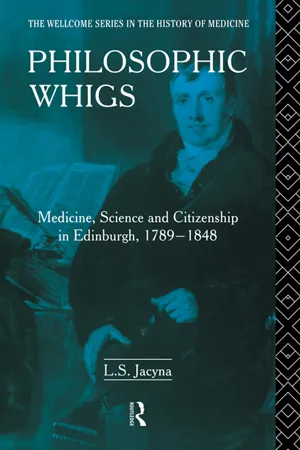
Philosophic Whigs explores the links between scientific activity and politics in the early nineteenth century. Through a study of the Edinburgh medical school, L.S. Jacyna analyses the developments in medical education in the context of the social and political relationships within the local Whig community. Philosophic Whigs is a fascinating study of the links between science and the society that produces it.
eBook - ePub
Philosophic Whigs
Medicine, Science and Citizenship in Edinburgh, 1789-1848
- 224 pages
- English
- ePUB (mobile friendly)
- Available on iOS & Android
eBook - ePub
About this book
Information
1
Philosophie Whiggism
Introduction
Henry Cockburn in the Memorials of his Time (1856) provided a famous account of the Whig party in Edinburgh at the turn of the nineteenth century. He represented them as a small embattled group surrounded by powerful and vindictive enemies; the ‘real Whigs’, he declared, were extremely few. ‘Self-interest had converted some, and terror more; and the residue, which stood out, consisted of only the stronger-minded men of the party’.1 Among these men of ‘rational opinions’ Cockburn was especially concerned with a tight-knit set who first rose to prominence in the 1790s: Henry Brougham, Francis Horner and Francis Jeffrey, were its leading members. These are famous names. They were the moving force behind the establishment of the Edinburgh Review in 1802, and they went on to have distinguished political careers.2 A few professors in the University of Edinburgh, notably Dugald Stewart and John Playfair, acted as their allies and mentors. While ‘John Allen and John Thomson, of the medical profession, were active and fearless’ in the Whig cause.3
Cockburn’s characterization of Francis Jeffrey as a ‘philosophical Whig’ can be extended to the group as a whole.4 This appellation can be construed in various ways.5 It might signify a propensity to explore the philosophical foundations of political action – a conviction of the need to return politics to first principles: in Dugald Stewart’s words,
In order to lay a solid foundation for the science of politics, the first step ought to be, to ascertain that form of society which is perfectly agreeable to nature and justice; and what are the principles of legislation necessary for maintaining it’.6
But ‘philosophic Whiggism’ might also imply that in order to be a Whig, one needed also to be a philosopher. Philosophy in this context possessed a very wide denotation; it comprised ‘the knowledge of those numerous existents or beings that compose the universe, and of those various events which compose the phenomena of the universe’.7 On this definition, philosophy encompassed the natural as well as the social world; a philosophic Whig might in consequence be expected to be not only a political but also a natural philosopher.
In Edinburgh during the 1790s this logical possibility became a reality. One of the main foci of the Whig community was a shared interest in natural science. John Allen and John Thomson, the two medical Whigs mentioned by Cockburn, played an important enabling role in these activities: they acted as purveyors of scientific knowledge to an intellectually voracious group of consumers. In this chapter I want to consider the ideological dimension of this interest in the natural sciences; to reconstruct an ethos in which the pursuit of science might be seen as expressive of and integral to a particular form of political commitment.
John Thomson and the Lure of Chemistry
According to Henry Brougham, John Thomson ‘was called by his contemporaries “the most learned of physicians”’. Brougham added that ‘the discursive character of his scientific acquirements rendered him valuable to the body of young men in Edinburgh, who, at the beginning of the century, were ambitious of adding physical science to their acquirements in law, politics, and general scholarship’. Thomson served this function chiefly by providing instruction in chemistry, a science which possessed a particular appeal to these young men. He seemed to have made a lasting impression; in 1835 the now Lord Chancellor Brougham visited the elderly and ailing Thomson and the two ‘talked over their old chemical recreations as if they were still young students with the world before them’.8
John Thomson’s early career was a tribute to the genuinely democratic possibilities of the Scottish educational system.9 Born the son of a Paisley silk weaver and apprenticed to his father’s trade at the age of eleven, he rose to be a professor in the University of Edinburgh. The transition is somewhat less startling when the high level of literacy among the Paisley websters is recognized: they were said to possess ‘libraries equal to those of ministers and professional men’.10 This lends credibility to the story that Thomson
laid the foundation for his future eminence by laborious study while following [his father’s occupation]. He had the books he was studying always lying open at the side of his loom, and never lost a moment he could spare in making use of them’.11
The handloom weavers of the west of Scotland were also noted throughout the eighteenth century for their activism12; it is likely that Thomson was exposed to ‘advanced’ political views at an early age. Thomson’s enemies in later life did not forget his social origins: an anonymous denunciation sent to the War Office in 1817 alleged that ‘this man by his political intrigues his violence against Government & democratic Principles raised himself from being a Journey Man weaver … to his present situation’.13
Having persuaded his father that neither weaving nor the church were suitable careers for him, Thomson spent three years apprenticed to a local surgeon. During the 1788–9 session he attended medical classes in Glasgow where he paid special attention to chemistry. The novel doctrines of Lavoisier were at this time giving ‘much interest to the proceedings of a society of young and ardent cultivators of chemical science’ to which Thomson attached himself.14 His time in Glasgow may have made a further contribution to the development of Thomson’s politics. The University of Glasgow possessed at this time a reputation as a seminary of Whiggism largely through the influence of John Millar, the Professor of Civil Law. Millar later enjoyed the reputation of ‘having formed the minds of many of those who have been distinguished in the political world on the liberal side during the last fifty or sixty years’.15 There is no evidence that Thomson met Millar during his time in Glasgow; he is known, however, to have engaged shortly afterwards in political activities with Millar’s eldest son; and in 1806 Thomson married the third of John Millar’s seven daughters.16
Thomson came to Edinburgh to continue his medical studies in the auspicious year 1789. He was indentured to a surgeon of the city in whose house he first met John Allen a fellow apprentice. Later Allen and Thomson served together as residents at the Royal Infirmary.17 Allen’s father was a Writer to the Signet and owned a small estate near Edinburgh. But for his father’s bankruptcy, Allen would have pursued a career in the law. Medicine was a poor second choice; and Allen never had any real taste for medical practice as opposed to medical science.18
Thomson and Allen shared politics as well as a profession. They were involved in the organization of the famous or infamous dinner at the Fortune Tavern to celebrate the fall of the Bastille – ‘an event so interesting to mankind as the redemption of twenty-six millions from servitude, an event that promised unexampled happiness to the human race’ – in the words of the advertisement for the gathering.19 Allen also became a member of the Society of the Friends of the People and participated in the British Convention that met in Edinburgh in 1792 to call for parliamentary reform much to the alarm of the authorities.20
At the same time both men began to be known among the rising generation of Edinburgh literati as men of science and learning as well as of sound political views. During Thomson’s early years in Edinburgh, in addition to his strictly professional studies, ‘Chemistry … occupied a considerable share of his attention.’ The publication in 1800 of an edition of Fourcroy’s Elements of Chemistry was public testimony to those labours.21 Thomson appended copious notes to the edition in which he thanked ‘his friend Mr Allen for the Notes on Caloric … and for the greater part of the Notes on Animal Substances’;22 the two were clearly working in close collaboration.
By the later 1790s Thomson had thus established a reputation in Edinburgh as an authority on chemistry and particularly on French chemistry. This status helps to explain an approach he received late in 1799:
During that winter the late Earl of Lauderdale came to reside in Edinburgh, and being, with that ardour which characterized him in all his pursuits, very desirous to prosecute the study of chemistry, Mr Thomson was introduced to him as a person qualified to assist him.
Under Lauderdale’s patronage, ‘a chemical class was formed, consisting chiefly of gentlemen connected with the Parliament House, and which met at Mr Thomson’s private residence’.23
The allusion to ‘gentlemen of the Parliament House’ requires some elucidation. No parliament had sat in Edinburgh since the Act of Union of 1707. The buildings in Parliament Square retained, however, their function as the seat of the Court of Session; in the words of a nineteenth-century wag, ‘although laws are no longer manufactured, they are now retailed, within [the Parliament House], to all who have cash and courage enough to buy them’.24 The gentlemen in question were therefore the lawyers for whom the Parliament House was a centre for social intercourse as well as for business.25
The audience for Thomson’s private chemistry class therefore comprised a group of lawyers gathering under the auspices of a member of the aristocracy. The role of aristocrats as patrons of science in eighteenth-century Britain is sufficiently well known; the collective participation of lawyers in scientific activities was, however, a peculiarly Scottish phenomenon. It was an aspect of the unique position occupied by the legal profession in the social, political and cultural life of Scotland in the eighteenth and for much of the nineteenth century. Nowhere was this more the case than in the country’s capital. The law, declared an English visitor in 1825,
is [Edinburgh’s] Alpha and her Omega, – the food which she eats, the raiment she puts on, the dwelling-house which she inhabits, the conversation in which she engages, the soul which animates her whole frame, the mind which is discovered in every feature of her countenance, and every attitude of her body.26
In the post-Union period a close alliance developed between the legal profession in Edinburgh and the landed classes. Gentry families sent their younger sons to study for the law while successful lawyers invested in land. Often the same individual filled both roles: John Allen’s father was both a Writer to the Signet and owned an estate. Lauderdale himself had qualified as an advocate in 1780. The legal profession was by virtue of these links an essential part of the civic leadership of eighteenth-century Scotland.27 They also exercised a great deal of political power. Scotland had little in the way of central government for most of the eighteenth century; but such executive functions as remained in Edinburgh were discharged by the Law Officers of the Crown.28 Finally, lawyers aspired to a leading part in the intellectual life of the country. Although they may not have been outstanding among the authors of the high Scottish Enlightenment, lawyers were prominent in the clubs and societies dedicated to the assimilation and discussion of the new knowledge.29 Nor did the legal profession participate in these intellectual pursuits in a spirit of idle dilettantism: they saw such engagement with developments in the arts and sciences as integral to their role as the defenders of Scottish liberties, guardians of the nation’s virtue, and trustees of its future prosperity.
Cockburn articulated the lawyers’ self-conscious image of themselves as an aristocracy of learning as well as of wealth and land:
The legal profession in Scotland had every recommendation to a person resolved, or compelled, to remain in this country. It had not the large fields open to the practitioner in England, nor the practicable seat in the House of Commons, nor the lofty political and judicial eminences, nor the great fortunes. But it was not a less honourable or a less intellectual line. It is the highest profession that the country knows; its emoluments and prizes are not inadequate to the wants and habits of the upper classes; it has always been adorned by me...
Table of contents
- Cover
- Half Title
- Title Page
- Copyright
- Contents
- List of Abbreviations
- Introduction
- 1. Philosophic Whiggism
- 2. John Allen, Physiologist and Friend of the People
- 3. The Old Chairmaker
- 4. Pathologists and practitioners
- 5. A Whig decline
- Epilogue
- Notes
- Index
Trusted by 375,005 students
Access to over 1.5 million titles for a fair monthly price.
Study more efficiently using our study tools.
Frequently asked questions
Yes, you can cancel anytime from the Subscription tab in your account settings on the Perlego website. Your subscription will stay active until the end of your current billing period. Learn how to cancel your subscription
No, books cannot be downloaded as external files, such as PDFs, for use outside of Perlego. However, you can download books within the Perlego app for offline reading on mobile or tablet. Learn how to download books offline
We are an online textbook subscription service, where you can get access to an entire online library for less than the price of a single book per month. With over 1.5 million books across 990+ topics, we’ve got you covered! Learn about our mission
Look out for the read-aloud symbol on your next book to see if you can listen to it. The read-aloud tool reads text aloud for you, highlighting the text as it is being read. You can pause it, speed it up and slow it down. Learn more about Read Aloud
Yes! You can use the Perlego app on both iOS and Android devices to read anytime, anywhere — even offline. Perfect for commutes or when you’re on the go.
Please note we cannot support devices running on iOS 13 and Android 7 or earlier. Learn more about using the app
Please note we cannot support devices running on iOS 13 and Android 7 or earlier. Learn more about using the app
Yes, you can access Philosophic Whigs by Stephen Jacyna in PDF and/or ePUB format, as well as other popular books in Medicine & Scottish History. We have over 1.5 million books available in our catalogue for you to explore.