- 208 pages
- English
- ePUB (mobile friendly)
- Available on iOS & Android
eBook - ePub
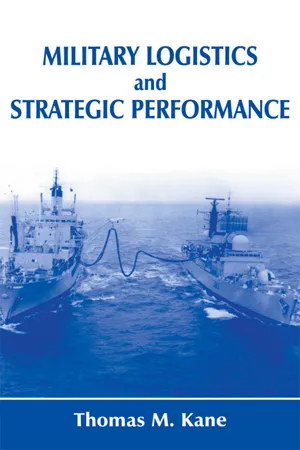
Military Logistics and Strategic Performance
About this book
This work argues that logistics in warfare is crucial to achieving strategic success. The author identifies logistical capabilities as an arbiter of opportunity, which plays a critical role in determining which side will hold the strategic iniative in war. Armies which have secured reliable resources of supply have a great advantage in determining the time and manner in which engagements take place. Often, they can fight in ways their opponents cannot. The author illustrates this point with case studies of British logistics during the Burma campaign in the World War II, American logistical innovations during the Pacific War, Communist supply methods during the American phase of the Vietnam War and the competing logistical systems of both NATO and Warsaw Pact conventional forces during the Cold War.
1
The Arbiter of Opportunity
To judge by the remarks of experienced soldiers from every era, logistics ranks among the most crucial elements contributing to military success. Yet, for the student of strategy, the subject of supply has become similar to oatmeal and chicken soup. Everyone agrees that it is good for you, but nobody is enthusiastic enough to say much more than that. To paraphrase one dedicated supporter of logistical studies, this topic has the same level of appeal as a post-game interview with a football team’s water boy.1 It is, however, the purpose of this study to show, not only that supply officers perform an indispensable service, but that logistics ought to excite us, because it helps to set the stage upon which strategists act, and therefore ranks among the factors which decide the course and outcome of a war.
This study fulfils two overall purposes. First, it offers historical analysis to expand a neglected field of strategic research. As a book reviewer in the journal Joint Forces Quarterly noted, ‘for every thousand books published on military strategy, one deals with logistics’.2 Second, this study closes a gap which has developed between the common sense of military leaders and the findings of academic researchers.
Despite all the sayings which remind us that logistics are important, historians and scholars in the field of political studies have been unable to explain why this is so. The obvious explanation – that soldiers need food and ammunition to carry out their functions – has proven too simplistic to explain the relationship between logistical planning and military success. For these reasons, certain scholars suggest that logistics may be less important than it seems. This study counters their arguments, reaffirms the importance of supply, offers a theoretical explanation of why logistics matters, and then explains, through a series of historical case studies, how commanders have used their logistical resources to win wars.
A PARADOX
How, exactly, does supply affect warfare? The answer to that question is not as obvious as it would seem. Clearly, soldiers who run out of food, fuel or ammunition will cease to fight, and to the German troops who spent December outside Moscow in summer uniforms or the American soldiers of Task Force Smith who faced 33 North Korean tanks with only six rounds of effective armour-piercing ammunition, the importance of logistics would seem straightforward.3 Over time, however, such calamities tend to affect both sides, and one is hard pressed to think of a war which ended because an entire army ran out of supplies.
Hence, General Nathanael Greene refused a post as George Washington’s chief logistician with the sneer ‘Whoever heard of a quartermaster in history as such’4 Jomini found himself forced to ask, ‘Is logistics simply a science of detail?’5 Martin Van Creveld, whose book Supplying War rates as a pillar of academic logistical studies, concludes that efforts to win wars through improved supply systems have been futile at best.6 When one compares these feelings and findings to the quotations at the beginning of this chapter, it seems that at least one set of authorities must be missing an important point.
The term ‘logistics’ can mean many things. Those interested in the convoluted derivation of this word might consult Jomini.7 Recent books on the topic have considered the subject of logistics broad enough to encompass manpower reserves and mobilisation of national industry.8 Official military definitions differ both between nations and between branches of service.9 However, for purposes of this paper, logistics is neither less nor more than the business of ‘moving, supplying and maintaining military forces’.10 Both logistical supporters and logistical sceptics have generally concentrated their analysis upon the actual business of getting materiel to the fighting forces, and under this focused definition, the conflict between the observations of a Van Creveld and the sensibilities of a Bradley becomes yet more of a paradox.
GENRES OF GENERALISATION
Although most commentators lament what they see as an absence of interest in logistics, a review of the relevant literature reveals not so much a dearth of material as a lack of direction.11 The authors who have tackled this subject conflict on the fundamental issues of what a theory of supply should explain. Economists have treated the whole business of logistics as a single factor in calculating the cost of war for an entire nation. Meanwhile, historians and professional soldiers have concentrated on the specifics of individual supply operations. Some have distilled these observations into principles which purport to explain how logisticians can best serve the purposes of the armed forces. Other historical scholars have followed the lead of Van Creveld and sought to identify the points at which logistics serves as a constraint upon military undertakings. In reality, of course, these different problems are all facets of the same gemstone. To understand logistics as a whole, we might do well to look beyond these authors’ explicit conclusions and examine their common intuition about the deeper importance of the subject.
During the 1960s, certain economists, notably Kenneth E. Boulding, used logistics as the basis for a general theory of military power.12 These theorists proposed that armed forces are strongest in the vicinity of their home country, where they have ready access to food, ammunition and other vital materiel. As military units venture away from their own borders, this theory would have us believe, they experience greater and greater difficulties supplying themselves with such things, and therefore they become progressively weaker in combat. These economists referred to the gap between well-equipped units fighting near their home territory and less well-equipped ones fighting far from their bases as the ‘loss-of-force gradient’.
Albert Wohlstetter, however, rejected this entire concept in his Foreign Affairs article ‘Illusions of Distance’. As Wohlstetter noted, the differences in efficiency between sea and land transport may reverse the logic of the loss-of-force gradient. During the Vietnam War, for instance, the People’s Republic of China provided logistical support to the Communist forces in North Vietnam while the United States sent supplies to its own forces and those of its allies in South Vietnam. China shared a border with North Vietnam whereas America was on the other side of the Pacific Ocean, but US forces managed to ship four times as much materiel into the war zone by sea as the Chinese could transport the much shorter distance over land.13 Within an area of operations, Wohlstetter observes, any attempt to measure logistics as a constant function breaks down even more completely, as purely local features such as roads, mountains, plains, airfields and cities determine the accessibility of any given point.
Both the economists and Wohlstetter take it for granted that an increase in logistical efficiency will directly increase the overall fighting power of a military organisation. Therefore, all parties to this debate felt qualified to draw conclusions about the implications of their arguments for high state policy. To Boulding, advances in technology which change the slope and curve of the ‘gradient’ are a key factor in determining whether small states will survive and how frequently nations of any size will attack each other.14 Wohlstetter hoped that his rebuttal of the gradient argument would draw attention to the importance of distant events to the safety of the American homeland, and the consequential folly of isolationism. Furthermore, Wohlstetter wished to make the point that it is perfectly feasible for the United States to intervene in distant parts of the world when such actions suit its interests.15
Meanwhile, as economists and their critics have relied on assumptions about logistics in theory, historians have approached the subject from the opposite angle. These authors accept national policy concerning war and peace as a given, but follow the day-to-day results of logistical operations in detail. Examples of historical works which explicitly focus upon logistics range from Donald Engels’ minor classic, Alexander the Great and the Logistics of the Macedonian Army, to the US Army’s series on Global Logistics and Strategy during the Second World War, to Allan Gropman’s recent study of the logistics of that conflict, The Big ‘L’: American Logistics in World War Two, to the popular memoirs of General William Pagonis, who supervised United States logistical operations during Operations Desert Shield and Desert Storm.16
Every war involves its own story of supply. Since the volume of historical data on this subject is staggering, both scholars and soldiers attempt to sift the past for lessons that are generally useful to operations in any age.17 However, there is a crucial difference between the general assumptions of the economists and the general principles of soldiers. Whereas an assumption is something which one must accept, a principle is something which one must apply. Therefore, the advice which historians give to supply officers offers us a clearer picture of what logisticians believe that they are supposed to do.
Logistical operations in the military require many of the same skills as management in any other bureaucracy. For those who wish to master the organisational aspect of logistics, there is an entire body of literature on the subject within the field of business administration.18 Pagonis devotes part of his concluding chapter to the application of his experience in the corporate world.19 The author who drew attention to an age-old plague of organisations by coining the term ‘Parkinson’s Law’ was originally writing about naval administration. (In this context, Parkinson’s Law reads, ‘The smaller the fleet, the larger the Admiralty.)20 Admiral Eccles explores this concept of a ‘logistical snowball’ at great length in his book Logistics in the National Defense.21 However, when one exhausts the study of resource allocation within an organisation, one finds that there is still another dimension to the practice of logistics.
For a supply officer, these authors offer no easy measure of success. A logistical organisation cannot fulfil its duty simply by keeping a large volume of materiel flowing to the front line. Units on the attack require a different level of support from units on the defence, and the rhythm of a particular battle may modify supply demands radically. Furthermore, although the consequences of having a unit run out of supplies at a critical moment are grim, there is also such a thing as too much supply. The logistical snowball’ which Eccles mentioned not only wastes resources, it creates administrative logjams which impede active operations. Logisticians must strike a balance between starvatio...
Table of contents
- Cover
- Halftitle
- Title
- Copyright
- Dedication
- Contents
- Series Editor’s Preface
- Acknowledgements
- List of Abbreviations
- 1 The Arbiter of Opportunity
- 2 The Burma Campaign
- 3 Making It Work: America’s War in the Pacific
- 4 Making Haste Slowly: Communist Logistics in Vietnam
- 5 The Cold War
- 6 The Revolution in Military Affairs
- Conclusion: The Foundation of Strategy
- Bibliography
- Index
Trusted by 375,005 students
Access to over 1.5 million titles for a fair monthly price.
Study more efficiently using our study tools.
Frequently asked questions
Yes, you can cancel anytime from the Subscription tab in your account settings on the Perlego website. Your subscription will stay active until the end of your current billing period. Learn how to cancel your subscription
No, books cannot be downloaded as external files, such as PDFs, for use outside of Perlego. However, you can download books within the Perlego app for offline reading on mobile or tablet. Learn how to download books offline
Perlego offers two plans: Essential and Complete
- Essential is ideal for learners and professionals who enjoy exploring a wide range of subjects. Access the Essential Library with 800,000+ trusted titles and best-sellers across business, personal growth, and the humanities. Includes unlimited reading time and Standard Read Aloud voice.
- Complete: Perfect for advanced learners and researchers needing full, unrestricted access. Unlock 1.5M+ books across hundreds of subjects, including academic and specialized titles. The Complete Plan also includes advanced features like Premium Read Aloud and Research Assistant.
We are an online textbook subscription service, where you can get access to an entire online library for less than the price of a single book per month. With over 1.5 million books across 990+ topics, we’ve got you covered! Learn about our mission
Look out for the read-aloud symbol on your next book to see if you can listen to it. The read-aloud tool reads text aloud for you, highlighting the text as it is being read. You can pause it, speed it up and slow it down. Learn more about Read Aloud
Yes! You can use the Perlego app on both iOS and Android devices to read anytime, anywhere — even offline. Perfect for commutes or when you’re on the go.
Please note we cannot support devices running on iOS 13 and Android 7 or earlier. Learn more about using the app
Please note we cannot support devices running on iOS 13 and Android 7 or earlier. Learn more about using the app
Yes, you can access Military Logistics and Strategic Performance by Thomas M. Kane in PDF and/or ePUB format, as well as other popular books in History & Military & Maritime History. We have over 1.5 million books available in our catalogue for you to explore.