![]()
PART I
RESEARCH AND METHODOLOGIES
In Part I of the text, we begin in Chapter 1 with the definitions of market and research, marketing research, market segmentation, targeting, and positioning. All of these are key concepts and the terms are supported by research. In Chapter 2, we point out the differences between primary research and secondary research as well as discuss the concept of sampling. In Chapters 3 and 4, we look at the roles and related research techniques associated with qualitative and quantitative research. In Chapter 5, we examine integrative research, its advantages and disadvantages, and the concept of triangulation. Overall, this part should provide an understanding of where research plays a significant role in marketing strategy and market analysis. Further, a synopsis of the major qualitative and quantitative research methodologies and related techniques is provided.
![]()
Chapter 1
Defining Marketing Research, Market Analysis, and Applications
Chapter Objectives
• To provide an overview of the purpose of marketing research in the decision process.
• To define marketing research, market research, and types of research studies.
• To relate the types of research studies applicable to the various stages of product development and the product life cycle.
• To delineate the marketing research process, formulation, and approach.
• To present various marketing research techniques and applications.
Purpose
Marketing research is the active process of identifying and gathering information pertinent to assisting in the decision-making process. The type of information gathered for analysis is dependent upon the purpose of the research. In addition there are a variety of research methodologies and information-gathering processes utilized by market researchers. One definition of marketing research is that it is the “function that links the consumer, customer, and public to the marketer through marketing information.”1* However, this is but one of many different definitions. Frequently, businesses want to know what the market for a specific product is or service before it can be sold to the consumer. And, frequently the term market research is used to describe the process of identifying and gathering information related to the specific product or service. In this latter case the focus is on consumer demand, product and/or service supply, the present and future scenarios, and many other factors that can impact the decision process. Again, the type of information gathered for analysis is dependent upon the purpose of the research.
The purpose of the research can be focused on analyzing customer needs, product/service attributes, competitors’ strengths and weaknesses, and even external events likely to impact the product or service offering. The research might focus on the product/service offering in terms of supply and demand, both current and future. The research may focus on actual markets, countries, and cities, seeking to identify opportunities for or threats to an existing product/service offering. Research may focus on new product/service development by identifying market segments or product/service offerings currently not being served.
Market research must be timely, accurate, and reliable to be of value in assisting decision making.
Research can be designed to measure and evaluate the performance of actual marketing pro-grams, the quality of service delivery, the faults in a production process, the mix of products being offered, price points, sales approaches, and more. Research, be it qualitative or quantitative, should be designed so that the result of the information-gathering process is applicable to reducing uncertainty in managerial decisions. Decisions on pricing, product/service positioning, distribution, promotion, and any changes to product/service offerings should be based on carefully structured and conducted marketing research.
Finally, marketing research must be timely to support the decision process. And, equally important, marketing research must be ongoing to truly contribute to purposeful managerial decisions. Virtually all products and services find their environment to be very dynamic in today’s marketplace. Change not only is constant but also occurs at a more rapid pace due to technology. Research can focus on the dynamics of change by identifying the needs for everything from a minor change in pricing to a major change in product/service design or offering.
Marketing research may be conducted and/or coordinated internally within the corporation and/or by an external commercial marketing research firm or service. It is also common practice to utilize both internal functions and external research firms to conduct research. Marketing and product managers, corporate managers, marketing information systems and marketing decision support system managers, R&D managers, and advertising and promotion agencies may individually, cooperatively, or collectively all be involved in the research process or subcomponents of the process. Sometimes it is more efficient and effective to utilize what is referred to as “syndicated” research. Syndicated research is based on common pools of data such as diary and scanner-panel based studies, standardized research services, and customized research services.
To succeed as a marketing manager, it is beneficial to have an understanding of the research process and to have a working knowledge of how to use marketing research and how to interpret and apply findings. Mastering this base of knowledge combined with understanding the position and life cycle stage of your product/service offerings can give you the support you need along with the knowledge to make informed and successful strategic marketing decisions. The other obvious benefit is that the facts and research-based knowledge will assist in selling senior management to support recommendations needed for the ultimate success of the marketing program.
Research should be an ongoing process as the marketplace is ever changing.
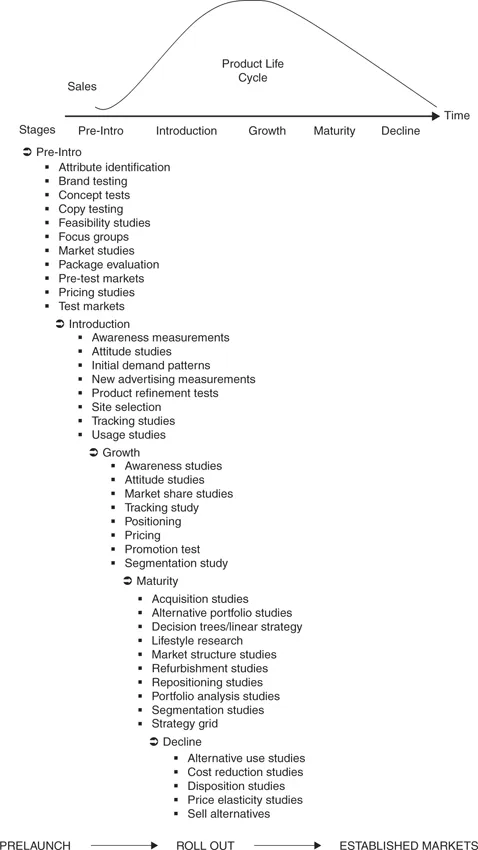
Marketing research needs tend to be dynamic or ever changing over time. These needs and even approaches to research may vary considerably during the life cycle of the product or service offering. Predevelopment research activities may involve site selection and feasibility studies. Prelaunch of new products/services might require concept testing, product attribute research and packaging, and name testing. In the introductory and growth stages of the product life cycle, research may be more focused on sales trends, pricing sensitivity, consumer attitudes and preferences, competitive responses, and other patterns that emerge. In the maturity phase, marketing research may focus on alternative portfolio scenarios, new product development, acquisitions, segmentation, and rejuvenation/rebirth strategic research. In the decline cycle, research might focus on sales strategies, dispositions, and asset redevelopment. Figure 1.1 profiles types of research and product life cycle stages.
Figure 1.1 Types, Studies, and Stages.
Source: Adapted from W. R. Dillon, T. J. Madden, and N. H. Firtle, Marketing Research in a Marketing Environment (Burr Ridge, IL: Irwin, 1994), p. 20.
Process
Almost all companies have some informal or formal process for finding and using marketing research data. The level of sophistication varies widely and often the process is evolutionary. Some organizations have a highly structured and formal process for marketing research while others utilize an informal approach. As in any research methodology undertaking, in marketing research also there is a multiple-step process.
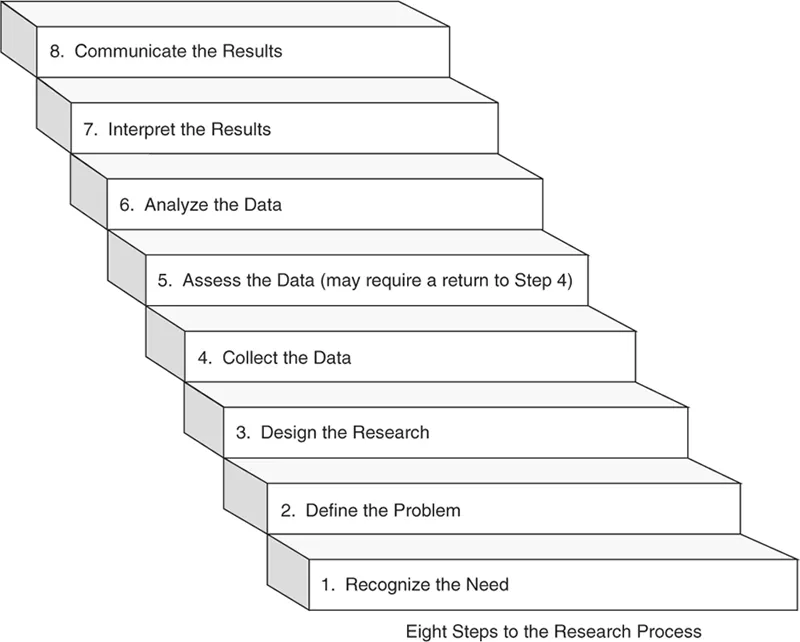
At the outset, an organization must recognize the need for research. This is where the process begins. Once there is a need to assess performance, to view competition, or do a forecast, the first step of recognizing a need has occurred. In Figure 1.2, the following eight-step research process is graphically presented.
Figure 1.2 The Research Process
• Recognizing the need. Sometimes the need might be difficult to recognize, especially if the need is related to an external event unassociated with the existing product or service. Simple changes in tax laws in the late 1980s had dramatic effects on the lodging industry, real estate industry, and savings and loan industry. Often new products that had resulted from external technological advances can have substantial impact on traditional products and services, even render them obsolete, that is, 8-track audio, 45 and 78 rpm records, wiring, etc. Many other unexpected events can dramatically alter the marketplace. Recognizing the need to continually assess trends, the environment, and competition may prove to be extremely significant to a product or service in its struggle for market share or even survival.
• Defining the problem. At this stage, marketing managers and researchers need to jointly define the purpose for which marketing research will be conducted, including the types of ques-tions that the research must answer, the types of information already available, additional information wanted, and the use to which research results will be put. Exploratory research at this stage helps clarify what the problem really is and generates ideas on alternate research approaches.
• Designing the research. This entails setting the research budget and identifying data sources. The researcher must identify how much is already known about the research question, including the data, models, and analytic techniques available. Further, the need to identify whether the research is descriptive (i.e., attempting to describe a marketing phenomenon, such as how consumers shop) or causal (i.e., attempting to predict cause-effect relationships, such as sales changes when a product package change is introduced). The type of data required and the manner in which they are collected are driven by the research design. For example, qualitative data may be sufficient for descriptive research, but experiments or quasi-experiments may be necessary for causal research. When identifying data sources, the researcher must answer questions such as which is the target population, whether a sample is required, and, if so, what sampling frame will be used, what type of sample will be drawn, how it will be drawn, and how large it will be.
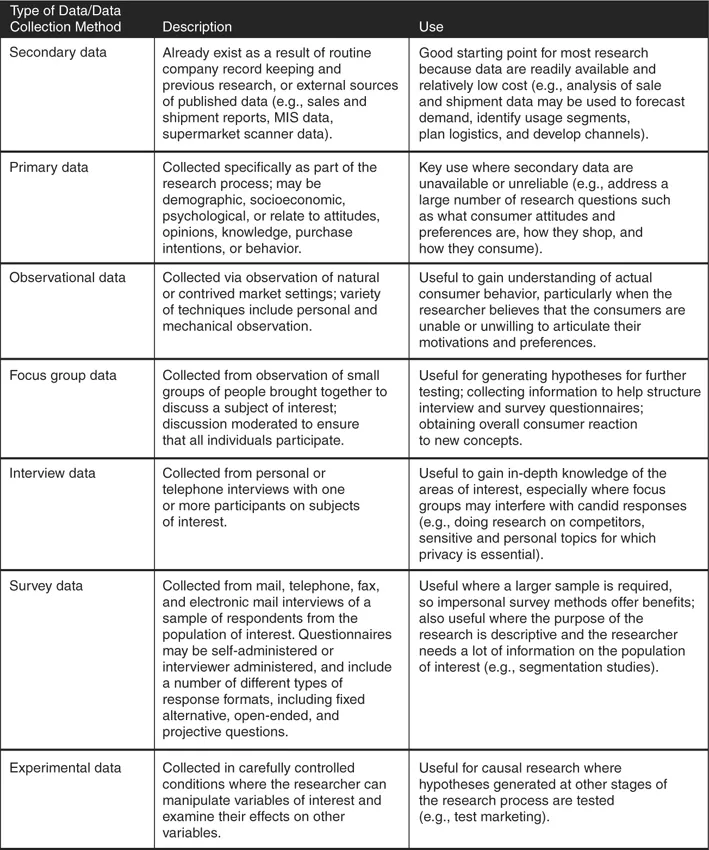
• Collecting data. Decisions at this stage include who will collect the data, the timeframe for data collection, required supervision, and the methods that will be used to ensure data quality and comparability across samples and studies. Data can be collected in a variety of ways. At the initial exploratory stage of the research process, including problem definition and hypotheses generation, managers may collect information informally through discussions with colleagues, field marketing personnel, distributors, customers, and noncustomers; all can provide valuable information. Additional data may be collected from secondary sources (published sources, syn-dicated studies) and through primary research, which includes a variety of research methods, such as interviews, surveys, focus groups, observation, and experiments. Figure 1.3 lists the types of data and data collection methods and provides brief descriptions of key uses of each.
Figure 1.3 Data—Types, Collection Methods, and Key Uses
• Assessing the data. Often researchers tend to skip this very important step in the process. Once the data have been collected, it is a good practice to review all information and develop a list of what is not there or has not been collected and assess its significance to helping answer or provide solutions to the problem. Frequently, this exercise and the subsequent round of data collec...