- 208 pages
- English
- ePUB (mobile friendly)
- Available on iOS & Android
eBook - ePub
About this book
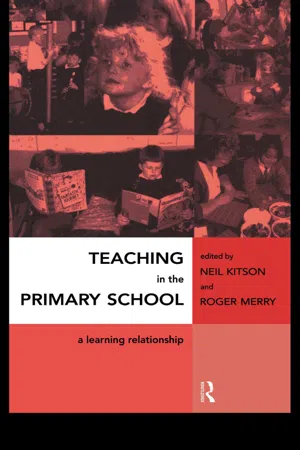
It is now widely recognized that learners are more successful when they are active participants in the learning relationship. This book offers a general introduction to primary education and child development, using the learning relationship between teachers and children as its focus. Divided into two parts, the first looks at the child's contribution to the learning relationship, and the second examines that of the teacher.
Information
Chapter 1
Just for fun?
The child as active learner and meaning maker
INTRODUCTION
For the past several decades in many parts of the world, play and active learning have been acknowledged as crucial to the cognitive and other developmental processes of children. That the child learns through making his or her own physical and mental connections with the world, through sensory explorations, personal effort, social experiences and the active seeking of meanings from experiences, has been established in the theories of psychologists and educationalists such as Froebel, Montessori, Isaacs, Steiner, Vygotsky and, later, Piaget and Bruner. Yet it is by no means easy for teachers and other adults in schools and kindergartens to achieve these ideals in practice, where so-called ‘child-centred’ education and individualised learning are either logistically, pragmatically or culturally considered inappropriate or unrealisable. Similarly, while many educators may see themselves as providing opportunities for children to be actively engaged in their learning, how far this is a reality will depend upon the interpretation and evaluation of these beliefs in practice.
In many countries, curricular debates have focused around the perceived imperative to balance the needs of society for a suitably educated workforce and the needs of children to learn at their own pace and in ways deemed appropriate to their current developmental phase. One view would suggest that we must allow young children to revel in their childhood and childhood experiences before we consider them to be future employees, with an entitlement to have the needs of their particular age group met before they, in turn, must meet the needs of an industrial society (Moyles, 1996). The whole concept of an industrially and economically dominated curriculum militates against a curriculum based upon individual learning needs which is deemed by many to be at the heart of effective primary school practices (Siraj-Blatchford and Siraj-Blatchford 1995).
This chapter sets out to identify the basis upon which these various beliefs about children’s active learning as both part of their intellectual development and of their rights as children are justifiable. It also examines their substance in terms of the teaching and learning relationship
and how such beliefs may be translated into curricular practices in different cultural settings. First, we explore the issue of how children perceive the world and are, in turn, perceived in the context of childhood by the dominant adults.
PRIMARY CHILDREN MAKING SENSE OF THE WORLD
The children in the kindergarten were told by the adult that it was nearly time to go outside for outdoor play. It was a beautiful, hot, sunny day though Anna, aged 4 years, moved towards the coat-racks and asked the adult to help her put on her coat. The adult laughed, saying, ‘You don’t need your coat It’s too nice out there. Go and feel how hot it is.’ Anna stood on the steps outside the nursery door and was seen to stretch out her arms and then pinch her fingers and thumbs together in a ‘feeling’ action.
As an example of ‘intelligent’ behaviour, the reader may wonder what on earth Anna was doing. But looked at from the child’s perspective, Anna was doing exactly what she perceived the adult had told her to do: in Donaldson’s (1978) words she was attempting to make ‘human sense’ of what had been said to her. The fact that she so literally interpreted the action behind the adult’s words is not uncommon in young children for it takes some time for them to grasp the different interpretations implicit in the words and actions of others.
Children in the primary years learn directly about their immediate environment through exploration using their senses: by attending to the world around them through touching, listening, tasting, smelling and looking, they begin to make generalisations. By generalising from these experiences, children begin to form the basis of lasting understandings. Without the ability to generalise and put ‘chunks’ of learning into large wholes, we would all rapidly become overloaded and overwhelmed with information (McShane 1991). But this very need to generalise means that children will not always be ‘right’, for, as Edwards and Knight (1994: 21) emphasise, ‘Young children have less information on which to build new understandings and their strategies for organising and holding information are less well developed.’ It is interesting to note that this equally applies to adult learners in contexts which are new to them, such as learning a second language.
Sensory learning combined with existing experience leads children to perceive the world in certain ways which, at different stages in the child’s development, leads to different levels of understanding being available to the child. As Merry (1995: 84) points out, ‘Perception is not a passive taking-in of our surroundings but a highly active process in which the information supplied by our brains is at least as important as the information received by our senses’. Donaldson (1993: 19) also believes that Most of the knowledge that matters to us – the knowledge that constitutes our conception of the world, of other people and of ourselves – is not developed in a passive way. We come to know through processes of active interpretation and integration.
Reality from the child’s perspective
Children’s views of the world are very much human-centred: they perceive and conceive of events and things through the experiences they themselves encounter and in which adults offer support and models. But there are times when perception dominates children’s thinking, and if they cannot perceive something they may well doubt its existence. Even when primary-age children do perceive something they frequently misinterpret what the reality is by attending only to those aspects which are immediately recognisable, adopting what Piaget and Inhelder (1969) called ‘unscientific causations’.
From much research (see, e.g., Langford 1987, Willig 1990, Bonnett 1994) it is clear that children bring a different kind of ‘logic’ to situations from which it is possible for the practitioners1 to learn a great deal with which to inform primary practice. Consider the following: after a short discussion about how they learned to read with a group of 11-year-olds clustered around a computer, the writer was presented with the following text and asked to ‘read’ it:

The children explained that this was how many of them had perceived reading as young children, a series of squiggles on paper which meant very little to them but which they knew that somehow they were intended to read. (The text, in Symbol font, actually says ‘Why can’t you read this? It is perfectly simple – provided you understand the language and the symbols in the first place!’)
Other instances spring to mind. Consider the child who answered ‘11’ to the seemingly simple sequence of numbers 2, 4, 6, 8, _. Although we would immediately perceive the answer from a numerical base as 10, this child’s interpretation was equally valid because she was actually perceiving the numbers to relate to a social and personal (egocentric) context: she is one of five children whose ages are 2, 4, 6, 8 and 11 years. The misinterpretation of the context of learning needed to be understood by the adult in order for the child’s ‘error’ to be understood.
Language proves to be no less confusing. Consider the child who has just had a large dish of their favourite food and is asked if they would like to have some ‘more’. What will they inevitably get? Well, certainly less than they had the first time! Or the child who, when asked which out of two ribbons is the longer, the red or the yellow, confidently responds ‘The yellow one – because I like that colour’. As Hughes (1983) points out, whereas adults would recognise that they have insufficient information, children do not always know the appropriate questions to ask and assume that a response is possible because the question has been asked by an older person.
Abstraction and symbolism
As adults, we are in danger of forgetting just how abstract – and symbolic – much of what we present to children really is. What must be recognised is that children’s thinking is not inferior to adults, but rather that it is different in form and experience. Their thinking is embedded in a context which has some meaning to them, whereas much school activity, such as filling in the blanks in a workbook, is what Donaldson (1993: 19) describes as ‘disembedded’ tasks: tasks divorced from a context in which children can see purpose and meaning and which, therefore, make the processes of learning much more difficult. Sotto (1994: 44) suggests that meaning emerges slowly from the learner’s active involvement in thinking through and understanding the ‘patterns’ which underlie understanding, and emphasises that learning is not the same as remembering. Wood (1988: 35) stresses that ‘Learning involves the search for pattern, regularity and predictability’, and urges us to view children as ‘limited information processors’. These findings propose a very different model of the child as learner from the one which suggests that they are passive recipients of handed-down information and ideas. As Bruce et al. (1995: 59–60) suggest,
Adults seize on the child’s developing ability to make and use symbols and often cannot wait to begin to teach directly the symbols of their particular society. In some cultures this begins at a very young age. . . . What is it that activates these important symbolic developments in children and . . . what turns them into ever deeper levels of symbolic learning? The key issue in answering this revolves around what kind of symbols children are most at ease with in their early years. This will dictate what symbols they can most readily engage with.
Bruce and her colleagues go on to propose that the development of the use of symbols in children is most likely to take place through ‘real experiences’ and ‘a consideration of the links among play, experience, relationships and creativity’, rather than pressure from adults to conform to learning which is outside the children’s current potential to understand.
It is acknowledged that, towards the end of primary schooling, children are more able to cope with disembedded tasks as their thinking becomes more abstract. However, as primary practitioners, we need to consider (and observe for) embedded thinking when we set out to teach different kinds of knowledge and understanding, for, whatever the content demands of a curriculum subject, the children need to have tasks presented to them which offer a meaningful context in which they can bring their previous experiences and understandings to bear and which fit in with the new experiences and patterns of understanding they are already acquiring. As Donaldson (1993: 20) suggests, ’ . . . it is even more important to recognise that the processes of coming to know transform us. This is particularly so when these entail sustained, self-directed effort.’
Teaching must acknowledge the learner’s role in the essential links between teaching and learning effectiveness. This means particularly recognising that the ability to think abstractly about things has a starting point in action, a feature of the work of Piaget, Bruner and Vygotsky which often manifests itself in the process we call ‘play’. It is to the links between play and active learning that we now turn.
ACTIVE LEARNING AND CHILDREN’S PLAY
The primary classroom is carefully arranged with all materials necessary for the morning’s session. The teacher has planned an active lesson for the children aimed at helping them to understand the concept of electricity. Each group of tables is equipped with a collection of bulbs, wires, batteries and switches, a new experience this term for this class of 9-year-olds. The active learning session has arisen because the teacher has recognised that, despite telling the children in a class session yesterday about electricity, they still do not appear to understand how a circuit is made.
When the children enter the room from the playground, many of them rush to the tables and, in the teacher’s words, start ‘messing about’ with the materials and arguing over them. It takes some time to bring the class back to order and to gather in the electricity resources. The teacher gives out a worksheet in which the children complete a series of sen...
Table of contents
- COVER PAGE
- TITLE PAGE
- COPYRIGHT PAGE
- ILLUSTRATIONS
- INTRODUCTION: TEACHING - A LEARNING RELATIONSHIP
- CHAPTER 1: JUST FOR FUN?: THE CHILD AS ACTIVE LEARNER AND MEANING MAKER
- CHAPTER 2: CHILDREN’S DEVELOPMENT 3–7: THE LEARNING RELATIONSHIP IN THE EARLY YEARS
- CHAPTER 3: COGNITIVE DEVELOPMENT 7–11: THE LEARNING RELATIONSHIP IN THE JUNIOR YEARS
- CHAPTER 4: CHILDREN WITH SPECIAL EDUCATIONAL NEEDS: SUPPORTING THE LEARNING RELATIONSHIP
- CHAPTER 5: KEEPING TRACK: OBSERVING, ASSESSING AND RECORDING IN THE LEARNING RELATIONSHIP
- CHAPTER 6: PRIMARY CULTURE AND CLASSROOM TEACHING: THE LEARNING RELATIONSHIP IN CONTEXT
- CHAPTER 7: LOOK BACK AND WONDER: THE REFLECTIVE PRACTITIONER AND THE LEARNING RELATIONSHIP
- CHAPTER 8: CLASSROOM TALK: COMMUNICATING WITHIN THE LEARNING RELATIONSHIP
- CHAPTER 9: MANAGING PRIMARY SCHOOLS: FACILITATING THE LEARNING RELATIONSHIP
- CHAPTER 10: BACK TO THE FUTURE: THE LEARNING RELATIONSHIP IN INITIAL TEACHER TRAINING
Trusted by 375,005 students
Access to over 1.5 million titles for a fair monthly price.
Study more efficiently using our study tools.
Frequently asked questions
Yes, you can cancel anytime from the Subscription tab in your account settings on the Perlego website. Your subscription will stay active until the end of your current billing period. Learn how to cancel your subscription
No, books cannot be downloaded as external files, such as PDFs, for use outside of Perlego. However, you can download books within the Perlego app for offline reading on mobile or tablet. Learn how to download books offline
Perlego offers two plans: Essential and Complete
- Essential is ideal for learners and professionals who enjoy exploring a wide range of subjects. Access the Essential Library with 800,000+ trusted titles and best-sellers across business, personal growth, and the humanities. Includes unlimited reading time and Standard Read Aloud voice.
- Complete: Perfect for advanced learners and researchers needing full, unrestricted access. Unlock 1.5M+ books across hundreds of subjects, including academic and specialized titles. The Complete Plan also includes advanced features like Premium Read Aloud and Research Assistant.
We are an online textbook subscription service, where you can get access to an entire online library for less than the price of a single book per month. With over 1.5 million books across 990+ topics, we’ve got you covered! Learn about our mission
Look out for the read-aloud symbol on your next book to see if you can listen to it. The read-aloud tool reads text aloud for you, highlighting the text as it is being read. You can pause it, speed it up and slow it down. Learn more about Read Aloud
Yes! You can use the Perlego app on both iOS and Android devices to read anytime, anywhere — even offline. Perfect for commutes or when you’re on the go.
Please note we cannot support devices running on iOS 13 and Android 7 or earlier. Learn more about using the app
Please note we cannot support devices running on iOS 13 and Android 7 or earlier. Learn more about using the app
Yes, you can access Teaching in the Primary School by Neil Kitson,Roger Merry in PDF and/or ePUB format, as well as other popular books in Education & Education General. We have over 1.5 million books available in our catalogue for you to explore.