Maria Sophia Quine demystifies the population policies of fascist regimes by looking at them in the wider context of how societies in general reacted to the profound economic changes brought by industrialization. Population Politics in Twentieth Century Europe:
* provides an original, comparative treatment of European population policies
* gives the historical background to twentieth-century population policies
* considers topics such as racism and sexism in Nazi ideology, Eugenics in England, family allowance schemes in France, and sterilization
* synthesizes the latest research in different fields and countries.
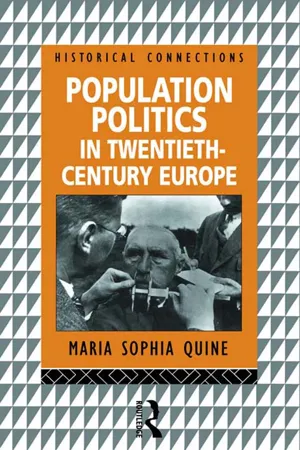
eBook - ePub
Population Politics in Twentieth Century Europe
Fascist Dictatorships and Liberal Democracies
- 160 pages
- English
- ePUB (mobile friendly)
- Available on iOS & Android
eBook - ePub
Population Politics in Twentieth Century Europe
Fascist Dictatorships and Liberal Democracies
About this book
Information
1 From Malthus to Mussolini
Fascist Italy’s ‘battle for births’
No one today can take the notorious, would-be ‘law’ of Malthus at all seriously..... It is absurd to think that a decreasing birthrate will improve the living standards of the Italian people.
(Benito Mussolini. From his essay entitled ‘Numbers as force’, which first appeared in print in 1928)
Italian fertility during the years 1870–1945 gave no cause for complaint. In many countries, an eighteenth-century average of around forty live births per 1,000 of the total population started to descend in the late nineteenth century and finally reached about twenty by the early twentieth century. Britain, and Germany to a lesser extent, fit this pattern of ever rapid decline in the decades after 1870. Italy, however, did not share this experience. The drop in the kingdom’s birthrate began after 1890 and was hardly precipitous thereafter. Italian natality still stood at 36.8 in the period 1870–2, remained well above thirty throughout the prewar period, and only slowly dwindled to 23.1 in the years 1930–2. Not until after 1945 did levels fall below twenty. And, somewhat exceptionally, at no time during this demographic shift did the Italian birthrate ever sink below the deathrate (Bacci 1980:80; Bacci and Breschi 1990:385–408).
The peculiar distinction of Italy during this downturn was the kingdom’s still healthy prospect for continued demographic expansion. After 1914, governments world-wide grew increasingly worried about the birthrate because of the unprecedented toll of casualties caused by the First World War. An estimated 765,400 British soldiers lost their lives during the hostilities. After three years of combat, 680,070 Italian servicemen were reported either killed or missing in action. And as many as 1,393,515 men died while defending France. Rising rates of sickness among the civilian population also prompted public debate. The sheer magnitude of death and destruction caused by total war provoked concern about the ‘population question’.
In the postwar period, the numerical preponderance of women over men, and of old people over young people, drove the birth, fertility and marriage rates far below prewar levels. In Britain, statesmen understood only too well that the birthrate fell by 50 per cent between 1900 and 1930, and that over three-quarters of this diminution occurred after 1914. French observers were also painfully aware of the huge ‘deficit’ in births. Without heavy immigration during the years 1921 to 1930, the French population would not have grown nearly as much as it did. Many belligerent nations did not experience any pronounced fertility upswings after the cessation of war. But Italy saw its birthrate bounce back vigorously after 1918 when natality reached an all-time low of eighteen. By 1920, the Italian birthrate rose to 31.8 as a result of a boom in marriages and babies (Glass and Blacker 1939:11–26). Although this brief upturn did not arrest the long-term momentum of demographic decline, it was an index of the country’s continued commitment to the perpetuation of the population.
Italians were in fact propagating at an exceptional rate despite the postwar odds. In marked contrast, the French had long since renounced a lively birthrate as a cause of population increase. The French birthrate started to plummet around 1740, when other nations like Italy, Britain and Germany were experiencing the first signs of a prolonged boom in births. In France, natality was already as low as 30.8 in 1821–30 and 27.4 in 1841–50. The rate plunged further to 26.2 in 1876, 18.8 in 1911–13 and 9.5 in 1916 (McLaren 1983:25 and 169; Ogden and Huss 1982:285). Moreover, during this period of decline, deaths exceeded births in a number of years. France had more reason than any other European nation to worry about becoming a moribund people. Far from facing any threat of imminent depopulation, however, Italy actually seemed to be suffering from a veritable ‘Malthusian’ crisis of over-population. Acute demographic pressure on limited economic resources condemned the bulk of the Italian populace to very low subsistence.
The human cost of high fertility in such an impoverished nation was high mortality. An index of low living standards, levels of infant and child mortality were much higher in Italy than they were in more wealthy nations (Hogan and Kertzer 1986:361–85). About one-quarter of all newborn infants died during their first year of life in 1881. In 1901, only sixty-nine out of one hundred children could expect to live for ten years. In 1911, 15 per cent of babies perished before they reached the age of one and another 10 per cent failed to survive into adulthood. And prenatal and neonatal mortality actually rose after 1871. Indices of poor standards of health, nutrition and housing, these rates may have increased partly because of better medical registration. But significantly, they still did not begin to show a persistent decline until after 1945 (Del Panta 1979:204). Another indication of population excess, about 25,000 unwanted infants were abandoned each year at convents, roadsides and churches. The deathrate of foundlings was more than double that of infants raised within families (Quine 1990: ch. 7).1
Italian demography reflected peculiarities in the kingdom’s economic development. If industrialization is taken to mean the transference of resources from agriculture into industry, then the Italian economy was relatively backward until a later date. With most of its labour force still on the land throughout the prewar period, Italy remained an overwhelmingly rural and underdeveloped nation. As late as 1937, the proportion of the economically active population engaged in agriculture was as high as 48.1 per cent, while only 33.1 per cent worked in industry. Italy had a ‘big spurt’ in industrial production during the years 1896–1908, when the annual rate of growth reached 6.7 per cent (Federico and Toniolo 1992:206–7). But the process of industrialization was slow, uneven and interrupted. Throughout the years 1870–1945, many of those who were listed in censuses as industrial workers would have toiled in small workshops employing no more than a few labourers.
After unification, the kingdom suffered from a chronic ‘agrarian problem’ characterized by the persistence of outmoded forms of underproductive and labour-intensive agriculture. In southern Italy, labourers worked on huge estates, called latifundia, which were owned by quasi-seignorial, absentee landlords. Drawn from the local nobility, proprietors owned not only the means of production but also most of the crop. Productivity was low given the extensive cultivation of land, the poor quality of the soil, the intemperate climate, the lack of investment and the primitive nature of farming technique. The latifundo economy proved to be thoroughly unable to keep food production in pace with prodigious population pressure (Serpieri 1930:12–18). Because of competition for work, labour was cheap and exploited. Southern agricultural workers lived well below subsistence, and their lives were characterized by seasonal poverty, unemployment, hunger and disease. Despite the wretchedness of their condition, Southern peasants continued to have large families. Cultural rather then economic factors accounted for the maintenance of high fertility in the Mezzogiorno.
Because of the failure of unification to integrate the South into a new national community, the Mezzogiorno remained largely untouched by the processes of change affecting more advanced regions (Barbagli 1984). In the North, the modernizing influences of secularization, a shift towards industrial work, the expansion of compulsory primary education, rising literacy rates, the beginnings of labour legislation and the spread of socialism undermined traditional family structures and social relations (Musso 1988:61–106). But in the South, the customarily large patriarchal peasant family survived well into the twentieth century (Manoukian 1988:3–61).
Other forms of agricultural organization provided an economic rationale for high fertility. In central Italy, the dominant form of land tenure was still the archaic mezzadria, a system of sharecropping in which extended families lived together in multi-unit households. Under the terms of the mezzadria contract, the proprietor provided land and the mezzadro (the tenant farmer) provided labour. The landlord took a share of the crop and the remainder went to the peasant (Serpieri 1920:84 and 89). Although it reduced labourers’ living standards to a bare subsistence, sharecropping provided no incentive to limit children since it was built around the household as a unit of production. The family economy depended on the exploitation of female and child labour and the existence of a large domestic work force (Kertzer 1984; Kertzer and Hogan 1989).
Older productive and social systems survived into an industrial age. Co-existing with the latifundia and the mezzadria, highly commercialized agriculture and agro-industry did develop throughout the Po Valley (Cardoza 1979:172–212 and 1982; Bull and Corner 1993: ch. 1). These gave rise to a class of landless day labourers. Like wage-workers in factories, braccianti had begun to limit fertility by the end of the nineteenth century. But because of the uneven pattern of Italian industrialization, the size of the rural and urban proletariat remained small compared to other countries. About 20 per cent of the population was classified as working class as late as the interwar period, and many of these workers were concentrated in isolated areas. The Italian peninsula and islands had few pockets of capitalist industry and agriculture which could generate new social values and reproductive habits. Located in the north-west, Piedmont, Lombardy and Liguria became known as Italy’s ‘industrial triangle’, an oasis of large-scale production and urban development within a predominantly rural society. In Italy, regional variations in economic progress were particularly pronounced, and these differences had significant demographic consequences.
Italian demography reflected the widening economic gap between North and South after 1881. Population trends varied enormously between the more industrialized and prosperous regions of the North and Centre and the more backward and impoverished Mezzogiorno. A distinct pattern of ‘demographic dualism’ gradually arose in which the South as a whole clung to an old regime of high fertility and high mortality. The sharpest decline in births occurred in the big cities of the North where the average age at marriage was 22–4 years for women and 26–7 years for men. The drop in Italian fertility after 1890 was due mainly to the increasing tendency of younger women to concentrate births in the early years of marriage. The entrepreneurial, mercantile and professional middle classes took the lead by limiting child output in this way. The Italian working class was also beginning to redefine maternity by having fewer children and confining childbearing to briefer periods. But Italy still had no shortage of large families.
For more advanced nations like Britain, the war completed the transformation of the large Victorian family into its diminutive twentieth-century successor. Only belatedly, however, did Italy experience this demographic transition. A far better index of procreative performance than the crude birthrate, fertility quotients measure the reproductive output of the female population. By the end of the 1920s, Britain reluctantly claimed the lowest level of fertility of any Western European nation, with 56.43 births annually for every 1,000 women of childbearing age (Wrigley 1961:144–7; Brookes 1986:149–75). French contemporaries witnessed a no less shocking reality when their fertility ratio dropped to 67.37 by 1930 (Wrigley 1969:158–9; 174–5; 183–7). But in 1931, the Italian kingdom still boasted an unusually high fertility rate of 95.35 births for every 1,000 women between the ages of 15 and 55 (Glass and Blacker 1939:9).
The progressive shift towards the two-child families more typical of north-western Europe occurred only slowly in Italy. In 1928, an official census revealed that over 14 per cent of all Italian families were ‘large’, defined as containing at least seven children. The 1928 census also investigated class differentials in female fertility and family size. According to the results, an Italian middle-class couple had three children on average. Urban and rural wage-earners were far more prolific. Women listed in the census as wives of factory workers had produced 5.9 live children on average. And an average family of agricultural labourers comprised 6.5 children.
Nor had all Italian women even begun to confine childbearing to the early stages of their reproductive cycles. The practice of birth control was far more widespread in the nation’s northern regions, and women from the South routinely produced children well into middle age. From 1880–90, millions fled the South for unskilled jobs in northern industries and foreign countries. Despite mass emigration and the preponderance of females in the population, the birthrate remained very high in the South. In Calabria, Apulia and Sicily, for example, most women married before their eighteenth birthday. And although they limited output by spacing births, many still fell pregnant at regular two or two-and-a-half-yearly intervals until they reached menopause. Not all newborn infants survived adolescence because the South was a region blighted by high unemployment, low wages and social misery. In 1928, Southerners figured prominently among the 1.5 million families with between seven and ten children and the 500,000 with ten or more. But because standards of health and welfare in the Mezzogiorno were among the worse in all of Europe, the premature deaths of infants and children from preventable causes remained disturbingly common. Population attrition, rather than prudent planning, somewhat limited the size of Southern families.
Recognition of the pronounced disequilibrium between population and subsistence grew. Compelling evidence of the poor living standards and quality of life of the masses renewed interest in the writings of Malthus. At the turn of the century, some liberal economists came to espouse the view that Italy had to curb population growth in order to prosper. A few members of the medical profession also began to champion the cause of ‘voluntary motherhood’. Vaguely eugenic aims motivated doctors to support birth control on the grounds that too many pregnancies caused a woman to produce inferior offspring. From the 1880s on, Italian doctors showed an increased willingness to study sex and reproduction, two areas which had traditionally been the province of religion and morality. Left-wing gynaecologists published a number of ‘neo-Malthusian’ works describing birth control methods (De Longis 1982:157–62), but inevitably, these reached only a tiny proportion of the 38 per cent of the population which was literate.
In 1909, a circle of progressive thinkers based in Milan decided to provoke a public debate about fertility. They sent out questionnaires to prominent figures investigating attitudes towards birth control. Interestingly however, the majority of respondents vehemently rejected the principles of Malthusianism. They criticized the idea that an excess of ‘prolificity’ condemned the proletariat to poverty and misery. Some doctors argued that any form of birth control, including abstinence and coitus interruptus, degraded the sexual act, endangered health and violated the ‘law of nature’. Among the few women who voiced an opinion, Ester Bonomi opposed contraception because she believed it would increase women’s sexual servitude and economic insecurity. If Italy became a more permissive society, she contended, men would have no compulsion to marry. Moral standards would degenerate and the family would perish. Moreover, economists provided detailed arguments about why Italy should strive to increase the size of its population (Lanaro 1979:56–7).
The unpopularity of the notion that fertility should be limited did not deter birth controllers from seeking a forum for debate. In 1910, the only prewar conference on the ‘sexual question’ took place in Florence. Advocates of birth control represented only a small minority of the participants. The revolutionary syndicalist, Luigi Berta, urged those present to educate the masses about contraceptive methods. He put forth a motion calling for the immediate dissemination of Malthusian propaganda among the people (Wanrooij 1990:74). But delegates at the convention did not subject this resolution to a vote. Even committed supporters of Malthusianism were timid in their approach. They believed that any radical initiative in such a confessional nation would provoke strong opposition from the Church and its followers.
The cautiousness of neo-Malthusians is somewhat surprising, given the fact that Italian criminal law had no specific statute against the publication of information about birth control. Italian firms could also freely manufacture contraceptives, though most of these were in the form of condoms. Too prohibitively expensive for the working class, condoms were produced mainly for the armed forces and they were advertised as prophylactics against venereal disease. Chemists even sold a number of products which could be used as abortifacients in home remedies. Women could buy enema kits with or without special vaginal tubes. They gave themselves soapy hot water enemas in order to abort. And douching with readily available caustic substances was a common, though sometimes fatal, method to induce abortion. Unified Italy’s first penal code, the Zanardelli Code of 1889, was moderately liberal in that it abolished capital punishment and reduced the severity of punishments for many crimes. The code made provision for abortion but not for birth control. Various clauses defined abortion as a ‘crime against the person’, much like infanticide and homicide, though less grave. Medical and legal strictures made a distinction between a foetus, which was defined in terms of its inability to thrive outside the womb, and an infant, seen as a fully-formed human being who enjoyed the rights of personhood. The code, accordingly, prescribed harsh sentences for abortion, including prison terms of up to four years for anyone procuring it and up to seven years for anyone performing it. But, if done without the woman’s consent, the crime was punishable by a prison term of up to twelve years. Article 369 of the code, by contrast, prescribed even heavier sentences of up to twelve years for anyone found guilty of infanticide. The medical and legal professions suspected that abortion was endemic, in spite of the severity of prescribed sentences. Doctors also recognized that many apparent miscarriages which came to their attention were probably self-induced ‘white abortions’ in disguise. And they knew that women performed and sought late terminations, a fact which obscured somewhat the fine distinction between abortion and infanticide. Despite the gravity of the offence, few abortion cases ever came before the law, and when they did, courts were inclined to take extenuating circumstances into account. The leniency shown to offenders, however, did not derive from sympathy with the plight of women. It reflected the influence on Italian criminology of the followers of Cesare Lombroso, a theorist who believed in women’s mental inferiority. The works of evolutionists who argued that women suffered from arrested development affecting the functioning of their faculties also bolstered this prevailing view. Since they were not intelligent enough to exercise intent, many maintained, women could not be held accountable for their crimes.
Because of the limitations of Italian criminal law, opponents of birth control were forced to invoke statutes safeguarding public decency. After three decades in which the reading public could easily find birth control information, a conservative backlash began. Twenty-seven thousand copies of The Art of Not Having Children: Practical Neo-Malthusianism were sold after its publication in 1911. Increasingly active as a national citizens’ lobby with branches in the major cities, the League of Public Morality determined to stop the traffic in ‘obscene and pornographic’ literature. Although it was a lay organization with no political or religious affiliation, the league drew support from practising Catholics within the upper classes. In 1913, the society in Turin filed an action against the manual. A self-taught working man, Secondo Giorno, had written the tract, a work which caused no furore until Luigi Berta provided a preface for its second edition in 1912. When Giorno and Berta were brought to trial for obsenity, the Italian birth control movement finally had a cause célèbre similar to the famous Charles Bradlaugh and Annie Besant case in 1877, which inadvertently brought the cause of English neo-Malthusians to the attention of the general public (Glass 1967; 32–4). The Giorno and Berta trial also provided a great deal of free publicity, if not public sympathy, for the fledgling birth control campaign in Italy. Since their pamphlet could be found to contain no offensive language or illustrations, the verdict begrudgingly went in favour of the defendants. Despite the fact that the jury found the work ‘immoral’, they could not uphold the charge that it was obscene.
Completely exonerated, Berta and Giorno took advantage of their celebrity. Soon after the trial, they founded the Lega Neo-Malthusiana (the Neo-Malthusian League). For the next two years, Berta published a periodical which was entitled Sexual Education: The Journal of Neo-Malthusianism and Eugenics. The journal emphasized the revolutionary nature of birth control. Berta believed that neo-Malthusianism was a doctrine favouring the sexual liberation of women and the economic emancipation of the working class. Publishing information about available contraceptive devices, he determined to free the proletariat from the burden of large families and perpetual poverty. In 1913, Sexual Education asked readers whether they thought neo-Malthusianism was ‘immoral’. The young socialist leader Benito Mussolin...
Table of contents
- Front Cover
- Half Title
- Title Page
- Copyright
- Contents
- Acknowledgements
- Introduction: Fears of ‘over-population’ and ‘depopulation’ in the nineteenth century
- 1 From Malthus to Mussolini: Fascist Italy’s ‘battle for births’
- 2 Fathers of the nation: French pronatalism during the Third Republic
- 3 Nazi population policy: pronatalism and antinatalism during the Third Reich
- 4 Conclusion: the politics of race and population in the twentieth century
- Bibliography
- Other sources
- Index
Trusted by 375,005 students
Access to over 1.5 million titles for a fair monthly price.
Study more efficiently using our study tools.
Frequently asked questions
Yes, you can cancel anytime from the Subscription tab in your account settings on the Perlego website. Your subscription will stay active until the end of your current billing period. Learn how to cancel your subscription
No, books cannot be downloaded as external files, such as PDFs, for use outside of Perlego. However, you can download books within the Perlego app for offline reading on mobile or tablet. Learn how to download books offline
Perlego offers two plans: Essential and Complete
- Essential is ideal for learners and professionals who enjoy exploring a wide range of subjects. Access the Essential Library with 800,000+ trusted titles and best-sellers across business, personal growth, and the humanities. Includes unlimited reading time and Standard Read Aloud voice.
- Complete: Perfect for advanced learners and researchers needing full, unrestricted access. Unlock 1.5M+ books across hundreds of subjects, including academic and specialized titles. The Complete Plan also includes advanced features like Premium Read Aloud and Research Assistant.
We are an online textbook subscription service, where you can get access to an entire online library for less than the price of a single book per month. With over 1.5 million books across 990+ topics, we’ve got you covered! Learn about our mission
Look out for the read-aloud symbol on your next book to see if you can listen to it. The read-aloud tool reads text aloud for you, highlighting the text as it is being read. You can pause it, speed it up and slow it down. Learn more about Read Aloud
Yes! You can use the Perlego app on both iOS and Android devices to read anytime, anywhere — even offline. Perfect for commutes or when you’re on the go.
Please note we cannot support devices running on iOS 13 and Android 7 or earlier. Learn more about using the app
Please note we cannot support devices running on iOS 13 and Android 7 or earlier. Learn more about using the app
Yes, you can access Population Politics in Twentieth Century Europe by Maria-Sophia Quine in PDF and/or ePUB format, as well as other popular books in Politics & International Relations & 20th Century History. We have over 1.5 million books available in our catalogue for you to explore.