George Berkeley is one of the most prominent philosophers of the eighteenth century. His Principles of Human Knowledge has become a focal point in the understanding of empiricist thought and the development of eighteenth century philosophy.
This volume introduces and assesses:
* Berkeley's life and the background to the Principles
* The ideas and text in the Principles
* Berkeley's continuing importance to philosophy.
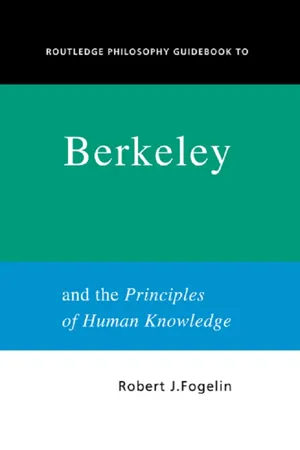
eBook - ePub
Routledge Philosophy GuideBook to Berkeley and the Principles of Human Knowledge
- 176 pages
- English
- ePUB (mobile friendly)
- Available on iOS & Android
eBook - ePub
Routledge Philosophy GuideBook to Berkeley and the Principles of Human Knowledge
About this book
Information
Part 1
General Introduction
Chapter 1
The Context of Berkeley’s Philosophy
Berkeley’s Life and Writings
George Berkeley (1685–1753) was born and educated in Ireland. At the age of twenty- four he began a remarkable period in which he published his Essay towards a New Theory of Vision (1709) and then the two works on which his philosophical reputation rests: A Treatise Concerning the Principles of Human Knowledge (1710), and Three Dialogues between Hylas and Philonous (1713). He also published a book on physical theory, De Motu (1721), a work that illustrates his lifelong interest in scientific issues. Berkeley never abandoned philosophy, but other interests and obligations prevented him from dedicating himself fully to it. He became deeply involved in missionary efforts intended to found a college in Bermuda. When these efforts failed for lack of funding, he returned to England. In 1734 he was appointed Bishop of Cloyne. During the time when he was largely occupied with missionary and ecclesiastical matters, Berkeley was still able to publish works on a wide variety of topics. Alciphron (1732) is a long dialogue defending Anglican dogma against freethinkers, atheists, skeptics, materialists, and other “minute philosophers,” as he calls them. The Analyst (1734) raises important mathematical objections to Newton’s theory of infinitesimals. The Querist (1735) offers reflections on economic matters, wholly written, remarkably enough, as a series of questions. Siris (1744) is a curious combination of reflections on metaphysical topics together with a defense of the powers of tar-water, an infusion made from pine tar. (Berkeley’s advocacy of tar-water has led some writers to treat him as a quack when, in fact, he was simply touting a traditional nostrum whose lineage goes back to antiquity.) After his early efforts, Berkeley did not again produce a general statement of his philosophical position. However, he seems never to have abandoned this standpoint, and many of his later writings are specific applications of it.
The Philosophical Setting
John Locke, George Berkeley, and David Hume are often grouped under the heading of British Empiricists or, to separate them from later empiricists and to give them pride of place, Classic British Empiricists. This grouping is illuminating but, in some ways at least, misleading. It can be illuminating because there certainly is a natural line of development starting with Locke, running through Berkeley and culminating in Hume. Sketched in broad strokes, the development looks like this: Locke, in opposition to the Rationalist philosophy that dominated seventeenth-century Continental philosophy, and much of British academic philosophy, rejected the doctrine of innate ideas and in its place presented a classic statement of empiricism. He then tried to show that the empiricist standpoint provides a suitable basis for our knowledge concerning the material world, the mental world, and the spiritual world. Berkeley, the story continues, showed that Locke’s account of our knowledge and understanding of the material world is untenable and for this reason adopted an idealist position, that is, the theory that the only substance that exists is spiritual or mental substance. Hume, agreeing with Berkeley’s criticism of Locke, went on to argue that we are no better placed to understand and have knowledge of the mental and spiritual world than we are to have knowledge of the material world. Thus the empiricist program, optimistically begun by Locke, ends in Hume’s radical skepticism.
This historical or, as we might better call it, dialectical account of the relationship between these three philosophers is not wholly misguided, for something like this development did take place. What gets lost on this approach is, first, the complexity of this historical development, and second, the power and richness of each position taken on its own terms. The depth and originality of Berkeley’s works suffers under this historical interpretation, as does Hume’s. Recognizing that his own position might be viewed as a mere exploitation of the shortcomings found in Locke’s system, Berkeley insists in the strongest terms that his position securely rests on independent grounds of its own. He offers extensive criticisms of Locke’s position in an effort to eliminate a powerful and influential alternative to his own theory, but Berkeley never argues as follows: “One must choose between Locke’s position and mine. Locke’s position is untenable, so mine is correct.” The difficulty with that line of argument is that it can be countered by the claim later made by Hume and others that both the Lockean and the Berkelean positions are untenable. The only way for Berkeley to counter a challenge of this kind is to provide satisfactory positive arguments in behalf of his philosophy. He saw this clearly and attempted to meet this demand. Bringing into prominence these positive aspects of Berkeley’s philosophy is one of the central themes presented in this work.
That said, it remains a fact that understanding Berkeley’s philosophy demands an understanding of the philosophical context in which it arose, and John Locke’s writings were a central force in shaping this context. Berkeley saw Locke as an opponent, both with respect to the things he said on specific subjects, and also as the representative of a broadly held philosophical standpoint that Berkeley rejected. In many contexts it is not entirely clear whether Berkeley had Locke specifically in mind in formulating certain criticisms. Yet, as his informal writings indicate, Locke was a central figure in Berkeley’s thought. He was also a figure whom Berkeley deeply respected, referring to him in one place as a “gyant.”1 It is important then to have at least a broad understanding of Locke’s position in order to appreciate Berkeley’s attempt to develop a radical alternative to it. With apologies for its oversimplification and its tendency to gloss over difficult interpretative questions, the following is an effort in that direction.
The Lockean Framework
John Locke gives the following account of the circumstances that led him into a labyrinth of philosophical reflections. He was, he tells us, engaged in a discussion with five or six friends, presumably on moral and religious topics, when he came to a sudden realization:
After we had awhile puzzled ourselves, without coming any nearer a resolution of those doubts which perplexed us, it came into my thoughts, that we took a wrong course; and that before we set ourselves upon enquiries of that nature, it was necessary to examine our own abilities, and see what objects our understandings were, or were not, fitted to deal with.
(Essay, Epistle to the Reader)
Twenty years of reflecting and writing on these questions yielded his Essay Concerning Human Understanding. It appeared in 1690 and secured his lasting philosophical reputation.
In the Essay, Locke undertook “to inquire into the original, certainty, and extent of human knowledge, together with grounds and degrees of belief, opinion, and assent.” In pursuing this program, Locke took over ideas from a wide variety of sources, adapting them to his purposes; thus, many of the items that are here included as parts of what I have called the Lockean framework are not distinctively Lockean in character. It is important, then, to remember that, in attacking components of what I have called the Lockean framework, Berkeley is often targeting views that were widely held, forming part of what was then called “received opinion” on certain matters. Furthermore, Berkeley sometimes attempted to distance himself from views that Locke would reject as well. Granting all this, it remains a fact that Locke’s philosophy was a central—perhaps the central—object of Berkeley’s criticism; thus, understanding Berkeley’s philosophy demands at least a broad understanding of Locke’s.
In outline, Locke’s philosophical program involves three tasks:
[Firstly to] enquire into the original of these ideas, notions, or whatever you please to call them, which a man observes, and is conscious to himself he has in his mind.
Secondly, [to] endeavour to shew what knowledge the understanding hath by those ideas; and the certainty, evidence, and extent of it.
Thirdly, [to] make some enquiry into the nature and grounds of faith, or opinion; whereby I mean that assent, which we give to any proposition as true, of whose truth yet we have no certain knowledge; and here we shall have occasion to examine the reasons and degrees of assent.
(I, i, 3)
Here we will concentrate on Locke’s execution of the first two parts of this program.
The Origin of Ideas
In the seventeenth century it was broadly held that our minds become furnished with ideas in two fundamental ways: some are given to us by perception, others are innate, that is, in some manner implanted in us at birth. All other ideas must be constructed from ideas provided by these two sources. Innate ideas were considered the more important source of ideas on what Locke calls the “received,” that is, dominant, opinion of the time. The doctrine of innate ideas had a long history stretching back to antiquity, but Locke’s primary concern was with the central role this doctrine played in Descartes’ philosophy and in the philosophy of other so-called Continental Rationalists who followed him. These rationalist thinkers considered innate ideas superior to ideas derived from perception in at least two respects: Innate ideas concern more profound matters than anything presented to us by the senses, and the judgments employing innate ideas possess a level of certainty that no empirical judgments can attain. The idea of God was often taken as an example of an innate idea; here, it seems, we have an idea that far exceeds anything we could acquire by experience, for nothing like an infinite being is encountered in experience. Not only was our knowledge of God derived from an innate idea, God was also taken to be the source of innate ideas, thus lending them the dignity of divine support. As Descartes put it, God “placed this idea in me to be, as it were, the mark of the craftsman stamped on his work” (Descartes, Méditations on First Philosophy, III). For the Continental Rationalist, the correct way of doing philosophy is to begin with “clear and distinct” innate ideas and then to construct a secure edifice of knowledge upon them. Ideas drawn from experience had their role as well, but an inferior role dependent for their usefulness on knowledge derived from God-given innate ideas.
Locke denied that there are any such things as innate ideas. He further denied that there are any innate principles that employ them. The first book of his Essay is dedicated to showing this. Locke’s attack on innate ideas has the following curious feature: As most scholars agree, the arguments that Locke brought against the existence of innate ideas are quite feeble and easily answered. (It is generally thought that Leibniz succeeded in doing this in his New Essays on Human Understanding, a work written specifically in response to Locke’s Essay.) For all that, Locke’s attack on the doctrine of innate ideas was enormously influential. Part of the reason is, perhaps, that the rejection of innate ideas was intellectually liberating. With supposedly God-backed innate ideas pushed aside— and in effect this is what Locke did—the way is opened for fresh and independent thinking on a wide range of philosophical topics. As the following passage shows, Locke thought that the rejection of innate ideas could also have important political consequences.
When men have found some general propositions, that could not be doubted of as soon as understood, it was, I know, a short and easy way to conclude them innate. This being once received, it eased the lazy from the pains of search, and stopped the enquiry of the doubtful concerning all that was once styled innate. And it was of no small advantage to those who affected to be masters and teachers, to make this the principle of principles, “that principles must not be questioned”: For having once established this tenet, that there are innate principles, it put their followers upon a necessity of receiving some doctrines as such; which was to take them off from the use of their own reason and judgment, and put them on believing and taking them upon trust, without farther examination: In which posture of blind credulity, they might be more easily governed by, and made useful to, some sort of men, who had the skill and office to principle and guide them.
(I, iv, 24)
Having (to his satisfaction) eliminated the doctrine of innate ideas in the first book of the Essay, in the second book Locke initiates the long project of laying out his alternative to it—a project intended to establish that “men, barely by the use of their natural faculties, may attain to all the knowledge they have, without the help of any innate impressions and may arrive at certainty without any such original notions or principles” (I, ii, 1). Locke referred to the procedure he would employ in his attempt to achieve this goal as “the historical, plain method.” This “historical, plain method” is an attempt to give an account of how the mind, starting at birth with no ideas of any kind, is able to acquire the vast system of complex, subtle and often remote ideas found in human consciousness solely on the basis of constructions from ideas given in experience. He gives an outline of this program in this famous passage:
Let us then suppose the mind to be, as we say, white paper, void of all characters, without any ideas; how comes it to be furnished? Whence comes it by that vast store which the busy and boundless fancy of man has painted on it with an almost endless variety? Whence has it all the materials of reason and knowledge? To this I answer, in one word, from experience; in all that our knowledge is founded, and from that it ultimately derives itself. Our observation employed either about external sensible objects, or about the internal operations of our minds, perceived and reflected on by ourselves, is that which supplies our understandings with all the materials of thinking. These two are the fountains of knowledge, from whence all the ideas we have, or can naturally have, do spring.
(II, i, 2)
Here Locke is speaking about the origin of ideas. He is not yet concerned with the status of principles or judgments expressed by means of these ideas. In more modern language, he is initially concerned with concepts and not yet with the propositions in which concepts are employed. His claim, then, is that all concepts—or the content of all concepts—are ultimately derived from experience. Using this language, Locke is sometimes called a concept empiricist. He was not, however, a thoroughgoing empiricist with respect to the grounds needed to support judgments or propositions. For Locke certain judgments can be known to be true on a priori grounds even though the concepts employed in the judgment must be derived from experience. Hume adopted the same position, as did many later empiricists, for example, the logical empiricists.
There seems to be an obvious objection to Locke’s claim that all of our ideas are derived from experience. People have ideas of things that they have never experienced, for example, an idea of the Taj Mahal. They may even have ideas concerning things that no one has experienced, for example, a city with its streets paved with gold. Locke’s careful wording anticipates this objection, for he tells us that all ideas are ultimately derived from experience. His claim is that the basic constituents of ideas—their simple components—are derived from experience. So Locke’s concept empiricism comes to this: All complex ideas can be reduced to a system of simple ideas, and these simple ideas, without exception, are derived from experience.
With his methodology in place, Locke is now faced with the formidable task of showing how a wide range of complex ideas can be reduced to collections of simple ideas, all of which are derived from experience. Locke, no shirker, presented an extraordinary inventory of ideas, both simple and complex, that he claimed could be dealt with employing his “historical plain method.” It includes an examination of the ideas of God, space and time, infinity, causality, substance, personal identity, liberty, and so on. In each case, he is presented with a double task. The first is to give what is now called a correct analysis of these concepts, that is, to show how ideas, if complex, are constructs out of simple ideas. The second is to show that the ideas so analyzed can be brought into the compass of his empiricist theory. How well he does in these efforts can only be settled on a case-by-case basis, something that cannot be undertaken here.
Locke’s Theory of Perception
Since Locke holds that all of our ideas are ultimately derived from experience, a theory concerning the nature of perception must hold a central place in his system. Though Locke never uses the expression “representational realism,” it is an expression commonly used as a label for his theory of perception. This, however, brings us into disputed territory, for a number of able commentators have argued that Locke was not a representational realist—at least as that position is commonly understood.
This presents a problem. It is important to understand his v...
Table of contents
- Cover
- Half Title
- Title Page
- Copyright
- Dedication
- Contents
- Preface
- Texts and citations
- Part 1: General Introduction
- Part 2: The Basic Arguments of Berkeley’s Principles of Human Knowledge
- Part 3: Epilogue
- Notes
- Further reading
- Index
Trusted by 375,005 students
Access to over 1.5 million titles for a fair monthly price.
Study more efficiently using our study tools.
Frequently asked questions
Yes, you can cancel anytime from the Subscription tab in your account settings on the Perlego website. Your subscription will stay active until the end of your current billing period. Learn how to cancel your subscription
No, books cannot be downloaded as external files, such as PDFs, for use outside of Perlego. However, you can download books within the Perlego app for offline reading on mobile or tablet. Learn how to download books offline
Perlego offers two plans: Essential and Complete
- Essential is ideal for learners and professionals who enjoy exploring a wide range of subjects. Access the Essential Library with 800,000+ trusted titles and best-sellers across business, personal growth, and the humanities. Includes unlimited reading time and Standard Read Aloud voice.
- Complete: Perfect for advanced learners and researchers needing full, unrestricted access. Unlock 1.5M+ books across hundreds of subjects, including academic and specialized titles. The Complete Plan also includes advanced features like Premium Read Aloud and Research Assistant.
We are an online textbook subscription service, where you can get access to an entire online library for less than the price of a single book per month. With over 1.5 million books across 990+ topics, we’ve got you covered! Learn about our mission
Look out for the read-aloud symbol on your next book to see if you can listen to it. The read-aloud tool reads text aloud for you, highlighting the text as it is being read. You can pause it, speed it up and slow it down. Learn more about Read Aloud
Yes! You can use the Perlego app on both iOS and Android devices to read anytime, anywhere — even offline. Perfect for commutes or when you’re on the go.
Please note we cannot support devices running on iOS 13 and Android 7 or earlier. Learn more about using the app
Please note we cannot support devices running on iOS 13 and Android 7 or earlier. Learn more about using the app
Yes, you can access Routledge Philosophy GuideBook to Berkeley and the Principles of Human Knowledge by Robert Fogelin in PDF and/or ePUB format, as well as other popular books in Philosophy & Empiricism in Philosophy. We have over 1.5 million books available in our catalogue for you to explore.