eBook - ePub
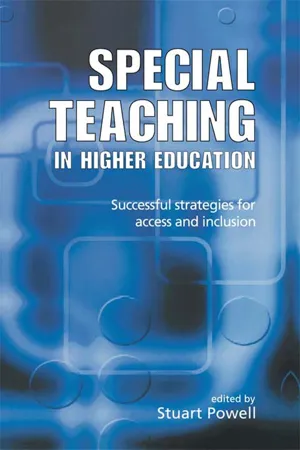
Special Teaching in Higher Education
Successful Strategies for Access and Inclusion
- 244 pages
- English
- ePUB (mobile friendly)
- Available on iOS & Android
eBook - ePub
About this book
Covering the Special Educational Needs and Disability Act (SENDA), this book addresses the learning needs of impaired and disabled students. It suggests effective responses for those designing and delivering the curriculum and discusses flexible teaching strategies.
An essential purchase for any education professionals wanting to implement best practice when catering for those with particular needs - whether lecturers, course developers, course leaders or learning and teaching interest groups.
Information
Part one
Introduction
1
Special teaching in higher education
Introduction
This chapter seeks to outline the approach taken in the book and indicate its underlying principles. The genesis of the book is described by way of giving an initial justification, and subsequently the way it is structured around identified areas, deemed to require special teaching, is discussed. The issue of the right for all to be able to access appropriate education is explored, along with the needs for a new kind of curricular flexibility and openness in higher education. Finally, the chapter emphasizes the valuing of diversity, and the need to recognize and understand the range of individual differences in learning, and respond to them with a way of teaching that utilizes knowledge of special skills and strategies.
Origins
The origins of this book can be traced to two complementary sources. Some of my own professional work involves issues surrounding autism, and the psychology and education of individuals with ‘autistic spectrum disorders’ (ASD). Much of the pioneering research and practice in the field has been targeted at the early years, the years of formal schooling, and care in the post-schooling phase. But as understanding of autism and its range of manifestations across the spectrum (and I include here Asperger's syndrome) has improved, as diagnosis has become more sophisticated and more widely available, and as provision within the school sector has increased, so the issues have been pushed up the age range. Individuals who less than 20 years ago would have been described by those in authority as mystifyingly odd, and who would have had little formal schooling of an appropriate kind, and therefore little opportunity of progressing into further or higher education, are now gaining an appropriate education. Consequently they are proving themselves able to gain access to higher education, and potentially to be successful within it. Of course this success story brings with it new challenges for all concerned. I have been contacted on a number of occasions by parents of young people with autism about to go to university, anxious to know what can be done to facilitate their child's successful inclusion within that university. Similarly, I have been contacted by lecturers who either have or are about to have a student in their classes with a diagnosis of ASD, and who want to know at a very pragmatic level what they should do to enable that student to be successful.
I should note that anxiety often typifies both parents and professionals, though clearly the roots of that anxiety are different. Parents have invariably had the child's lifetime of experience of trying to understand him or her, trying to pass on their understanding to professionals, and also often to persuade professionals of the child's needs and potential. This is not the place to go into the detail surrounding understanding of autism, but it is important perhaps to note that parents are often experts on their own child, though not necessarily expert in the complexities of educational systems. The anxiety of lecturers often relates to their own lack of knowledge about the condition and its relationships to the kind of learning that goes on in university, and sometimes to a worry about the effects on the other students of the individual's presence in learning groups and within the cohort as a whole. My premise is that anxiety is a natural enough state of mind in this respect, and that those willing to ask the questions, as long as they are asking with a view to improving their own teaching, have made the necessary first step to success. (I am making this premise even if some of the initial questions and the attitudes that underpin them are misguided in themselves.) What is really required of educators, at least in the first instance, is a willingness to try to understand; the pragmatics leading to successful inclusion for the individual student will follow.
The second source of this book is a more personal one, and I note it here merely to indicate why I think it is so important to recognize that some students have needs that are special, and yet also amenable to resolution. My daughter progressed through the school system successfully because key individual teachers and headteachers were prepared to take on ideas and procedures with which they were wholly unfamiliar. Her profound hearing loss was a challenge to her and to those she came into contact with. (I recognize here that the issues are not just matters of ‘challenge’—see the section on Diversity later in this chapter.) At the stage of university entrance, a new set of challenges faced all concerned. Again, it was the willingness of key academic staff to set their minds to how to enable her very specific needs to be met that was a key factor in her ultimate success in degree-level work. This is not, of course, to underplay her own determination and ability In the period during which this phase of her education was taking place, there was little published material to help academic and support staff in their efforts. The intention behind this book is that academics in similar positions today will find explanation and guidance in particular chapters—in the instance quoted here, in the chapter by Jarvis and Knight (Chapter 4).
Structure of this book
A fragmented view of pedagogical issues?
Some readers may find the approach taken in this book unusual in the current climate of special needs provision in society in general, and in education in particular. Indeed, some may share the discomfort felt by an academic colleague, who rejected involvement with the book on the grounds, one, that the approach taken ‘suggests a somewhat fragmented view of pedagogical issues associated with access and disability’, and two, that a more appropriate approach would be to ‘address the pedagogy first and look at how it might be adapted, by means of dialogue, to fit the needs of individual students. In other words, to determine the learning needs of the student body as a whole and then to design a curriculum that, as far as possible, takes account of the heterogeneity of learning needs.’ In putting forward these criticisms the argument is made that the approach taken in the book runs counter to ‘a more inclusive approach’. I take the liberty of repeating the discomforts expressed here because I think they represent in broad terms a body of opinion that needs recognition. I am not merely trying to create a straw man or woman, but rather to recognize a view (and one that may dominate thinking in this area at the moment).
Inherent in the criticisms outlined above is a reluctance to see individuals as having definable and special needs with regard to their education, that can be directly addressed in a compartmentalized way. For some, to have chapters specifically addressing the needs, for example, of the hearing impaired is to run the risk of returning to the days when individuals with such needs were separated out by their disability and offered something different by way of education: a different curriculum delivered in a different way and in a different location.
Does the structure of the book, then, suggest a fragmented view of pedagogical issues associated with access and disability? Clearly it suggests that it is reasonable to separate out different kinds of disability and specific learning need, in respect of at least some aspects of the educative process. In so doing it does not deny in my view that there are some commonalities in terms of issues—indeed these are picked up in the ‘Issues for pedagogy’ chapters. For example, it does not suggest denial of the principle of equal right of access to the possibility of success in education. But it does suggest that there are some aspects of that educative process that are specific to one group of individuals in exclusion of all others.
For example, those individuals with a hearing impairment need provision within an auditory domain that is a separate, compartmentalized issue for them (and therefore for their educators). They do need special treatment if they are to gain the same possibility of accessing curricula as their non-hearing-impaired peers. Indeed to deny them such special consideration for ideological reasons would be, in my view, to deny a necessary advantage in the search for inclusion. To indicate to an individual student with a hearing impairment that his or her needs for auditory support cannot be dealt with specifically (in this case by way of a separate chapter) because we have to include him or her in the whole of our approach to pedagogy ‘first’ is somewhat perverse. If the goal of inclusion is to be attained, it will only be by considering the specifics of need as well as a pedagogy for all. In short, to separate out a set of issues and give it special consideration is not to deny that the set is also embedded (included) in a greater whole—it is merely to suggest that to understand its place within the whole, one needs to understands the specifics that define it. And for those who find no definable specifics within hearing impairment or schizophrenia or dyslexia or similar conditions, I would suggest a careful reading of the case studies that underpin most of the chapters in this book.
The heterogeneity of learning needs
Certainly, it was the intention when I conceived of this book and its layout that contributing authors would consider the curriculum in such a way as to ‘take account of the heterogeneity of learning needs’. Indeed what underpins the book is the notion that all students have different learning needs, and that each individual student comes to the learning context of a particular university with his or her own set of expectations, motivations, prior knowledge and experience, as well as levels of ability and skill across a range of intellectual and social domains that are specific to him or her alone. I would argue that in recognizing this heterogeneity, it is also possible to identify sets of learning characteristic within the continuum of difference that can usefully be addressed in a direct and compartmentalized way. Indeed, as I have already noted, I would argue that to fail to address specific kinds of need in this direct way is to do a disservice to individuals who can only succeed when such attention is paid.
The university lecturer engages with large numbers of students every year. That lecturer may well recognize that those students are a heterogeneous group, and try to devise and deliver a curriculum that meets all their needs. What this book seeks to do is to help that lecturer by giving direct information about the learning needs of particular groups of individuals, and advice on how best to adapt the curriculum and its delivery in such a way as to include individuals within those groups in an educative process that seeks to offer the best opportunities for successful learning for all.
The students’ perspectives
The contributing authors in this book are all experienced in the area that they address in their respective chapters. Some have themselves disabilities, or difficulties with some aspects of learning. There is not however a specific chapter written by a disabled student giving her or his perspective on the experience of higher education. Rather the device has been used of incorporating the student's view in each chapter by way of student comment and by case studies. Those views are taken to be of vital importance in the search for inclusion, and are built into the text in the various chapters. In this way it is hoped that the range of views and interpretations can be encompassed.
Rights and privileges
It is not the purpose of this book to consider in detail the specific legal situation with regard to the rights and privileges of the disabled in higher education. Indeed the book considers a kind of teaching that is responsive to students who would not fall within the terms of the Disability Act: it contains a chapter on English as a second language. (Clearly the claim being made is not that this is a disability, but rather that it requires special teaching.) The book is intended to focus on issues of pedagogy that will hopefully transcend the particular period of time of publication and the immediate legal context. Nevertheless the various chapters are written within the current legal and social climate, and reflect a concern therefore with the issues that arise from recent legislation. In addition, the chapter by Jeremy Cooper (Chapter 2) does address issues within the legal scenario, taking an international perspective in order to set what is happening in the UK within a wider context. In this introductory chapter I touch upon some of the issues, but again from the point of view of pedagogy rather than of the specifics of legality or social change. I will however summarize the current situation with regard to disability very briefly in the section below.
Disability legislation—brief overview
The Disability Discrimination Act (DDA) gives those with disabilities a legal right to fair treatment in certain defined areas such as employment and the provision of services. Disability here is defined as ‘mental or physical impairment that has a substantial and long term effect on the ability to carry out day to day activities’ (again, I stress that this book transgresses this boundary). Basically this means that in the UK at present, those with disabilities must not be treated any less favourably than those without. Of course there are ‘reasonable’ limits to what is required of employers and to the kind of adjustments they are expected to make. In itself the DDA did not offer students protection from discriminatory practices in education, but universities were required to state to the funding council their present and future provision for disabled students. (This latter requirement has changed since later amendments to the Act.)
The Special Needs and Disability Act of 2001 amended the DDA and included education in Part IV. Effectively this amendment requires universities (among others) not to treat disabled students less favourably (without justification) than those who are not disabled, and to make reasonable adjustments to ensure that people who are disabled are not substantially disadvantaged in gaining access to the education on offer. The amendment is being staged in implementation at the time of writing this book, with the duty to make reasonable adjustments in terms of auxiliary aids and services coming into force in 2003, and to make physical adjustments by 2005. Guidance on the implementation of the Act is provided in a Statutory Code of Practice.
Curricular flexibility
It is incumbent upon higher educational institutions (HEIs) therefore to ensure that students with disabilities can participate fully in the curriculum, and that the kinds of educational activity contained within that curriculum have enough inbuilt flexibility to enable that participation. Again, in this book we are including in this aim students who have learning needs that require a special response from educators, but who do not fall within the definition of disabled. Such a process of enabling participation requires that HEIs analyse what they offer to their students and what expectations they have of them. This in itself is, of course, no bad thing. Working through what learning experiences are essential for a set of outcomes to be realized, and what ‘performances’ would legitimately count as indicators of a successful realization of those outcomes, is useful in the same way as any fundamental reappraisal of aims and ways of achieving and measuring them. In short, addressing the special needs of some learners is likely to lead to an enhancement of educators’ understanding of their own implicit and explicit aims, and the processes by which they try to attain them. Seeing the procedures and outcomes of education from the perspective of the disabled may throw a new light on the process—elements of what have been established as custom and practice may be challenged by an examination of real purposes, to the benefit of all students.
In the current legislative climate in the UK, HEIs are required to review what courses require of students with declared disabilities, and where appropriate, reasonable adjustments must be made to those requirements so as to enable participation by such students. This makes sense where adjustments to learning processes, or the context within which those processes take place, can lead to the same opportunity for successful learning outcomes for all students. In my own view, the students whose needs are addressed in this book (whether or not they fall within the DDA) have the same right to the opportunity for successful learning as all other students.
Curricular additions and substitutes
If there is to be true inclusion within an HEI, then it is also clear that additional support needs to be provided by that HEI where it is necessary for all individuals to achieve desired learning outcomes. It may be that the extra support takes the shape of additional resources, or of additional courses that are embedded within the individual's overall programme of study Clearly, what is needed here is for educators to think flexibly about ways of achieving the same goals but by different means. In this book it is the intention of contributors to challenge preconceived ways of designing and delivering the curriculum, and to offer ways in which educators can think outside traditional curricular parameters. This latter kind of thinking may involve creating educational activities that act as substitutes for those that are traditionally made available, and that are, for whatever reason, unavailable or inappropriate to the individual concerned. From a pedagogical point of view, the important thing about the substitute is, again, that it should act as an alternative means to the same (learning) end. From a legalistic point of view, words such as ‘reasonable within the overall aims of the course’ come into play In Chapter 2, Jeremy Cooper draws attention to the way in which failure to provide the kinds of inclusive programme and their supplements indicated here may be seen as discriminatory.
Of the additional resources that are mentioned in the preceding paragraph, one common area of need is for course study materials to be made available in a non-traditional formats. It is important to note that, in terms of rights and privileges, the student who has special learning needs has not only a right to the conversion from traditional to non-traditional material (for example, printed text into Braille), but also the right not to be disadvantaged by the time taken for conversion. This notion of...
Table of contents
- Front Cover
- Half Title
- Title Page
- Copyright
- Dedicaiton
- Contents
- Contributing authors
- Preface
- List of abbreviations
- Part one— Introduction
- Part two— The context for change
- Part three— Visual and auditory impairments: physical disability
- Part four— Specific learning issues
- Part five— Mental health issues
- Afterword
- Index
Trusted by 375,005 students
Access to over 1.5 million titles for a fair monthly price.
Study more efficiently using our study tools.
Frequently asked questions
Yes, you can cancel anytime from the Subscription tab in your account settings on the Perlego website. Your subscription will stay active until the end of your current billing period. Learn how to cancel your subscription
No, books cannot be downloaded as external files, such as PDFs, for use outside of Perlego. However, you can download books within the Perlego app for offline reading on mobile or tablet. Learn how to download books offline
We are an online textbook subscription service, where you can get access to an entire online library for less than the price of a single book per month. With over 1.5 million books across 990+ topics, we’ve got you covered! Learn about our mission
Look out for the read-aloud symbol on your next book to see if you can listen to it. The read-aloud tool reads text aloud for you, highlighting the text as it is being read. You can pause it, speed it up and slow it down. Learn more about Read Aloud
Yes! You can use the Perlego app on both iOS and Android devices to read anytime, anywhere — even offline. Perfect for commutes or when you’re on the go.
Please note we cannot support devices running on iOS 13 and Android 7 or earlier. Learn more about using the app
Please note we cannot support devices running on iOS 13 and Android 7 or earlier. Learn more about using the app
Yes, you can access Special Teaching in Higher Education by Stuart Powell in PDF and/or ePUB format, as well as other popular books in Education & Education General. We have over 1.5 million books available in our catalogue for you to explore.