The Limits of Medical Paternalism defines and morally assesses paternalistic interventions, especially in the context of modern medicine and health care, particular emphasis is given to the analysis of the conceptual background of the paternalism issue. In this book an anti-paternalistic view is presented and defended.
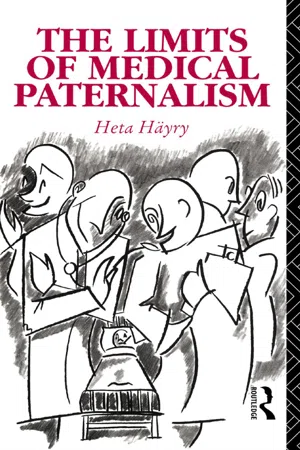
- 220 pages
- English
- ePUB (mobile friendly)
- Available on iOS & Android
eBook - ePub
The Limits of Medical Paternalism
About this book
Information
1
THE PROBLEM OF PATERNALISM IN MODERN MEDICINE AND HEALTH CARE
It is an old tradition in medicine and health care to suppose that since ‘the doctor always knows best’, it is not the patients’ business to interfere with her or his professional choices. It has, indeed, been customary that in the doctor-patient relationship patients have been seen as quasi-children seeking help from their medical quasi-parents, or—to use a classic term introduced by the sociologist Talcott Parsons—as persons reduced to playing the ‘sick role’ to gain the acceptance of their social environment and the attention of the health care personnel.1 Accordingly, the authority and power relations between the doctor and the patient have quite understandably been coined ‘paternalistic’, or to substitute a non-sexist metaphor which some authors prefer, ‘parentalistic’.2
An unquestioned subordination to medical authority is not as self-evident today, however, as it may have been in the times from which the tradition of widespread social and political paternalism dates. There was an era in Western history when individuals could see themselves primarily as occupants of fixed social roles, elements in a predetermined political order, rather than separate persons and makers of their own lives and worlds.3. In those days it was natural to obey the monarch and the patriarch, who were more or less thought of as omnipotent and omniscient representatives of God on Earth. However, the rise of liberalism and the new liberal society marked the end of most blind obedience on a large scale. The new individual, armed with Reason and Natural Rights, emerged to challenge the old order in most areas of social and political life.4 In fact, as John Kleinig has stated the matter in his informative account entitled simply Paternalism, by the latter part of the nineteenth century the situation was already much the same as it is today in that ‘though in some areas patriarchal perspectivesand practices persist, liberal reconceptualization [had already or at least now has] articulated a new bête noire—paternalism.’5
However, beast or no beast, medicine and health care are practices which have managed to preserve the patriarchal spirit to a large extent even in our own days. On reflection this is not very surprising when one recalls that medical professionals can by and large claim self-evident epistemic authority over their patients in medical matters: they really ‘do know best’ in the sense that they do possess more knowledge concerning injuries and diseases and their elimination and alleviation than most patients. It is therefore both intelligible and advisable that those who require medical help should succumb to this epistemic authority.
But the problem here is that epistemic authority does not necessarily justify all the patriarchal practices that doctors and nurses are accustomed to carrying out in its name. There are moral, social, political and ideological aspects to most authoritative directives which require separate legitimization, quite apart from the superior factual knowledge of the (alleged) authority. In particular, in questions of life and death or illness and health these extra-epistemic considerations become pressing, since the (alleged) authority’s knowledge concerning the subject’s values and expectations—which are clearly relevant to the issue—can always be challenged.
This, in short, is the background against which the problems of paternalism and moralism in modern medicine become visible.
The aims of the present study are, first, to analyse and explicate the concept of paternalism, as well as related concepts such as freedom, constraint and coercion; second, to distinguish between ethically acceptable and unacceptable modes of paternalism; third, to defend this distinction against the most important types of counterargument presented in the literature; and fourth, to apply the distinction to some of the central problems of modern medicine and health care.
My presentation will proceed in five stages, (a) I shall begin in this chapter by introducing some of the most persistent fortresses of paternalism in health care. The examples will, it is to be hoped, go some considerable way towards showing how the physician’s epistemic authority related to the patient’s physical condition tends to be transformed into other forms of (alleged) authority in current medical practices, (b) In chapter 2, the conceptual background issues concerning freedom, constraint and coercion are defined. UsingJ.S.Mill’s anti-paternalism as the starting point, I shall unearth the main descriptive, normative and axiological aspects of liberty and its restrictions by law and social policy. (c) The axiological conclusions of chapter 2 will then be carried over to the third, where types of paternalism are distinguished. As a corollary to the classification, I shall state which modes of paternalism can be regarded as legitimate within the liberal theory and which cannot. (d) In chapters 4, 5 and 6 this normative view will be defended against three prominent counterarguments. The core of the defence is that despite the many claims to the contrary, individual liberty and autonomy should always be given priority over welfare calculations, public morality and abstract rationality in matters which solely or primarily concern the individuals themselves. (e) Chapter 7 concludes the examination by analysing and assessing the main practices nurturing possibly illegitimate medical paternalism.
A word of warning is appropriate at this point. Since the justificatory problems in the issue at hand are complex and deep, it is not my intention to actually put forward any solutions in this first chapter. Rather, the occasional arguments introduced here should be seen only as examples of the lines of thinking generally employed in the issue of medical paternalism. Fuller accounts on the normative and axiological basis of the matter, as mentioned above, will be provided in later chapters.
VARIETIES OF PATERNALISM IN DAY-TO-DAY MEDICAL PRACTICE
Acting in the patient’s best interest is one of the most important prerequisites of all medical practice. In their work, doctors and nurses regularly have to do unpleasant things to their patients: they push needles into them, cut them with knives, expose them to toxic substances and harmful radiation, and restrict their freedom. Surely these activities would merit moral condemnation and legal prosecution if they were to take place in the absence of mitigating circumstances. Medical practitioners are, however, immune to such charges on the grounds that what they do is, by the codes of their explicit professional ethics, always directed towards helping those in need of aid. From the Hippocratic Oath onwards one can read in various professional codes for physicians and nurses echoes of the line of the Oath,‘Whatever houses I may visit, I will come for the benefit of the sick.’6
But the ‘benefit of the sick’ is sometimes an ambiguous matter indeed, and this is where problems arise. The following six cases represent some of the categories in which it is not entirely clear where the patient’s best interest lies—or whether appeals to it could be used to justify decisions.
(1) The Case of the Dying Mother
Mrs A is lying in a hospital bed, dying. Collecting the last of her strength, she calls for her doctor, and asks if there is any word about her son, whom she has not seen or heard of during the last few months. The doctor has just learned that the son was killed a few days ago trying to escape from prison after having been indicted for multiple rape and murder. Thinking that it is in the best interest of Mrs A, the doctor tells her that the son is doing well.7
(2) The Case of the Man with Lung Cancer
When a man aged 75 was examined for respiratory infection a shadowed area was detected in the chest x-ray. This was thought to indicate cancer of the lung. The patient recovered from the infection, and the only complaint he afterwards suffered from was intermittent claudication due to atherosclerosis. The patient was not informed about the suspected lung cancer—the doctor, however, followed up the progress of the shadow through chest x-ray examinations every few months, and noticed that it was growing very slowly. The patient was content and died suddenly two and half years later owing to occlusion of the cerebral artery.8
(3) The Case of the Fatal Urography
An experienced radiologist decided that what Mrs E needed was intravenous urography. He knew that with this procedure there would be a very small yet nevertheless a potential risk on the patient’s life—however, he had himself done 6,000–8,000 urograms during the preceding thirteen years and no patient had ever had a fatal reaction. To facilitate things, and acting on the strong conviction that a warning would in the end do Mrs E absolutely no good, he withheld the information from her.The urography was performed, Mrs E developed a reaction, and died of it.9
(4) The Case of the Determined Doctor
A middle-aged man comes to see his physician, and asks her to test him extensively to find out if he has contracted any sexually transmissible diseases during his one-year stay in Central Africa. ‘It’s no use testing for HIV, though,’ he continues, ‘it doesn’t do any good to know as there is no cure for AIDS, anyway. I’d rather remain ignorant about that.’ The doctor, however, thinking that it is in the patient’s best interest, tests his blood for HIV antibodies, finds the result positive, and informs him of the fact.
(5) The Case of the Refused Sterilization
Dr Elizabeth Stanley, a sexually active 26-year-old intern in the field of Internal Medicine, requests a tubal ligation. She insists that she has been thinking about this decision for months, she does not want children, she does not like available contraceptives, and she understands that tubal ligation is irreversible. When the staff gynaecologist on service suggests that Dr Stanley might sometime marry and that her future husband might want children, she indicates that she would either find another husband or adopt children. Although she concedes that she might possibly change her mind in the future, she thinks that this is unlikely and views the tubal ligation as making it impossible for her to reconsider her current decision. She speaks quietly but sincerely. She has scheduled a vacation in two weeks and wants the surgery performed then. The gynaecologist, however, refuses to do the operation, mainly on two grounds: first, because he has known her father during the war and feels she is letting him down by the decision, and second, because he firmly believes that irreversible decisions like this will eventually harm patients if they are made too hastily. Accordingly, he suggests that the matter could be discussed again in a year.10
(6) The Case of the Lady with Mnemic Problems
A 60-year-old woman, Mrs L, suffered from chronic brain syndrome with arteriosclerosis. As a result, she had periods of confusion and mild loss of memory, interspersed with times of mental alertness and rationality. She was hospitalizedafter having been found wandering on a city street; when questioned she could not give her home address. During her third hospitalization, she petitioned for release on the grounds of unlawful deprivation of liberty.
In the hearing a psychiatrist testified that Mrs L showed no tendency to harm either others or herself intentionally. Her commitment was based solely on the need for supervision because of her confused and defenceless state. Mrs L herself also testified at the hearing. She appeared to be fully rational, and stated that she understood her condition and the risks involved in her living outside the hospital. But she preferred to accept these risks rather than endure continued hospitalization.
The petition was, however, denied, and Mrs L died four years later, still confined in a mental hospital.11
In all these cases, medical practitioners, experts and judges have thought that it is in the patients’ best interest that they are lied to, deceived, insufficiently informed, compulsorily informed, left untreated or forcibly detained against their own expressed wishes. In some of these cases it may, indeed, genuinely be the authority’s first consideration to seek the patient’s good. In some of them, the decisions may even be justifiable. But since some of the cases nevertheless remain ambiguous, several additional reasons are often given to justify authoritarian medical decisions. These include harm inflicted on other people (a possible consideration in The Case of the Determined Doctor),12 inconvenience or waste of time (as in The Case of the Fatal Urography), and offence against other people’s feelings on moral convictions (apparently a factor in The Case of the Refused Sterilization).
More systematically, it seems that medical professionals employ four standard lines of defence when faced with pertinacious clients such as Elizabeth Stanley, who requested the sterilization in Case (6) above. In conversational terms, these four responses might be put in something like the following forms:
- ‘But it’s for your own good!’
- ‘It would be irrational to do otherwise.’
- ‘It would be immoral to do otherwise.’
- ‘It would hurt other people if you were allowed to choose so selfishly.’
The succession of these four arguments—which appeal, respectively, to the person’s own good, rationality, morality and offence to others—can be seen in any one of the truly contentious issues within medical ethics; i.e., usually where sex or reproduction or death or a combination of these are involved.
SEX, REPRODUCTION AND THE EMERGENCE OF MORAL UPROAR
The case of the Refused Sterilization, originally presented in 1980 for discussion in a conference on ethics, humanism and medicine, offers an outstanding example. As for the contentiousness of the case, here is how Marc Basson, the editor of the conference proceedings, describes the session in question:
The question in this topic is a simple one, quiet and undramatic. No one is dying or being forced to live in agony against his will. No ignorant or distraught patient is being overruled or manipulated into an unsafe experiment. The doctor does nothing irreversible to the patient and the patient surely can find someone else to perform the tubal ligation she seeks. Yet the discussion on this topic ranked among the most heated that has ever occurred at one of the conferences in this series. Several times it threatened to degenerate into a shouting match.13
In his account, Basson goes on to attribute the heatedness of the discussion to the concepts of ‘paternalism’ and ‘patient rights’, which at the beginning of the 1980s were according to him among the ‘buzz words of bioethics’ in the United States. But the use of these concepts cannot have been the only reason for the vivid response, since they appear in relatively uncontroversial issues as well. Rather, what aroused excitement in the audience must have been, at least partly, the unique combination of sex, childbearing and the battle between the sexes, apparent in the case.14
This interpretation is strongly, albeit implicitly, supported by Eric Cassell’s presentation given at the conference.15 He provides an imaginative first person narrative from the viewpoint of a middle-aged male gynaecologist, who obviously does not think much of women’s capacity for reasoning or discussing matters calmly. Thenarrative begins with a background story which Cassell himself seems to consider relevant:
I knew Elizabeth’s father from way back and we were in the Army together in an infantry unit around Salerno that had a bad time for a few days. He died when Liz was still in high school but we had always kept in touch. He was a good man whom I owe a favour, dead or not…. So when she came in the first time to talk about the tubal I was totally unprepared. I wanted to tell her about her father and about what we all wanted, and hoped for, and talked about endlessly because we were even younger than she is. You know, the way you would talk to the child of a friend who was old enough to know something and to joke and talk about wars and parents and training programs. Someone who was at the same time your child and not your child. A surgeon and a friend, but a young friend.16
After this nostalgic moment, Cassell moves on to contradict the original formulation of the case:
Anyway that was definitively not Elizabeth Stanley. I got the whole tubal ligation number by the Woman’s Movement book. Every objection that I offered was countered not by any content but merely by her telling me about her rights as an individual…. So after hearing her out…I said that I was sorry, but I was not going to tie her tubes and that was the end of it. She said it was certainly not the end of it…. To tell you the honest truth, all the substantive matters about having children or not, reversibility or not, surgical risk or not, the actual factual basis for her desire to become infertile got lost in the yelling that followed my saying NO.17
The contradiction with the original case is twofold: first, Elizabeth Stanley replied to the physician’s tentative objections with precise and reasonable answers, not with feminist slogans, and second, Cassell has miraculously transformed her ‘quiet but sincere’ speech into uncontrolled yelling at the practitioner.
What, then, is the point of these alterations in the story? And more generally, what kinds of reasons does Eric, Elizabeth’s father’s brother-in-arms, present in favour of his refusal? In what follows, I shall endeavour to show that Cassell’s way of formulating theissue neatly brings forth the four principles mentioned in the above, namely the principles of: (i) the best interest of the patient; (ii) irrationality; (iii) immorality; and (iv) offence to other people. As the point of the exercise is classificatory rather than genuinely justificatory, I have not followed the possibly more tenable lines of argument which might be developed in favour of paternalism here. These will be tackled in due course at the later stages of the study,
...Table of contents
- Cover Page
- Title Page
- Copyright Page
- Preface
- 1: The Problem of Paternalism in Modern Medicine and Health Care
- 2: Freedom, Constraint and the Value of Liberty and Autonomy
- 3: Paternalism, Coercion and Constraint
- 4: The Utilitarian Case for Strong Paternalism
- 5: Morals and Society
- 6: Appeals to Rationality: The Varieties of Prudentialism
- 7: The Limits of Medical Paternalism
- Notes
- Bibliography
Trusted by 375,005 students
Access to over 1.5 million titles for a fair monthly price.
Study more efficiently using our study tools.
Frequently asked questions
Yes, you can cancel anytime from the Subscription tab in your account settings on the Perlego website. Your subscription will stay active until the end of your current billing period. Learn how to cancel your subscription
No, books cannot be downloaded as external files, such as PDFs, for use outside of Perlego. However, you can download books within the Perlego app for offline reading on mobile or tablet. Learn how to download books offline
Perlego offers two plans: Essential and Complete
- Essential is ideal for learners and professionals who enjoy exploring a wide range of subjects. Access the Essential Library with 800,000+ trusted titles and best-sellers across business, personal growth, and the humanities. Includes unlimited reading time and Standard Read Aloud voice.
- Complete: Perfect for advanced learners and researchers needing full, unrestricted access. Unlock 1.5M+ books across hundreds of subjects, including academic and specialized titles. The Complete Plan also includes advanced features like Premium Read Aloud and Research Assistant.
We are an online textbook subscription service, where you can get access to an entire online library for less than the price of a single book per month. With over 1.5 million books across 990+ topics, we’ve got you covered! Learn about our mission
Look out for the read-aloud symbol on your next book to see if you can listen to it. The read-aloud tool reads text aloud for you, highlighting the text as it is being read. You can pause it, speed it up and slow it down. Learn more about Read Aloud
Yes! You can use the Perlego app on both iOS and Android devices to read anytime, anywhere — even offline. Perfect for commutes or when you’re on the go.
Please note we cannot support devices running on iOS 13 and Android 7 or earlier. Learn more about using the app
Please note we cannot support devices running on iOS 13 and Android 7 or earlier. Learn more about using the app
Yes, you can access The Limits of Medical Paternalism by Heta Häyry in PDF and/or ePUB format, as well as other popular books in Medicine & Ethics in Medicine. We have over 1.5 million books available in our catalogue for you to explore.