- 288 pages
- English
- ePUB (mobile friendly)
- Available on iOS & Android
eBook - ePub
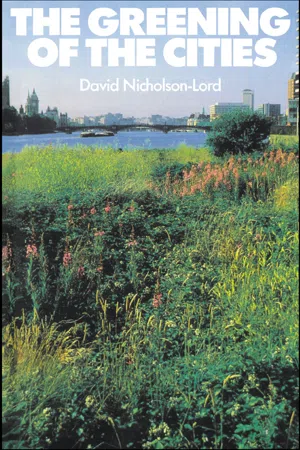
The Greening of the Cities
About this book
First Published in 2004. The majority of our large manufacturing cities are in decline—thousands of acres of their former industrial greatness have become gigantic scrapheaps. New industries with new technologies no longer make it necessary to locate industry in cities, and social and fiscal pressures are drawing people out into the countryside. Thus a conflict is growing with cities dying for lack of industry and new housing— whilst conservationists resist the spread of development into the green belts or further into the rural landscape. This book is an important contribution to a contemporary debate which is of significance to everyone living in Britain: the need for a land-use policy which looks simultaneously at the towns and country and strikes a balance between urban and rural renewal
1
DETRITUS
Its urbanization, progressing steadily, had finally reached the ultimate. All the land surface of Trantor, 75,000,000 square miles in extent, was a single city…. It had only one function, administration; one purpose, government; and one manufactured product, law…. There was no living object on its surface but man, his pets and his parasites.
(The imperial planet-city of Trantor, described in Isaac Asimov’s ‘Foundation Trilogy’, 1951–3)
At some point in the early 1960s an event took place the significance of which was not fully appreciated until well over a decade later. London—that is, the Greater London area—began to lose jobs. Its rate of growth had been slowing, in common with other big cities, since the 1950s but so far the loss of employment had been relative: it had merely grown more slowly. In 1961 or 1962, the loss became absolute.
Greater London is, of course, a useful administrative fiction. London’s true identity has been in doubt ever since the king and court set up a rival enterprise at Westminster in the eleventh century. Nevertheless it is legitimate to describe the event as a watershed. London led the west into a new era of urban growth and for almost a century, until overtaken by New York, was the largest city in history. It was the first of the ‘cities of the main street of the world’, in Robert Park’s vivid phrase, and continues to embody so much of what we mean by the word ‘city’. Indeed throughout much of the reign of the Tudor, Stuart and Hanoverian monarchs, as Raymond Williams has pointed out, London was the city. The rest of England, even thriving provincial centres like Norwich and Bristol, was merely ‘country’.
London’s employment had grown, with its population, for the best part of a millennium. The abrupt reversal of its growth, and that of the other big cities, caught Government on the hop and lends a curiously old-fashioned air to many works on urbanization written before 1970. These acknowledge some decentralization but assume, for most of us, a relatively closely packed urban future, hence the flutterings at the census results of 1971 and 1981, which showed an overall drop in London’s population of 16 per cent since 1961. More than a million and a quarter people moved out of the capital in those two decades, leaving London’s population below seven million for the first time since 1901. In the 1970s, moreover, the rate of outflow was accelerating. Over the same period, meanwhile, another three-quarters of a million people, or 17.5 per cent of 1961 populations, moved out of the six principal English cities—Birmingham, Leeds, Liverpool, Manchester, Newcastle-upon-Tyne and Sheffield. The inner cities were the worst hit. Inner London lost one million people—almost a third of its population— between 1961 and 1981.
The effect on jobs was devastating. Since the mid- 1960s the employment base of the big cities has collapsed, initially and most acutely in manufacturing but later extending to services and office-based jobs. Between 1960 and 1981. London and the major conurbations lost 1.7 million manufacturing jobs, 79 per cent of the total national loss of 2.1 million jobs. By 1985 London could claim the dubious distinction of having the largest concentration of unemployed people in the advanced industrial world. In relative terms, however, the great northern cities like Manchester, Liverpool and Newcastle were much worse off.
Government, notably the Labour administration of 1974–79, responded by dusting off a somewhat antiquated urban programme—founded, remarkable though it now seems, as long ago as 1968—and declaring an end to the long-running New Towns programme accused (wrongly) of siphoning off inner-city investment. It also abolished the Location of Offices Bureau, although offices continued, at a somewhat diminished rate, to leave London and the other cities. The inner cities, meanwhile, denuded progressively of jobs and people and erupting into riots in 1981 and 1985, have assumed a status in contemporary myth rather more alarming than the depressed areas of the 1930s.
This brief summary only hints at the more significant implications of the emptying of the cities. The first is that it predates the major recession beginning in the mid-1970s and is generally acknowledged to have its deepest roots elsewhere. Indeed it seems likely that city decline has become a product of economic growth: an upturn in the economy would thus intensify it.
Linked with this is a second important feature, which is that the extent of decline is directly related to the extent of urbanization. The fastest growth tends to be associated with the most ‘rural’ places. The bigger the city, meanwhile, the more quickly it is emptying. The representative modern growth point is no longer metropolis but, to use one recent American neologism, ‘micropolis’.
A leading geographer, Brian Berry, has employed the rather more precise term ‘counter-urbanization’, a phenomenon first described in the United States in the mid1970s—Berry’s usage dates from 1976—and then diagnosed further afield. In 1982 a study found evidence of it in nine out of fourteen European countries. In 1983 a manufacturing shift from cities to rural areas was documented for the first time throughout the European Economic Community. For whatever reason, counter-urbanization appears to affect developed countries in proportion to their development.
The rural renaissance has produced some surprising results. One of America’s most inhospitable tracts of sparseland, the Great Plains plateau east of the Rocky Mountains, has seen a reversal of its longstanding population drain. And in Britain growth has been fastest in regions like East Anglia and the South-West, where the population increase over the two decades 1961–81 was, respectively, 27 and 18 per cent. Cornwall’s population, for example, grew by a quarter between 1961 and 1981. A survey of these immigrants to Cornwall found them to be economically active—typically aged between 40 and 60—and generally very well educated. Many also seemed to be unemployed, at least formally, although they may instead have been devoting themselves to that rich mixture of do-it-yourself, barter, exchange and payment in kind known as the ‘black economy’. They appeared, the survey concluded, to be searching for an alternative lifestyle.
This sketchy portrait of the new urban refugees—’drop-outs’ is too idiosyncratic a term in view of the numbers involved—touches on two other features of the exodus. The first is its relationship with the flight to the suburbs: there are links but there are also important differences. The second is that, having served for so long as a brake on the movement of people out of cities or as an inertial force preventing them from moving too far, industry has now enthusiastically joined in the flight. Indeed it is well in its van.
Although the picture thus emerges of jobs now leaving the cities faster than people, the phenomenon is, of course, less an actual physical flight than the death of old firms in the city and the birth of new ones elsewhere. More pliant rural workforces, spiralling urban rents and rates, the growth of ‘footloose’ industry able to operate from rural seclusion by means of information technology—all these have been suggested as causes. So, too, has the concentration of ageing industry in the cities. Yet there is clearly more involved. The EEC-wide analysis already mentioned points to urban regions broadly enjoying a more modern spread of industry than rural—a structural pattern which should have produced a shift from country to city, not the reverse. Forces are indicated, it seems, ‘whose strength is directly dependent on the scale and degree of urban development, measured by size and density of urban agglomeration’. A strong candidate may be a lack of land in cities on which space-hungry businesses, increasingly demanding more square feet per worker, can expand. This is the influential ‘constrained location’ theory advanced by a Cambridge University research team.
Yet the freeing of industry from its need to be near the city and what it offered— transport, services, concentrations of labour—has also enabled it to respond far more to the values of its workforce. Suburbanization, the modern quest for arcadia, offers one historic clue to those values but there are signs that this concept itself is undergoing a fundamental change—that the contemporary vision of arcadia is altogether earthier, more muscular, wilder and in some respects more resolutely anti-urban than its precursors. It is this vision of arcadia, and the changes it is enforcing on cities, which forms much of the matter of this book.
The cities are meanwhile suffering the backwash of the rural revival. The exodus has coincided with the progressive collapse of the urban foundations built by the Victorians: the sewers, drains and watermains, and also the houses. In 1985 the country faced a housing repairs bill estimated at £47 billion. Technological and industrial change has meant that great lumps of the city’s fabric have suddenly become so much scrap. ‘Smokestack’ industries are vanishing; containerization has superannuated the docks. North Sea gas has made the gasometer redundant, while electricity generation has shifted to isolated coastlines. Never before in recorded history has a civilization left such vast junkyards behind it as it passes on to found new settlements. It is, in a sense, prehistoric ‘slash and burn’ on a massive scale.
The consequence is the freeing of space in unprecedented quantities. The chief feature of dereliction in the 1970s was that, from being a phenomenon of mining areas and mineral workings, it arose suddenly and spectacularly in the cities. The geographer Alice Coleman, one of the few people to have examined in detail land-use changes in Britain since the Second World War, found in the Inner London borough of Tower Hamlets a threefold rise in what she calls ‘dead and disturbed space’ between 1964 and 1977. In the latter year it amounted to 14 per cent of the borough. Other statistics more starkly convey the sense of unproductive emptiness and neglect in Tower Hamlets: the 30 miles of corrugated iron, the amount of land—37 per cent of the total—where buildings were too sparse for the term ‘townscape’ to be applied, the fact that 56 per cent of the borough generated no rate income.
The old industrial towns and cities have suffered the worst. Vacant land in the eastern area of Glasgow, for instance, has been estimated at 20 per cent. In Greater Manchester alone, in 1982 the officially registered area of derelict land was five times greater than in the whole of East Anglia and 60 per cent more extensive than in all twelve rural counties in the South-East—an area twenty times as large. Manchester has been active in reclamation yet such has been the pace of decay that while 4,200 acres were restored between 1974 and 1982, another 5,760 fell derelict.
The true extent of urban waste space in Britain can only be guessed at. In 1982 Greater London and the six main conurbations, occupying 6.5 per cent of the land area of England, contained 32 per cent of the country’s total dereliction. This total was put at 113,000 acres, an area substantially larger than the Isle of Wight. One of the few certainties about this figure, however, is that it is a gross underestimate. The local authorities responsible for the derelict land returns, for example, count differently from each other. They also ignore, at Government behest, land which most people would regard as derelict—small sites awaiting development, for instance. Much urban dereliction comes in tiny pockets of land and results from comprehensive redevelopment schemes which never materialize. One survey of Birmingham found that two-thirds of the empty land in its centre consisted of sites of less than five acres. Thirty-five years after the war ended, a bomb-site in Hull was still empty: in 1947 the council had refused residents a community hall there because the land was needed for redevelopment. Such examples could be repeated interminably. Hence it is no surprise that a council survey in the West Midlands in 1974 counted more than three times as much dereliction as recorded in official figures.
The tininess of so many sites, testimony to an erosion of the city almost geological in its gradualness, goes some way to explaining the peculiar invisibility of the issues at stake, particularly in Westminster, the City and Fleet Street. It takes imagination, fact-finding tours or a riot to remove the mental cosseting of the metropolitan commuter.
Even less visible, however, is the vacancy behind office façades and factory windows. Between 1979 and 1983 the national stock of available industrial floorspace more than tripled. Available office space in Britain almost doubled between 1981 and 1984. Such hidden emptiness is the dereliction of tomorrow. A third of the 153 million square feet of vacant industrial floorspace in England and Wales in 1984 was estimated to be ‘chronically unlettable’. Office blocks erected in haste only a decade earlier stood as monuments to a vanished seller’s market, when city-centre property was a blue-chip investment. Inflexibly designed, expensive to run, lacking the space for cabling required by new technology, they were the commercial equivalent of high-rise council estates. In 1982 a watershed was reached when the total area of industrial floorspace began its decline from the historical peak of the previous year. At this stage, vacant industrial and office space together amounted to at least 200 million square feet, the equivalent of 1,000 Centrepoints. The change from concealed to revealed emptiness, however—from old buildings to new uses (or no uses at all)—was now showing through in the statistics.
Houses must be included in this picture of ‘hidden’ emptiness. Between 1977 and 1985 the number of vacant houses in London and the six metropolitan counties alone grew by 24 per cent to reach a figure of 294,000, equivalent to over 23,000 acres of unused land— an area the size of the city of Coventry. Since seven-tenths of the houses were privately owned, many had clearly been abandoned. The 1981 census ‘snapshot’ produced a figure of 974,000 empty dwellings for the United Kingdom, equal to 96,000 acres of waste land, almost as much again as the official total of derelict land for the whole of England.
Emptiness in the cities is thus clearly much greater than official figures imply. The Civic Trust in 1977 put the extent of urban wasteland at 250,000 acres. In Britain’s Wasting Acres, the land-use planner Graham Moss estimated the national total of spoiled, blighted and idle land to be 2.5 million acres, an area the size of Devon and Cornwall. Since there is no national land-use survey, one has to make do with estimates like these, however unsatisfactory.
The failure to put this land to new use is a critical factor in the decline of the cities. Some of the reasons are physical: the sheer volume of clutter and debris, the poisoning of the soil by industrial pollutants, the costs of large-scale reclamation and ‘detoxification’. Much initiative has been thwarted by the immense complexities of land ownership: it has often proved impossible to find out who actually owns a particular patch of ground. One expert working party concluded that with much disused land, developers would make a loss even if they had acquired it for nothing, so corrosive has been a century and more of industrial habitation.
Many landholders also refuse to entertain the possibility—publicly, at least—of a drop in land values. Overall it seems that well over half the waste land is publicly owned, 60 per cent of this by councils and about a quarter by nationalized or state industries. The urban land market thus assumes a stagnant, monopolistic aspect. In London’s docklands the creation of a development corporation has sheared straight through the complexities and turgidities of the land market. Development pressures throughout the South-East have also, though somewhat patchily, spurred on land take-up in the capital. Elsewhere, however, the land market continues to act as a brake on the emergence of a new city.
Yet there is an important sense in which the ravelled intricacies of the land market stand as a metaphor for a deeper blockage. In The Four-Gated City, the final part of Doris Lessing’s fictional account of the twentieth century, ‘Children of Violence’, the central character, newly arrived in post-war Britain from Africa, watches excavations in London. She
had never before seen soil that was dead, that had no roots. How long had this street been built?…if one was to wade through earth in Africa, around one’s legs roots: tree roots, thick, buried branches…a mat of working life… But walking here, it would be through unaired rootless soil, where electricity and telephone and gas tubes ran and knotted and twined.
The impression is partly of the city, indeed of civilized life, as a lie, built on dearth and deadness. But there is also a powerful feeling of exhaustion through over habitation: a place has become too cluttered and enmeshed in its past. It recalls the strange observation of Strehlow on the aboriginal Arunta tribes of Australia, for whom every landscape feature has a mythical association. Their forefathers/ he remarked, ‘have left them not a single unoccupied scene which they could fill with creatures of their own imagination.’ Tradition had stifled creativity, no new myths were being invented. ‘They are on the whole…not so much a primitive as a decadent race.’ It also brings to mind Jane Jacob’s argument in The Economy of Cities that initiative and innovation are products of disordered, not regimented, environments.
Regimentation and overelaborateness are hallmarks of institutions that have outlived their original function and are losing touch with reality. Amongst those caught up in their trails, they can induce an unreasoning desire for escape—physical flight, perhaps, or a bonfire of controls. The revival of the smaller country towns in Tudor and Stuart times, based in many areas on a spontaneous growth of local markets, was in part a response to the dead hand of the urban craft guilds and corporations: in their insistence on regulating every commercial activity, they merely succeeded in killing it off or driving it outside the city. Too many inner-city local authorities have displayed a similar perversity, imposing increasing restrictions on a diminishing amount of activity. Hence the urban development corporation, the enterprise zone and the free port—applications of an axe to the Gordian knot.
Yet no amount of purely administrative deregulation could abolish the boundary crossed by Doris Lessing’s heroine, between African bush and London street, because they represent the separate worlds of country and city, one of which possesses the mysterious quality of ‘life’ while the other does not. And these feelings are extraordinarily pervasive, even amongst the supposedly dispassionate. A study of private housebuilders found that a major reason deterring them from even contemplating building on empty city land was the city’s image: not only of a poor environment but of delays, restrictions and complexities. The difficulties were often entirely imaginary. Yet a green field site was, in some unspecified and ambiguous way, simpler, cleaner and freer.
Such feelings are rooted deep in the flight to the suburbs. When Peter Hall and colleagues surveyed householders on their ‘desired future place’ of residence in the early 1970s, there was an overwhelming presumption—not merely a wish—that movement would be outwards from the city. Fifty-nine per cent of the respondents listed ‘country’, 29 per cent suburbs and 8 per cent towns. Yet the fact that Hall’s families were actually more likely to end up in a suburb rather than the country—the figures were 58 per cent and 35 per cent—indicates a considerable unrealized aspiration. For many the suburbs are clearly only a staging post in a longer journey.
How much is ‘pull’ and how much is ‘push’ is a moot point. Large-scale studies for the International Labour Office and the US Bureau of Census show that living conditions, crime, pollution and congestion worsen as cities grow larger and that dissatisfaction with neighbourhood is directly related to size. Inhabitants of cities of over three million are between four and seven times more likely to be dissatisfied than those of towns and rural areas of under 50,000—a preference apparently now reflected in the link established between an area’s speed of decay and the extent of its urbanization. A MORI poll in 1983 found the two most important factors listed as contributing to the quality of life were safe streets, cited by 72 per cent, and attractive countryside, mentioned by 53 per cent. Both, self-evidently, bear directly on what we now mean by city and country.
These are a few studies from the many available. What they speak of is the increasingly exclusive identification of the countryside with the qualities necessary for a fulfilling and civilized life: the city, inevitably, is left with the dregs. And this is also how the c...
Table of contents
- COVER PAGE
- TITLE PAGE
- COPYRIGHT PAGE
- FIGURES
- PLATES
- FOREWORD
- PREFACE
- ACKNOWLEDGMENTS
- CREDITS
- 1: DETRITUS
- 2: THE GREAT WEN VERSUS THE GARDEN CITY
- 3: WILDERNESS, NATURE AND MUNICIPALITY
- 4: THE RECOVERY OF THE PRIMITIVE— ENERGY, ECOLOGY AND GOD
- 5: A GEOGRAPHY OF THE SACRED
- 6: THE PARABLE OF THE BOG
- 7: THE COUNTRY COMES TO TOWN
- 8: A PEOPLE’S LANDSCAPE
- 9: SMALL WORLDS
- 10: EARTHWORKS
- 11: LARGER WORLDS: THE CITY RESHAPED
- 12: CONNECTIONS AND RECONSTRUCTIONS
- 13: BEYOND THE CITY
- NOTES
- BIBLIOGRAPHY
Trusted by 375,005 students
Access to over 1.5 million titles for a fair monthly price.
Study more efficiently using our study tools.
Frequently asked questions
Yes, you can cancel anytime from the Subscription tab in your account settings on the Perlego website. Your subscription will stay active until the end of your current billing period. Learn how to cancel your subscription
No, books cannot be downloaded as external files, such as PDFs, for use outside of Perlego. However, you can download books within the Perlego app for offline reading on mobile or tablet. Learn how to download books offline
Perlego offers two plans: Essential and Complete
- Essential is ideal for learners and professionals who enjoy exploring a wide range of subjects. Access the Essential Library with 800,000+ trusted titles and best-sellers across business, personal growth, and the humanities. Includes unlimited reading time and Standard Read Aloud voice.
- Complete: Perfect for advanced learners and researchers needing full, unrestricted access. Unlock 1.5M+ books across hundreds of subjects, including academic and specialized titles. The Complete Plan also includes advanced features like Premium Read Aloud and Research Assistant.
We are an online textbook subscription service, where you can get access to an entire online library for less than the price of a single book per month. With over 1.5 million books across 990+ topics, we’ve got you covered! Learn about our mission
Look out for the read-aloud symbol on your next book to see if you can listen to it. The read-aloud tool reads text aloud for you, highlighting the text as it is being read. You can pause it, speed it up and slow it down. Learn more about Read Aloud
Yes! You can use the Perlego app on both iOS and Android devices to read anytime, anywhere — even offline. Perfect for commutes or when you’re on the go.
Please note we cannot support devices running on iOS 13 and Android 7 or earlier. Learn more about using the app
Please note we cannot support devices running on iOS 13 and Android 7 or earlier. Learn more about using the app
Yes, you can access The Greening of the Cities by David Nicholson-Lord in PDF and/or ePUB format, as well as other popular books in Physical Sciences & Geography. We have over 1.5 million books available in our catalogue for you to explore.