eBook - ePub
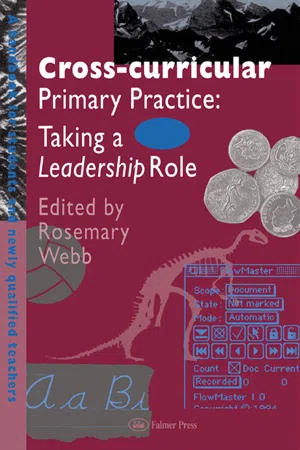
Cross-Curricular Primary Practice
Taking a Leadership Role
- 192 pages
- English
- ePUB (mobile friendly)
- Available on iOS & Android
eBook - ePub
Cross-Curricular Primary Practice
Taking a Leadership Role
About this book
This text discusses the theory and practice of several important areas of cross-curricular work in primary schools. It uses the National Curriculum Council's categories of themes, skills and dimensions to examine what is involved in such practice and to consider its current status in schools and future possibilities.; Providing practical suggestions for more well- established areas such as environmental studies, it also examines topical but under-represented themes, skills and dimensions such as media education, pupil self-assessment and discipline. The authors argue that cross-curricular practice both contributes to National Curriculum requirements and gives these requirements overall coherence. Cross- curricular practice also enables children to develop the knowledge, skills and concepts that are of value in coping with, and enjoying, the complexities of the 21st century. Suggestions are provided on how to provide leadership and stimulate staff interest in these areas by reviewing existing policies, teaching and resources.
Information
Chapter 1
Meeting Special Educational Needs in the Classroom
Rosemary Webb
The Education Act (1993), which introduced the Code of Practice governing the identification and assessment of all special educational needs (SEN), is part of a series of legislation set in motion by the 1988 Education Reform Act (ERA). This has led to a situation where schools are immersed in the implementation of multiple innovations which in combination make enormous demands for change in school policies and practices. This chapter examines the curriculum and classroom provision for children with special educational needs, especially those without statements, in the context of some of these demands. It considers how aspects of the classroom environment and the differentiation of tasks and activities can improve their learning experiences. It also examines the role of the Special Educational Needs Coordinator (SENCO) who plays a vital part not only in establishing the quality and range of this provision but also in generating the interest and commitment of class teachers to maintain and develop it.
In discussing issues and offering advice in relation to the implementation of the National Curriculum and children with SEN, I shall draw particularly on two phases of qualitative research sponsored by the Association of Teachers and Lecturers (ATL) which were carried out in fifty primary schools across thirteen LEAs between October 1992 and February 1994. The first phase focused on the implementation of the National Curriculum at Key Stage 2 and the second on the changing roles and responsibilities of primary school teachers (Webb and Vulliamy, 1996).
The Code of Practice
The 1994 Code of Practice (DfE, 1994) required by the 1993 Education Act was introduced to ensure better provision for both the 2 per cent of pupils who need statements and the notional 18 per cent with SEN who are not statemented. The definition of SEN remains the same as that given in the Education Act 1981. Thus ‘a child has special educational needs if he or she has a learning difficulty which calls for special educational provision to be made for him or her’ (section 156). The Code, which sets out the respective duties of schools and education authorities in providing for these pupils and gives detailed principles and procedures to be followed, aims to address the issues raised in two reports by the Audit Commission (1992a and 1992b) which identified major inconsistencies between LEAs and schools in SEN practices and policies throughout England and Wales. These procedures are set within the framework of responsibilities of a school’s governing body to provide for pupils with SEN and to publish details of this provision at the school’s annual meeting, in the school’s annual report and in summary form in the school prospectus. The Code is a non-statutory document. However, those to whom it applies have a statutory duty ‘to have regard to it’ and the regulations to which it refers are statutory. As explored by Garner (1995), there is considerable potential for tension between the Code’s guidance and the statutory regulations. However, during OFSTED inspections schools will need to demonstrate how the Code is being interpreted and implemented.
Lewis (1995) describes the findings of a questionnaire survey designed to collect information about primary schools’ special needs policies and provision in order to better understand how equipped they were to implement the Code. The survey was published in Junior Education (April 1994) and 292 primary schools elected to respond The majority of schools (87.2 per cent) reported having written a SEN policy document and most of these were produced within the three years leading up to the survey. Lewis (1995) found that ‘the plurality and variation of personnel, timetabling arrangements, and tasks of the SENCO were striking’ (p. 14). In 11 per cent of schools the head was responsible for SEN and in 252 schools (86 per cent) there was a SENCO who was someone other than the headteacher. Only about one third (38.4 per cent) had an incentive allowance specifically for SEN. Approximately two-thirds of SENCOs also held other responsibilities as well as class teaching and in about one quarter of the schools the role was filled by someone with significant additional managerial responsibilities. In twelve schools (4.8 per cent) the role was filled by a part-time teacher. She found that:
In the vast majority of schools with a SENCO any one special educational needs related activity occupied less than 2 hours per week. The general picture was of a highly fragmented and diversified role. (Lewis, 1995, p. 17)
Special Educational Needs Coordinators
Every school must now appoint a special educational needs coordinator (SENCO). While this role is central to the implementation of the Code, in the majority of primary schools it has not been created by it. The introduction of the 1981 Education Act based on the recommendations of the Warnock Report led to a steady increase in the designation of posts of responsibility for SEN. However, as Moss (1994) comments: ‘In some schools this developed into no more than a relatively perfunctory function; in others it was a senior appointment with the post holder already doing as much, if not more, than the Code recommends’ (p.1).
The impact of the Code of Practice on the role of SEN coordinators is massive. It states that they should be responsible for:
- the day-to-day operation of the school’s SEN policy;
- liaising with and advising fellow teachers;
- coordinating provision for children with special educational needs;
- maintaining the school’s SEN register and overseeing the records on all pupils with special educational needs;
- liaising with parents of children with special educational needs;
- contributing to the in-service training of staff; and
- liaising with external agencies, including the educational psychology service and other support agencies, medical and social services and voluntary bodies, (para.2:14)
During the first three of the five stages in the identification and assessment of SEN set out in the Code, SEN identification, provision and monitoring are based in schools—although advice and support may be sought from external specialists. During stages 3 and 4 the local authority shares responsibility with schools. SENCOs have a vital part to play in administering the first three of the five stages—especially stage 2 when the SENCO takes the lead in managing provision. A further dimension is also given to the role of many coordinators in relation to the drafting of individual education plans (IEPs), the new procedures for the annual review of statements (the organization of which the headteacher may delegate to the SENCO), and the introduction in the 1993 Education Act of SEN tribunals which will be held regionally to hear appeals. The introduction of the tribunals raises the possibility of schools and teachers who have not had ‘regard’ to the Code being found negligent, which places additional pressure on SENCOs to maintain thorough and accurate records of children’s needs and to develop the provision made to meet those needs.
Lewis (1995) found that most SENCOs have little non-contact time to carry out their role and approximately one-third of teachers with this responsibility had no non-contact time. Where a school had some non-contact time for SENCOs to carry out SEN work, the most popular use of that time was for withdrawal group work followed by—but a long way behind—in-class support for colleagues. Lack of non-contact time seriously undermines the efficiency of SENCOs. The paperwork alone, which is required by the Code, is enormously time-consuming. For example, the SEN register needs to be updated regularly and additions to children’s records need to be made following consultations with specialists, meetings with parents and actions taken by staff. Gains (1994) outlined eight major functions for the SENCO under the Code only one of which directly involved them with the process of teaching and learning. This leads Garner (1995) to suggest that perhaps ‘the Code of practice is simply bureaucratising a group of experienced SEN teachers, effectively reducing the amount of time they spend with their pupils’ (p.6).
All schools are now required to have a special educational needs policy which had to be published by 1 August 1995. This must include information on the school’s special educational provision, the identification and assessment of pupils with SEN, relevant in-service training, external links and cooperation with parents and the criteria for evaluating the success of the policy. While this policy is the overall responsibility of the headteacher and governors it is likely that the SENCO will take the lead in working with staff to produce it. As with the drafting of curriculum policies (Webb, 1994), a range of approaches was being taken to get these into place as speedily as possible. Some SENCOs either revised existing policies, or drafted new ones, by themselves in consultation with the head, senior management team and in some cases the SEN governor. Alternatively, policies were the focus of school professional development days where staff brainstormed ideas and these were converted into a policy document by the SENCO or a working party. Then this was circulated for comment or became the subject of a staff meeting called to obtain feedback. By this process of negotiation a document was ultimately decided upon. There was general agreement that the greater the staff involvement in producing the policy the more commitment there would be to its implementation.
Implementing the first stage of the Code appears to be causing the most difficulties. This places responsibility on the class teacher to identify a child’s SEN, gather information—ranging from evidence of National Curriculum attainment and standardized test results to observations of behaviour—and to take initial action to meet those needs. Arrangements also need to be made for monitoring the child’s progress and for a review of the provision put into place. As argued by Visser (1994), placing the responsibility for SEN on the class teacher has positive implications:
It avoids the de-skilling process which can all too easily become part of special educational provision. There remains a tendency in special education for teachers to believe that the SENCO has all the answers in meeting the needs of the pupil with SEN…. The Code encourages cooperation between staff in meeting special educational needs…(Visser, 1994, p.27)
However, class teachers will need different degrees of support in fulfilling their responsibilities. For some systematizing their existing practice will be sufficient while others will need considerable support and practical advice. Many teachers do not have the training or experience required to recognize the wide range of different types of learning difficulty which might be experienced by some of the children in their classes. This could lead to the source of these children’s difficulties going unrecognized. Therefore the guidance that SENCOs can provide for their colleagues is vital. This is likely to take the form of the provision of resources describing and targetting particular types of need (for example, Webster et al., 1994), information on sources of external help, advice on the collection of appropriate evidence, strategies and resources to help children’s learning and assistance with the preparation of lEPs and the writing of reports.
As identified by Buchanan (1995), in the context of heavy workloads caused by the implementation of the National Curriculum and its associated assessments class teachers under pressure might be reluctant to identify the existence of pupils with SEN in their classes because doing so generates additional paperwork, assessment and communications with parents. In schools, where—as perhaps is too frequently the case—SENCOs have responsibility without power, this potential conflict of interest between the SENCO and the classteacher needs recognizing and addressing. While personalities influence the way in which such situations are handled and good interpersonal skills and leadership qualities on the part of the SENCO are important, a supportive management structure must be put in place in order that tasks may be delegated and carried out and conflicts, whether between parents, children or colleagues, can be avoided or at least resolved swiftly. As found by Webb (1994), where responsibility for SEN is shared by the head and the SENCO this gives more clout to decision-making. However, if aspects of the shared role are not carefully delineated, this can lead to resentment, overlapping work and time wasted.
Some schools (see for example, Harvey, 1995) find it useful to have termly year group or key stage meetings—depending on the size of the school—in order to review the progress and the strategies being used to help children with SEN. These are attended by the head, deputy or other members of the senior management team, the class teachers concerned and others who may work with the children being discussed, such as teachers’ aides and the homeschool liaison teacher. External experts, such as the educational psychologist, may also attend meetings where their advice would be particularly useful. To make the meetings as effective as possible the SENCO draws up an agenda, gathers evidence to support the discussions, takes minutes to record the decisions made and action points agreed and communicates these in writing to those concerned.
While meetings, such as these, add to the administrative load of SENCOs, they also provide them with support. Especially where SENCOs have little non-contact time, it is vital that aspects of the role can be shared. Hence, the school secretary might assist with the administration, a home-school liaison teacher might communicate information on children’s progress to parents and feed back concerns, a teacher’s aide might assist in the preparation of teaching materials, the head might take responsibility for liaison with outside agencies and the INSET coordinator could help arrange training opportunities. Implementing the SEN policy is a whole school responsibility, which is likely to be tackled with greater thoroughness, if everyone makes a contribution. A team approach is also necessary to make the role manageable for the SENCO. As one primary school SENCO put it:
The SEN co-ordinator has a responsibility to her/himself. There is going to be a great deal of work involved in implementing the Code, and this will place demands on the time of the SEN co-ordinator. It will be hard, but it is important to keep things in perspective and try to plan change and development so that they can be implemented in a manageable and realistic way, and so that the role of SEN coordinator is rewarding rather than impossible. (Harvey, 1995, p.82)
Impact of the National Curriculum
The principle of the entitlement for all pupils to share the same statutory right to the National Curriculum was broadly welcomed when the National Curriculum was introduced. However, making this a real possibility is often a very complex and demanding process. Research into the implementation of the National Curriculum at Key Stage 2 (Webb, 1993) revealed that in some schools the additional work required to draw up plans and policies for the implementation of the National Curriculum meant that producing or reviewing the school’s SEN policy was ‘put on the back burner’. However, in other schools the implementation of the National Curriculum caused them to rethink their approach to SEN support in order to protect pupils’ entitlement. Thus, one junior school decided that instead of withdrawing pupils for extra help with ‘the basics’ they would use the withdrawal time to do practical activities in mathematics and science to develop the skills of investigation, problem-solving and cooperation with others. Most of the pupils with SEN found these activities very demanding and sometimes upsetting and those with emotional and behavioural difficulties could not readily work with their peers. In a supportive closely supervised environment, where individual assistance was immediately available, the children could be helped to overcome their difficulties.
Overwhelmingly in schools in the ATL research, teachers considered that curriculum overload caused inadequate time to be spent on basic numeracy and literacy, especially listening to pupils reading, and led to work being ‘rushed’ or skimmed over’ resulting in it being unfinished or of poor quality. The pace and volume of work to be got through was thought to be particularly stressful for pupils with SEN who were ‘just swamped by it’. They tended to be the children with the most unfinished work, as there were fewer opportunities for them to be given the extra time needed to co...
Table of contents
- Cover Page
- Title Page
- Copyright Page
- Introduction
- Chapter 1: Meeting Special Educational Needs in the Classroom
- Chapter 2: Analysing Classroom Discipline
- Chapter 3: Children Evaluating and Assessing Their Progress in Learning
- Chapter 4: English Language Development Across the Curriculum in Multilingual Primary Classrooms
- Chapter 5: Learning about the World: Principles and Practice of Global Education
- Chapter 6: Teaching, Learning and the Environment
- Chapter 7: Education for Citizenship
- Chapter 8: Media Education: A Rich life in the Margins
- Chapter 9: Developing a School’s Work with its Parents: Key Task or Optional Extra?
- Chapter 10: Leading Cross-curricular Practice
- Notes on Contributors
Trusted by 375,005 students
Access to over 1.5 million titles for a fair monthly price.
Study more efficiently using our study tools.
Frequently asked questions
Yes, you can cancel anytime from the Subscription tab in your account settings on the Perlego website. Your subscription will stay active until the end of your current billing period. Learn how to cancel your subscription
No, books cannot be downloaded as external files, such as PDFs, for use outside of Perlego. However, you can download books within the Perlego app for offline reading on mobile or tablet. Learn how to download books offline
Perlego offers two plans: Essential and Complete
- Essential is ideal for learners and professionals who enjoy exploring a wide range of subjects. Access the Essential Library with 800,000+ trusted titles and best-sellers across business, personal growth, and the humanities. Includes unlimited reading time and Standard Read Aloud voice.
- Complete: Perfect for advanced learners and researchers needing full, unrestricted access. Unlock 1.5M+ books across hundreds of subjects, including academic and specialized titles. The Complete Plan also includes advanced features like Premium Read Aloud and Research Assistant.
We are an online textbook subscription service, where you can get access to an entire online library for less than the price of a single book per month. With over 1.5 million books across 990+ topics, we’ve got you covered! Learn about our mission
Look out for the read-aloud symbol on your next book to see if you can listen to it. The read-aloud tool reads text aloud for you, highlighting the text as it is being read. You can pause it, speed it up and slow it down. Learn more about Read Aloud
Yes! You can use the Perlego app on both iOS and Android devices to read anytime, anywhere — even offline. Perfect for commutes or when you’re on the go.
Please note we cannot support devices running on iOS 13 and Android 7 or earlier. Learn more about using the app
Please note we cannot support devices running on iOS 13 and Android 7 or earlier. Learn more about using the app
Yes, you can access Cross-Curricular Primary Practice by Rosemary Webb, Rosemary Webb,Dr Rosemary Webb, Dr Rosemary Webb, Rosemary Webb in PDF and/or ePUB format, as well as other popular books in Education & Education General. We have over 1.5 million books available in our catalogue for you to explore.